Image

Pull Out What Didn’t Make It.

“To every thing there is a season, and a time to every purpose under the heaven.” — Ecclesiastes 3:1 (KJV)

This morning, I decided it was time to reset my garden.

Life had gotten in the way, and honestly, so had disappointment.

Some things I planted never became what I imagined. The squash bed became the scene of what I jokingly call the vine borer massacre. The kale and collards eventually lost their battle with the beetles. There are potato bags I am almost afraid to open because I don’t know whether there is a harvest underneath all that dirt—or evidence of an experiment gone terribly wrong.

But before I call the season a failure, I need to tell the whole story.

We harvested greens five times.

There are three gallon-sized bags of tomato sauce in my freezer, made from tomatoes that grew right here in this garden.

There was one little green pepper.

There were about ten green beans—not exactly enough to open a produce stand.

There were carrots.

And basil, radishes and beets we would never eat, but were pretty and make novice gardeners feel like experts.

And there were more social-media-worthy pictures than I can count.

There was laughter. There was anticipation. There were lessons I didn’t know I was planting. There were mornings when I walked outside just to see what had changed. There were days when checking on something growing gave my mind somewhere peaceful to go when life was doing entirely too much.

Not everything the garden produced could be put on a plate.

Some of the harvest fed me differently.

Funny how quickly disappointment can make us forget the harvest.

We can become so focused on what died, what got eaten, what never produced, and what didn’t turn out the way we planned that we overlook all the evidence that something did grow.

So no, this garden was not a total failure.

Neither was this season.

And neither am I.

I don’t have to throw away the whole garden just because everything in it didn’t make it.

I can pull out what is finished.

I can clean up what was damaged.

I can keep what still has life.

I can remember what already fed me.

I can refresh depleted soil.

And I can plant again.

There’s even one Brussels sprout plant that’s been hanging around since last November.

She never produced one identifiable Brussels sprout.

By the original expectation, I could call her a failure.

Except we discovered that her leaves were delicious mixed with our greens.

She didn’t produce what I expected.

She still fed us.

And maybe that’s a word for more than my garden.

There are seasons in life that don’t produce everything we expected either. Goals don’t get reached. Plans get interrupted. Things we carefully planted get attacked by circumstances we never saw coming. Energy gets spent dealing with things we never intended to carry.

It’s easy to stare at what didn’t happen until disappointment convinces us that nothing happened.

But that’s not always the truth.

Sometimes there are three bags of sauce sitting in the freezer while we’re mourning the squash.

Sometimes we are so busy counting the ten green beans that we forget the greens fed us five times.

Sometimes what we planted never becomes what we expected, but like my stubborn old Brussels sprout plant, it finds another way to feed us.

And sometimes the harvest isn’t something we can count at all.

Sometimes it is peace.

Sometimes it is laughter.

Sometimes it is a lesson.

Sometimes it is simply having somewhere to put our hands while God settles our hearts.

So today, I’m taking a lesson from my garden.

A disappointing harvest does not mean the soil has lost its purpose.

And an unmet expectation does not erase a harvest that has already happened.

Some things need to be pulled.

Some things deserve another season.

Some things may never become what I originally expected, yet still have value.

And some empty places are simply waiting for new seed.

So I’m not dragging everything that disappointed me into the next season.

I’m cleaning the bed.

I’m keeping what still has life.

I’m remembering what already fed me.

I’m refreshing the soil.

And, by the grace of God, I’m planting again.

And Then I Went Outside…

A few hours after writing those words, I finally made it to the garden.

I had gotten distracted. Life was still doing what life does. Both of my boys needed rides to work, and somewhere in there I stopped to get breakfast. The great potato excavation would have to wait.

But when I finally went outside, the garden had another lesson waiting for me.

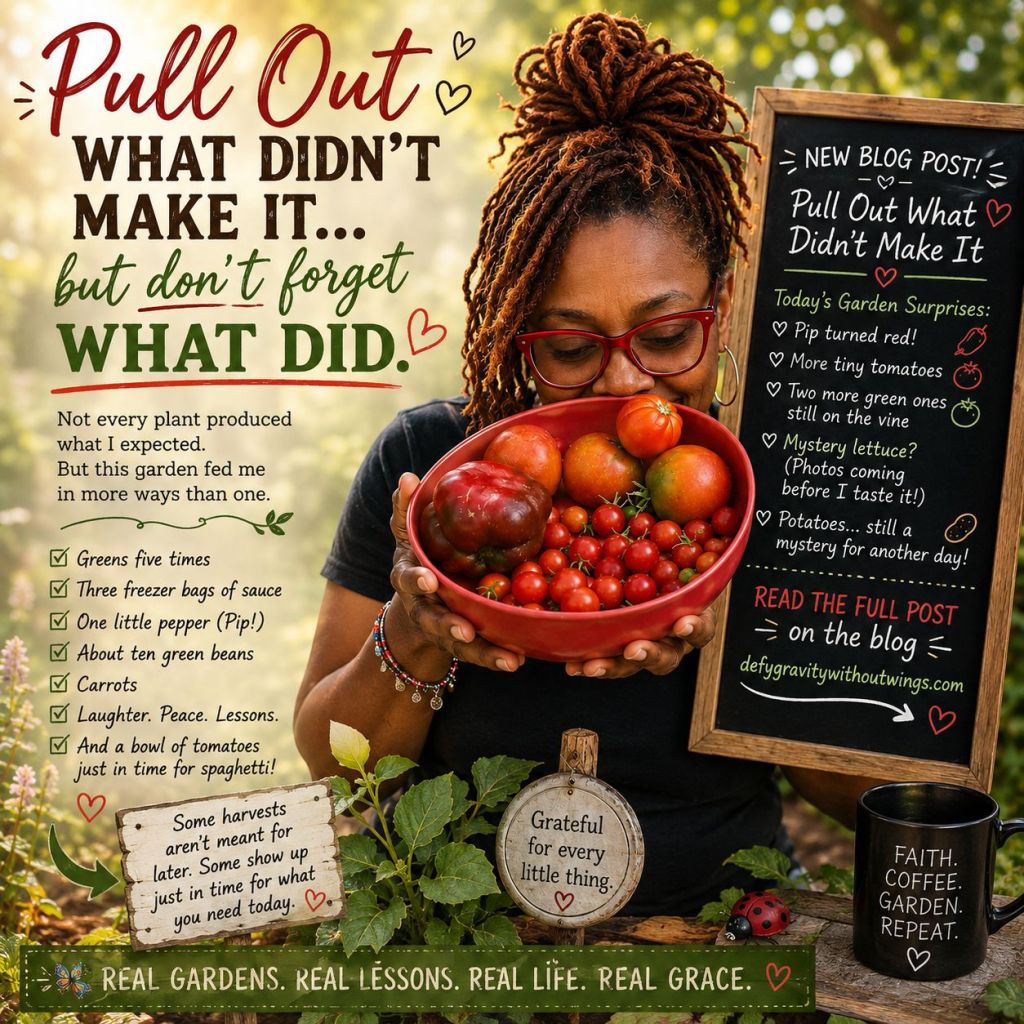
There were tomatoes.

Lots of tiny ones. A couple of the last larger ones. Two more green ones still hanging on the vine that I decided to leave there and give a little more time.

And Pip—my little pepper plant that had managed to produce just one tiny green baby—had quietly ripened that baby all the way to red.

I had gone outside thinking about what needed to be cleaned up.

Meanwhile, the garden was still producing.

There I stood with a bowl of tomatoes and one little red pepper from plants I had already mentally begun wrapping up for the season.

And tonight, I’m making spaghetti.

These tomatoes won’t make it into another gallon freezer bag. They’ll be chopped up and added to the jarred sauce we’re eating tonight.

And suddenly there was another lesson.

Some harvest isn’t meant to be stored for later. Some of it shows up just in time for what you need today.

Maybe that’s why we have to be careful about declaring a season over simply because it didn’t produce the way we expected.

There may still be something growing that we haven’t noticed.

There may still be something ripening while we’re looking at what died.

There may still be provision hanging on a vine we were preparing to pull.

And sometimes God doesn’t give us enough to stock the freezer.

Sometimes He gives us enough for tonight’s spaghetti.

That’s still provision.

That’s still harvest.

That’s still something worth thanking Him for.

So perhaps today’s garden reset isn’t only about pulling out what didn’t make it.

Maybe it’s also about slowing down long enough to recognize what did.

What survived.

What fed me differently.

What is still growing.

And what showed up right on time.

Prayer

Lord, forgive me for the times disappointment has made me forget the harvest.

Thank You for every place where something grew, every provision I almost overlooked, every unexpected thing that still managed to feed me, and even the harvests I couldn’t put on a plate.

Thank You for what I was able to preserve for another season.

And thank You for what You provide simply because I need it today.

Give me wisdom to recognize what has finished its season and courage to release it.

Show me what still has life, even when it doesn’t look the way I expected.

Keep me from pulling up something You are still allowing to grow just because I decided its season should be over.

Restore the places in me that have been depleted. Refresh the soil of my heart. And prepare me for whatever You want to plant next.

Help me remember that a disappointing harvest is not the end of the garden.

There is still good soil here.

There may even be something still ripening on the vine.

And with You, there is always reason to look again before I call the season finished.

Amen.

Love, Chelle
defygravitywithoutwings.com
Image

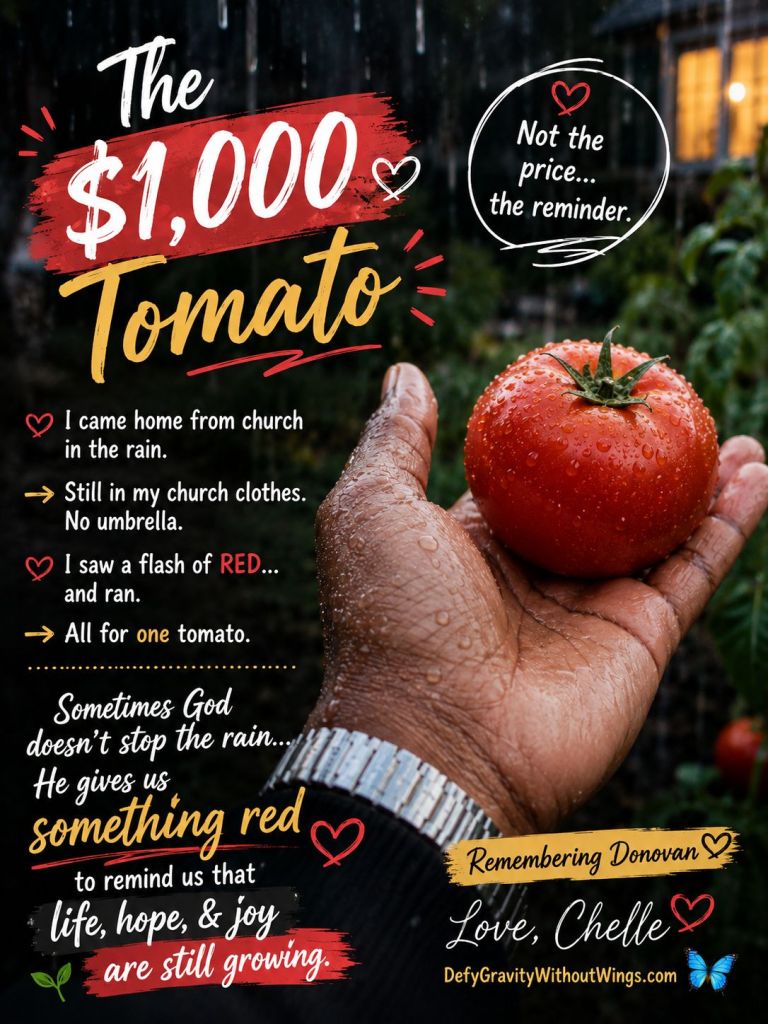
The $1000 Tomato

Tonight, I came home from church just as the rain started. I was still in my church clothes.
No umbrella.  No plans to go into the garden.

Truthfully, my heart was still heavy.

Just yesterday, we laid my bonus son to rest. It was a beautiful celebration of his life, filled with music, laughter, tears, and memories. But funerals have a way of leaving an echo. Even after the final song is sung and everyone goes home, grief lingers quietly in the background.

My church clothes still carried the memory of yesterday.

And so did my heart.

As I hurried toward the house through the rain, something caught my eye. A flash of red. On one lonely big boy tomato.

Without thinking, I turned around and ran straight into the rain. No umbrella. Still dressed in my church clothes. Hair…well, let’s not even discuss the hair.

All for one tomato.

I laughed the moment I picked it. After months of building raised beds, filling grow bags, hauling soil, buying fertilizer, tomato cages, watering before work, battling mosquitoes, checking on my plants every morning, and praying over a garden that often seemed determined to test my patience, I joked that I was holding a $1,000 tomato.

The truth is…

It wasn’t worth a thousand dollars.

But in that moment…

It was worth running through the rain for.

Then the Holy Spirit gently whispered to my heart, “Isn’t that what I did for you?”

Jesus saw us caught in a storm far greater than rain. He didn’t stay where it was comfortable. He stepped into our brokenness.

Into our grief. Into our sin. Into death itself.

Not because we were perfect.

Not because we had everything together.

But because He saw something worth rescuing.

The Bible tells us that “while we were still sinners, Christ died for us.” (Romans 5:8)
He didn’t wait until we had cleaned ourselves up. He came running toward us while we were still standing in the storm.

Sometimes life leaves us bruised by disappointment, exhausted by loss, or wondering if joy will ever find us again. Yet Jesus never measures our value by what we’ve been through.

He measures it by what He was willing to pay. The cross settled that question forever.

Then another thought settled into my spirit.
Yesterday, I ran toward a casket. Today, I ran toward a tomato.


One reminded me that life on earth is temporary.

The other reminded me that God still has a way of bringing new life out of seasons of sorrow.

Tonight, as I stood in my kitchen holding my little ‘$1,000 tomato,’ I realized maybe God wasn’t just letting me harvest fruit.

Maybe He was reminding me that even after a day of burying someone I loved…

Even while my heart was still aching…

There was still something worth running toward.

Sometimes God doesn’t stop the rain. Sometimes He places a glimpse of hope right in the middle of it.

A reminder that life is still growing.

That joy is still possible.

That healing is still coming.

Sometimes…

It looks like one little red tomato.

“Weeping may endure for a night, but joy comes in the morning.” — Psalm 30:5

Prayer

Father, thank You for stepping into my storms instead of watching them from a distance. Thank You for reminding me that even in seasons of grief, You continue to plant signs of hope along my path. Open my eyes to the little gifts You place in front of me each day, and help me remember that my value was settled at the cross. When my heart is heavy, give me the courage to keep running toward the joy You have prepared for me. In Jesus’ name, Amen.

Remembering Donovan ❤️

Love, Chelle
DefyGravityWithoutWings.com

Image

KEEP BELIEVING

This morning I walked into my garden carrying more than Tomato-tone.

I carried worry.

Last week’s storms had been relentless. Then life happened. Family emergencies. Hospital visits. Exhaustion. The garden got the best I could give it, but not always everything I wanted to give it.

As I made my rounds, my fears seemed justified. Several of my biggest green tomatoes had blossom end rot. Months of watering, fertilizing, staking, and waiting… only to find them ruined before they ever ripened.

I picked them off one by one and tossed them across the yard to the squirrels, who had probably been waiting all season for me to make a mistake.

I was disappointed. Maybe even a little angry.
Not just because of the tomatoes. Sometimes one rotten tomato becomes the place where everything else finally shows up.

The financial pressures.


Watching people I admired and believed would make it…walk away from marriages I thought would last forever.


Family struggles I can’t fix.


Dreams that seem to take one step forward and two steps back.


Storm after storm.

The tomatoes just happened to be what broke my heart that morning.

Then I walked around to the other side of the my garden expecting more losses. More disappointments.

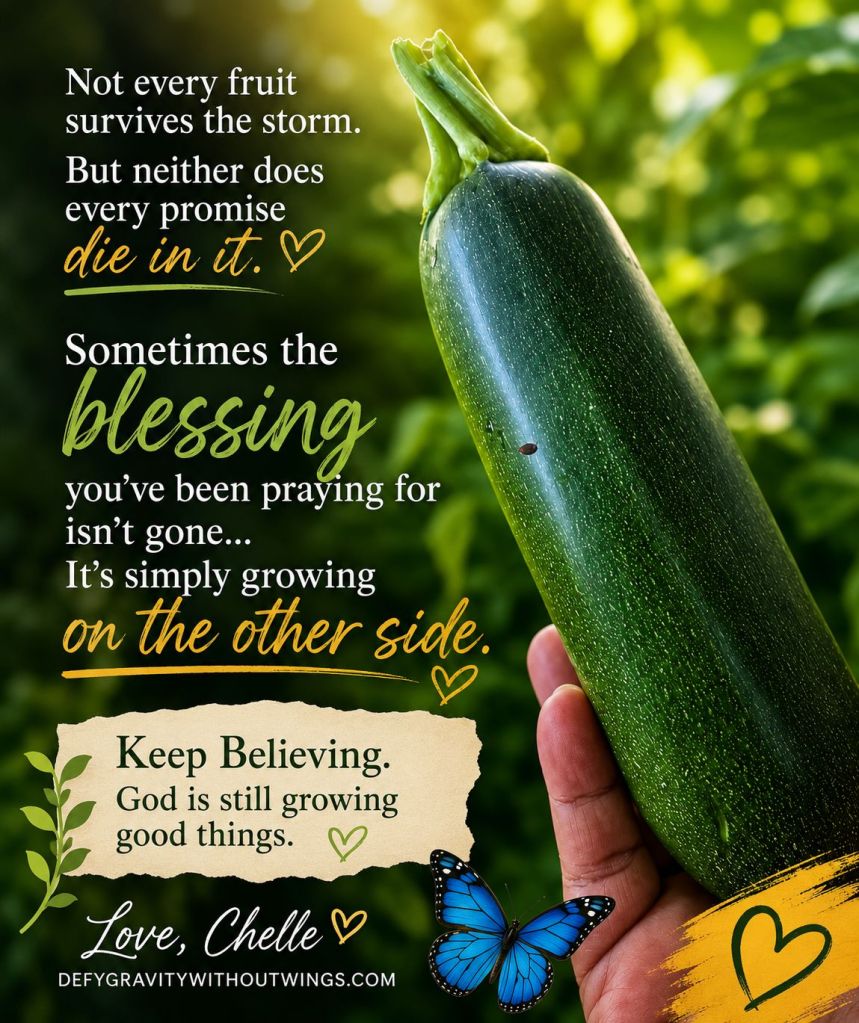
But, there she was. My very first zucchini. She hadn’t even been there the last time I looked. Then I remembered something.

The bees hadn’t been showing up because of all the rain. That little zucchini only existed because, one morning, I stepped in and hand-pollinated the flower. At the time it felt almost foolish. I wondered if it would even matter.

Today I held the answer in my hand.

Isn’t that just like God?

Sometimes we become so focused on what’s been damaged that we almost miss what He’s growing on the other side.

The rotten tomatoes were real. But so was the harvest.

Maybe that’s the lesson I needed today.

Not every fruit survives the storm. But neither does every promise die in it.

The storms didn’t stop the zucchini. The rain didn’t cancel the harvest.

The bees didn’t show up… but God still did.

If God asks us to keep planting, keep watering, keep believing, He also has a way of surprising us with fruit we weren’t expecting.

Today, my first zucchini wasn’t just dinner. It was a reminder that disappointment is never the whole story.

Sometimes the blessing you’ve been praying for isn’t gone. It’s simply growing on the other side.

So if today you find yourself throwing rotten tomatoes to the squirrels, don’t leave the garden just yet. Walk around to the other side.

You just might find that while you were grieving what didn’t make it… God was quietly growing something beautiful all along.

“Let us not become weary in doing good, for at the proper time we will reap a harvest if we do not give up.” — Galatians 6:9

Love, Chelle
DefyGravityWithoutWings.com ❤️

Image

Silent Screaming

Trigger Warning: This reflection discusses grief, youth violence, childhood trauma, emotional neglect, and the long-term impact of silence within families and communities.

I thought I was just there to sing.

Instead, after my last song,  I sat listening to a mother whose 19-year-old son had been killed less than five minutes from home. She described him as the good kid. The one who checked on his parents. The one who helped people. The one who stayed connected.

And somehow, despite all of that goodness, she now lives with the reality that she had to bury him.

What shook me even more was not just her pain, but her posture.

As she spoke about the young man responsible receiving a 46-year sentence, I heard both grief and forgiveness in her voice. Not weakness. Not denial. Just a heartbreaking understanding that tragedy had swallowed more than one life that night.

She spoke about childhood trauma. About children carrying pain nobody stops to address until it explodes into violence in the streets. And then she said something that settled heavily in my spirit. She talked about the dangerous things we normalize in our homes:

“Children are to be seen and not heard.”

“What happens in this house stays in this house.”

For generations, many of us were taught those sayings as discipline, respect, or family loyalty. But sometimes those same words teach children something else entirely:

Your feelings do not matter here.

Your pain is inconvenient here.

Your truth is unsafe here.

So children learn to survive by swallowing emotions they were never meant to carry alone. Fear gets buried. Anger gets buried. Shame gets buried. Hurt gets buried.

But buried pain does not disappear.

Eventually it leaks somewhere.

Sometimes it leaks into addiction.
Sometimes into rage.
Sometimes into depression.
Sometimes into violence.
Sometimes into emotional numbness.
Sometimes into streets filled with children trying to release emotions nobody allowed them to safely process at home.

As I listened to her speak, a familiar phrase rose in my spirit so strongly that I walked up and shared it with her afterward.

I told her, “I call it silent screaming.”

Because that is exactly what so many people are doing.

They are screaming internally while functioning externally.

Smiling.
Working.
Going to church.
Posting selfies.
Making jokes.
Serving others.
Showing up every Sunday while quietly unraveling inside.

And honestly, the church should be leading the effort to erase silent screaming.

Not by becoming a place where people perfect appearances, but by becoming safe enough for honesty again.

Too many people have mastered church behavior while still bleeding emotionally underneath the surface. We know how to shout over pain, dance over pain, quote Scripture over pain, and hide pain behind ministry titles.

But Jesus always stopped for what was underneath.

He noticed the overlooked.
He listened to the hurting.
He saw what everybody else missed.

And maybe that is part of our assignment too.

To hear people before they become headlines.

To create homes where children feel emotionally safe enough to speak.

To remind people that silence is not always strength.

Sometimes silence is survival.

And some children end up on the 6 o’clock news because nobody heard them when they whispered.

“There is a time to be silent and a time to speak.”
— Ecclesiastes 3:7

Love, Chelle


DefyGravityWithoutWings.com

Image

BUT GOD SAID NO

Early this morning, before the day had a chance to get loud, my phone lit up with a simple question:


“Can I get 10 minutes of your time?”

After more than 40 years apart, God had already reconnected us… and this morning, He gave us the time to remember why.

But God doesn’t measure time the way we do. Ten minutes turned into an hour and a half. Tears. Laughter. Testimony. We weren’t catching up. We were bearing witness.

She told me about losing her husband. How the grief felt like it might finish what life had already taken.

Then she said it… “But God said no.”

She told me about her  rare illness. The kind where doctors speak carefully, and silence says more than words.
And again “But God said no.”

Every story she told had a place where it could have ended. Every chapter carried the weight of finality. But it didn’t end there. Because God kept interrupting what should have been the last line.

And somewhere in the middle of her testimony, I felt my own rise up quietly. Moments I don’t always name. Situations that could have taken me out in ways nobody else would have understood.

And if I’m honest… Some of those moments didn’t look like mercy at first. But I’m still here.

So even there, I say it: But God said no.

No to the thing that tried to take me out.
No to grief settling in as permanent.
No to despair having the final word.
No.

Psalm 118:17
“I shall not die, but live, and declare the works of the Lord.”

That’s what this morning was. Declaring. Not polished. Not practiced. Just two women, after decades apart, brought back together by grace… reminding each other that what should have taken us out didn’t get permission.

Sometimes the most powerful testimony is also the simplest. “It should have ended me…but God said no.”

And if you’re reading this from the middle of something that feels like an ending, hold on.
The same God who interrupted ours is still writing yours.

Love, Chelle ( And Lisa)
defygravitywithoutwings.com

Image

Worship Beyond The Song

Worship is easy when the music is right,
the lights are soft, and nobody has touched your wounds that day.

But real worship?
Real worship sounds different.
It sounds like forgiving while your heart is still tender to the touch. It looks like choosing God when people are still choosing to bruise you.

Because worship was never just a song…
it’s a decision. A decision to trust that God is still good even when people are not.

And we saw it—not in a sanctuary, but on a cross.

When Jesus looked at the very people who were crucifying Him and said, “Father, forgive them…” (Luke 23:34)

Not after it was over. Not when it stopped hurting. While it was happening.


Sometimes worship looks like the opposite of what we expected:
Forgiving when you’re still hurting.
Praying when you’re disappointed.
Trusting when nothing makes sense.
Giving when you feel empty.
Staying when it would be easier to walk away.
Walking away when it would be easier to stay.
Being kind to people who mishandled you.
Keeping your heart soft in a hard situation.
Choosing peace when chaos would feel justified.
Telling the truth when a lie would protect you.
Resting when pressure says perform.
Waiting when everything in you wants to rush.
Obeying when you don’t understand.
Loving without getting anything back.
Letting go of what you prayed would stay.
Thanking God before you see the outcome.
Showing up again after being let down.
Keeping your integrity when nobody is watching.
Not clapping back when you have the perfect comeback.
Blessing people who bruised you.
Believing God is still good on a bad day.
Choosing joy without evidence.
Honoring God privately, not just publicly.
Surrendering your version of how it should go.
Standing still when fear says run.
Moving forward when comfort says sit down.

Because sometimes the most powerful worship isn’t what you sing in a moment of peace… it’s what you choose in the middle of pain.


It’s saying:
“God, I honor You… not because this feels good, but because You are good.”

So yes, worship Him even while the bruise is still fresh.

Not because they deserve it.But because He does.

“In quietness and trust shall be your strength.”
— Isaiah 30:15


God, teach me how to worship You beyond what is comfortable. When my heart is bruised, help me not to harden it.

When I don’t understand what You’re allowing, help me trust who You are.

Give me the strength to forgive even when the pain is still fresh, and the courage to release what is trying to take root in me that You never planted.

Let my life honor You not just in my songs,
but in my choices.

Even here. Even now.

Amen.

Love, Chelle
DefyGravityWithoutWings.com

Image

When It Bolts

It’s 4:23 a.m. on Easter Sunday and I’m standing in my little greenhouse, looking at spinach that decided overnight… it was done.

Tall stems where leaves used to be. Little flowers where nourishment used to grow.
Bolting.

Translation? “It’s too hot for what I used to do.”

And for a second, I felt disappointed. Like I did something wrong. Like I missed a window. Like I should’ve held on longer.
But spinach doesn’t argue with the season.
It doesn’t force itself to keep producing what the environment no longer supports. It shifts.

“To every thing there is a season, and a time to every purpose under the heaven.” — Ecclesiastes 3:1

And standing there, I realized… Some of us are still trying to produce peace in places that have already gotten too hot.

Still trying to hold conversations that only grow bitterness. Still trying to get nourishment from situations that have already shifted into something else.

And we call it perseverance. But sometimes…
It’s just a season that’s ended. The spinach didn’t fail. The season changed.

And instead of forcing leaves that would turn bitter anyway… it moved on to producing something new.
Seeds.
Future.
What’s next.

And maybe that’s where I am too.
Not failing.
Not falling apart.
Not losing ground.
Just recognizing that I don’t have to keep forcing what no longer grows here.

Because the work of the  Cross didn’t just prove He could get up… it proved that endings don’t get the final say.

So I don’t have to panic when something stops producing. Idon’t have to force life out of what has already shifted. And I don’t have to sit in disappointment like something has gone wrong.

Nothing went wrong.

The season changed.

And the same God who allowed this one to close… is already making room for what comes next. And instead of holding on too tight… I’m learning how to release without fear.

“Remember ye not the former things, neither consider the things of old. Behold, I will do a new thing; now it shall spring forth…” — Isaiah 43:18–19

So I’m not mourning what bolted. I’m watching for what’s about to spring up.

Love, Chelle
defygravitywithoutwings.com

Image

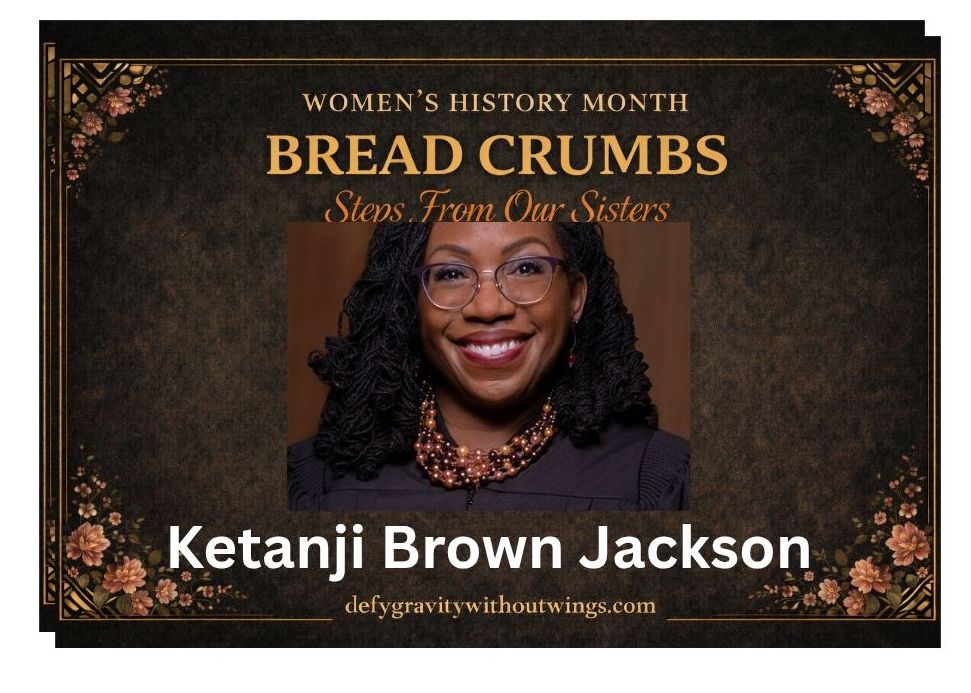
Ketanji Brown Jackson -When preparation meets history.


Some victories do not come bursting through the door.
They come with their shoes in their hand.
With grace under pressure.
With long study hours, quiet discipline, and the kind of strength that has learned how to hold itself still.


Ketanji Brown Jackson was born in Washington, D.C., in 1970 and raised in Miami.
She went to Harvard, graduating from college in 1992 and law school in 1996, serving along the way on the Harvard Law Review.
She clerked for Justice Stephen Breyer.
Worked as a public defender.
Served on the United States Sentencing Commission.
Became a federal judge in 2013.
Rose to the D.C. Circuit in 2021.


Nothing about her path says sudden.
Everything about it says prepared.
And maybe that is what makes this kind of history so holy.
Because on April 7, 2022, when the Senate confirmed her by a 53 to 47 vote, and on June 30, 2022, when she was sworn in as the 104th Associate Justice of the Supreme Court of the United States, becoming the first Black woman ever to serve there, it was not the beginning of her worth.
It was the public naming of what had already been true.
Brilliant.
Capable.
Measured.
Ready.


She became the first former federal public defender to sit on that Court.
Only the sixth woman in its history.


A Black woman in a seat this nation took far too long to imagine her in, though women like her have always been here carrying wisdom, justice, memory, and backbone in places that rarely gave them the microphone.


So no, her presence does not just say look what happened.
It says look what endured.
Look what kept going.
Look what kept studying.
Look what kept showing up polished and prepared while carrying the weight of being doubted before speaking.
For every door that opened late
For every gift that had to prove itself twice
For every girl taught to be excellent and careful at the same time
Her presence speaks.
Not just I made it.
But women like her have always been here.


Have I not commanded you? Be strong and courageous. Do not be frightened, and do not be dismayed, for the Lord your God is with you wherever you go.
Joshua 1:9


And maybe that is the part I love most.
Not just that she made it to the room
but that God walked her all the way there.

Steps From Our Sisters
Honoring the Women Who Marched Before Us
Curated by
Michelle Gillison-Robinson
DefyGravityWithoutWings.com

Image

You Are Black History

Black history does not live only in textbooks, timelines, or framed portraits. It lives in you.


It lives in the prayers your grandmother whispered that no one recorded. It lives in the courage it took for your parents and grandparents to keep going when quitting would have been easier.

It lives in the way you show up to work, to church, to community, to family — even when the reward is unclear.


Black history is not only something that happened. It is something that is still happening.


It is made every time you choose dignity over bitterness. Every time you carry joy in a system that profits from your exhaustion. Every time you tell the truth — even quietly. Every time you endure, love, build, teach, heal, or believe anyway.


Some names were written down. Many were not.
Some stories were celebrated. Many were survived.
But history is not only what is remembered — it is what continues.


You stand on the shoulders of those who were victorious without reward. Those who served faithfully without applause. Those who planted seeds they would never live to see bloom.


Their courage flows through you.


And we have always known how to leave something behind.


Breadcrumbs on the ground when the path was uncertain. Hushpuppies tossed not as waste, but as wisdom — a way to distract danger long enough to keep moving. Cornrows braided tight to the scalp, not only as beauty or tradition, but as memory — paths etched into hair, holding maps to water, to safety, to freedom.


What could not be written down was carried. What could not be spoken aloud was encoded. What could not be protected by law was protected by love, community, and God.


This was not myth. This was method.
A people learning how to survive systems designed to erase them — by remembering anyway.


If you are still leaving breadcrumbs for those coming behind you… still marking the way quietly… still choosing faith, dignity, and care when no one is watching…
You are doing what has always been done.


You are part of a holy lineage of guidance and endurance. A living echo of the God who makes a way where none seems visible and leads His people forward, step by step.


“Let us not become weary in doing good, for at the proper time we will reap a harvest if we do not give up.”
— Galatians 6:9
“Your word is a lamp to my feet and a light to my path.”
— Psalm 119:105


If you are still standing, still hoping, still loving, still reaching for God and for one another — you are Black history in motion.
Not just because of where you came from, but because of how you choose to live.


We see you. We honor you. You matter.
Love, Chelle

Image

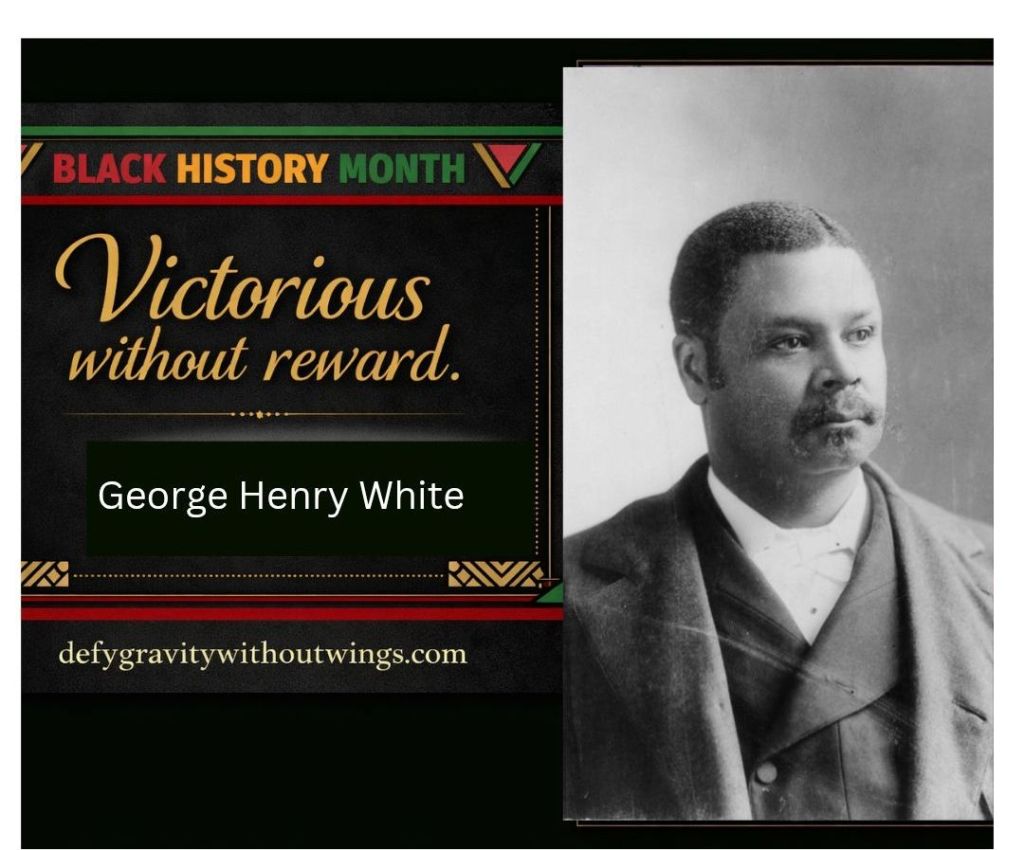
George Henry White: The Last Voice Before the Silence

George Henry White (1852–1918) was the final African American to serve in the United States Congress at the close of Reconstruction. When he left office in 1901, Black representation in Congress disappeared for nearly three decades.

Born in Bladen County, North Carolina, to a free father and a mother who had been enslaved, White came of age in the uncertain promise of Reconstruction. He attended Freedmen’s schools, graduated from Howard University in 1877, became a teacher, then a lawyer, and entered public service during a narrow window when Black political participation was still possible in the South.

Elected to the U.S. House of Representatives in 1896 and reelected in 1898, he served as the only Black member of Congress during his tenure.

While in office, he:

• Introduced the first federal anti-lynching bill in 1900
• Spoke against voter suppression and racial violence
• Defended equal protection under the law
• Warned that disenfranchisement would wound the nation itself

As Jim Crow laws tightened and Black voters were systematically removed from the ballot, White chose not to seek reelection in a system engineered to silence his people.

On January 29, 1901, he delivered his farewell address. In it he declared:

“This… is perhaps the Negroes’ temporary farewell to the American Congress; but… Phoenix-like he will rise up some day and come again.”

It was not wishful thinking. It was vision.

Twenty-eight years later, Oscar Stanton De Priest returned Black representation to Congress in 1929. Since that return, more than 160 African Americans have served in the United States Congress.

White’s prophecy stretched further still. The groundwork laid by those who endured Reconstruction and its collapse helped clear the path for Thurgood Marshall on the Supreme Court, Barack Obama in the White House, and Ketanji Brown Jackson becoming the first Black woman Justice of the United States Supreme Court.

He did not see those milestones.

But he named the future in a moment designed to erase it.

After Congress, White practiced law, helped establish the Black town of Whitesboro, New Jersey, and founded a Black-owned bank in Philadelphia.

He was the last of an era.
And the prophet of the next one.


Scripture

“Write the vision and make it plain upon tables, that he may run that readeth it.
For the vision is yet for an appointed time… though it tarry, wait for it;
because it will surely come.”
— Habakkuk 2:2–3


BREADCRUMB

Sometimes the assignment is not to hold the seat,
but to hold the prophecy.


SALUTE

We see you, George Henry White —
for legislating in hostile air,
for introducing justice when it would not pass,
for declaring return when disappearance looked certain.

You stood at the edge of erasure
and named the future anyway.

Bread Crumbs — for those coming after us.
Victorious without reward.
Still here.