Before it was debated, Before it was dissected on timelines and talk shows, it was a hymn.
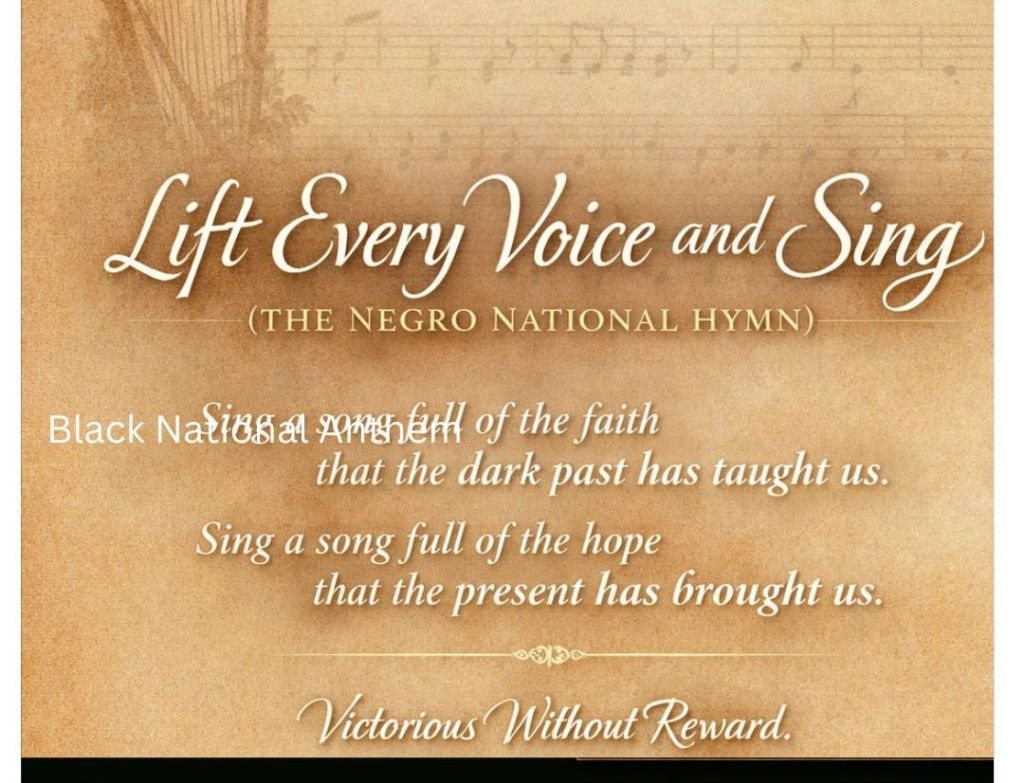
Originally titled Lift Every Voice and Sing (The Negro National Hymn)
Hymn.
Not rebellion. Not replacement.
Hymn.
Written in 1900 by James Weldon Johnson, and set to music by his brother John Rosamond Johnson, it was first sung by Black schoolchildren who were barely a generation removed from bondage.
And still they sang.
Psalm 98 says, “Sing unto the Lord a new song.”
Our ancestors did.
They sang through Jim Crow. They sang through separate water fountains. They sang when hoses knocked bodies down and dogs were turned loose. They sang when grief had no courtroom relief.
This hymn was not written to divide a nation. It was written to steady a people.
When it shows up on a Super Bowl stage, that is not intrusion. That is history breathing.
A hymn is not about replacing anything. It is about remembering.
Black History Month is not about exclusion. It is about acknowledgment.
And acknowledgment is not an attack. It is truth standing upright.
So when we lift every voice, we are not asking permission.
We are honoring inheritance.
Sing a song full of the faith that the dark past has taught us. Sing a song full of the hope that the present has brought us.
Some songs survive because they are catchy. This one survived because it carried us.
To the children who first sang it. To the elders who kept it in the pews. To every voice that trembled but did not stop
Bread Crumbs — for those coming after us. Victorious without reward. Still here..
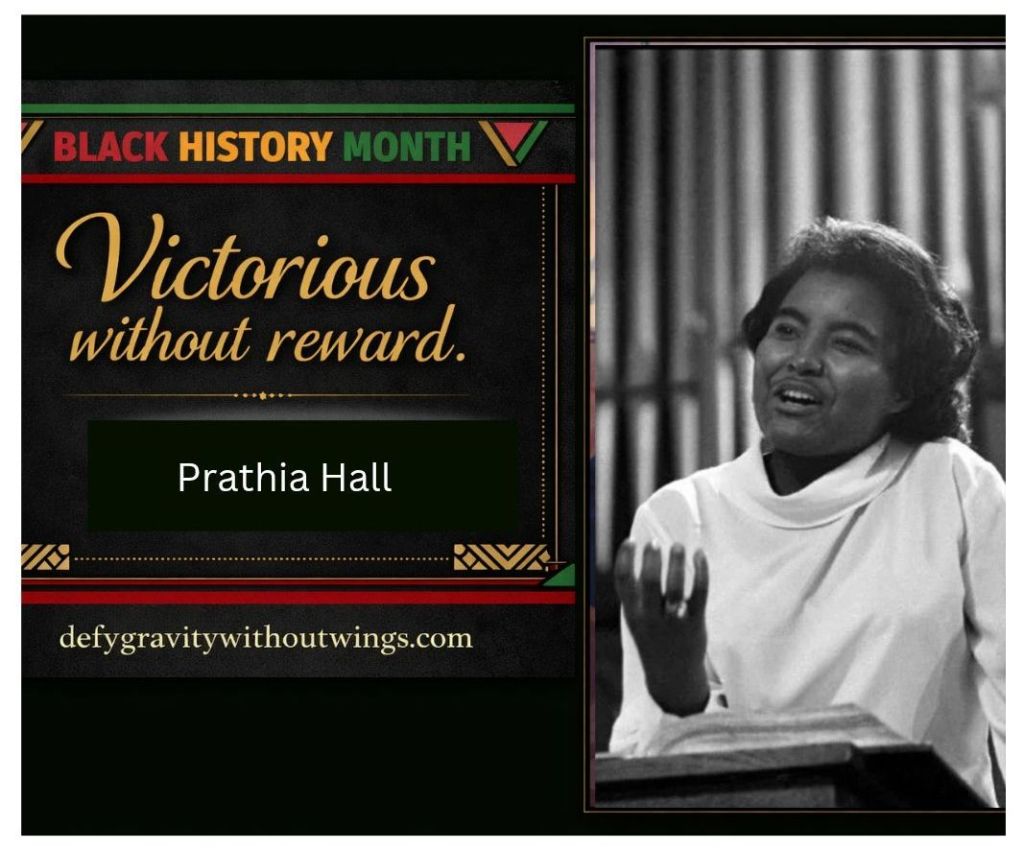
Prathia Hall was a preacher—and I don’t mean honorary, invited-once-a-year preacher. I mean called, trained, Scripture-handling, fire-in-her-bones preacher. That alone put her at odds with the world she was born into. She came up in the middle of the Civil Rights Movement, not watching it on television, but working it. Organizing. Marching. Preaching. Sitting in mass meetings where faith wasn’t decoration—it was fuel.
And Prathia knew words mattered. She preached with rhythm and Scripture braided together. Not shouting just to shout. Not performing. She preached like someone who believed God was actually listening—and that people were, too.
One night, after a church had been bombed, Prathia stood in the rubble and began to pray out loud. And as she prayed, she kept saying a phrase again and again: “I have a dream…” Not as a speech. As a prayer.
That cadence—the hope, the structure, the repetition—later showed up on a much bigger stage through Dr. King. History remembers the microphone. It often forgets the woman who helped tune the sound.
Prathia Hall kept preaching anyway. She worked with the Student Nonviolent Coordinating Committee (SNCC), helped train young leaders, and taught theology that didn’t separate heaven from justice. She believed faith was supposed to interrupt oppression, not soothe it. She didn’t chase credit. She chased truth.
“So then faith comes by hearing, and hearing by the word of God.” — Romans 10:17
SIT WITH THIS Who taught you how to speak hope before the world was ready to hear it? And where might God be asking you to keep saying the thing—even if someone else gets the credit later?
BREADCRUMB Some words don’t echo right away. They wait—until the world is ready to hear them.
We see you, Prathia Hall — for preaching freedom into the air before it had a stage.
Bread Crumbs — for those coming after us. Victorious without reward. Still here.
Charles Hamilton Houston believed something radical for his time:
That the law — when disciplined, prepared, and forced to tell the truth — could be used to dismantle injustice.
He was not a march leader. He was not a headline. He was a builder.
Born in 1895, Houston became a lawyer and educator who saw segregation not just as wrong, but as structural. He believed it had to be taken apart piece by piece, case by case, classroom by classroom.
So he did the slow work.
As a professor at Howard University School of Law, Houston trained a generation of Black lawyers to be precise, relentless, and morally clear. Among them was a young man named Thurgood Marshall.
Houston taught his students that excellence was not optional — because lives depended on it.
“A lawyer is either a social engineer or a parasite on society.”
Houston chose to be a social engineer.
Long before Brown v. Board of Education reached the Supreme Court, Charles Hamilton Houston was already laying the groundwork.
He challenged unequal pay for Black teachers. He dismantled segregation in graduate and professional schools. He forced courts to confront the lie of “separate but equal.”
Case by case, brick by brick, he weakened the foundation of legalized segregation.
Others would stand in front of the nation when the walls finally fell.
Houston would not.
His health deteriorated under the strain of the work. He died young. And when history celebrated the victory, his name was often missing from the story.
He was victorious without reward.
Charles Hamilton Houston reminds us that some people are called to prepare the way, not walk through the door themselves.
“Prepare the way of the Lord; make straight paths for Him.” — Isaiah 40:3
Houston prepared paths others would walk — paths that led to justice, dignity, and opportunity for generations he would never meet.
If you have ever done work that made someone else visible, labored behind the scenes while others stood at the microphone, poured yourself into something you knew you might not live to see finished, or believed faithfulness mattered more than credit,
Charles Hamilton Houston stands with you.
He built the road. Others crossed it.
And God saw every stone he laid.
We see you, Charles. We honor the work you did quietly.
Bread Crumbs — for those coming after us. Victorious without reward. Still here.
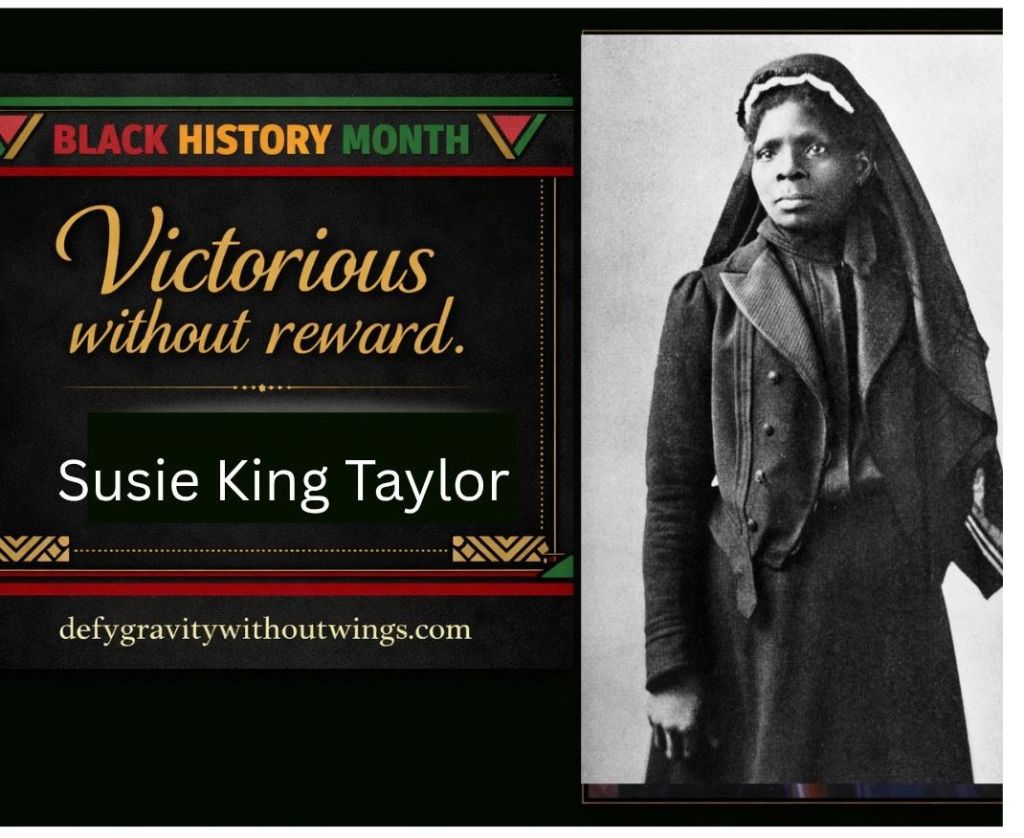
Susie King Taylor was born enslaved in Georgia in 1848, in a world where teaching Black people to read was a crime and Black women’s labor was expected but never honored.
From a young age, Susie learned to read and write in secret. She was taught quietly, moving from place to place so no one would notice. Knowledge, for her, was not just education—it was resistance.
When the Civil War came, Susie did not wait to be invited into history.
She followed Union troops, and at just fourteen years old, she began teaching formerly enslaved soldiers and children how to read. She became the first Black woman known to openly teach formerly enslaved people in a Union camp.
She did not stop there. Susie served as a teacher, a nurse, a laundress, and a caregiver to wounded Black soldiers. She worked in field hospitals. She tended infections. She cleaned wounds. She buried the dead. She did the work that kept soldiers alive long enough to keep fighting.
She did this without rank. Without formal pay. Without protection. Without promise of recognition. And when the war ended, the men she served alongside received pensions. Susie did not.
Her body carried the cost of years of labor and exposure. Her hands had held dying boys. Her back bore the weight of war. Yet the government decided her service did not count. She was victorious without reward.
In 1902, Susie King Taylor published Reminiscences of My Life in Camp with the 33rd United States Colored Troops—one of the only Civil War memoirs written by a Black woman.
She wrote because she knew that if she did not tell the story, it would be told wrong—or not at all.
She documented unequal treatment, exhaustion, racism within the Union Army, and the quiet strength required to keep serving anyway.
Recognition did not follow. She died poor. Her contributions remained footnotes. Her name was largely absent from textbooks.
And yet, without women like Susie King Taylor, the war would not have been survivable for Black soldiers.
Susie King Taylor teaches us that some people do the work because it needs doing, not because they expect to be thanked. She was not disguised like Cathay Williams. She was not sidelined like Claudette Colvin. She was fully visible—and still denied.
“Whatever you do, work at it with all your heart, as working for the Lord, not for human masters.” — Colossians 3:23
If you have ever done essential work no one wanted to name, given care without credentials, served faithfully while others were promoted, or known your contribution mattered even when systems said it didn’t—Susie King Taylor stands with you. She served anyway. History followed later.
We see you, Susie. We honor you now.
Bread Crumbs — for those coming after us. Victorious without reward. Still here. Love, Chelle
Cathay Williams is one of my favorite Black history figures — not because she is well known, but because she is not.
I was first introduced to her by my nephew, Remmie, during one of the hardest seasons of my life — while I was going through breast cancer. He told me her story and then said something that stopped me cold.
He said I reminded him of her.
Like Cathay, I hid some of the pain I was really going through — not out of denial, but out of love. Not because the fight wasn’t real, but because I wanted to encourage others who were fighting too.
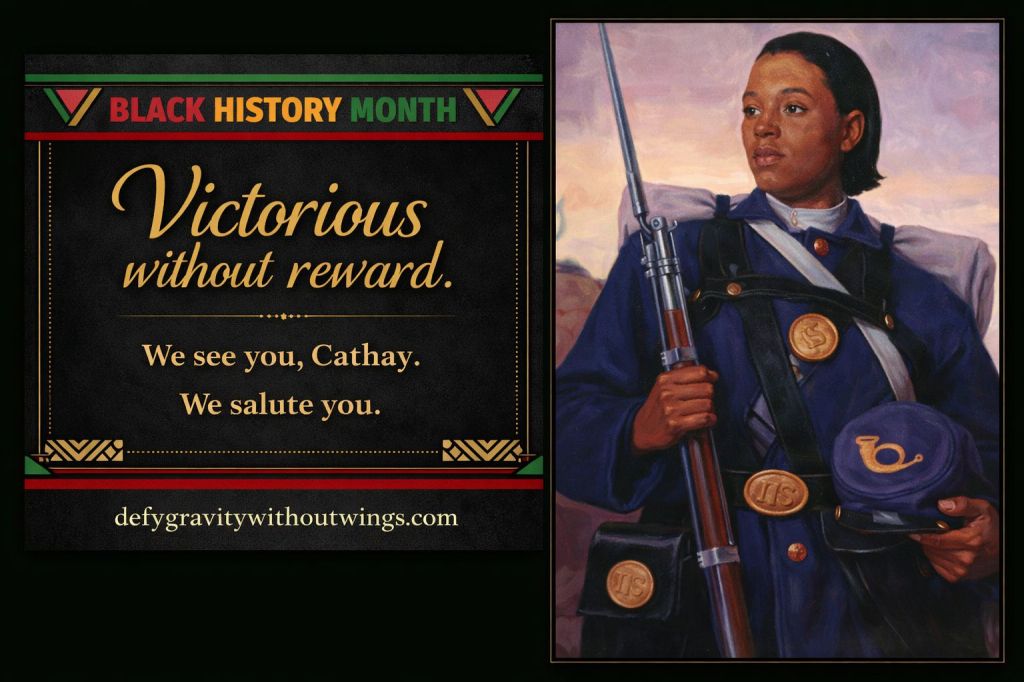
Cathay Williams was born enslaved in Missouri around 1844. During the Civil War, she followed the Union Army as a cook and laundress. But when the war ended and the Army opened its ranks to Black men only, Cathay did something unthinkable.
She cut her hair,
wrapped her body,
changed her name to William Cathay
— and enlisted.
For nearly two years, she served as a soldier in the 38th U.S. Infantry, one of the original Buffalo Soldier regiments. She marched. She guarded. She endured brutal conditions — all while hiding her identity in a world that would not make space for who she truly was.
Eventually, illness exposed what society refused to imagine: a Black woman had carried a rifle, worn the uniform, and served her country faithfully.
She was discharged — not for lack of courage, but for daring to exist outside the rules.
Cathay Williams lived a life where survival required disguise. Not because she lacked strength — but because the world lacked vision.
There are seasons when God calls people to serve before the world is ready to name them correctly. Cathay was known as William by the Army. But she was known fully by God. “The Lord does not see as mortals see; they look on the outward appearance, but the Lord looks on the heart.” — 1 Samuel 16:7
History overlooked her. The Army dismissed her. But heaven recorded her obedience. Some call her story deception. Others call it desperation.
But I call it courage under constraint.
And here is the part history often whispers instead of says out loud: Cathay Williams never received military honors. She never received a pension. In 1891, after her health had been permanently damaged by her service, she applied for a military disability pension. It was denied. She died poor and largely forgotten.
She was victorious without reward.
Cathay Williams did everything she was asked to do — and more. She served faithfully. She endured quietly. She finished her assignment.
Her story reminds us that victory and recognition are not the same thing. “Well done” does not always come from the systems we serve — but it is always recorded by God. She didn’t fight for history. She fought through it. And God did not waste a single step she took.
She did not live to see her story told. But her life still speaks.
And for those who have ever given their strength, their hope, or their encouragement without guarantee of return: You may be unrewarded by the world — but you are not unseen by God.
We see you, Cathay. We salute you.
Love, Chelle
About the History in Bread Crumbs Bread Crumbs reflections are grounded in documented historical records, including archives from the U.S. National Archives, Library of Congress, court records, contemporaneous newspapers, and first-person accounts. Spiritual reflections and personal connections are clearly marked as such and are offered with respect for the historical record.
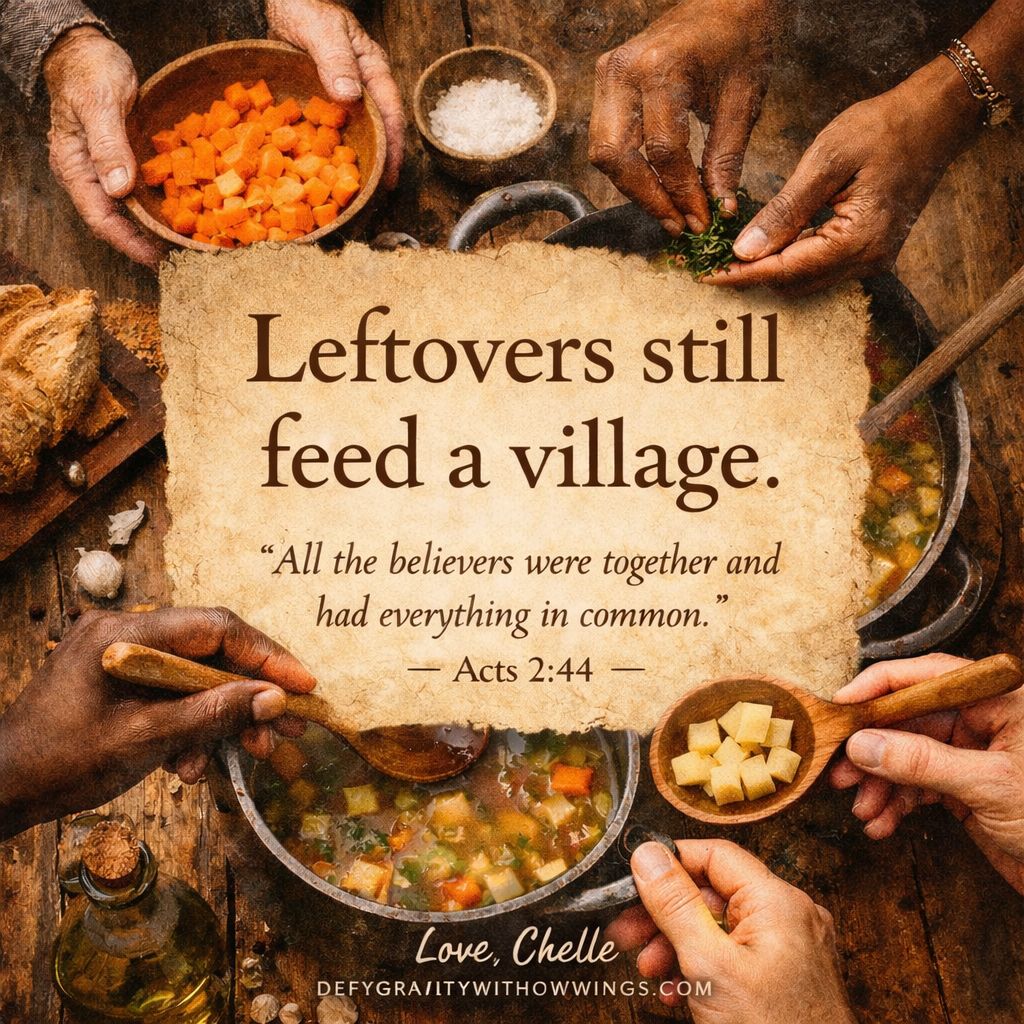
(Inspired by the traditional folktale “Stone Soup”) There is an old folktale—often called Stone Soup—with roots in European oral tradition, passed from voice to voice long before it ever lived on a printed page. No single author can claim it, because it belongs to the people. To grandmothers. To kitchens. To cold evenings and tired hearts. My grandma told me this story when I was a child. In it, strangers arrive in a village with nothing but a pot, water, and a stone. The villagers insist they have nothing to give. Nothing extra. Nothing to spare. But as the pot begins to simmer, curiosity loosens fists. A carrot appears. Then an onion. A potato. A handful of herbs. What begins as nothing becomes a feast—not because of the stone, but because everyone adds what they already had. “All the believers were together and had everything in common.” — Acts 2:44 What my grandmother made sure I understood wasn’t cleverness or trickery. It was this: waste nothing, because even the smallest thing can become enough. That lesson followed me into adulthood and straight into my freezer. I freeze the little bits. The half cup of vegetables left after dinner. The last spoonful of beans. The scraps that don’t look like a meal on their own. And on nights like this—when the world feels heavy, when the news is loud, when unrest simmers hotter than any stove—I pull out those frozen fragments. I drop my own version of a stone into broth. I add spices. I stir. And somehow, once again, there is soup. Scripture reminds us that when we bring what we have—no matter how small—God knows how to make it enough. “Each of you should use whatever gift you have received to serve others.” — 1 Peter 4:10 Nothing fancy. Nothing wasteful. Nothing done alone. Wouldn’t it be lovely— in a world so divided, so guarded, so afraid of scarcity— if we could remember how to do this together? Not fix everything. Not agree on everything. Just show up with what we have. A carrot. A story. A pot. A willingness. Stone Soup reminds us that abundance doesn’t start with excess. It starts with shared heat. With open hands. With the quiet decision to believe that together is still possible. Tonight, I’ll keep stirring. And I’ll keep believing. Love, Chelle DefyGravityWithoutWings.com
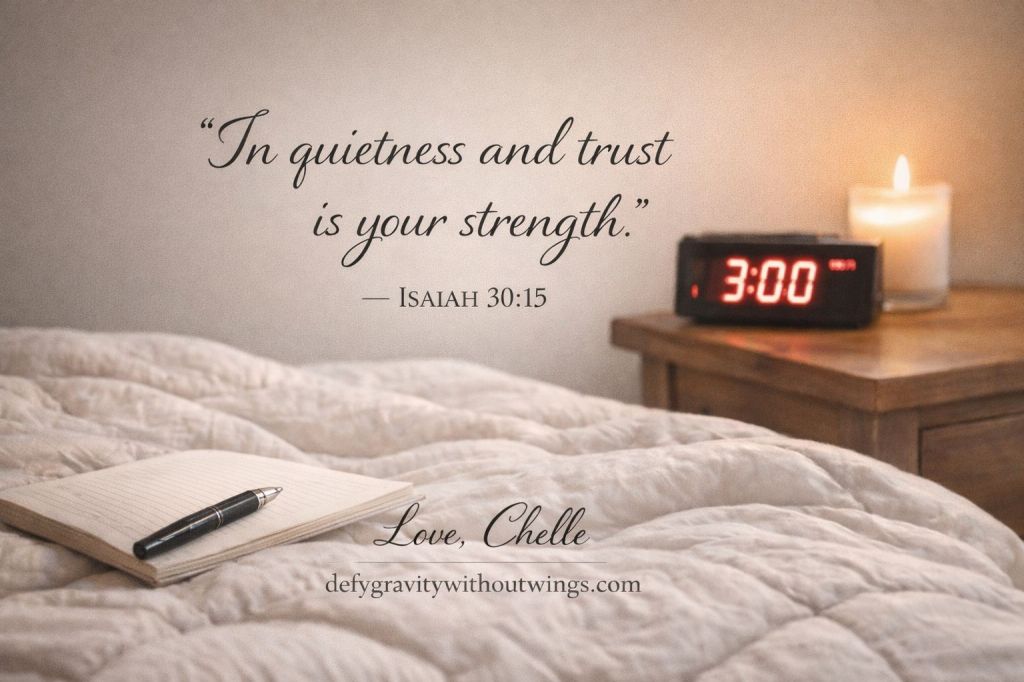
Like some kind of finely tuned timepiece, my internal alarm goes off — clockwork faithful. No snooze button negotiations. No grace period. Just “bing.”
And there it is… 3:00 a.m. glowing on my digital clock (yes, I still have one — don’t judge).
I pull the comforter up like it might save me. It does not.
My body says, up up up, while my soul whispers, “Really, Lord? Again?”
There was a time I filled those early hours with “responsible things” — finishing chores I ignored the night before, paying bills that had been staring at me all day, or letting the TV talk so I didn’t have to think.
Busy things. Distracting things. Things that looked productive but didn’t change me one bit.
But lately… I’m up writing.
Blog entries. Poems. Devotionals.
Words spilling out at a pace that tells me I’m not in charge of this schedule anymore.
And somewhere between the glow of that clock and the scratch of my pen, truth had my full attention.
I’ve moved from me cleaning house to God housekeeping me.
Because once I’m fully awake, I go full steam — fixing, managing, pushing, performing. But at 3 a.m.? I’m not impressive. I’m not polished. I’m barely caffeinated.
And that’s exactly when God starts pointing things out.
Things my soul was too tired to hear during the day, my pen now faithfully records in the quiet.
Cleaning me. Pruning me. Digging around places I thought were “fine.” Re-creating what I rushed past in daylight.
This isn’t insomnia. This is divine interruption.
Early-morning housekeeping — the kind where God gently rearranges what I’ve been tripping over inside while I’m still wrapped in blankets and honesty.
And I’m reminded, softly, without accusation or demand: “In quietness and trust is your strength.” (Isaiah 30:15)
Turns out, God doesn’t always wake us up to get more done.
Sometimes He wakes us up because He’s not finished with us yet.
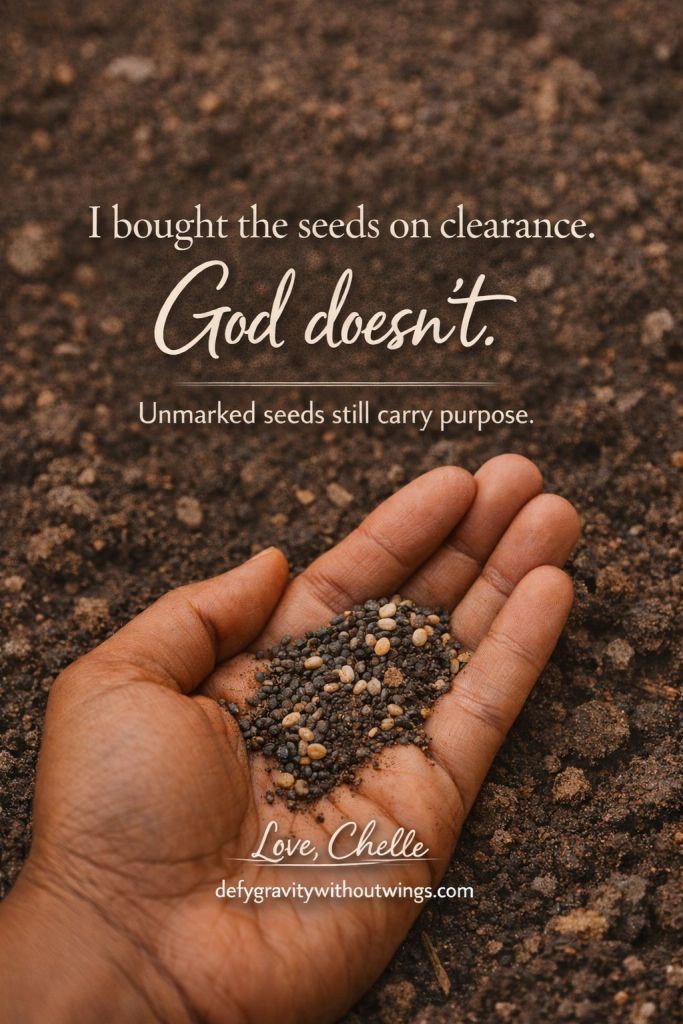
I was standing there with a handful of seeds and no idea what any of them were. No labels. No instructions. No promises. Just seeds.
Some were round. Some looked like dust. Some looked like… dirt pretending to be something important.
And full confession — I made the executive decision to buy them from a discount house online, which should have been my first clue that clarity was not included in the price.
Because planting unmarked seeds feels risky. You don’t know what you’re committing to. You don’t know how long it will take. You don’t know what kind of care it will need — or if you just planted hope, oregano, and disappointment all in the same row.
And that is where I had to repent of my disgust with not being able to see the seeds’ vision.
God has planted a lot of unmarked seeds in me. No timeline. No instruction card. No neat little packet that says “This will bloom in 90 days if watered weekly and protected from disappointment, other people’s opinions, and your own impatience.”
Just obedience. Just trust. Just dirt and hope. Some seeds He plants look insignificant — almost invisible. Some feel mislabeled by other people. Some feel like they were handed to us without explanation at all.
And yet… seeds don’t need labels to know what they are. They just need soil. Light. Time.
And a gardener who doesn’t dig them up every five minutes to check progress — which, for the record, I have learned is frowned upon in both gardening and faith.
I think that’s where I get tripped up. I keep wanting proof before growth. Confirmation before commitment. Fruit before faith.
But the seed already knows what it carries — even when I don’t.
“So neither he who plants nor he who waters is anything, but only God who gives the growth.” — 1 Corinthians 3:7
Maybe the confusion isn’t failure. Maybe it’s faith in its earliest form. Maybe God is saying: Plant it anyway. Water it anyway. Stop interrogating the soil. Because unmarked doesn’t mean unintentional. And unseen doesn’t mean unimportant. And dormant is not the same thing as dead.
I didn’t wake up asking for a lesson. I woke up asking a question.
When, Lord? When will things be different? When will healing finally arrive?
A year has passed since surgery. By my own calendar, I decided I should be past this. Past the restrictions. Past the tenderness. Past the reminders that my body has its own pace.
But today, my belly disagrees with my timeline.
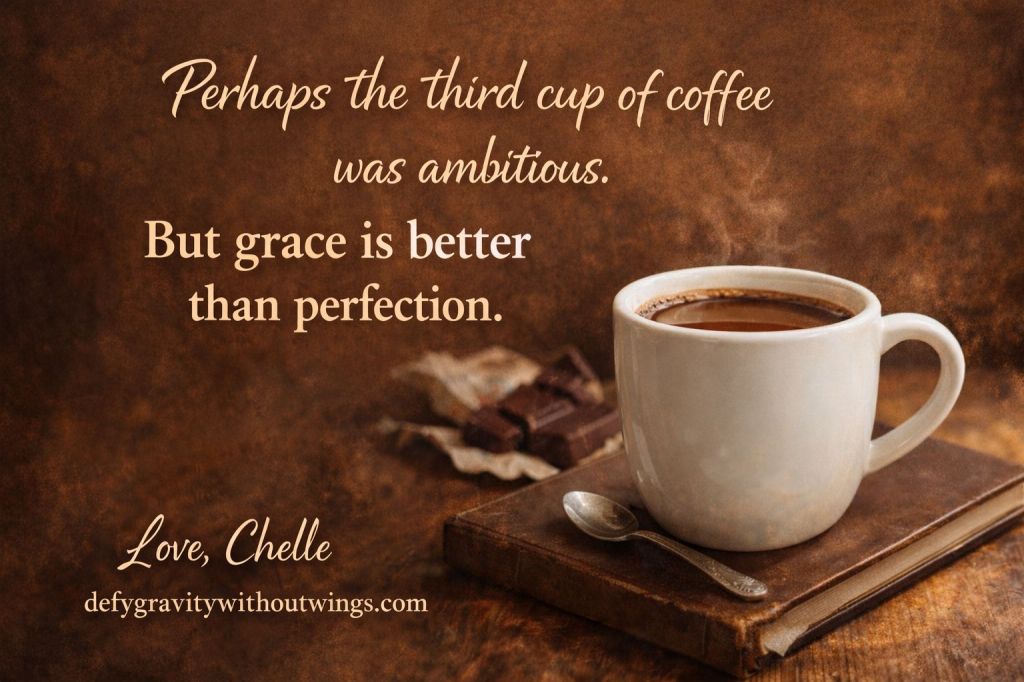
If I’m being honest, it may also disagree with my choices. Perhaps the third cup of coffee was ambitious. Perhaps chocolate and I — though still emotionally attached — are currently not on speaking terms. And perhaps I should have remembered the boatload of readily available internet wisdom that calmly, repeatedly explains the very misery I have managed to create for myself.
Still, I find myself asking God the same question Scripture has echoed for generations.
“How long, Lord? Will you forget me forever?” (Psalm 13)
That cry reminds me that impatience is not a lack of faith. It is often proof that we believe God hears us well enough to answer.
What if healing is not only about what is removed, but about what is relearned?
Without a gallbladder, my body asks for gentleness. Without certainty, my heart does the same.
Maybe the invitation today is not to rush healing, but to remember that restrictions are not punishment — they are protection still at work.
And maybe God isn’t offended by my when. Maybe He meets it with mercy.
“Because of the Lord’s great love we are not consumed, for his compassions never fail. They are new every morning.” (Lamentations 3:22–23)
That promise doesn’t say mercy arrives when I finally get it right — only that it shows up faithfully, even when I don’t.
So today, I loosen my self-imposed deadlines. I stop arguing with my body. I release the belief that progress must look linear to be real.
I may not control the timeline, but I can choose attentiveness over impatience.
And instead of asking, When will this be over? I ask a better question:
Lord, how do You want to meet me here?
Because even here — especially here — He is present.
I still don’t know what I’m doing. The sweet potato in the jar in my window can confirm it.
I stood it upright like a microphone instead of laying it down like a seed. Slips are forming anyway—which feels both rude and deeply grace-filled.
By every measurable standard, I am grossly underqualified for this harvest. I don’t garden with confidence — I garden with Google and apologies. I whisper encouragement to my plants like they’re on a faith journey too.
And yet… green keeps showing up.
Scripture says, “Do not despise these small beginnings, for the Lord rejoices to see the work begin.” — Zechariah 4:10
Apparently, this applies to gardeners too.
The sweet potato didn’t ask for my credentials. It didn’t wait for me to feel confident. It just responded to warmth, light, and the fact that I didn’t give up on it.
That feels uncomfortably familiar.
God has never waited for my expertise before growing something in my care. He responds to availability, not mastery. To people who stay put long enough for growth to decide it’s safe.
I keep expecting God to say, “You’re not ready for this yet.” Instead, He keeps saying, “Watch.”
Watch what grows when you stop over-correcting. Watch what happens when you don’t uproot yourself every time doubt shows up. Watch what slips free when the season is right.
Turns out God grows things even when the gardener is winging it.
I may be underqualified. But I’m determined. And apparently… that’s enough for a harvest.