
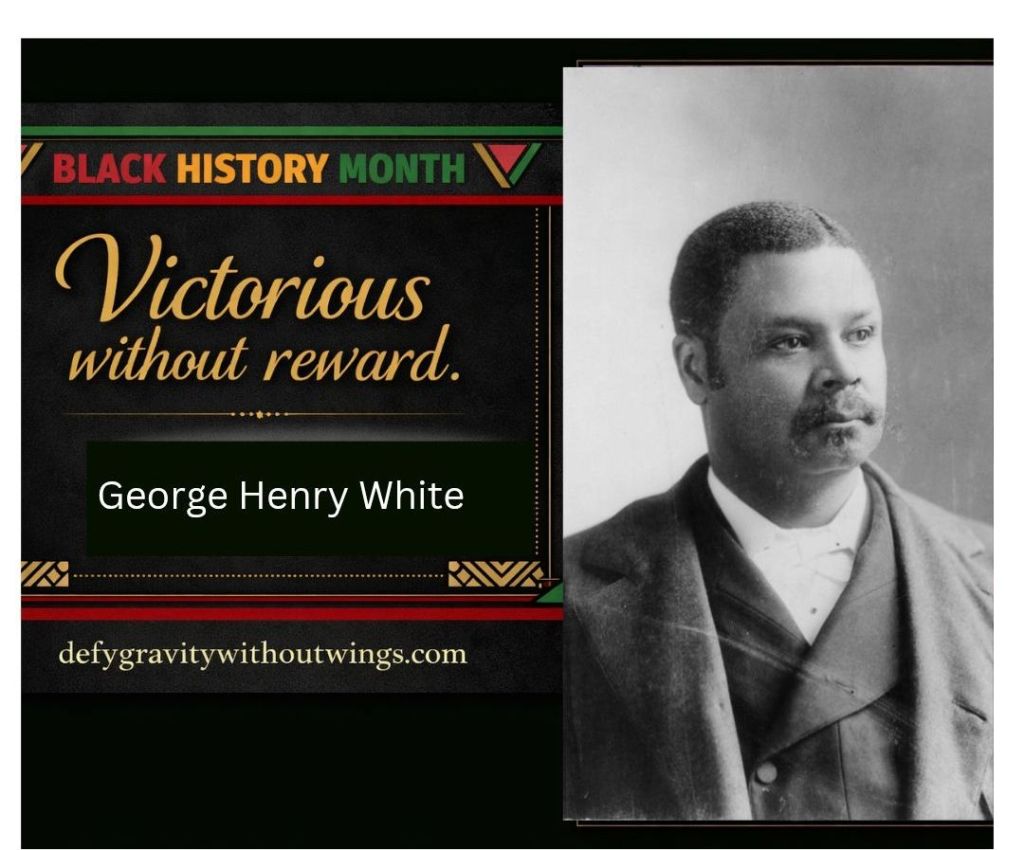
George Henry White (1852–1918) was the final African American to serve in the United States Congress at the close of Reconstruction. When he left office in 1901, Black representation in Congress disappeared for nearly three decades.
Born in Bladen County, North Carolina, to a free father and a mother who had been enslaved, White came of age in the uncertain promise of Reconstruction. He attended Freedmen’s schools, graduated from Howard University in 1877, became a teacher, then a lawyer, and entered public service during a narrow window when Black political participation was still possible in the South.
Elected to the U.S. House of Representatives in 1896 and reelected in 1898, he served as the only Black member of Congress during his tenure.
While in office, he:
• Introduced the first federal anti-lynching bill in 1900
• Spoke against voter suppression and racial violence
• Defended equal protection under the law
• Warned that disenfranchisement would wound the nation itself
As Jim Crow laws tightened and Black voters were systematically removed from the ballot, White chose not to seek reelection in a system engineered to silence his people.
On January 29, 1901, he delivered his farewell address. In it he declared:
“This… is perhaps the Negroes’ temporary farewell to the American Congress; but… Phoenix-like he will rise up some day and come again.”
It was not wishful thinking. It was vision.
Twenty-eight years later, Oscar Stanton De Priest returned Black representation to Congress in 1929. Since that return, more than 160 African Americans have served in the United States Congress.
White’s prophecy stretched further still. The groundwork laid by those who endured Reconstruction and its collapse helped clear the path for Thurgood Marshall on the Supreme Court, Barack Obama in the White House, and Ketanji Brown Jackson becoming the first Black woman Justice of the United States Supreme Court.
He did not see those milestones.
But he named the future in a moment designed to erase it.
After Congress, White practiced law, helped establish the Black town of Whitesboro, New Jersey, and founded a Black-owned bank in Philadelphia.
He was the last of an era.
And the prophet of the next one.
Scripture
“Write the vision and make it plain upon tables, that he may run that readeth it.
For the vision is yet for an appointed time… though it tarry, wait for it;
because it will surely come.”
— Habakkuk 2:2–3
BREADCRUMB
Sometimes the assignment is not to hold the seat,
but to hold the prophecy.
SALUTE
We see you, George Henry White —
for legislating in hostile air,
for introducing justice when it would not pass,
for declaring return when disappearance looked certain.
You stood at the edge of erasure
and named the future anyway.
Bread Crumbs — for those coming after us.
Victorious without reward.
Still here.

 defygravitywithoutwings.com