
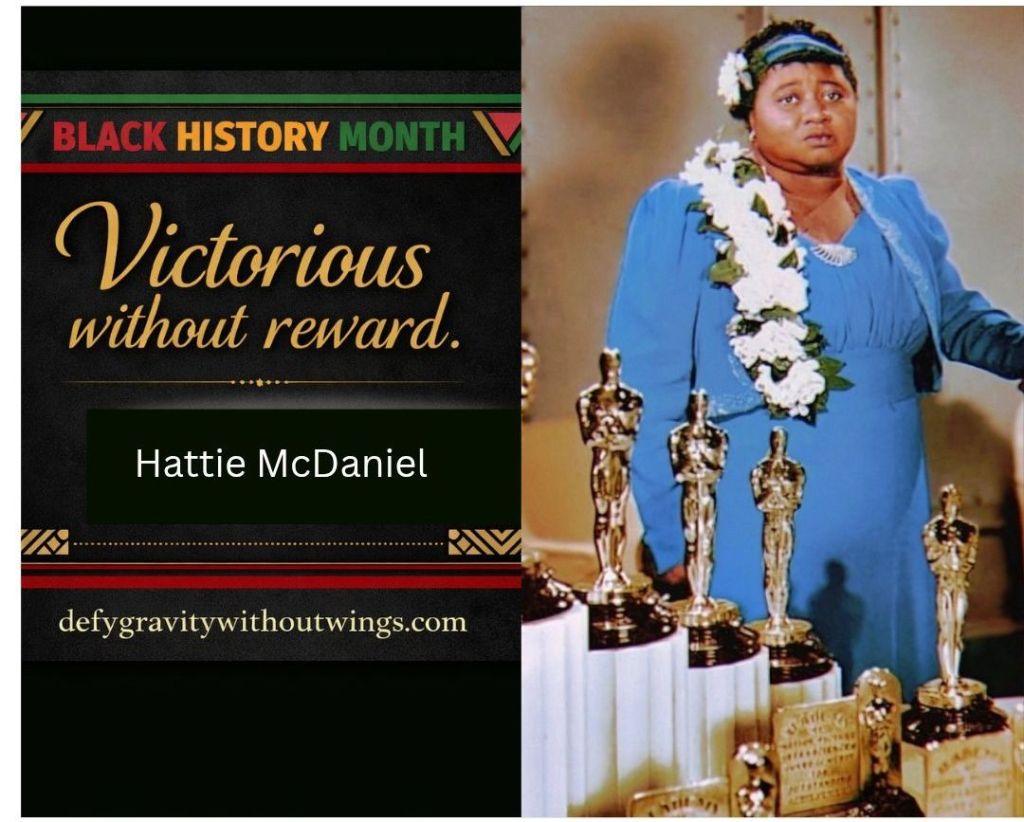
In 1940, Hattie McDaniel became the first African American to win an Academy Award. She won Best Supporting Actress for her role as Mammy in Gone with the Wind (1939). She was also the first African American ever nominated for an Oscar. History shifted that night.
And yet, at the ceremony held at the Ambassador Hotel in Los Angeles, she was required to sit at a small segregated table against the wall, apart from her white castmates. Victory. With boundaries.
When the film premiered in Atlanta in 1939, Georgia’s Jim Crow laws barred Black cast members from attending. It is widely reported that her co-star Clark Gable objected strongly and threatened not to appear in protest. Accounts say Hattie encouraged him to attend, understanding the political climate and the fragile footing of her position in Hollywood. Public outrage from powerful allies could make headlines. But she would still have to live and work inside the system afterward. Strategy is not surrender.
MORE THAN MAMMY
Hattie McDaniel was born in Kansas to parents who had been enslaved.
She was among the first Black women to sing on American radio in the 1920s, a successful blues performer before Hollywood and recorded 16 blues sides between 1926 and 1929. She appeared in over 300 films, though many roles went uncredited. Her best known other major films are Alice Adams, In This Our Life, Since You Went Away, and Song of the South.
She became one of the highest-paid Black entertainers of her era and later starred in the radio show Beulah, becoming one of the first Black women to headline a nationally broadcast radio program.
In 1952, she became one of the first Black women to star in a television series when Beulah moved to television.
She holds two stars on the Hollywood Walk of Fame — one for motion pictures and one for radio.
All of this was before Rosa Parks. Before Martin Luther King Jr. became a national figure. Before the Civil Rights Act.
Jim Crow was law. Black actors were largely confined to domestic or servile roles. Many within the Black community criticized those portrayals for reinforcing stereotypes.
Hattie’s response was pragmatic and pointed: “I’d rather play a maid than be one.”
Being first does not mean being free. McDaniel died of breast cancer on October 26, 1952, at age 59 in Woodland Hills, California. Her final wish to be buried in the Hollywood Cemetery was denied due to its segregation policy at the time. Decades later, a memorial plaque was placed in her honor.
In 2006, she was honored with a US postage stamp, and in 2010, she was inducted into the Colorado Women’s Hall of Fame.
In 2006, the Academy replaced her long-missing Oscar, confiscated by IRS debt, with a replica, formally acknowledging her historic win. The original was to have been displayed at Howard University but went missing in the 1970s
Notably, no other Black woman would win an Oscar for 50 years after Hattie. Not until Whoopie Goldberg won for Best Supporting Actress in Ghost.
Galatians 6:9
“Let us not grow weary in well doing: for in due season we shall reap, if we faint not.”
CARRY THIS WITH YOU
Sometimes the door that opens to you is imperfect. Sometimes the room is segregated.
Sometimes you are allowed in — but only to the edge.
Hattie McDaniel walked in anyway. Not because the system was fair. But because excellence inside limitation still moves history forward.
BREADCRUMB
What opportunity are you resisting because the conditions are not ideal? Being the first often means carrying contradictions so others can inherit clarity.
SALUTE
We see you, Hattie McDaniel — for becoming the first when the room was not ready, and for claiming victory in a nation that tried to seat you in the shadows.
Bread Crumbs — for those coming after us.
Victorious without reward. Still here.

 defygravitywithoutwings.com