
Before rock & roll had a king… there was a woman with a guitar in church. Before They Called It Rock
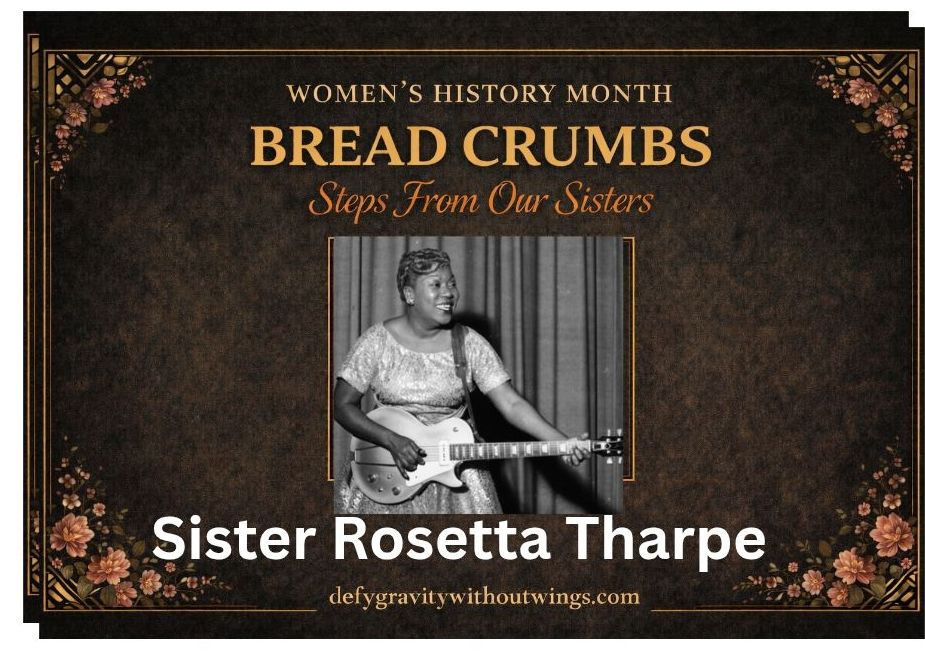
Sister Rosetta Tharpe was born in 1915 in Cotton Plant, Arkansas. By 6 years old she was already traveling with her mother, performing in churches across the country. A little girl with a guitar and something on her life that didn’t wait for permission.
By the 1930s, she had moved to Chicago and New York, recording gospel music that didn’t sound like what people expected. Her 1938 recording of “Rock Me” carried gospel into spaces folks said it didn’t belong.
Sometimes God will let you sound different before the world catches up.
She played electric guitar. Loud. Joyful. Unapologetic. Too church for the world. Too worldly for the church. But she didn’t split herself to make others comfortable. She carried both.
By the 1940s she was touring, recording hits, and drawing crowds.
In 1951, she turned her wedding into a concert at a baseball stadium in Washington, D.C., with over 20,000 people in attendance.
She was not standing on the front lines of a march, but make no mistake, Sister Rosetta Tharpe was pushing against every line drawn around her. In a time when Black women were expected to be quiet, when stages were dominated by men, and when gospel music was supposed to stay inside church walls, she stepped forward with an electric guitar and refused to shrink. She played to integrated audiences, carried Black gospel into mainstream spaces, and stood fully in her calling without asking permission to belong. She didn’t organize protests, but every note she played disrupted something that said she should not be there.
“Do not conform to the pattern of this world, but be transformed…” — Romans 12:2
Her guitar style helped shape what became rock & roll. Artists like Chuck Berry, Little Richard, and Elvis Presley drew from that sound. But her name was not always given its place.
Because sometimes history doesn’t forget. Sometimes it just misplaces.
“For nothing is hidden that will not be revealed.” — Luke 8:17
She later settled in Richmond, Virginia and lived in the Barton Avenue area. No spotlight. Just legacy waiting. But Heaven Kept the Records. In March 2026, the city council of Richmond, Virginia voted to rename a portion of Barton Avenue in her honor, recognizing her contributions to music and culture.
She didn’t wait to be understood. She played anyway. And maybe what feels unseen in you is not buried — just early.
“In due season we shall reap, if we do not lose heart.” — Galatians 6:9
In her later years, Sister Rosetta Tharpe carried both the weight of her health and the quiet of a life that had already poured so much out. She passed in 1973 in Philadelphia after complications from a stroke, having lived a life that did not follow straight lines—married three times, with no children to carry her name forward in the traditional sense.
And yet, her legacy did not fade. It waited. Thirty-four years after her death, she was finally inducted into the Rock & Roll Hall of Fame, a long-overdue recognition for a sound she helped birth. Even Johnny Cash once recalled hearing her records in shops, noting how her music left an imprint before many even understood what they were hearing.
What About You? Maybe what you’ve poured out feels unseen. Maybe it feels like it didn’t matter. But what if it’s not gone just waiting what heaven records earth will eventually recognize.
Breadcrumbs From Our Sisters Who Marched Before Us.
— Love, Chelle
DefyGravityWithoutWings.com

 defygravitywithoutwings.com