Image

Lace Under My Armor

Someone told me I was one of the strongest women they know. Juggling a crippling set of battles and making it look easy.

I smiled… but something in me shifted.

Because strength has a way of being misunderstood.
People see what you carried.
They don’t always see what it cost you to carry it.

And before I could stop myself, I said it out loud:
“There is lace under my armor.”

Not everything about me is steel.
Not everything about me is survival.
There are still places in me that feel deeply.
Places that bruise.
Places that hope… even when hope has been stretched thin.

And right there… in this tender space… God met me with this:
2 Corinthians 12:9
“My grace is sufficient for you, for my power is made perfect in weakness.”

Not weakness like quitting.
Not weakness like falling apart with no return.

But the kind that says…
I don’t have to be hard all the time.
I don’t have to pretend I am unaffected.
I don’t have to wear armor so tight that grace can’t get in.

And, I have learned about armor,
the belt of truth holding me steady,
the breastplate guarding my heart,
the shield lifted when the hits keep coming,
the helmet covering my thoughts,
the shoes that keep me standing when I’d rather sit down,
and the sword I reach for when I need to speak life.

Each piece doing what it was designed to do…
and still, not covering everything all the time.

There are moments when something sacred shows through;
a tender place,
an honest place,
a place still being healed.

Because His strength was never designed to sit on top of my perfection.
It settles into the soft places.
The honest places.
The lace.

So yes… I am strong.
But not because I stopped feeling.
Not because I became unbreakable.

I am strong because I let God meet me in the places that still are.

There is lace under my armor…
and sometimes, my slip shows.

And that is exactly where His grace rests.

Love,
Chelle
defygravitywithoutwings.com

Image

Not Chained. Positioned.

It’s 1:15 a.m.
The house is quiet, but my mind isn’t.
My spirit is talking, but my thoughts keep trying to interrupt. And if I’m honest, I don’t even want to go where my mind keeps taking me.

Because yesterday… I got burned.
Not a misunderstanding.
Not a small thing I can laugh off later.
Burned.
And not the kind you can just pray off and keep it moving like nothing happened.

And the part that makes it sit heavy in my chest is this: I’m still expected to show up tomorrow like nothing happened.
Smiling. Producing. Performing.
Because apparently… healing is not on the job description.

Because responsibilities don’t pause for disappointment. Bills don’t care about betrayal. And sometimes… purpose doesn’t immediately pull you out of uncomfortable places.

So there I was… sitting in the quiet, feeling tired in a way sleep can’t fix and the thought slipped in:

“I’m chained to this situation.”


Gee… I didn’t even like how that sounded coming out of my own mouth. But just as quickly… something in my spirit pushed back.

Not loud.
Not dramatic.
Just steady:

“You’re not chained… you’re positioned.”

Whew.

Because chained means stuck. No movement. No options. No end.
But positioned? Positioned means this is not permanent… no matter how long it’s been.
Positioned means there is purpose even here.
Positioned means you’re still on your way somewhere.

So I had to correct myself. I am not chained.
I am in transition with responsibilities.
And that changes how I stand in this space.

It means I don’t burn bridges out of frustration but I also don’t build my identity in a place that hurt me.

It means I pay attention. Because what hurt me also showed me something.
How people move.
What I can and cannot depend on.
Where I need boundaries.

What happened yesterday? That wasn’t just pain. That was data. And baby… I take notes.
And data helps you move wiser.

So instead of letting my mind replay the moment or fast-forward me into feeling stuck forever, I made a decision in the quiet:

I will deal with this tomorrow. Not at 1:15 a.m. Because I am not losing sleep over something God is already handling.

Because this hour isn’t for fixing. It’s for listening. And when I listened,I heard it clearly:
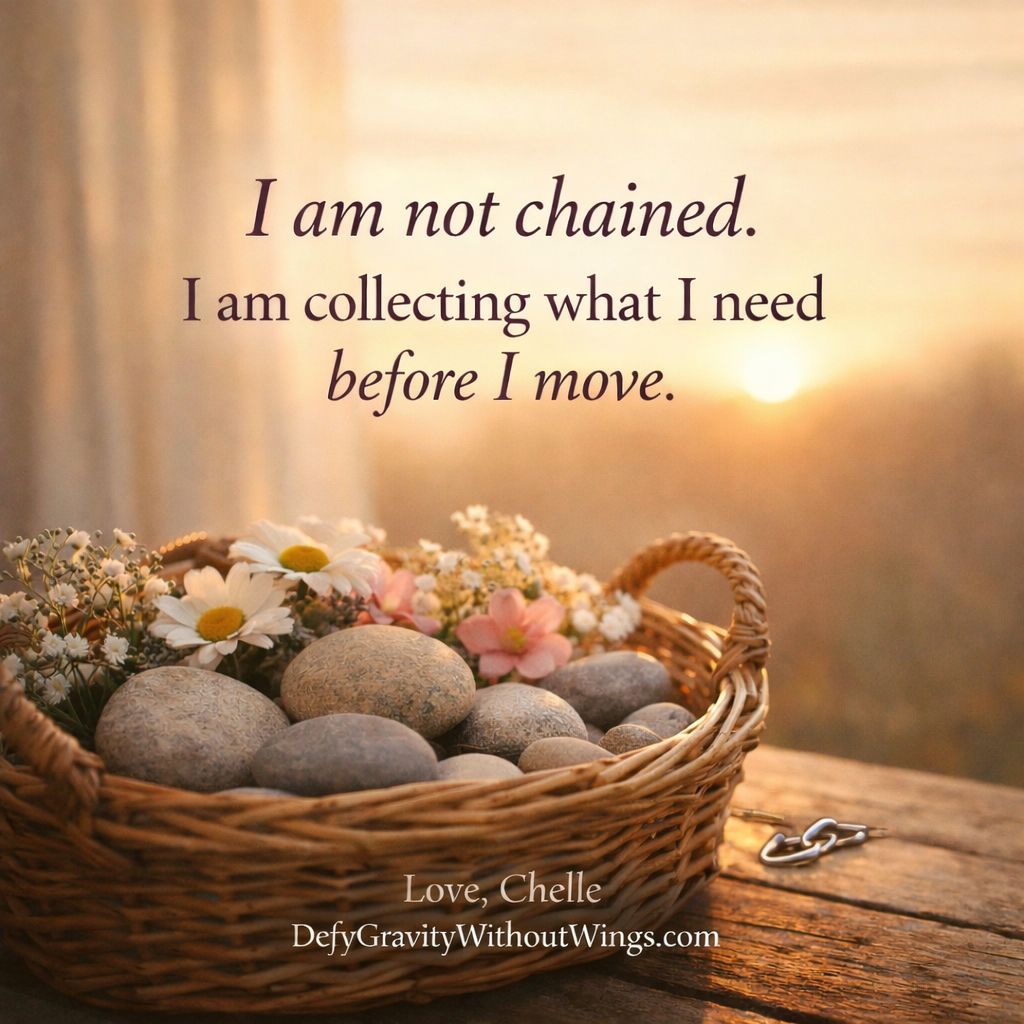
“I am not chained. I am collecting what I need before I move.”

So I’ll show up. I’ll do what needs to be done.
Not because they deserve my best… but because I do.

But I won’t shrink. I won’t forget who I am or whose child I am. And I won’t mistake a temporary season for a permanent assignment.

To be clear… just because I’m still here doesn’t mean I’m staying. Because even here,

God is still positioning me.


For I know the plans I have for you,” declares the Lord… “plans to prosper you and not to harm you, plans to give you hope and a future. – Jeremiah 29


Love,
Chelle
DefyGravityWithoutWings.com 💛

Image

Release While In Motion


It was one of those days that needed me to be focused.

Not halfway. Not distracted.
The kind of day where details matter, timing matters, and anything pulling at your attention feels like it’s trying to sabotage something important.

And yet… my mind would not sit still.

It kept circling the same place.
Big decisions. Career. Finances. Life.

The kind of decisions that don’t come with a clear map. The kind that make you pause long enough to ask God, “Am I supposed to stay… or am I free to go?”

So somewhere in the middle of moving, thinking, preparing, and trying to keep my day on track, I said it:

“Lord… I need You to tell me I’m released.”

Not emotional. Not panicked. Just honest.

Because I wasn’t trying to escape anything…
I just didn’t want to stay somewhere out of habit when You had already given permission to move.

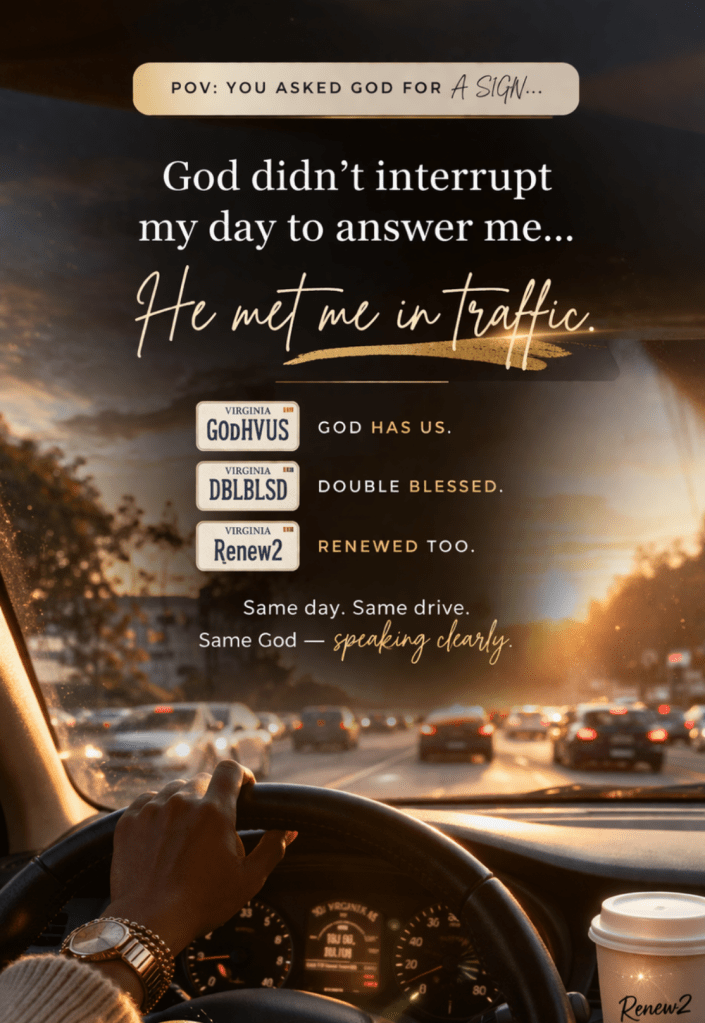
And without missing a beat…God answered me in traffic.

A car passed by with the license plate:

GodHVUS

I paused.

Because… okay Lord. I hear You.

A few minutes later, another one rolled past:

DBLBLSD

Now I’m sitting there like… “Sir… are You serious right now?”

And then it settled in. Not just what passed me… but what I was already sitting in.

My own car. My own plate.

Renew2

“See, I am doing a new thing; now it springs up—do you not perceive it?” — Isaiah 43:19

I asked God for release… and He answered with coverage, increase, and a reminder I had been carrying the whole time.

God has us. Double blessed. Renewed too.

And just like that, what felt heavy…
shifted.

Because release doesn’t always come with a loud announcement. Sometimes it comes with peace that quietly replaces pressure. Sometimes it shows up while you’re still in motion… not when you’ve stopped everything to go looking for it.

God doesn’t just release you from a place.
He renews you for the next one.

Because walking into something new with an old mindset will have you second-guessing doors He already opened.

It will make you call provision “too uncertain”
and growth “too uncomfortable.”

But when God is in it…there is a steadiness that follows.

Not because you have every answer but because you know you’re not walking alone.

So if you find yourself in the middle of a busy day… trying to hold everything together while quietly asking God for direction,

Pay attention.

He may not stop your schedule to answer you. But He will meet you right in it. And when He does…you won’t have to force clarity.

It will roll right past you.

Love, Chelle
defygravitywithoutwings.com

Image

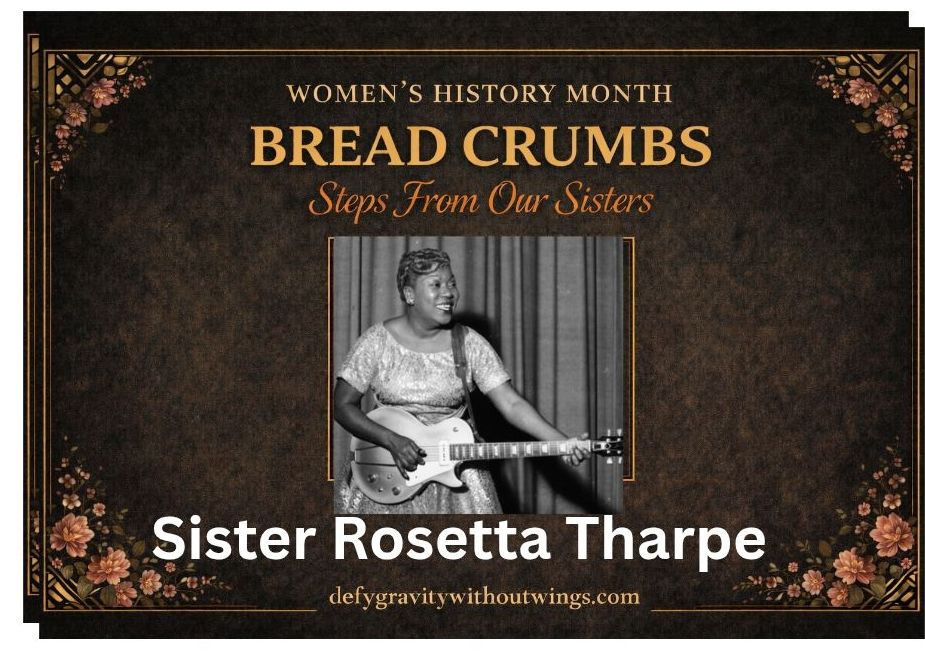
Sister Rosetta Tharpe — Godmother of Rock And Roll

Before rock & roll had a king… there was a woman with a guitar in church. Before They Called It Rock
Sister Rosetta Tharpe was born in 1915 in Cotton Plant, Arkansas. By 6 years old she was already traveling with her mother, performing in churches across the country. A little girl with a guitar and something on her life that didn’t wait for permission.
By the 1930s, she had moved to Chicago and New York, recording gospel music that didn’t sound like what people expected. Her 1938 recording of “Rock Me” carried gospel into spaces folks said it didn’t belong.
Sometimes God will let you sound different before the world catches up.
She played electric guitar. Loud. Joyful. Unapologetic. Too church for the world. Too worldly for the church. But she didn’t split herself to make others comfortable. She carried both.
By the 1940s she was touring, recording hits, and drawing crowds.
In 1951, she turned her wedding into a concert at a baseball stadium in Washington, D.C., with over 20,000 people in attendance.
She was not standing on the front lines of a march, but make no mistake, Sister Rosetta Tharpe was pushing against every line drawn around her. In a time when Black women were expected to be quiet, when stages were dominated by men, and when gospel music was supposed to stay inside church walls, she stepped forward with an electric guitar and refused to shrink. She played to integrated audiences, carried Black gospel into mainstream spaces, and stood fully in her calling without asking permission to belong. She didn’t organize protests, but every note she played disrupted something that said she should not be there.
“Do not conform to the pattern of this world, but be transformed…” — Romans 12:2
Her guitar style helped shape what became rock & roll. Artists like Chuck Berry, Little Richard, and Elvis Presley drew from that sound. But her name was not always given its place.
Because sometimes history doesn’t forget. Sometimes it just misplaces.
“For nothing is hidden that will not be revealed.” — Luke 8:17
She  later settled in Richmond, Virginia and lived in the  Barton Avenue area. No spotlight. Just legacy waiting. But Heaven Kept the Records. In March 2026, the city council of Richmond, Virginia voted to rename a portion of Barton Avenue in her honor, recognizing her contributions to music and culture.
She didn’t wait to be understood. She played anyway. And maybe what feels unseen in you is not buried — just early.
“In due season we shall reap, if we do not lose heart.” — Galatians 6:9
In her later years, Sister Rosetta Tharpe carried both the weight of her health and the quiet of a life that had already poured so much out. She passed in 1973 in Philadelphia after complications from a stroke, having lived a life that did not follow straight lines—married three times, with no children to carry her name forward in the traditional sense.
And yet, her legacy did not fade. It waited. Thirty-four years after her death, she was finally inducted into the Rock & Roll Hall of Fame, a long-overdue recognition for a sound she helped birth. Even Johnny Cash once recalled hearing her records in shops, noting how her music left an imprint before many even understood what they were hearing.
What About You? Maybe what you’ve poured out feels unseen. Maybe it feels like it didn’t matter. But what if it’s not gone just waiting what heaven records earth will eventually recognize.
Breadcrumbs From Our Sisters Who Marched Before Us.
— Love, Chelle
DefyGravityWithoutWings.com

Image

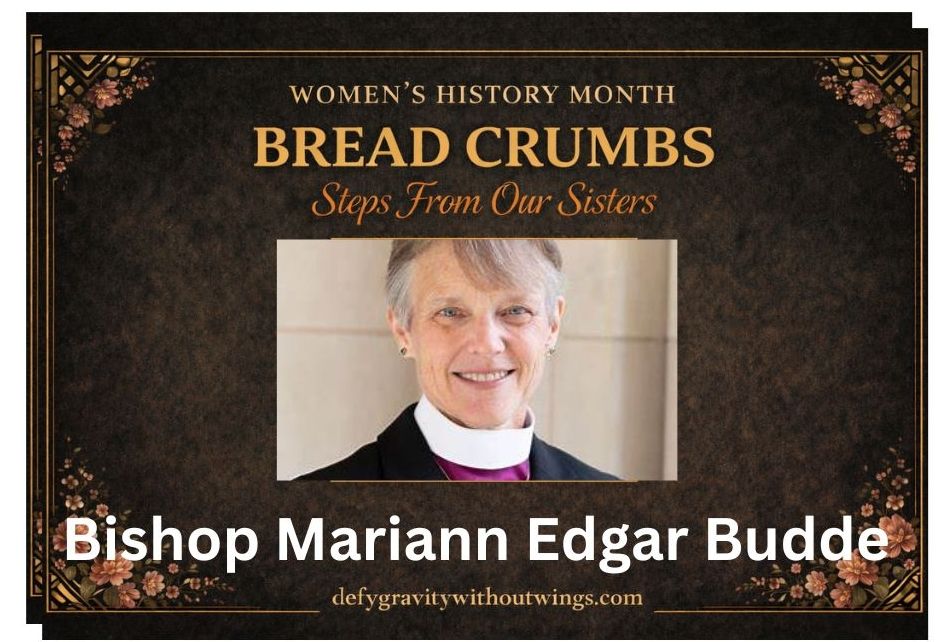
Bishop Mariann Edgar BuddeShe Brought Mercy Into a Room Built for Power

Some women do not raise their voices.
They raise the standard.

She was born in Summit, New Jersey, in 1959, and grew up in the Flanders section of Mount Olive Township, carrying both small-town roots and a wider view of the world.


After her parents’ divorce, she spent time living with her father in Colorado before returning to New Jersey and graduating from West Morris Mount Olive High School, a path that suggests early lessons in change, resilience, and finding your footing more than once.


Before she became known as an Episcopal bishop, she was shaped by an evangelical Christian upbringing, a background that helps explain the clear moral language and steady conviction people would one day hear from her in public life.

Bishop Mariann Edgar Budde became the first woman elected bishop of the Episcopal Diocese of Washington in 2011 after serving 18 years as rector of St. John’s Episcopal Church in Minneapolis.

In January 2025, during a prayer service at Washington National Cathedral attended by President Donald Trump, she spoke directly about mercy for immigrants, LGBTQ people, and others living in fear. What made the moment powerful was not volume. It was clarity. She stood in a sacred place, looked power in the face, and made room for compassion anyway.

That kind of courage belongs in Women’s History Month.

Not only the courage of women who marched with signs or shattered ceilings with applause behind them, but also the courage of women who held their ground in rooms built to intimidate. Women who spoke with steadiness when spectacle would have been easier. Women who understood that conviction does not have to be cruel to be strong.

Mariann Edgar Budde reminded the country that mercy is not frail. Mercy is not timid. Mercy is not a soft substitute for truth. Real mercy has a backbone. It knows exactly what it is doing. It steps into hard places and refuses to surrender its humanity.

She did not need rage to make history.
She did not need performance to make her point.
She did not need to wound anyone to be unforgettable.

She stood there as a woman, a leader, and a witness. Calm, clear, and unwilling to let fear have the final word.

That is how some women leave footprints.
Not by shouting over the room.
But by changing the temperature in it.

Speak up for those who cannot speak for themselves,
for the rights of all who are destitute.”
Proverbs 31:8

May we remember Bishop Mariann Edgar Budde not simply as the woman who unsettled a president, but as a woman who stood before power and still chose mercy. In a world that too often mistakes cruelty for strength, that witness matters.

We see you.

Steps From Our Sisters
Honoring the Women Who Marched Before Us

Curated by
Michelle Gillison-Robinson
DefyGravityWithoutWings.com
.

Image

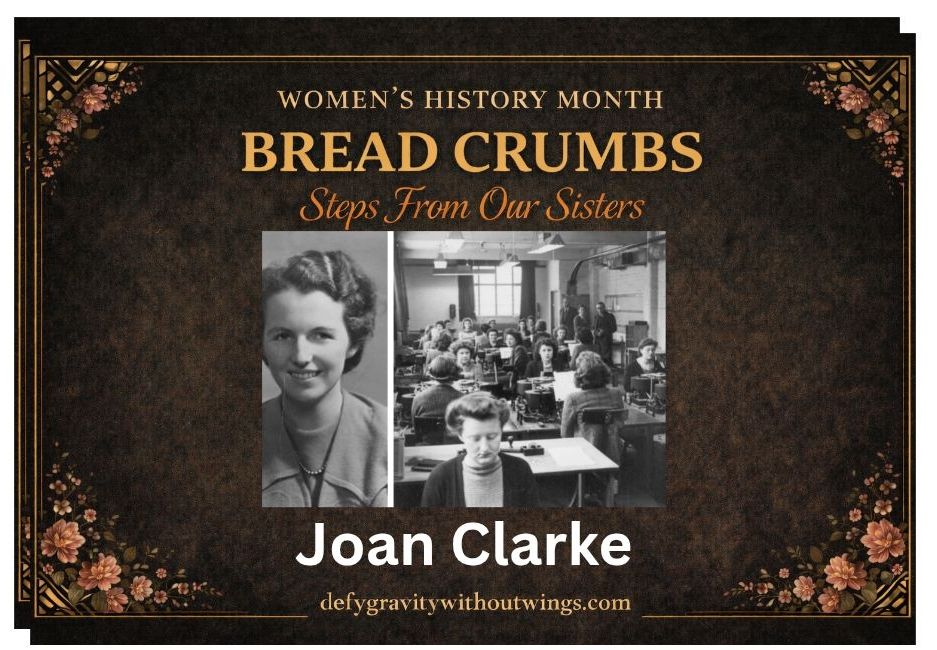
The Woman Who Helped Crack the Enemy’s Code  – Joan Clarke


(June 24, 1917 – September 4, 1996)

Sometimes the fate of nations depends on someone solving a puzzle.

During World War II, the British government gathered mathematicians, linguists, and puzzle solvers at a secret intelligence center called Bletchley Park. Their mission was to break the encrypted messages sent by Nazi Germany through the Enigma machine.

Among those brilliant minds was Joan Clarke.

Clarke had a remarkable talent for mathematics and logical reasoning. Despite her skill, she was initially placed in a clerical role because few people believed women belonged among the leading cryptanalysts.

But her brilliance soon became impossible to ignore.

Working alongside other codebreakers, including Alan Turing, Clarke helped decipher German military communications. The intelligence gathered from those messages allowed Allied forces to anticipate enemy movements and strategies.

Historians believe the success of the Bletchley Park team shortened World War II by several years and saved millions of lives.

There is a verse in Ecclesiastes that says, “Wisdom is better than weapons of war.”

Joan Clarke proved that truth in the quietest way possible.

Sometimes the mind that changes history
is sitting silently at a desk, pencil in hand.

Bread Crumbs

Not every hero stands on a battlefield.

Some sit in quiet rooms, solving problems others cannot see.

Joan Clarke reminds us that intelligence, patience, and perseverance can protect lives just as surely as strength or weapons.

Sometimes the wisdom God places in one mind
can help guide the safety of millions.

Steps From Our Sisters
Honoring the Women Who Marched Before Us

Curated by
Michelle Gillison-Robinson
DefyGravityWithoutWings.com


Image

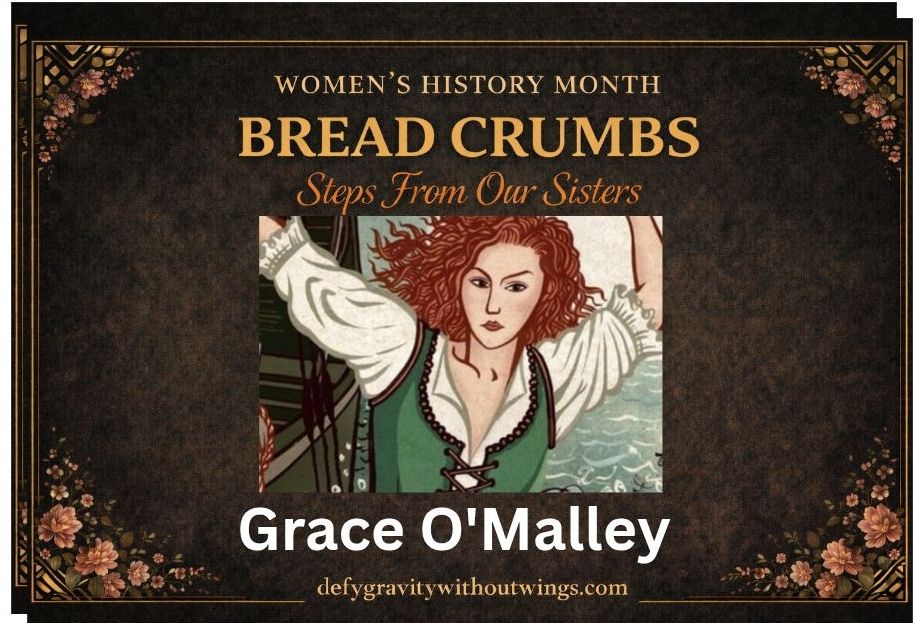
Grace O’Malley – Pirate Queen

(c.1530 – 1603)
Sometimes history remembers kings. But occasionally the sea belongs to a queen.
Grace O’Malley, known in Ireland as Gráinne Mhaol, was born into a powerful maritime clan along Ireland’s western coast. From a young age she refused the expectations placed upon women of her time.
She learned the sea instead. Grace commanded ships, led sailors, and controlled trade routes along the rugged Irish coastline. Her fleets became legendary, and her name was spoken with both admiration and caution.
When English forces threatened her family and territory, Grace O’Malley did something almost unheard of. She sailed to England and met Queen Elizabeth I face to face.
The two women spoke as equals, negotiating the freedom of O’Malley’s son and the restoration of her lands.
There is a verse in Psalm 93 that says, “The Lord reigns… the seas have lifted up their voice.”
Grace O’Malley’s life seemed to echo that image—strong, fearless, and unafraid of powerful waters.
Sometimes courage does not wait for permission.
Sometimes it sets sail.
Strength often begins with refusing the limits others place on you.
Grace O’Malley was expected to live quietly. Instead she commanded ships and negotiated with queens.
Her story reminds us that leadership can emerge from the most unexpected places.
Sometimes the waves that try to block your path are the very waters meant to carry you forward.
Steps From Our Sisters
Honoring the Women Who Marched Before Us

Image

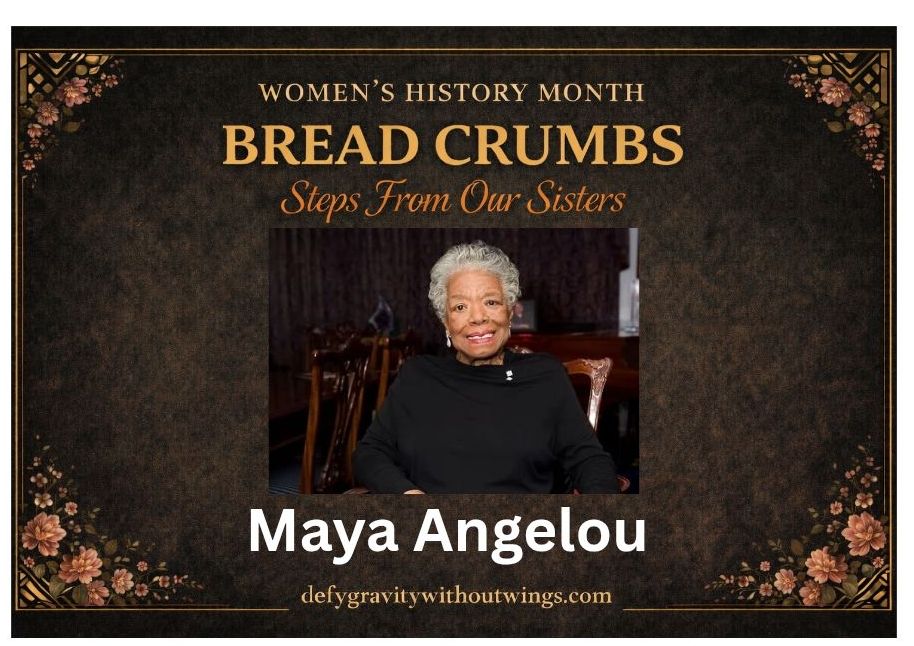
Maya Angelou: When a Voice Becomes Courage

She carried many lives before the world called her a poet.
Maya Angelou was born in St. Louis, April 4, 1928 as Marguerite Annie Johnson.   The name Maya was derived from her brother Bailey who just could not pronounce her name and would call her “My Sister” . It morphed into Maya which stuck. Angelou came from her first husband,  Enistasios Angelos, a Greek sailor. She adapted the surname slightly to Angelou when she began performing as a dancer and singer so it would sound more lyrical on stage.

She was  raised in the segregated South where dignity was often denied but never fully destroyed. Her childhood held both silence and survival, experiences that would later shape the voice the world came to know.
She refused to stay one thing. Angelou worked as a streetcar conductor, dancer, singer, journalist, and organizer long before the world recognized her literary voice. Her life moved through many stages, but each experience added depth to the perspective she would later bring to her writing.
Her voice extended beyond stages and books. During the Civil Rights Movement she worked alongside Martin Luther King Jr. and Malcolm X, helping organize, write, and advocate for justice. In 1964, after years living and working in Africa, Angelou returned to the United States at the invitation of Malcolm X to help him build a new civil rights organization focused on global Black unity.
Before that work could fully take shape, Malcolm X was assassinated.
The loss shook her deeply, but Angelou continued writing, speaking, and advocating for dignity and equality. Only a few years later the movement suffered another devastating loss when Dr. King was assassinated on April 4, Angelou’s own birthday.
Still she wrote.
In 1969, I Know Why the Caged Bird Sings gave voice to stories the world rarely allowed Black women to tell out loud. Stories of trauma, identity, and the quiet power of rising again. Her words did not whisper. They lifted.
As she once wrote: “Still I rise.” Three simple words that carried generations.
But the voice the world came to love was not always easy for her to use.
As a young girl Maya Angelou endured a violent assault. When she spoke the truth about what had happened, the man responsible was later killed. In her young mind she believed her words had caused it.
So she stopped speaking.
For years she lived in silence, afraid that her voice carried too much power. It was a teacher, Mrs. Bertha Flowers, who slowly led her back to language through books, poetry, and the music of words.
The voice that would one day move a nation had to be reclaimed first.
In 1993 she stood at the inauguration of President Bill Clinton and read On the Pulse of Morning, becoming only the second poet in American history to deliver a poem at a presidential inauguration.
But her greatest legacy was simpler.
She gave language to survival.
Her life echoes a truth older than any poem:
“We are hard pressed on every side, but not crushed; perplexed, but not in despair.” — 2 Corinthians 4:8

I once saw Maya Angelou in concert. In a packed 1000 plus  seat  theater she sang “God Sent a Rainbow” without a microphone. The room fell completely silent as her voice carried to every corner. It felt as if the walls themselves were listening.
In that moment I understood something about courage. Voices like Maya Angelou’s do more than speak. They remind us that we are not meant to stay silent either. Somewhere in our own lives there is a truth waiting to be spoken, a kindness waiting to be offered, a step waiting to be taken.
And that is how Bread Crumbs are made.
Poet. Witness. Voice for generations.
We see you, Maya Angelou — for giving language to survival and wings to truth.
Bread Crumbs — from those still marching forward.
Steps From Our Sisters. Still here.
What step might be waiting for you?

Image

Susie King Taylor: She Served Anyway


Susie King Taylor was born enslaved in Georgia in 1848, in a world where teaching Black people to read was a crime and Black women’s labor was expected but never honored.


From a young age, Susie learned to read and write in secret. She was taught quietly, moving from place to place so no one would notice. Knowledge, for her, was not just education—it was resistance.


When the Civil War came, Susie did not wait to be invited into history.


She followed Union troops, and at just fourteen years old, she began teaching formerly enslaved soldiers and children how to read. She became the first Black woman known to openly teach formerly enslaved people in a Union camp.


She did not stop there.
Susie served as a teacher, a nurse, a laundress, and a caregiver to wounded Black soldiers. She worked in field hospitals. She tended infections. She cleaned wounds. She buried the dead. She did the work that kept soldiers alive long enough to keep fighting.


She did this without rank.
Without formal pay.
Without protection.
Without promise of recognition.
And when the war ended, the men she served alongside received pensions.
Susie did not.


Her body carried the cost of years of labor and exposure. Her hands had held dying boys. Her back bore the weight of war. Yet the government decided her service did not count.
She was victorious without reward.


In 1902, Susie King Taylor published Reminiscences of My Life in Camp with the 33rd United States Colored Troops—one of the only Civil War memoirs written by a Black woman.

She wrote because she knew that if she did not tell the story, it would be told wrong—or not at all.


She documented unequal treatment, exhaustion, racism within the Union Army, and the quiet strength required to keep serving anyway.


Recognition did not follow.
She died poor.
Her contributions remained footnotes.
Her name was largely absent from textbooks.


And yet, without women like Susie King Taylor, the war would not have been survivable for Black soldiers.


Susie King Taylor teaches us that some people do the work because it needs doing, not because they expect to be thanked.
She was not disguised like Cathay Williams.
She was not sidelined like Claudette Colvin.
She was fully visible—and still denied.


“Whatever you do, work at it with all your heart, as working for the Lord, not for human masters.” — Colossians 3:23


If you have ever done essential work no one wanted to name, given care without credentials, served faithfully while others were promoted, or known your contribution mattered even when systems said it didn’t—Susie King Taylor stands with you.
She served anyway.
History followed later.


We see you, Susie.
We honor you now.


Bread Crumbs — for those coming after us.
Victorious without reward. Still here.
Love, Chelle

Image

Cathay Williams: Known By God. Hidden By History

Cathay Williams is one of my favorite Black history figures — not because she is well known, but because she is not.


I was first introduced to her by my nephew, Remmie, during one of the hardest seasons of my life — while I was going through breast cancer. He told me her story and then said something that stopped me cold.


He said I reminded him of her.


Like Cathay, I hid some of the pain I was really going through — not out of denial, but out of love.
Not because the fight wasn’t real, but because I wanted to encourage others who were fighting too.


Cathay Williams was born enslaved in Missouri around 1844. During the Civil War, she followed the Union Army as a cook and laundress. But when the war ended and the Army opened its ranks to Black men only, Cathay did something unthinkable.


She cut her hair,

wrapped her body,

changed her name to William Cathay

— and enlisted.


For nearly two years, she served as a soldier in the 38th U.S. Infantry, one of the original Buffalo Soldier regiments. She marched. She guarded. She endured brutal conditions — all while hiding her identity in a world that would not make space for who she truly was.


Eventually, illness exposed what society refused to imagine:
a Black woman had carried a rifle, worn the uniform, and served her country faithfully.


She was discharged — not for lack of courage, but for daring to exist outside the rules.


Cathay Williams lived a life where survival required disguise.
Not because she lacked strength — but because the world lacked vision.


There are seasons when God calls people to serve before the world is ready to name them correctly.
Cathay was known as William by the Army.
But she was known fully by God.
“The Lord does not see as mortals see; they look on the outward appearance, but the Lord looks on the heart.” — 1 Samuel 16:7


History overlooked her.
The Army dismissed her.
But heaven recorded her obedience.
Some call her story deception.
Others call it desperation.


But I call it courage under constraint.


And here is the part history often whispers instead of says out loud:
Cathay Williams never received military honors.
She never received a pension.
In 1891, after her health had been permanently damaged by her service, she applied for a military disability pension. It was denied. She died poor and largely forgotten.


She was victorious without reward.


Cathay Williams did everything she was asked to do — and more.
She served faithfully.
She endured quietly.
She finished her assignment.


Her story reminds us that victory and recognition are not the same thing.
“Well done” does not always come from the systems we serve — but it is always recorded by God.
She didn’t fight for history.
She fought through it.
And God did not waste a single step she took.


She did not live to see her story told.
But her life still speaks.


And for those who have ever given their strength, their hope, or their encouragement without guarantee of return:
You may be unrewarded by the world —
but you are not unseen by God.


We see you, Cathay.
We salute you.


Love, Chelle

About the History in Bread Crumbs
Bread Crumbs reflections are grounded in documented historical records, including archives from the U.S. National Archives, Library of Congress, court records, contemporaneous newspapers, and first-person accounts. Spiritual reflections and personal connections are clearly marked as such and are offered with respect for the historical record.

.