Image

When The Role Changes But The Purpose Remains


Yesterday, I did something that is not unusual for me when I get tired of adulting. I went to see a children’s movie.

Some people head to a spa. Some go shopping. Some book a weekend getaway. I apparently seek spiritual counseling from animated characters.

After a frustrating day at work and life, I exited being grown and didn’t  even stop for a grandchild so i wouldn’t look weird in the theater without a kid. 

I wasn’t looking for a life lesson. I was simply tired and in need of a break from the responsibilities and pressures of everyday life. I walked into the theater looking for a distraction. I walked out with a devotional.

As the story unfolded, I found myself drawn to Sheriff Jessie. Without spoiling Pixar’s story, Jessie finds herself wrestling with a question many of us eventually face: What happens when the role you’ve always known no longer defines your future?

At first glance, it sounds like a children’s movie question. It isn’t. It is a life question.

For years, Jessie understood who she was through a specific role and purpose. Then circumstances changed, and she had to decide whether she would cling to the identity she had always known or embrace the purpose that was still unfolding.

As I sat there with my popcorn, I realized I wasn’t really thinking about Jessie anymore. I was thinking about me.

Most of us spend years introducing ourselves by our roles. We are mothers, fathers, wives, husbands, employees, caregivers, ministers, leaders, providers, and problem-solvers. Those roles matter. They are gifts from God and assignments for a season.

But what happens when a season changes?
What happens when the children grow up?
What happens when retirement appears on the horizon? What happens when a ministry shifts? What happens when a relationship changes?

What happens when the title you’ve carried for years no longer fits as comfortably as it once did?

Too often, we mistake the role for the purpose. The role is simply the container. The purpose is what God placed inside it.

Moses was a prince before he was a shepherd. He was a shepherd before he was a deliverer.

Peter was a fisherman before he became a disciple.

Esther was an orphan before she became a queen.

Paul was a Pharisee before he became an apostle.

The roles changed. The purpose remained.

As I watched Jessie struggle with letting go of who she thought she was, I began to wonder how many of us are fighting the same battle. Sometimes God asks us to release an identity that has become too small for where He is leading us.

Not because the old role was bad. Not because the old season was a failure. But because the role was never meant to be permanent.

Recently, my garden has been preaching the same sermon. My potato plants are dying back. The leaves are yellowing. The vines are flopping. To an untrained eye, it looks like something is dying.

And it is.

But underneath the soil, something beautiful has been growing all along. The purpose was never the leaves. The leaves were evidence of the process. The harvest was hidden beneath the surface.

Yesterday morning, I found myself sad because some of the joy I usually feel in the garden seemed harder to find. Life had been busy. Responsibilities had piled up. Grief, work, caregiving, deadlines, and adulting had all been taking up more space than I wanted them to.

Then it rained.

While I sat in a movie theater watching Sheriff Jessie wrestle with purpose, the sky was watering my garden.

God has a way of doing that. He reminds us that not everything depends on us. Sometimes while we are busy worrying about the leaves, He is tending the harvest.

Perhaps you are standing in a season where the leaves are changing. A role may be ending. A chapter may be closing. A title may be shifting. If so, do not be afraid.

When God changes the role, He has not abandoned the purpose. What He planted in you is still there. What He called you to be is still there. What He spoke over your life is still there.

The role may change.

The purpose remains.

Love, Chelle

Pray with me:

Father, help me recognize the difference between my role and my purpose. When You call me into a new season, give me the courage to release what is familiar and trust what You are growing beneath the surface. Remind me that my value is not found in a title, an assignment, or the expectations of others, but in being Your child. When the leaves begin to change, help me trust the harvest You have been preparing all along. In Jesus’ name, Amen.

Image

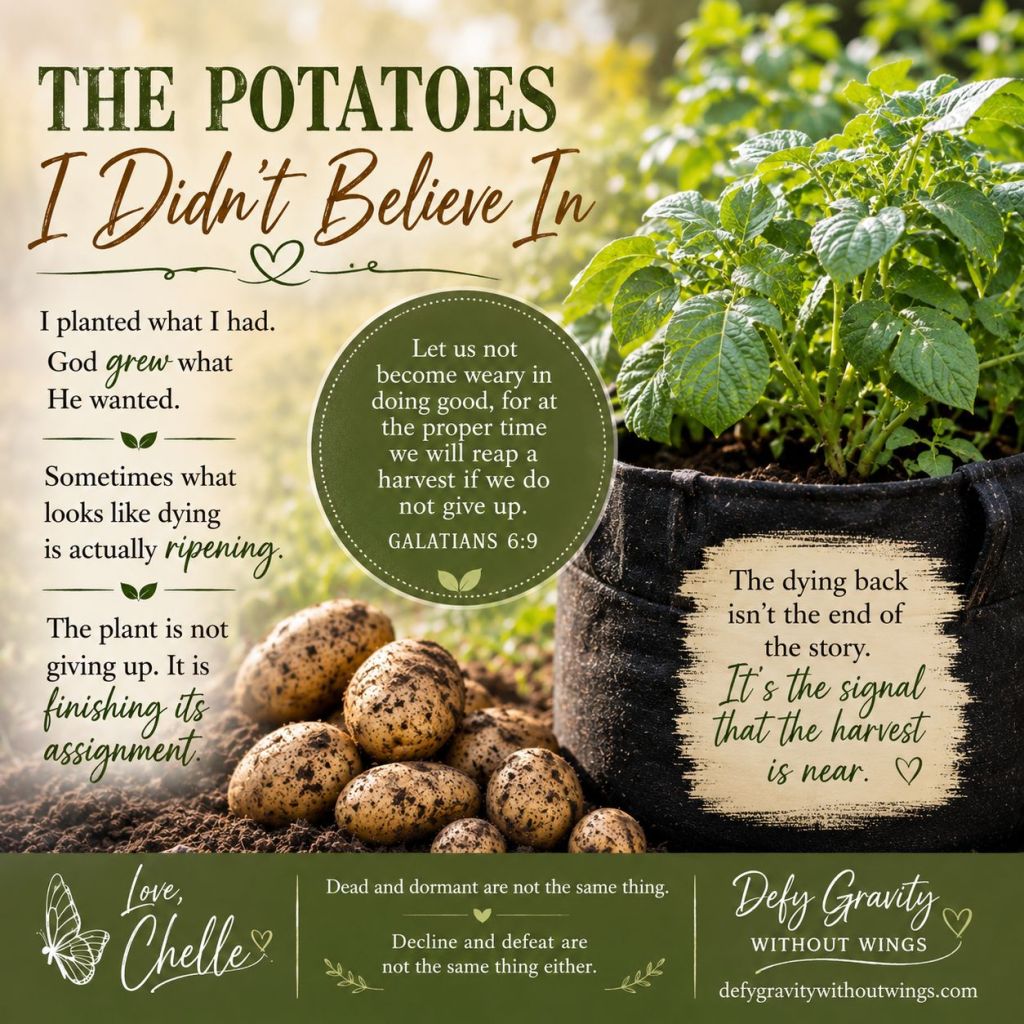
The Potatoes I Didn’t Believe In


I almost gave up on them.

Not because they died, but because they didn’t seem to be doing anything.

Day after day I walked past those grow bags, peeking into the soil, looking for evidence that my effort had mattered. I watered. I waited. I worried. Then I worried some more. Nothing. At least nothing I could see.

I remember standing over those bags convinced I had failed them. The gardening experts had plenty to say. Use seed potatoes. Use certified potatoes. Use organic potatoes. Use the right potatoes. Meanwhile, I was standing in the grocery store buying potatoes the same way I’ve bought them all my life—to cook, to eat, to turn into fried potatoes on a Saturday morning. I didn’t know their pedigree. I didn’t know their variety. I didn’t know whether they had the proper credentials for success.

I just planted what I had.

Then one morning, after weeks of wondering, I looked a little harder and found a tiny green shoot. Just one. Not a harvest. Not a miracle. Just enough evidence to keep me from giving up.

Soon there was another shoot. Then another. Before long, the bags were overflowing with green vines spilling over the edges. The plants that once seemed dead now looked determined to take over the backyard. My husband and I laughed about it because I honestly don’t know what kind of potatoes I planted. I never paid attention to potato varieties. I bought them because they were on sale, brought them home, cooked them, and ate them. Yet there they were, growing anyway.

The more I thought about it, the more I realized this wasn’t really about potatoes.

We pray for miracles, but we often expect God to use certified methods. We look for the right people, the right circumstances, the right timing, the right credentials, and the right opportunities. Yet over and over again, God chooses ordinary things. A shepherd’s staff. A boy’s lunch. A widow’s oil. A handful of grocery-store potatoes.

The lesson wasn’t really about gardening. The lesson was about trust.

Sometimes God is growing something long before we see it. Sometimes what looks dormant is simply developing underground. Sometimes the miracle isn’t cancelled; it’s just hidden beneath the surface.

But the funny thing about potato gardening is that the story doesn’t end with all that beautiful green growth.

In fact, after the vines have stretched, the leaves have multiplied, and you’ve finally convinced yourself you’ve succeeded, the plants begin to die back.

The leaves yellow. The stems droop. The lush green growth that once made you so proud starts to fade. If you don’t know better, you’ll think you’ve lost everything. After all that waiting, all that watering, all that hoping, it can feel like the story is ending in disappointment.

But experienced gardeners know something different.

Of which I am not—at least not yet.

I’m still the woman who planted grocery-store potatoes without knowing what kind they were. I’m still the gardener who stood over those bags convinced I had failed. Yet even I am beginning to learn that the dying back isn’t the end of the story. It’s the signal that the harvest is near.

The plant is not giving up. It is finishing its assignment.

All season long, the energy that showed up above ground has been quietly producing something beneath the soil. When the visible growth begins to decline, it often means the hidden work is complete. The harvest was forming long before anyone could see it.

It reminds me of Galatians 6:9:

“Let us not become weary in doing good, for at the proper time we will reap a harvest if we do not give up.”

The funny thing is that the harvest often begins forming long before we can see it. God is working beneath the surface while we are still looking for evidence above ground.

Isn’t that true in life sometimes?

We celebrate the seasons of visible growth. The opportunities, the promotions, the breakthroughs, the answered prayers we can point to and photograph. Yet there are other seasons when something appears to be fading, changing, or coming to an end. A role shifts. A season closes. A body grows tired. A prayer is answered differently than we expected.

What if every ending isn’t a failure?

What if some things have simply completed their work and are making room for a harvest we cannot yet see?

Sometimes what looks like dying is actually ripening.

Maybe that’s why I love these potato bags so much. They have been preaching a sermon all spring. First they taught me that dead and dormant are not the same thing. Soon they will teach me that decline and defeat are not the same thing either.

I planted what I had.

God grew what He wanted.

And somewhere beneath those leaves, where I cannot yet see, a harvest is forming.

Maybe that’s true in more places than my garden.

Love,
Chelle

defygravitywithoutwings.com


Image

When It Bolts

It’s 4:23 a.m. on Easter Sunday and I’m standing in my little greenhouse, looking at spinach that decided overnight… it was done.

Tall stems where leaves used to be. Little flowers where nourishment used to grow.
Bolting.

Translation? “It’s too hot for what I used to do.”

And for a second, I felt disappointed. Like I did something wrong. Like I missed a window. Like I should’ve held on longer.
But spinach doesn’t argue with the season.
It doesn’t force itself to keep producing what the environment no longer supports. It shifts.

“To every thing there is a season, and a time to every purpose under the heaven.” — Ecclesiastes 3:1

And standing there, I realized… Some of us are still trying to produce peace in places that have already gotten too hot.

Still trying to hold conversations that only grow bitterness. Still trying to get nourishment from situations that have already shifted into something else.

And we call it perseverance. But sometimes…
It’s just a season that’s ended. The spinach didn’t fail. The season changed.

And instead of forcing leaves that would turn bitter anyway… it moved on to producing something new.
Seeds.
Future.
What’s next.

And maybe that’s where I am too.
Not failing.
Not falling apart.
Not losing ground.
Just recognizing that I don’t have to keep forcing what no longer grows here.

Because the work of the  Cross didn’t just prove He could get up… it proved that endings don’t get the final say.

So I don’t have to panic when something stops producing. Idon’t have to force life out of what has already shifted. And I don’t have to sit in disappointment like something has gone wrong.

Nothing went wrong.

The season changed.

And the same God who allowed this one to close… is already making room for what comes next. And instead of holding on too tight… I’m learning how to release without fear.

“Remember ye not the former things, neither consider the things of old. Behold, I will do a new thing; now it shall spring forth…” — Isaiah 43:18–19

So I’m not mourning what bolted. I’m watching for what’s about to spring up.

Love, Chelle
defygravitywithoutwings.com

Image

Flowers Don’t Apologize

This prayer is for those who need to realize…
you can’t have flowers without the dirt… and some rain.

I know… we love the bloom.
We love the part people can see.
We love the color, the beauty, the evidence that something worked.

But real growth?
It doesn’t happen in the spotlight.

It happens down in the dirt.
In the messy places.
In the seasons that don’t look like anything is happening at all.

And if we’re being honest…
some of us have been side-eyeing the dirt in our lives.

Questioning it.
Trying to rush out of it.
Asking God why it had to be this way.

But this morning… let me remind you gently…

“His mercies are new every morning.”
— Lamentations 3:23

That means yesterday’s mess didn’t disqualify you. It didn’t ruin the process.
It didn’t cancel what God is growing in you.

It watered something.

Even the hard conversations. Even the tears.
Even the moments you wish you could redo.

God used it.

So yes… there may be some mud in your life right now. Yes… it may feel uncomfortable.
Yes… it may not look like growth yet.

But that doesn’t mean nothing is happening.
It means something is forming beneath the surface.

So today… we make a choice.
We choose to rejoice.
Not because everything feels good…
but because we trust what God is doing.

We rejoice in all things…
because we understand that dirt and rain
are part of the process of becoming.

And when it’s time to bloom…
You won’t have to explain a thing.

Flowers don’t apologize for the dirt it took to grow them.

Dear God,
Thank You for not wasting the dirt in our lives. Even the parts we didn’t choose…
even the seasons that felt heavy, messy, and unclear. 

Help us to trust You in the middle of it. When we don’t see growth…
when all we feel is the weight of the soil…
remind us that You are still working beneath the surface.


Teach us to stop resisting what You are using.
Give us the grace to endure the rain and the patience to wait for what is being formed.
And when it’s hard… help us to rejoice anyway. Not because everything feels good,
but because You are good in everything.

Grow us in the places we tried to escape.
Strengthen what we thought was breaking.
And when it’s time to bloom…
let it be undeniable that it was You.
In Jesus’ name, Amen.

Love, Chelle
defygravitywithoutwings.com

Image

When You Finally Deal With the Root


I’ve been out there in the yard, minding my business, working on my garden. And while I was planning what I could grow…
I kept looking over at this little tree behind the garage.

Now let me tell you this thing has been cut down more times than I can count.
And every time I thought we were done?
Here it come again.
Fresh. Bold. Unbothered. Like it pays a light bill back there.

And what really got me?

I realized I would have a whole lot more room
to grow something good…if that little joker would just go on and leave.**

But it won’t.
Because it’s not gone.
It’s rooted.

As frustrating as it is, I’m not losing. I’m just not dealing with the part that matters.
Because clearly…
cutting it ain’t killing it.

Some of us living like that. We trimming behavior. Fixing attitudes—for a week. Saying “this time I mean it” with our whole chest.

Meanwhile the root sitting underground like:
“I’ll be back.”

See, we like surface work. It’s quicker. It’s cleaner. It lets us feel productive without being uncomfortable.

But roots?
Roots require honesty.
Roots require time.
Roots require letting God get into places we’ve been managing real well on our own.

And God, in all His love, will look at something we keep trimming and say: We not doing this again. Not because He’s harsh. But because He’s not interested in your exhaustion becoming your lifestyle.


“See, I have set you this day over the nations and over the kingdoms, to pluck up and to break down, to destroy and to overthrow,
to build and to plant.” Jeremiah 1:10

Did you catch that order?
Pluck up first.
Then build.

Because God is not about to plant something new on top of something that keeps coming back.

Let me say it plain: Some of us don’t lack space for growth. We just haven’t removed what’s taking up room.

And I know… we get attached to our coping mechanisms. We get used to our patterns. We learn how to function with things that were never meant to stay.

But there comes a moment when you get tired enough to say: “Okay God…we not cutting this again. We removing it.”

Dear God, I see now that some things haven’t left because I haven’t let You deal with the root. Give me the courage to stop managing what You’re trying to remove. Clear out what’s taking up space in me so something better can grow. And help me trust that what You uproot is making room for something good.
Amen.

—

Love, Chelle
defygravitywithoutwings.com

Image

They Grow While You’re Gone


It’s 5:30 a.m.
I’m sipping my coffee, staring out the window into the darkness… somehow convinced I can see trouble in my garden from 100 feet away.

Don’t judge me… but I really considered stepping out there in my robe in 35 degrees to go check on my plant babies.

And somewhere between that first sip and the silence… I caught myself.

This isn’t about seeds.

This is about how easily my mind will grab hold of something—anything—and worry it to death.

Work stress that doesn’t clock out when I do.
Money questions that don’t always have quick answers.
A newborn I just prayed over in the hospital,
with whispers of concern about her ability to thrive.
Friends walking through the slow, sacred heartbreak of losing their parents…
and me carrying pieces of that with them.

All real things. All things that matter. All things experienced before.
And yet…

Look how quickly my heart starts hovering over them, like it’s my job to make sure everything turns out alright. Like if I think about it enough, check it enough, replay it enough…

I can help God along.

But I can’t.

Because even when I am doing the work of God, it is still God who is working.
I am not the outcome.
I am not the fixer.
I am not the one holding it all together.

I am just… hands in the soil.
Faithful to plant.
Faithful to water.
Faithful to show up.

But the growing?
The healing?
The sustaining?

That was never mine.

And if I’m not careful, I will let the weight of what I care about pull me out of the very places God is calling me to be present.

Sitting here with my coffee, trying to manage what He already has in His hands…
while He’s already prepared a seat for me somewhere else today.

There is a time to plant.
A time to water.
And then… a time to trust.
Not anxious trust.
Not hovering trust.
Real trust.

The kind that finishes the coffee,
gets dressed, and walks into the day
without carrying what God never assigned me to hold.

So I’m going where I’m supposed to be.
And I’m leaving the garden…
and everything it represents…
right where it is.

Because what God has already taken responsibility for does not need my worry added to it.

Even the good things don’t get to compete
with obedience.

“To everything there is a season, and a time to every purpose under the heaven.”
— Ecclesiastes 3:1

Love, Chelle

DefyGravityWithoutWings.com

Image

Cathay Williams: Known By God. Hidden By History

Cathay Williams is one of my favorite Black history figures — not because she is well known, but because she is not.


I was first introduced to her by my nephew, Remmie, during one of the hardest seasons of my life — while I was going through breast cancer. He told me her story and then said something that stopped me cold.


He said I reminded him of her.


Like Cathay, I hid some of the pain I was really going through — not out of denial, but out of love.
Not because the fight wasn’t real, but because I wanted to encourage others who were fighting too.


Cathay Williams was born enslaved in Missouri around 1844. During the Civil War, she followed the Union Army as a cook and laundress. But when the war ended and the Army opened its ranks to Black men only, Cathay did something unthinkable.


She cut her hair,

wrapped her body,

changed her name to William Cathay

— and enlisted.


For nearly two years, she served as a soldier in the 38th U.S. Infantry, one of the original Buffalo Soldier regiments. She marched. She guarded. She endured brutal conditions — all while hiding her identity in a world that would not make space for who she truly was.


Eventually, illness exposed what society refused to imagine:
a Black woman had carried a rifle, worn the uniform, and served her country faithfully.


She was discharged — not for lack of courage, but for daring to exist outside the rules.


Cathay Williams lived a life where survival required disguise.
Not because she lacked strength — but because the world lacked vision.


There are seasons when God calls people to serve before the world is ready to name them correctly.
Cathay was known as William by the Army.
But she was known fully by God.
“The Lord does not see as mortals see; they look on the outward appearance, but the Lord looks on the heart.” — 1 Samuel 16:7


History overlooked her.
The Army dismissed her.
But heaven recorded her obedience.
Some call her story deception.
Others call it desperation.


But I call it courage under constraint.


And here is the part history often whispers instead of says out loud:
Cathay Williams never received military honors.
She never received a pension.
In 1891, after her health had been permanently damaged by her service, she applied for a military disability pension. It was denied. She died poor and largely forgotten.


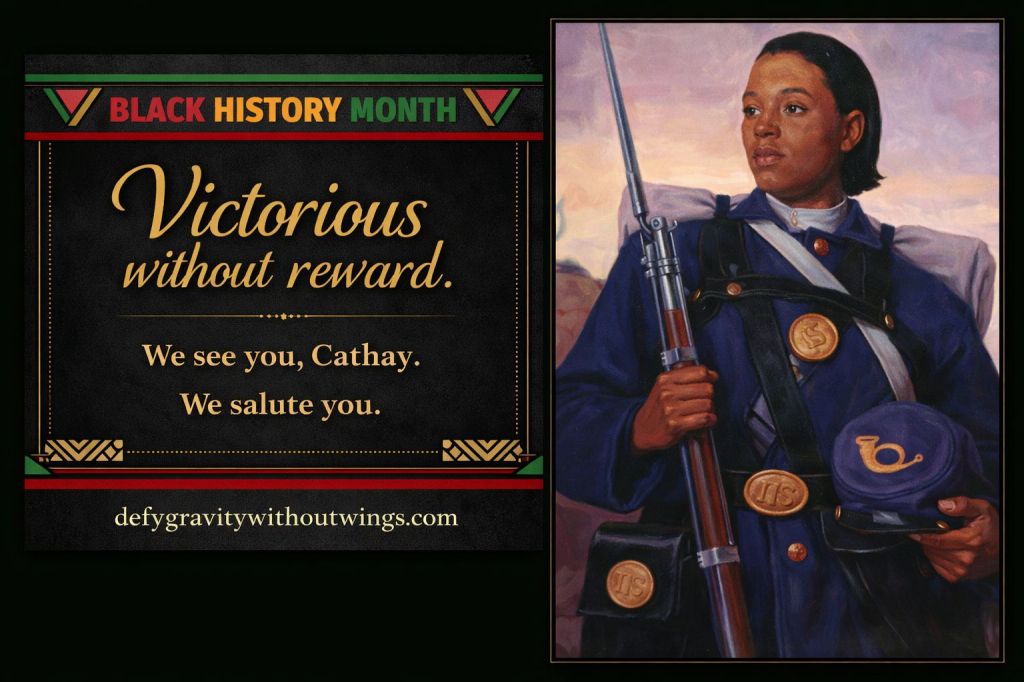
She was victorious without reward.


Cathay Williams did everything she was asked to do — and more.
She served faithfully.
She endured quietly.
She finished her assignment.


Her story reminds us that victory and recognition are not the same thing.
“Well done” does not always come from the systems we serve — but it is always recorded by God.
She didn’t fight for history.
She fought through it.
And God did not waste a single step she took.


She did not live to see her story told.
But her life still speaks.


And for those who have ever given their strength, their hope, or their encouragement without guarantee of return:
You may be unrewarded by the world —
but you are not unseen by God.


We see you, Cathay.
We salute you.


Love, Chelle

About the History in Bread Crumbs
Bread Crumbs reflections are grounded in documented historical records, including archives from the U.S. National Archives, Library of Congress, court records, contemporaneous newspapers, and first-person accounts. Spiritual reflections and personal connections are clearly marked as such and are offered with respect for the historical record.

.

Image

Reframing The Heart

Somewhere along the way, many of us learned a quiet lie —
not from God, but from human interpretation.

We learned it from what was modeled, praised, or rewarded.
From homes, churches, systems, and relationships that mistook endurance for faithfulness and exhaustion for virtue.


Most people were doing the best they could with what they knew — but they were still human.
And without realizing it, we carried those lessons into our understanding of God.

I know this because I have done it myself.

I confused being loved with doing to be loved.
I mixed up belief with performance.
And I carried that misunderstanding into my faith and called it obedience.

But that is not God’s heart.

God does not delight in depletion.
He delights in wholeness.

Jesus did not invite people to follow Him so they could replace Him.
He did not ask them to become saviors, fixers, or endless wells.
He asked them to come — as they were — and to unlearn what fear had taught them about love.

Scripture never praises burnout.
It praises obedience rooted in love, not fear.
It honors service that flows from being seen — not from trying to be noticed.

When Jesus said, “Come to Me, all who are weary and burdened, and I will give you rest,”
He was not offering a reward for those who gave the most.
He was correcting what people had been taught about God.

If your kindness comes from feeling unseen,
if your faith feels like constant output,
if your love has slowly turned into self-erasure —
that may be something you learned, but it is not something God requires.

God does not need you emptied to be faithful.
He desires you rooted, restored, and whole.

Being needed is not the same as being loved.
And God’s love has never required you to disappear.

God, help me separate Your voice from the voices that shaped me.
Heal what I learned in survival mode.
Teach me Your heart — not a human version of it.

Love, Chelle
DefyGravityWithoutWings.com

Image

Powder, Not Prison (and Apparently Winter Storms Have Names Now)

So here’s something I learned this week:
winter storms have names.
I was today-years-old when I found out they name winter storms the same way they name summer hurricanes. And wouldn’t you know it—the one that iced me into my house and blocked me from my greenhouse was named Fern.
Fern.
A plant name.
A green thing.
A symbol of life.
Make it make sense.
Winter Storm Fern didn’t just bring cold—she brought audacity. It was so cold one day that my front door wouldn’t even open. Not stuck—sealed. As if the house itself said, “Nope. You live here now.”
When the door finally did open the next day, I stepped outside and immediately thought,
“Oh. I was happier not knowing.”
That kind of cold doesn’t invite you out.
It humbles you back inside.
Now here we are again. More snow coming Saturday—and again on Wednesday. But this time, they’re calling for powder, not ice.
And apparently, there’s a difference.
Ice traps you.
Powder covers you.
Ice shuts doors.
Powder rests gently on what’s still alive underneath.
Some seasons don’t stop growth—they insulate it.
Under the white blanket, the soil is still breathing. Roots haven’t resigned. Seeds aren’t panicking. They know winter may come labeled and official, but it never gets the final word.
“Though the fig tree does not bud and there are no grapes on the vines… yet I will rejoice in the Lord.”
— Habakkuk 3:17–18
Faith isn’t pretending winter isn’t winter.
It’s recognizing the difference between what freezes you and what simply passes through.
Winter Storm Fern may have sealed my door for a day.
She may have iced the path to the greenhouse.
But she didn’t cancel the harvest.
Dead and dormant are not the same.
Covered and defeated are not synonyms.
Spring is not offended by powder.
And I’ve learned not to argue with doors God temporarily keeps shut.

Love, Chelle

Image

The Woman At The Table

Sometimes I miss the house in the middle of the corn fields with no indoor plumbing.
The pot-belly stove that decided when we were warm enough.
The way night fell heavy and close, and everyone settled where they could—sharing rooms, beds, blankets, breath.

I say my room, but that’s a loose word.
Privacy was a luxury we didn’t own.
Still, there was one place that felt like mine:
the narrow view through the keyhole.

Almost every night, after the fires were dampened and the house full of children finally stilled, I would watch my grandmother at her writing table. Her hands folded. Her Bible open. A pen moving slowly, deliberately.

Women of the Bible were her favorite.
Deborah. Ruth. Esther. Mary.
Women who listened closely and lived bravely.

She wrote sermons—real ones. Thoughtful. Scripturally sound. Insightful in ways people did not expect from a woman in those days. Especially a woman who cleaned other people’s houses for a living.

But it was her prayer ritual that marked me.

She prayed in whispers—not because God was quiet, but because love was.
She didn’t want to wake a house full of children.
Except, apparently, the little girl at the keyhole.

I couldn’t hear the words.
But I could see her face.

Sometimes she smiled.
Sometimes she laughed—like she and God shared a private joke.
Sometimes she cried. The kind of crying that doesn’t fall apart, just falls down.

And as I watched—hidden, still, unnoticed—I was learning.
Learning how faith looks when no one is applauding.
Learning that prayer does not need volume to have weight.
Learning that God listens closely to whispers.

When she finished praying, she always reached for the same thing.

A small plastic bread loaf.
One of those coin banks from organizations that fed “poor kids in Africa.”

She would slip a coin inside.
Sometimes a dollar.
Hard-earned. Scrubbed-for. Long-hours-standing money.

Money from a woman the world might have called poor—
but who never believed she was exempt from generosity.

I didn’t understand it then.
But I do now.

That table was a pulpit.
That whispering was power.
That plastic loaf was faith that refused to shrink.
And that keyhole?
It was my first seminary.

And that little girl at the keyhole?
She’s still watching.
Still learning how to pray without performing.
Still believing a few faithful offerings can touch a wide world.

“She opens her mouth with wisdom, and the teaching of kindness is on her tongue.” — Proverbs 31:26
“Your Father, who sees what is done in secret, will reward you.” — Matthew 6:6

Some of the strongest sermons are whispered after bedtime, preached without microphones, and learned by children watching through keyholes.

Love, Chelle