As part of my garden harvest process, I have a mantra: “I shall love anything I find.”
I shall love a marble-sized potato if it is all I find. I shall love a crooked carrot if it’s all I can find. One pepper, tomatoes that won’t turn red, and Brussels sprouts that won’t grow anything but leaves.
Anything except squirrels, snakes, and bugs I can’t identify. Then the mantra is: “I shall run from anything I find.”
Besides, most garden misfits can still find purpose in a good pot of soup. Put them in a pot with a few seemingly more perfect ingredients, and suddenly nobody is asking which one was pretty enough. Each one adds something to the flavor and body of the whole pot. Each one brings what it has, and together they become something none of them could have been alone.
There is purpose even in the imperfect.
Ephesians 2:10 (KJV) For we are his workmanship, created in Christ Jesus unto good works…
Now, squirrels and snakes are excluded from this particular revelation. I am from “the country,” but I am not that country.
I have always had a soft spot for misfits. Crooked vegetables. Broken toys. Bruised people. Things that didn’t turn out quite the way somebody thought they should.
Maybe that’s because I’ve learned that imperfect doesn’t mean worthless. Small doesn’t mean unsuccessful. Scarred doesn’t mean finished. And something doesn’t have to look like everybody else’s version of “good” to still be worthy of celebration.
Maybe I know that because there have been seasons when I looked at myself and saw the misfit.
I saw what was broken before I saw what had survived. I saw the scars before I saw the healing. I saw the places where life had changed me and wondered whether I still measured up to the woman I thought I was supposed to be.
There were times when I gave other broken things more grace than I gave myself.
But this garden keeps putting imperfect things in my hands and asking me the same question:
Can you love this anyway?
And maybe God has been asking me to turn that question around.
Can you love yourself anyway?
Then I remember Calvary.
Jesus did not wait for me to become some flawless version of myself before He decided I was worth saving. He took stripes for me. He carried the cross for me. He poured out grace and mercy for a woman He already knew would have scars, shortcomings, broken places, bad decisions, and days when she couldn’t see much worth in herself.
Calvary reminds me that my imperfections have never disqualified me from His love or His purpose.
The same Jesus who knew everything that would ever be imperfect about me still considered me worth the sacrifice.
So perhaps grace means I should stop demanding perfection from someone Jesus already died to redeem.
If I can celebrate the marble-sized potato because it pushed its way through the dirt and grew despite everything that worked against it, perhaps I can offer myself that same grace.
I grew too. Not perfectly. Not without scars. Not always according to plan.
But I grew.
And because of Jesus, I am still covered by grace, still surrounded by mercy, still carrying purpose.
So whatever comes out of those potato bags, I shall love anything I find.
And maybe when I look in the mirror, I can finally say the same thing.
Sick. Tired. Coughing. And carrying the weight of something happening in my family that I could neither fix nor control. I hadn’t been able to tend my garden.
I knew what the lack of rain had probably done. I knew I hadn’t watered. I knew that after a summer of planting, fighting bugs, pulling weeds, celebrating tiny victories, and spending entirely too much money to grow food I could have bought at the grocery store, much of it was probably dying.
Still, I wanted to see it. Maybe I needed to see it.
The problem was that I didn’t have the energy to walk across the backyard.
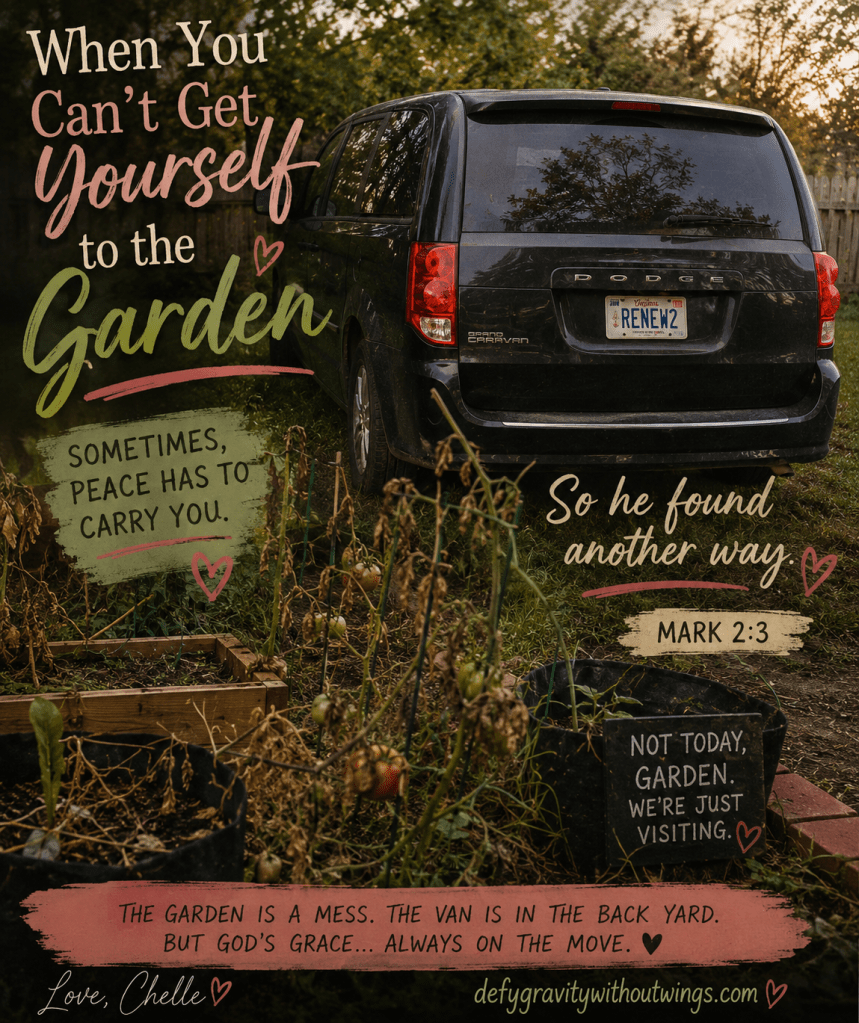
So Joseph drove me. Yes. You read that right. My husband put me in the minivan and drove me across our backyard — in reverse — to my garden.
I can only imagine what the neighbors thought. There we were, slowly backing a Dodge Grand Caravan through the grass as though this were a perfectly ordinary mode of transportation for visiting a garden twenty yards from the house.
But I didn’t care.
He knew I wasn’t strong enough to make the walk. So he found another way. And maybe that’s what love does.
For a little while, I was outside. There was fresh air. There was sunlight. There was my garden. And there was peace.
I didn’t go there to work. That may be the part I need to remember. I didn’t pull weeds. I didn’t drag out a hose. I didn’t try to resurrect what had dried up while I was sick.
For once, I wasn’t going to the garden because something needed something from me. I went because I needed something from the garden.
And when I didn’t have enough strength to get myself there, someone who loved me carried me to it.
That makes me think about the man in Mark 2. He needed to get to Jesus, but he couldn’t get himself there. So four men carried him. And when they arrived, they discovered they couldn’t get through the crowd.
So they found another way. They climbed onto the roof, opened it up, and lowered their friend down to Jesus.
Scripture says that when Jesus saw their faith, He responded. Their faith.
There are seasons when faith looks like walking boldly toward Jesus on your own two feet. And then there are seasons when faith looks like allowing somebody else to pick up your corner of the mat.
I think we talk a lot about being strong enough to keep going. We don’t talk nearly enough about the grace of being carried.
Moses knew something about that too. In Exodus 17, his hands grew tired. The battle had not ended simply because Moses was exhausted. So Aaron and Hur gave him a place to sit and held his hands up when he could no longer hold them up himself.
Nobody accused Moses of lacking faith because his arms got tired.
Nobody told the man on the mat that if he really wanted Jesus badly enough, he would figure out how to walk.
God allowed other people’s strength to become part of their story. Maybe that is a kind of provision we sometimes miss.
We pray ” Lord, give me strength.”
And sometimes He does. But sometimes His answer looks more like ” I’m sending someone who has enough strength for both of you today.”
Joseph couldn’t fix what was hurting me. He couldn’t make me well. He couldn’t change the things happening around me that I had no control over. He couldn’t even make it rain.
But he could put his wife in the minivan, throw that thing in reverse, and back across the backyard to the little patch of ground that had given her peace during so many other difficult days.
And that was enough.
When we got there, much of the garden looked exactly as I expected.
Dry. Spent. Finished.
But tucked among all of that were a few tomatoes. I picked them. Not enough for some grand harvest. Just enough to hold in my hands and smile.
Somehow, that felt like God too.
Not simply because something had survived. I’ve already learned that lesson. This time, the lesson was that I had been carried there to see them. Sometimes Peace Has to Carry You
Maybe you’ve been trying desperately to get yourself back to your garden. Not necessarily a garden with tomatoes, weird lettuce, and mosquitoes apparently operating an all-you-can-eat buffet.
Maybe your garden is prayer. Church. Writing. Music. Friendship. Laughter. The porch. A familiar place. Something that once quieted the noise inside you.
And perhaps you’ve been frustrated because you don’t have enough strength right now to get yourself there. Maybe you don’t have to. Maybe this isn’t the season for proving that you can still walk there alone. Maybe this is the season for letting somebody find another way. Let them bring dinner. Let them sit beside you. Let them hold up your hands. Let them carry one corner of the mat. Let them take you somewhere peaceful without requiring you to accomplish a single thing once you arrive.
Let them back the minivan across the backyard if necessary.
Because sometimes God’s provision isn’t the strength to keep carrying everything. Sometimes His provision is someone who helps carry you. “They came to him, bringing a paralyzed man, carried by four of them.” — Mark 2:3
Prayer Lord, thank You for the people who carry us when our own strength runs low. Help me remember that receiving help is not the absence of faith. Sometimes it is how You answer my prayer for strength. When I cannot get myself to the place of peace, send the hands, the shoulders, the friendship, the love — or even the minivan — that helps me get there. And when I am strong enough again, make me willing to pick up someone else’s corner. Amen. Love, Chelle
“To every thing there is a season, and a time to every purpose under the heaven.” — Ecclesiastes 3:1 (KJV)
This morning, I decided it was time to reset my garden.
Life had gotten in the way, and honestly, so had disappointment.
Some things I planted never became what I imagined. The squash bed became the scene of what I jokingly call the vine borer massacre. The kale and collards eventually lost their battle with the beetles. There are potato bags I am almost afraid to open because I don’t know whether there is a harvest underneath all that dirt—or evidence of an experiment gone terribly wrong.
But before I call the season a failure, I need to tell the whole story.
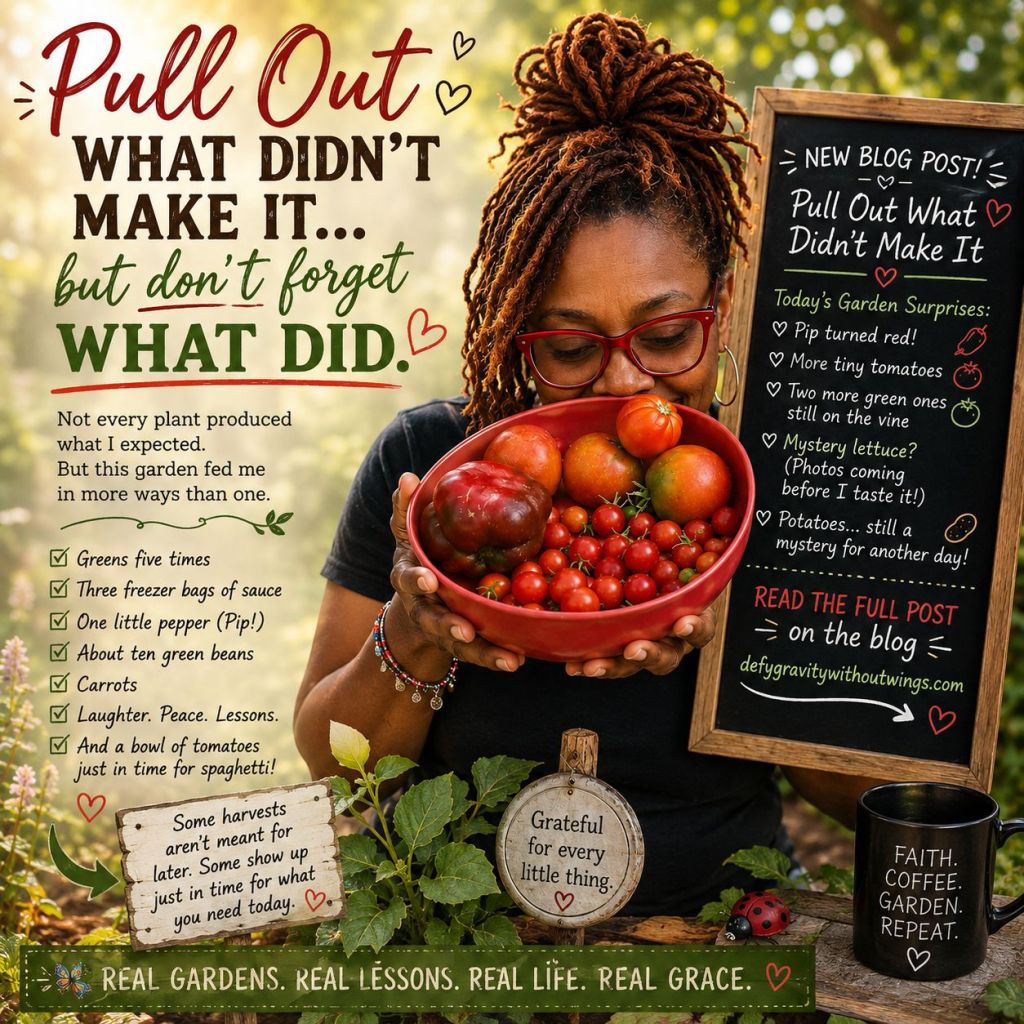
We harvested greens five times.
There are three gallon-sized bags of tomato sauce in my freezer, made from tomatoes that grew right here in this garden.
There was one little green pepper.
There were about ten green beans—not exactly enough to open a produce stand.
There were carrots.
And basil, radishes and beets we would never eat, but were pretty and make novice gardeners feel like experts.
And there were more social-media-worthy pictures than I can count.
There was laughter. There was anticipation. There were lessons I didn’t know I was planting. There were mornings when I walked outside just to see what had changed. There were days when checking on something growing gave my mind somewhere peaceful to go when life was doing entirely too much.
Not everything the garden produced could be put on a plate.
Some of the harvest fed me differently.
Funny how quickly disappointment can make us forget the harvest.
We can become so focused on what died, what got eaten, what never produced, and what didn’t turn out the way we planned that we overlook all the evidence that something did grow.
So no, this garden was not a total failure.
Neither was this season.
And neither am I.
I don’t have to throw away the whole garden just because everything in it didn’t make it.
I can pull out what is finished.
I can clean up what was damaged.
I can keep what still has life.
I can remember what already fed me.
I can refresh depleted soil.
And I can plant again.
There’s even one Brussels sprout plant that’s been hanging around since last November.
She never produced one identifiable Brussels sprout.
By the original expectation, I could call her a failure.
Except we discovered that her leaves were delicious mixed with our greens.
She didn’t produce what I expected.
She still fed us.
And maybe that’s a word for more than my garden.
There are seasons in life that don’t produce everything we expected either. Goals don’t get reached. Plans get interrupted. Things we carefully planted get attacked by circumstances we never saw coming. Energy gets spent dealing with things we never intended to carry.
It’s easy to stare at what didn’t happen until disappointment convinces us that nothing happened.
But that’s not always the truth.
Sometimes there are three bags of sauce sitting in the freezer while we’re mourning the squash.
Sometimes we are so busy counting the ten green beans that we forget the greens fed us five times.
Sometimes what we planted never becomes what we expected, but like my stubborn old Brussels sprout plant, it finds another way to feed us.
And sometimes the harvest isn’t something we can count at all.
Sometimes it is peace.
Sometimes it is laughter.
Sometimes it is a lesson.
Sometimes it is simply having somewhere to put our hands while God settles our hearts.
So today, I’m taking a lesson from my garden.
A disappointing harvest does not mean the soil has lost its purpose.
And an unmet expectation does not erase a harvest that has already happened.
Some things need to be pulled.
Some things deserve another season.
Some things may never become what I originally expected, yet still have value.
And some empty places are simply waiting for new seed.
So I’m not dragging everything that disappointed me into the next season.
I’m cleaning the bed.
I’m keeping what still has life.
I’m remembering what already fed me.
I’m refreshing the soil.
And, by the grace of God, I’m planting again.
And Then I Went Outside…
A few hours after writing those words, I finally made it to the garden.
I had gotten distracted. Life was still doing what life does. Both of my boys needed rides to work, and somewhere in there I stopped to get breakfast. The great potato excavation would have to wait.
But when I finally went outside, the garden had another lesson waiting for me.
There were tomatoes.
Lots of tiny ones. A couple of the last larger ones. Two more green ones still hanging on the vine that I decided to leave there and give a little more time.
And Pip—my little pepper plant that had managed to produce just one tiny green baby—had quietly ripened that baby all the way to red.
I had gone outside thinking about what needed to be cleaned up.
Meanwhile, the garden was still producing.
There I stood with a bowl of tomatoes and one little red pepper from plants I had already mentally begun wrapping up for the season.
And tonight, I’m making spaghetti.
These tomatoes won’t make it into another gallon freezer bag. They’ll be chopped up and added to the jarred sauce we’re eating tonight.
And suddenly there was another lesson.
Some harvest isn’t meant to be stored for later. Some of it shows up just in time for what you need today.
Maybe that’s why we have to be careful about declaring a season over simply because it didn’t produce the way we expected.
There may still be something growing that we haven’t noticed.
There may still be something ripening while we’re looking at what died.
There may still be provision hanging on a vine we were preparing to pull.
And sometimes God doesn’t give us enough to stock the freezer.
Sometimes He gives us enough for tonight’s spaghetti.
That’s still provision.
That’s still harvest.
That’s still something worth thanking Him for.
So perhaps today’s garden reset isn’t only about pulling out what didn’t make it.
Maybe it’s also about slowing down long enough to recognize what did.
What survived.
What fed me differently.
What is still growing.
And what showed up right on time.
Prayer
Lord, forgive me for the times disappointment has made me forget the harvest.
Thank You for every place where something grew, every provision I almost overlooked, every unexpected thing that still managed to feed me, and even the harvests I couldn’t put on a plate.
Thank You for what I was able to preserve for another season.
And thank You for what You provide simply because I need it today.
Give me wisdom to recognize what has finished its season and courage to release it.
Show me what still has life, even when it doesn’t look the way I expected.
Keep me from pulling up something You are still allowing to grow just because I decided its season should be over.
Restore the places in me that have been depleted. Refresh the soil of my heart. And prepare me for whatever You want to plant next.
Help me remember that a disappointing harvest is not the end of the garden.
There is still good soil here.
There may even be something still ripening on the vine.
And with You, there is always reason to look again before I call the season finished.
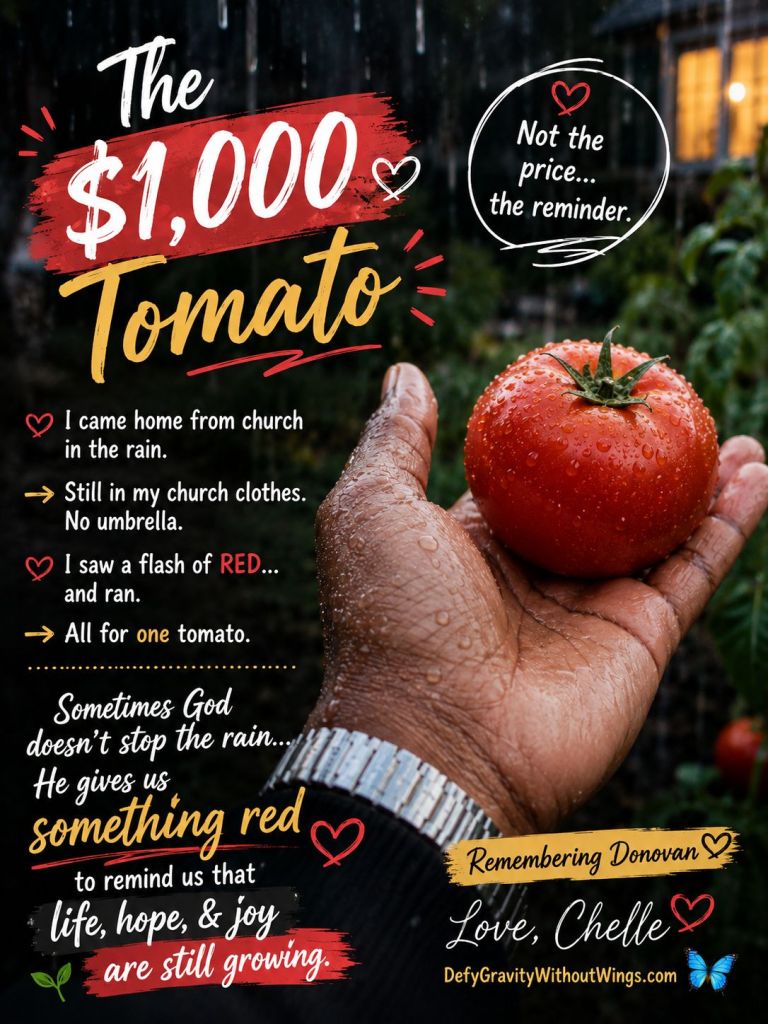
Tonight, I came home from church just as the rain started. I was still in my church clothes. No umbrella. No plans to go into the garden.
Truthfully, my heart was still heavy.
Just yesterday, we laid my bonus son to rest. It was a beautiful celebration of his life, filled with music, laughter, tears, and memories. But funerals have a way of leaving an echo. Even after the final song is sung and everyone goes home, grief lingers quietly in the background.
My church clothes still carried the memory of yesterday.
And so did my heart.
As I hurried toward the house through the rain, something caught my eye. A flash of red. On one lonely big boy tomato.
Without thinking, I turned around and ran straight into the rain. No umbrella. Still dressed in my church clothes. Hair…well, let’s not even discuss the hair.
All for one tomato.
I laughed the moment I picked it. After months of building raised beds, filling grow bags, hauling soil, buying fertilizer, tomato cages, watering before work, battling mosquitoes, checking on my plants every morning, and praying over a garden that often seemed determined to test my patience, I joked that I was holding a $1,000 tomato.
The truth is…
It wasn’t worth a thousand dollars.
But in that moment…
It was worth running through the rain for.
Then the Holy Spirit gently whispered to my heart, “Isn’t that what I did for you?”
Jesus saw us caught in a storm far greater than rain. He didn’t stay where it was comfortable. He stepped into our brokenness.
Into our grief. Into our sin. Into death itself.
Not because we were perfect.
Not because we had everything together.
But because He saw something worth rescuing.
The Bible tells us that “while we were still sinners, Christ died for us.” (Romans 5:8) He didn’t wait until we had cleaned ourselves up. He came running toward us while we were still standing in the storm.
Sometimes life leaves us bruised by disappointment, exhausted by loss, or wondering if joy will ever find us again. Yet Jesus never measures our value by what we’ve been through.
He measures it by what He was willing to pay. The cross settled that question forever.
Then another thought settled into my spirit. Yesterday, I ran toward a casket. Today, I ran toward a tomato.
One reminded me that life on earth is temporary.
The other reminded me that God still has a way of bringing new life out of seasons of sorrow.
Tonight, as I stood in my kitchen holding my little ‘$1,000 tomato,’ I realized maybe God wasn’t just letting me harvest fruit.
Maybe He was reminding me that even after a day of burying someone I loved…
Even while my heart was still aching…
There was still something worth running toward.
Sometimes God doesn’t stop the rain. Sometimes He places a glimpse of hope right in the middle of it.
A reminder that life is still growing.
That joy is still possible.
That healing is still coming.
Sometimes…
It looks like one little red tomato.
“Weeping may endure for a night, but joy comes in the morning.” — Psalm 30:5
Prayer
Father, thank You for stepping into my storms instead of watching them from a distance. Thank You for reminding me that even in seasons of grief, You continue to plant signs of hope along my path. Open my eyes to the little gifts You place in front of me each day, and help me remember that my value was settled at the cross. When my heart is heavy, give me the courage to keep running toward the joy You have prepared for me. In Jesus’ name, Amen.
This morning, my prayers took an unexpected detour. I started out praying over all the things that don’t make sense. The unexplainables. The burdens that have settled over my family. The heaviness I see across our nation. The questions that don’t come with easy answers. Somewhere between praying and borderline complaining, a thought slipped through my own conversation with God.
“Lord… I’m getting too old for this.” Just as quickly came another thought. “But I’m too young to give in.”
There I was, swinging back and forth between faith and frustration, hope and exhaustion, reminding God of everything that felt impossible.
Then, without warning, the Holy Spirit graciously interrupted my personal pity party with a sentence so simple I almost laughed. “Stop living like Jeremiah 29:11 doesn’t exist.” Ouch.
Because that’s exactly what worry does. It acts as if God has forgotten His plans. It behaves as though hope has expired. It assumes the future has already been decided by today’s circumstances. But Jeremiah 29:11 is still in the Bible. The economy doesn’t erase it. Bad news doesn’t cancel it. Family struggles don’t rewrite it. A doctor’s report doesn’t edit it. Political chaos doesn’t overrule it. God never said I would understand every chapter. He simply said He already knows the ending.
Here’s the part that humbled me. Jeremiah 29:11 wasn’t spoken to people whose lives were going according to plan. It was spoken to people living in exile. People who had lost what was familiar. People who couldn’t see how God could possibly bring beauty from the ashes around them. People who wondered if His promises had somehow expired. Yet God didn’t begin by explaining their circumstances. He began by reminding them of His sovereignty. “For I know the plans I have for you…” Notice the emphasis. You don’t have to know the plan… because God does. We spend so much time trying to figure out what God is doing that we forget Who is doing it. Maybe that’s today’s reminder. When our thoughts begin rehearsing every possible disaster, perhaps we need to lovingly interrupt ourselves. “Stop living like Jeremiah 29:11 doesn’t exist.” Not because life isn’t hard. But because God’s promises haven’t changed. Faith isn’t pretending the storm isn’t real. It’s refusing to live as though God misplaced the forecast. Maybe faith isn’t always loud. Maybe sometimes faith looks like getting up one more morning… praying one more prayer… believing one more promise… and taking one more step down a country road toward a sunrise you haven’t reached yet. Because Jeremiah 29:11 still exists. And so does the God who spoke it. Prayer Father, forgive me for the moments when I let fear preach louder than Your promises. When my circumstances become more believable than Your Word, gently redirect my heart. Teach me to remember that You already know the plans You have for me—even when I can’t see them. Help me walk by faith instead of forecasting disaster. Today I choose to trust that Your hope is greater than my uncertainty and Your future is stronger than my fear.
Thank You for reminding me that I don’t have to know the plan because I know the One who does. When I drift from praying into borderline complaining, lovingly call me back to Your promises. Give me the courage to take one more step, pray one more prayer, and trust You one more day.
In Jesus’ name, Amen. “For I know the plans I have for you,” declares the Lord, “plans for your welfare and not for evil, to give you a future and a hope.” — Jeremiah 29:11 (ESV)
This morning I walked into my garden carrying more than Tomato-tone.
I carried worry.
Last week’s storms had been relentless. Then life happened. Family emergencies. Hospital visits. Exhaustion. The garden got the best I could give it, but not always everything I wanted to give it.
As I made my rounds, my fears seemed justified. Several of my biggest green tomatoes had blossom end rot. Months of watering, fertilizing, staking, and waiting… only to find them ruined before they ever ripened.
I picked them off one by one and tossed them across the yard to the squirrels, who had probably been waiting all season for me to make a mistake.
I was disappointed. Maybe even a little angry. Not just because of the tomatoes. Sometimes one rotten tomato becomes the place where everything else finally shows up.
The financial pressures.
Watching people I admired and believed would make it…walk away from marriages I thought would last forever.
Family struggles I can’t fix.
Dreams that seem to take one step forward and two steps back.
Storm after storm.
The tomatoes just happened to be what broke my heart that morning.
Then I walked around to the other side of the my garden expecting more losses. More disappointments.
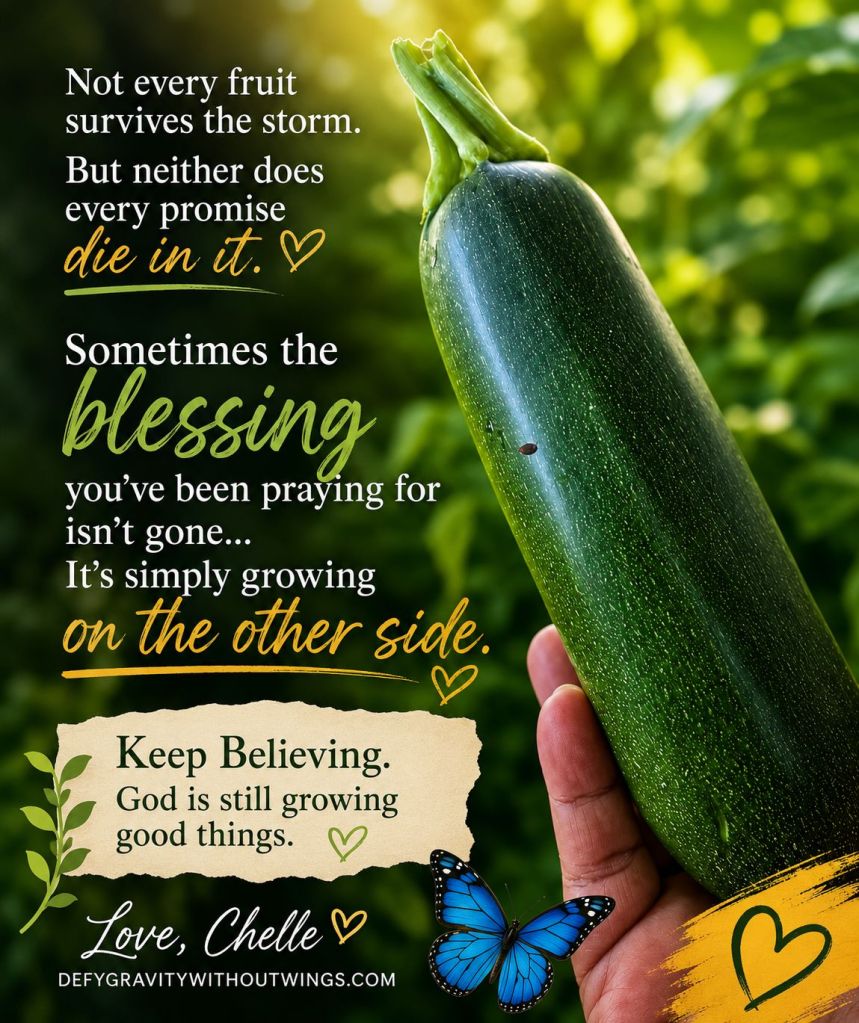
But, there she was. My very first zucchini. She hadn’t even been there the last time I looked. Then I remembered something.
The bees hadn’t been showing up because of all the rain. That little zucchini only existed because, one morning, I stepped in and hand-pollinated the flower. At the time it felt almost foolish. I wondered if it would even matter.
Today I held the answer in my hand.
Isn’t that just like God?
Sometimes we become so focused on what’s been damaged that we almost miss what He’s growing on the other side.
The rotten tomatoes were real. But so was the harvest.
Maybe that’s the lesson I needed today.
Not every fruit survives the storm. But neither does every promise die in it.
The storms didn’t stop the zucchini. The rain didn’t cancel the harvest.
The bees didn’t show up… but God still did.
If God asks us to keep planting, keep watering, keep believing, He also has a way of surprising us with fruit we weren’t expecting.
Today, my first zucchini wasn’t just dinner. It was a reminder that disappointment is never the whole story.
Sometimes the blessing you’ve been praying for isn’t gone. It’s simply growing on the other side.
So if today you find yourself throwing rotten tomatoes to the squirrels, don’t leave the garden just yet. Walk around to the other side.
You just might find that while you were grieving what didn’t make it… God was quietly growing something beautiful all along.
“Let us not become weary in doing good, for at the proper time we will reap a harvest if we do not give up.” — Galatians 6:9
This month marks 24 or 25 years at my job. I always get confused. Let’s just say a quarter of a century.
I’m grateful. I really am.
This job has put food on my table, helped pay mortgages and medical bills, carried me through cancer, raised children, celebrated grandchildren, and kept the lights on through seasons I never saw coming.
It has been a gift. But if I’m honest…
The thought made me pull the blanket back over my head and wish I was in kindergarten again.
No sales quotas. No deadlines. No responsibilities.
Just nap time, chocolate milk, and somebody else deciding what came next.
Instead, I lay there thinking about twenty-five years. I was thankful. But I was grieving too.
Not because I hated my job. I didn’t. Well not exactly. Lol
I was mourning the woman I thought I would have become by now. The books I thought I would have written. The places I imagined speaking. The dreams I assumed would have happened “one day.”
Somewhere between providing for everyone else and simply surviving life, I quietly convinced myself those dreams could wait.
Then I looked up… and decades had passed.
As I lay there feeling sorry for myself, the Lord interrupted my thoughts with a simple question.
“Who told you I was finished writing your story?”
I couldn’t answer. Because the truth is…
Dead dreams don’t keep showing up. They don’t whisper while you’re driving to work. They don’t find you while you’re digging in a garden. They don’t keep tapping you on the shoulder through devotionals, stories, and moments that won’t leave you alone.
Maybe I wasn’t mourning dead dreams. Maybe I was grieving the timeline I had written for God.
The older I get, the more I’m discovering that God isn’t nearly as concerned with my schedule as I am. He wastes nothing. Not the years. Not the detours.
Not the job that faithfully provided while quietly teaching me lessons I couldn’t have learned anywhere else. Looking back, maybe I wasn’t just building a career.
Maybe God was building a writer. A storyteller. A woman with enough life behind her to recognize His fingerprints in places she once overlooked.
This morning I wanted to hide under the covers like a kindergartener hoping the day would go away. Instead, God reminded me that I’m not in kindergarten anymore.
I’m still in His classroom.
And apparently…
The lesson isn’t over yet.
“Being confident of this very thing, that He who began a good work in you will carry it on to completion until the day of Christ Jesus.” — Philippians 1:6
I was already having one of those days. Maybe it was the stress of a long day at work spilling past quitting time and being made late getting to where I needed to be. Maybe it was the heaviness that has become familiar with my sister Cheryl’s illness.
But tonight, the nursing home had transformed one of its rooms into a prom. There were balloons, music, decorations, smiles, and volunteers who had worked hard to make it special.
Cheryl looked beautiful. She wore a bright red dress, fire engine lipstick and a crown. She smiled at her reflection . For a short while, she was the fashionable diva sister from her youth.
Her son and her former physical therapist proudly escorted her as her two handsome prom dates, while our older sister, Melody, and I happily served as her royal court attendants.
She enjoyed herself.
And yet, if I’m honest, part of me couldn’t stop seeing what wasn’t supposed to be.
It was still a nursing home. She was still in pain. She was still in a wheelchair.
Some losses don’t disappear just because someone hangs streamers on the wall.
Then the music changed.Whitney Houston’s “I Wanna Dance with Somebody” began filling the room.
Across the room sat another resident—a woman a little older than Cheryl. She was dressed in a sparkly black gown with a fluffy tutu peeking beneath it and ballerina slippers on her feet.
When the music started, she didn’t apologize for her wheelchair. She lifted her hands toward the ceiling. She spun. She laughed.
She did wheelies across that nursing home floor as though she were dancing on the biggest stage in the world.
As I sang along with Whitney’s words, she rolled her wheelchair right over to me, reached out with a smile, and invited me to dance with her.
For a moment, she wasn’t asking me to ignore her wheelchair. She was inviting me to look beyond it. I couldn’t stop watching her.
Then something surprised me. I wasn’t feeling pity. I was feeling jealousy.
Not because she could walk. She couldn’t. Not because she wasn’t hurting. I’m sure she was.
I was jealous because she possessed something I had misplaced:
Joy.
She reminded me that joy isn’t the absence of pain. Joy is refusing to let pain have the final word.
That woman never stood up. But somehow she rose above the room.
I wonder how many of us are waiting to dance until everything is healed. We’re waiting until the diagnosis changes. Until the relationship is restored. Until the finances improve. Until life looks the way we imagined.
But what if joy was never meant to wait for perfect circumstances? What if worship can happen in a wheelchair? What if celebration can exist in a nursing home?
What if God is inviting us to dance while we’re still waiting for the miracle?
That evening , I went to encourage my sister. Instead, God introduced me to a ballerina in a wheelchair who quietly preached a sermon I’ll never forget.
Maybe today you feel confined by something you didn’t choose. A diagnosis. A disappointment. A loss. A season that doesn’t look anything like you prayed it would.
If that’s you, don’t wait for life to become perfect before you lift your hands. Some of the most beautiful dances happen in places where no one expected joy to live.
“You have turned my mourning into dancing…” — Psalm 30:11
Healing isn’t always the first miracle. Sometimes joy is.
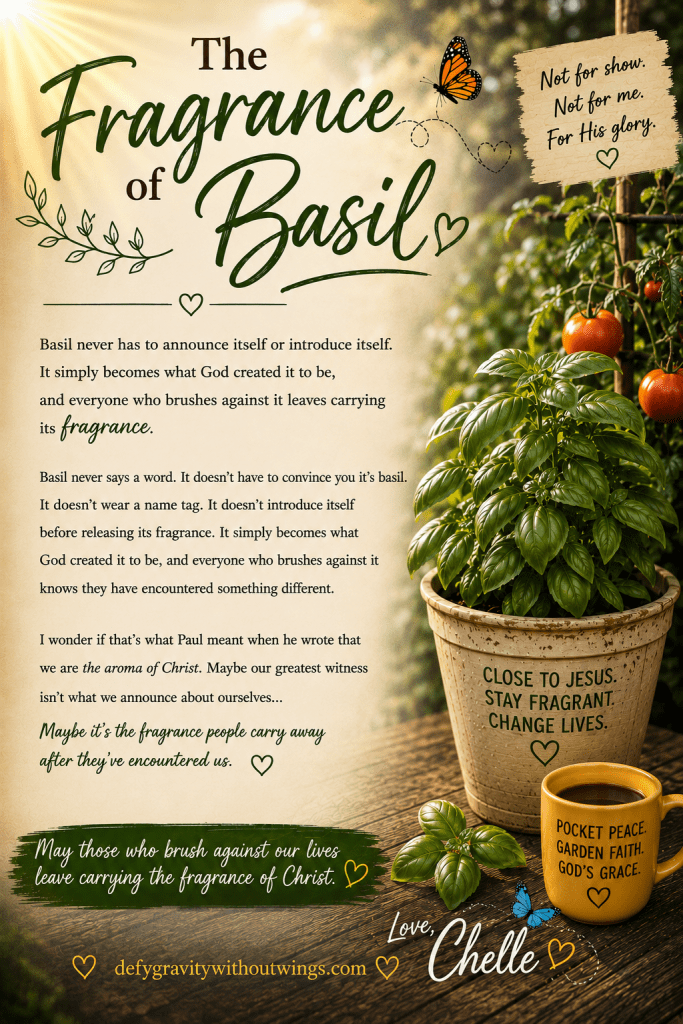
I don’t particularly enjoy eating basil by itself. In fact, I’ll probably never snack on a handful of basil leaves. But every time I walk through my little garden, I find myself rubbing a leaf between my fingers.
Hours later, the fragrance is still there.
It made me think about a dream I had years ago. In the dream, I was ushering at a funeral. I spent the service helping everyone else find their seats, passing tissues, comforting grieving families, and doing what ushers do. By the time I finally approached the casket to pay my own respects, something impossible happened.
The deceased sat up.
Looking directly at me, they smiled and said, “It was your perfume that made me rise.” I woke up before they explained what they meant, but I never forgot the dream.
Years later, I found myself saying something to another minister that surprised even me. “I can smell your anointing.”
Now…before rumors started another church meeting, let me explain. 😄 I wasn’t saying the man needed a shower. In fact, the congregation looked at me like I had just announced, “Pastor, you stink.” It took a minute to convince everyone I wasn’t talking about body odor at all.
I wasn’t talking about cologne. I wasn’t talking about lotion.I was trying to describe something words struggle to explain.
There are people whose lives have spent so much time in the presence of God that you sense His peace before they ever open their mouths. Their words aren’t louder. Their personalities aren’t bigger. Yet somehow, they leave behind hope, peace, and life wherever they go.
The Apostle Paul wrote that we are “the aroma of Christ.”
Not because we wear the right fragrance. But because we’ve been close enough to Him that His presence lingers on us.
This morning, while rubbing a basil leaf between my fingers, I realized that basil never has to announce itself or introduce itself. It simply becomes what God created it to be, and everyone who brushes against it leaves carrying its fragrance.
We spend so much time announcing ourselves. “I’m a minister.” “I’m an elder.” “I’m a worship leader.” “I’m a Christian.” “Blah, blah, blah” And so on.
There’s nothing wrong with those titles. They describe our calling and our service. But titles were never meant to substitute for transformation.
Basil never says a word. It doesn’t have to convince you it’s basil. It doesn’t wear a name tag. It doesn’t introduce itself before releasing its fragrance.
It simply becomes what God created it to be, and everyone who brushes against it knows they have encountered something different.
Maybe our greatest witness isn’t what we announce about ourselves… Maybe it’s the fragrance people carry away after they’ve encountered us.
Maybe our words comfort. Maybe our patience calms. Maybe our generosity feeds. Maybe our forgiveness heals. Maybe our presence reminds someone that God has not forgotten them.
Long after we’ve left the room…
…the fragrance remains.
This morning, I walked back into my house with basil on my hands. My prayer is that I walk into every room carrying Christ in my spirit.
So today I’m asking myself a different question.
Not…
“What perfume am I wearing?”
But…
“What fragrance am I leaving behind?”
Because if a simple basil plant can leave its scent on my hands with just the slightest touch…
How much more should a life touched by Christ leave behind His love, His peace, and His hope?
May those who brush against our lives leave carrying the fragrance of Christ.
Love, Chelle
“For we are to God the pleasing aroma of Christ among those who are being saved and among those who are perishing.” — 2 Corinthians 2:15
Yesterday, I did something that is not unusual for me when I get tired of adulting. I went to see a children’s movie.
Some people head to a spa. Some go shopping. Some book a weekend getaway. I apparently seek spiritual counseling from animated characters.
After a frustrating day at work and life, I exited being grown and didn’t even stop for a grandchild so i wouldn’t look weird in the theater without a kid.
I wasn’t looking for a life lesson. I was simply tired and in need of a break from the responsibilities and pressures of everyday life. I walked into the theater looking for a distraction. I walked out with a devotional.
As the story unfolded, I found myself drawn to Sheriff Jessie. Without spoiling Pixar’s story, Jessie finds herself wrestling with a question many of us eventually face: What happens when the role you’ve always known no longer defines your future?
At first glance, it sounds like a children’s movie question. It isn’t. It is a life question.
For years, Jessie understood who she was through a specific role and purpose. Then circumstances changed, and she had to decide whether she would cling to the identity she had always known or embrace the purpose that was still unfolding.
As I sat there with my popcorn, I realized I wasn’t really thinking about Jessie anymore. I was thinking about me.
Most of us spend years introducing ourselves by our roles. We are mothers, fathers, wives, husbands, employees, caregivers, ministers, leaders, providers, and problem-solvers. Those roles matter. They are gifts from God and assignments for a season.
But what happens when a season changes? What happens when the children grow up? What happens when retirement appears on the horizon? What happens when a ministry shifts? What happens when a relationship changes?
What happens when the title you’ve carried for years no longer fits as comfortably as it once did?
Too often, we mistake the role for the purpose. The role is simply the container. The purpose is what God placed inside it.
Moses was a prince before he was a shepherd. He was a shepherd before he was a deliverer.
Peter was a fisherman before he became a disciple.
Esther was an orphan before she became a queen.
Paul was a Pharisee before he became an apostle.
The roles changed. The purpose remained.
As I watched Jessie struggle with letting go of who she thought she was, I began to wonder how many of us are fighting the same battle. Sometimes God asks us to release an identity that has become too small for where He is leading us.
Not because the old role was bad. Not because the old season was a failure. But because the role was never meant to be permanent.
Recently, my garden has been preaching the same sermon. My potato plants are dying back. The leaves are yellowing. The vines are flopping. To an untrained eye, it looks like something is dying.
And it is.
But underneath the soil, something beautiful has been growing all along. The purpose was never the leaves. The leaves were evidence of the process. The harvest was hidden beneath the surface.
Yesterday morning, I found myself sad because some of the joy I usually feel in the garden seemed harder to find. Life had been busy. Responsibilities had piled up. Grief, work, caregiving, deadlines, and adulting had all been taking up more space than I wanted them to.
Then it rained.
While I sat in a movie theater watching Sheriff Jessie wrestle with purpose, the sky was watering my garden.
God has a way of doing that. He reminds us that not everything depends on us. Sometimes while we are busy worrying about the leaves, He is tending the harvest.
Perhaps you are standing in a season where the leaves are changing. A role may be ending. A chapter may be closing. A title may be shifting. If so, do not be afraid.
When God changes the role, He has not abandoned the purpose. What He planted in you is still there. What He called you to be is still there. What He spoke over your life is still there.
The role may change.
The purpose remains.
Love, Chelle
Pray with me:
Father, help me recognize the difference between my role and my purpose. When You call me into a new season, give me the courage to release what is familiar and trust what You are growing beneath the surface. Remind me that my value is not found in a title, an assignment, or the expectations of others, but in being Your child. When the leaves begin to change, help me trust the harvest You have been preparing all along. In Jesus’ name, Amen.