
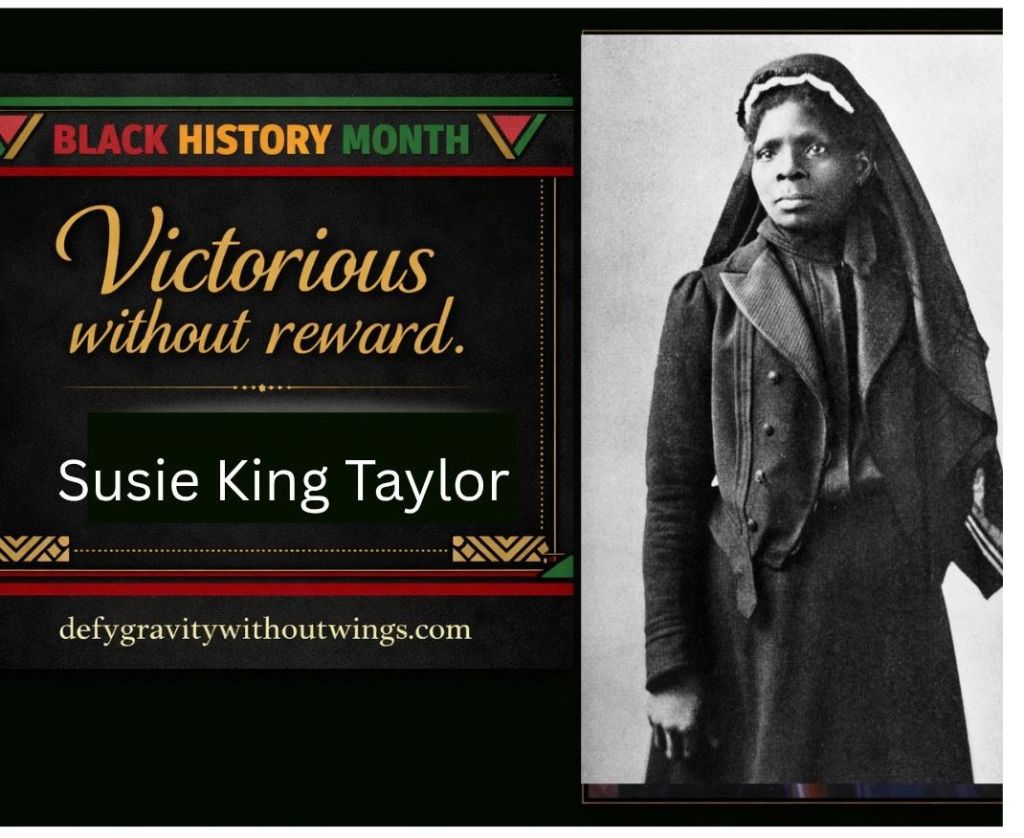
Susie King Taylor was born enslaved in Georgia in 1848, in a world where teaching Black people to read was a crime and Black women’s labor was expected but never honored.
From a young age, Susie learned to read and write in secret. She was taught quietly, moving from place to place so no one would notice. Knowledge, for her, was not just education—it was resistance.
When the Civil War came, Susie did not wait to be invited into history.
She followed Union troops, and at just fourteen years old, she began teaching formerly enslaved soldiers and children how to read. She became the first Black woman known to openly teach formerly enslaved people in a Union camp.
She did not stop there.
Susie served as a teacher, a nurse, a laundress, and a caregiver to wounded Black soldiers. She worked in field hospitals. She tended infections. She cleaned wounds. She buried the dead. She did the work that kept soldiers alive long enough to keep fighting.
She did this without rank.
Without formal pay.
Without protection.
Without promise of recognition.
And when the war ended, the men she served alongside received pensions.
Susie did not.
Her body carried the cost of years of labor and exposure. Her hands had held dying boys. Her back bore the weight of war. Yet the government decided her service did not count.
She was victorious without reward.
In 1902, Susie King Taylor published Reminiscences of My Life in Camp with the 33rd United States Colored Troops—one of the only Civil War memoirs written by a Black woman.
She wrote because she knew that if she did not tell the story, it would be told wrong—or not at all.
She documented unequal treatment, exhaustion, racism within the Union Army, and the quiet strength required to keep serving anyway.
Recognition did not follow.
She died poor.
Her contributions remained footnotes.
Her name was largely absent from textbooks.
And yet, without women like Susie King Taylor, the war would not have been survivable for Black soldiers.
Susie King Taylor teaches us that some people do the work because it needs doing, not because they expect to be thanked.
She was not disguised like Cathay Williams.
She was not sidelined like Claudette Colvin.
She was fully visible—and still denied.
“Whatever you do, work at it with all your heart, as working for the Lord, not for human masters.” — Colossians 3:23
If you have ever done essential work no one wanted to name, given care without credentials, served faithfully while others were promoted, or known your contribution mattered even when systems said it didn’t—Susie King Taylor stands with you.
She served anyway.
History followed later.
We see you, Susie.
We honor you now.
Bread Crumbs — for those coming after us.
Victorious without reward. Still here.
Love, Chelle

 defygravitywithoutwings.com