
Before the acclaim. Before the syllabus. Before the rediscovery.
There was a girl in Eatonville, Florida. One of the first all-Black incorporated towns in America. A place where Black men held office. Black businesses lined the streets. Black authority was ordinary. Zora did not grow up learning inferiority. She grew up witnessing Black self-governance.She later said she only felt “colored” when she left Eatonville. That foundation mattered.
Her mother told her to “jump at the sun.”
Then her mother died when Zora was thirteen.
Stability fractured. She was sent away. She worked as a maid. She fought for schooling. She even shaved years off her age to qualify for education she refused to surrender. She made her way to Howard University. Then to Barnard College — the only Black woman in her class.
Zora did not enter literature quietly. During the Great Depression, she worked under the Works Progress Administration, a federal New Deal program created to provide jobs for unemployed Americans. Through its Federal Writers’ Project, writers were paid to document American life.
Zora used that platform to travel the South collecting Black folklore. She sat on porches recording stories, sermons, songs, dialect. She preserved language as it was spoken — not polished for respectability. That was civil rights work.
She treated everyday Black life as worthy of scholarship at a time when much of the country treated it as caricature. But Zora did not always align with the popular script.
She did not write protest novels on demand.
She did not center white oppression in every paragraph. She resisted narratives that reduced Black identity to suffering alone. And when the Supreme Court decided Brown v. Board of Education in 1954 — declaring segregated public schools unconstitutional — Zora publicly criticized aspects of the ruling.
Not because she supported segregation.
But because she rejected the quiet assumption that proximity to whiteness was the only path to equality. She believed integration should not come at the cost of Black institutional pride or self-determination. She worried that dependence on white approval could weaken Black autonomy.
That stance placed her at odds with much of the civil rights leadership of her time. Some admired her independence. Some felt she undermined the movement. Some labeled her out of step. She kept writing anyway.
Their Eyes Were Watching God centered a Black woman’s voice, love, desire, and interior life. Not as political slogan — but as full humanity.
Joy, for Zora, was not a distraction from struggle. Joy was defiance.
And then — she died in 1960, poor and largely forgotten. Buried in an unmarked grave in Florida. No parade. No national mourning.
No bestseller comeback.
Years later, her work was rediscovered. Her grave was marked. Her voice returned to classrooms and conversations. Forgotten in her time. Found again by the next.
Zora reminds us that civil rights is not only marches and lawsuits. It is also narrative. It is who defines Black life. It is the refusal to shrink complexity for acceptance. She was brilliant and sometimes difficult. Independent and sometimes misunderstood. Unapologetic when it cost her.
CARRY THIS WITH YOU
Where have you been told that success requires you to leave something of yourself behind? Zora teaches us that preserving who you are — even when misunderstood — is its own form of resistance.
BREADCRUMB
Not all revolution is loud. Some of it sounds like porch laughter, a stubborn pen, and a woman refusing to be edited by her era.
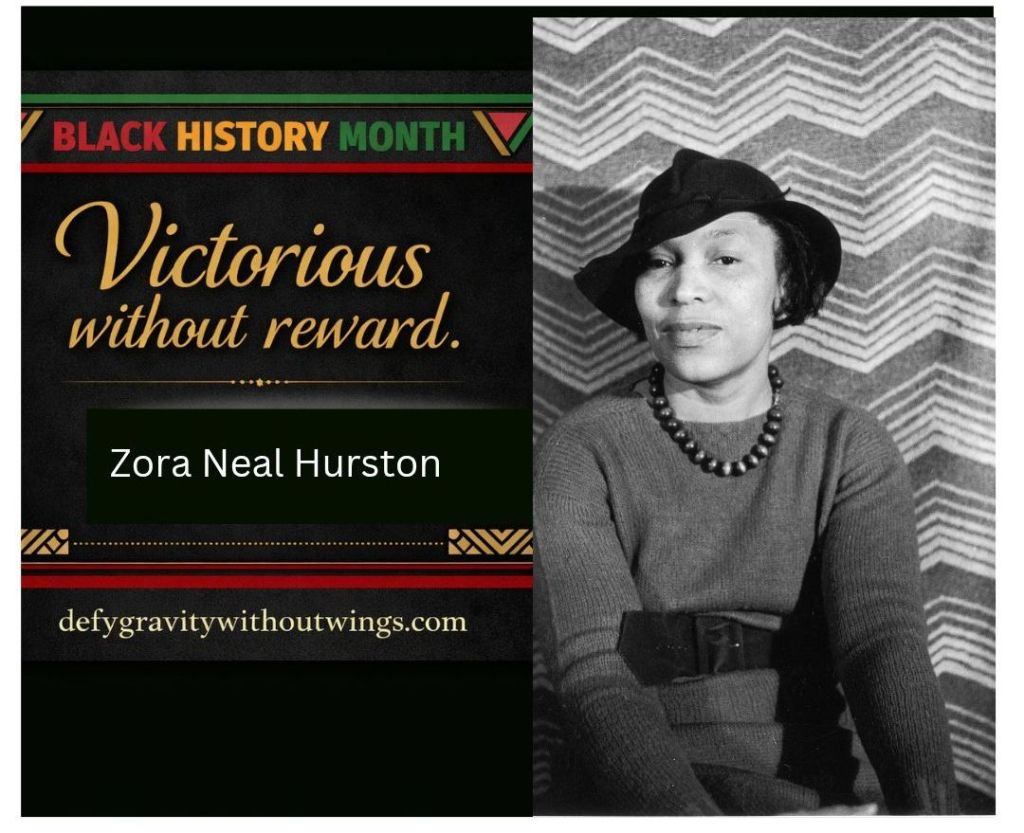
We see you, Zora Neale Hurston — for telling our stories without apology.
Bread Crumbs — for those coming after us.
Victorious without reward. Still here.

 defygravitywithoutwings.com