As part of my garden harvest process, I have a mantra: “I shall love anything I find.”
I shall love a marble-sized potato if it is all I find. I shall love a crooked carrot if it’s all I can find. One pepper, tomatoes that won’t turn red, and Brussels sprouts that won’t grow anything but leaves.
Anything except squirrels, snakes, and bugs I can’t identify. Then the mantra is: “I shall run from anything I find.”
Besides, most garden misfits can still find purpose in a good pot of soup. Put them in a pot with a few seemingly more perfect ingredients, and suddenly nobody is asking which one was pretty enough. Each one adds something to the flavor and body of the whole pot. Each one brings what it has, and together they become something none of them could have been alone.
There is purpose even in the imperfect.
Ephesians 2:10 (KJV) For we are his workmanship, created in Christ Jesus unto good works…
Now, squirrels and snakes are excluded from this particular revelation. I am from “the country,” but I am not that country.
I have always had a soft spot for misfits. Crooked vegetables. Broken toys. Bruised people. Things that didn’t turn out quite the way somebody thought they should.
Maybe that’s because I’ve learned that imperfect doesn’t mean worthless. Small doesn’t mean unsuccessful. Scarred doesn’t mean finished. And something doesn’t have to look like everybody else’s version of “good” to still be worthy of celebration.
Maybe I know that because there have been seasons when I looked at myself and saw the misfit.
I saw what was broken before I saw what had survived. I saw the scars before I saw the healing. I saw the places where life had changed me and wondered whether I still measured up to the woman I thought I was supposed to be.
There were times when I gave other broken things more grace than I gave myself.
But this garden keeps putting imperfect things in my hands and asking me the same question:
Can you love this anyway?
And maybe God has been asking me to turn that question around.
Can you love yourself anyway?
Then I remember Calvary.
Jesus did not wait for me to become some flawless version of myself before He decided I was worth saving. He took stripes for me. He carried the cross for me. He poured out grace and mercy for a woman He already knew would have scars, shortcomings, broken places, bad decisions, and days when she couldn’t see much worth in herself.
Calvary reminds me that my imperfections have never disqualified me from His love or His purpose.
The same Jesus who knew everything that would ever be imperfect about me still considered me worth the sacrifice.
So perhaps grace means I should stop demanding perfection from someone Jesus already died to redeem.
If I can celebrate the marble-sized potato because it pushed its way through the dirt and grew despite everything that worked against it, perhaps I can offer myself that same grace.
I grew too. Not perfectly. Not without scars. Not always according to plan.
But I grew.
And because of Jesus, I am still covered by grace, still surrounded by mercy, still carrying purpose.
So whatever comes out of those potato bags, I shall love anything I find.
And maybe when I look in the mirror, I can finally say the same thing.
Sick. Tired. Coughing. And carrying the weight of something happening in my family that I could neither fix nor control. I hadn’t been able to tend my garden.
I knew what the lack of rain had probably done. I knew I hadn’t watered. I knew that after a summer of planting, fighting bugs, pulling weeds, celebrating tiny victories, and spending entirely too much money to grow food I could have bought at the grocery store, much of it was probably dying.
Still, I wanted to see it. Maybe I needed to see it.
The problem was that I didn’t have the energy to walk across the backyard.
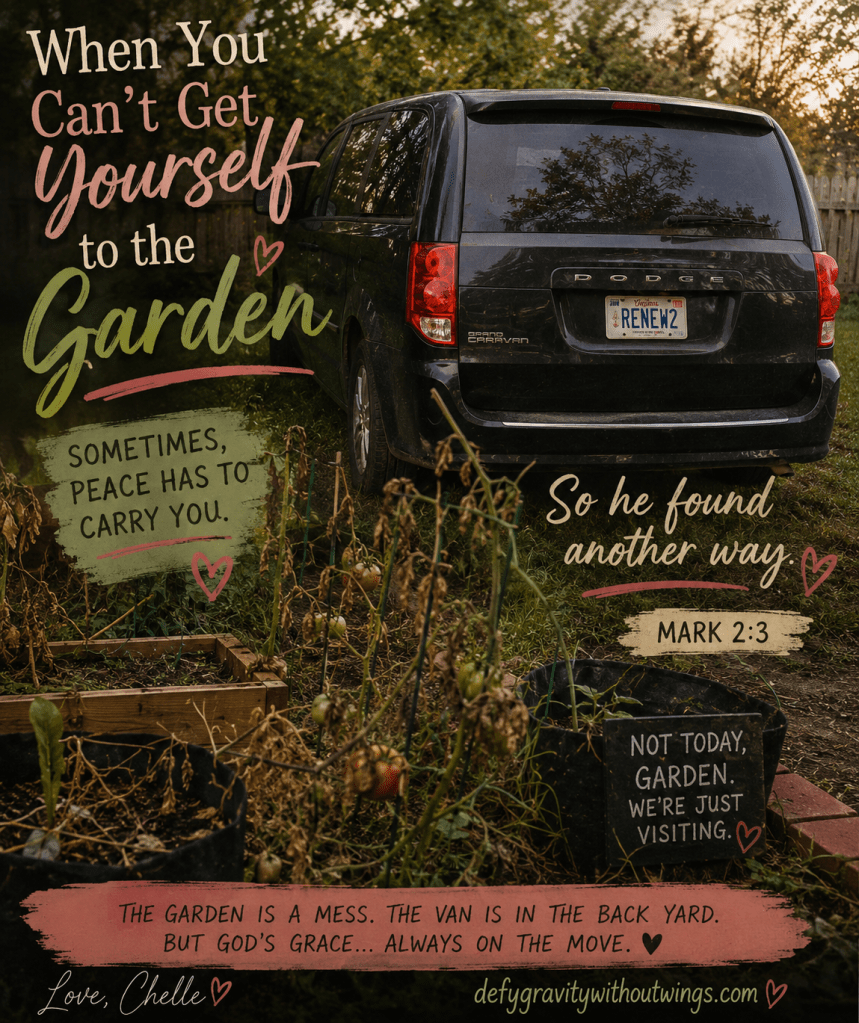
So Joseph drove me. Yes. You read that right. My husband put me in the minivan and drove me across our backyard — in reverse — to my garden.
I can only imagine what the neighbors thought. There we were, slowly backing a Dodge Grand Caravan through the grass as though this were a perfectly ordinary mode of transportation for visiting a garden twenty yards from the house.
But I didn’t care.
He knew I wasn’t strong enough to make the walk. So he found another way. And maybe that’s what love does.
For a little while, I was outside. There was fresh air. There was sunlight. There was my garden. And there was peace.
I didn’t go there to work. That may be the part I need to remember. I didn’t pull weeds. I didn’t drag out a hose. I didn’t try to resurrect what had dried up while I was sick.
For once, I wasn’t going to the garden because something needed something from me. I went because I needed something from the garden.
And when I didn’t have enough strength to get myself there, someone who loved me carried me to it.
That makes me think about the man in Mark 2. He needed to get to Jesus, but he couldn’t get himself there. So four men carried him. And when they arrived, they discovered they couldn’t get through the crowd.
So they found another way. They climbed onto the roof, opened it up, and lowered their friend down to Jesus.
Scripture says that when Jesus saw their faith, He responded. Their faith.
There are seasons when faith looks like walking boldly toward Jesus on your own two feet. And then there are seasons when faith looks like allowing somebody else to pick up your corner of the mat.
I think we talk a lot about being strong enough to keep going. We don’t talk nearly enough about the grace of being carried.
Moses knew something about that too. In Exodus 17, his hands grew tired. The battle had not ended simply because Moses was exhausted. So Aaron and Hur gave him a place to sit and held his hands up when he could no longer hold them up himself.
Nobody accused Moses of lacking faith because his arms got tired.
Nobody told the man on the mat that if he really wanted Jesus badly enough, he would figure out how to walk.
God allowed other people’s strength to become part of their story. Maybe that is a kind of provision we sometimes miss.
We pray ” Lord, give me strength.”
And sometimes He does. But sometimes His answer looks more like ” I’m sending someone who has enough strength for both of you today.”
Joseph couldn’t fix what was hurting me. He couldn’t make me well. He couldn’t change the things happening around me that I had no control over. He couldn’t even make it rain.
But he could put his wife in the minivan, throw that thing in reverse, and back across the backyard to the little patch of ground that had given her peace during so many other difficult days.
And that was enough.
When we got there, much of the garden looked exactly as I expected.
Dry. Spent. Finished.
But tucked among all of that were a few tomatoes. I picked them. Not enough for some grand harvest. Just enough to hold in my hands and smile.
Somehow, that felt like God too.
Not simply because something had survived. I’ve already learned that lesson. This time, the lesson was that I had been carried there to see them. Sometimes Peace Has to Carry You
Maybe you’ve been trying desperately to get yourself back to your garden. Not necessarily a garden with tomatoes, weird lettuce, and mosquitoes apparently operating an all-you-can-eat buffet.
Maybe your garden is prayer. Church. Writing. Music. Friendship. Laughter. The porch. A familiar place. Something that once quieted the noise inside you.
And perhaps you’ve been frustrated because you don’t have enough strength right now to get yourself there. Maybe you don’t have to. Maybe this isn’t the season for proving that you can still walk there alone. Maybe this is the season for letting somebody find another way. Let them bring dinner. Let them sit beside you. Let them hold up your hands. Let them carry one corner of the mat. Let them take you somewhere peaceful without requiring you to accomplish a single thing once you arrive.
Let them back the minivan across the backyard if necessary.
Because sometimes God’s provision isn’t the strength to keep carrying everything. Sometimes His provision is someone who helps carry you. “They came to him, bringing a paralyzed man, carried by four of them.” — Mark 2:3
Prayer Lord, thank You for the people who carry us when our own strength runs low. Help me remember that receiving help is not the absence of faith. Sometimes it is how You answer my prayer for strength. When I cannot get myself to the place of peace, send the hands, the shoulders, the friendship, the love — or even the minivan — that helps me get there. And when I am strong enough again, make me willing to pick up someone else’s corner. Amen. Love, Chelle
“To every thing there is a season, and a time to every purpose under the heaven.” — Ecclesiastes 3:1 (KJV)
This morning, I decided it was time to reset my garden.
Life had gotten in the way, and honestly, so had disappointment.
Some things I planted never became what I imagined. The squash bed became the scene of what I jokingly call the vine borer massacre. The kale and collards eventually lost their battle with the beetles. There are potato bags I am almost afraid to open because I don’t know whether there is a harvest underneath all that dirt—or evidence of an experiment gone terribly wrong.
But before I call the season a failure, I need to tell the whole story.
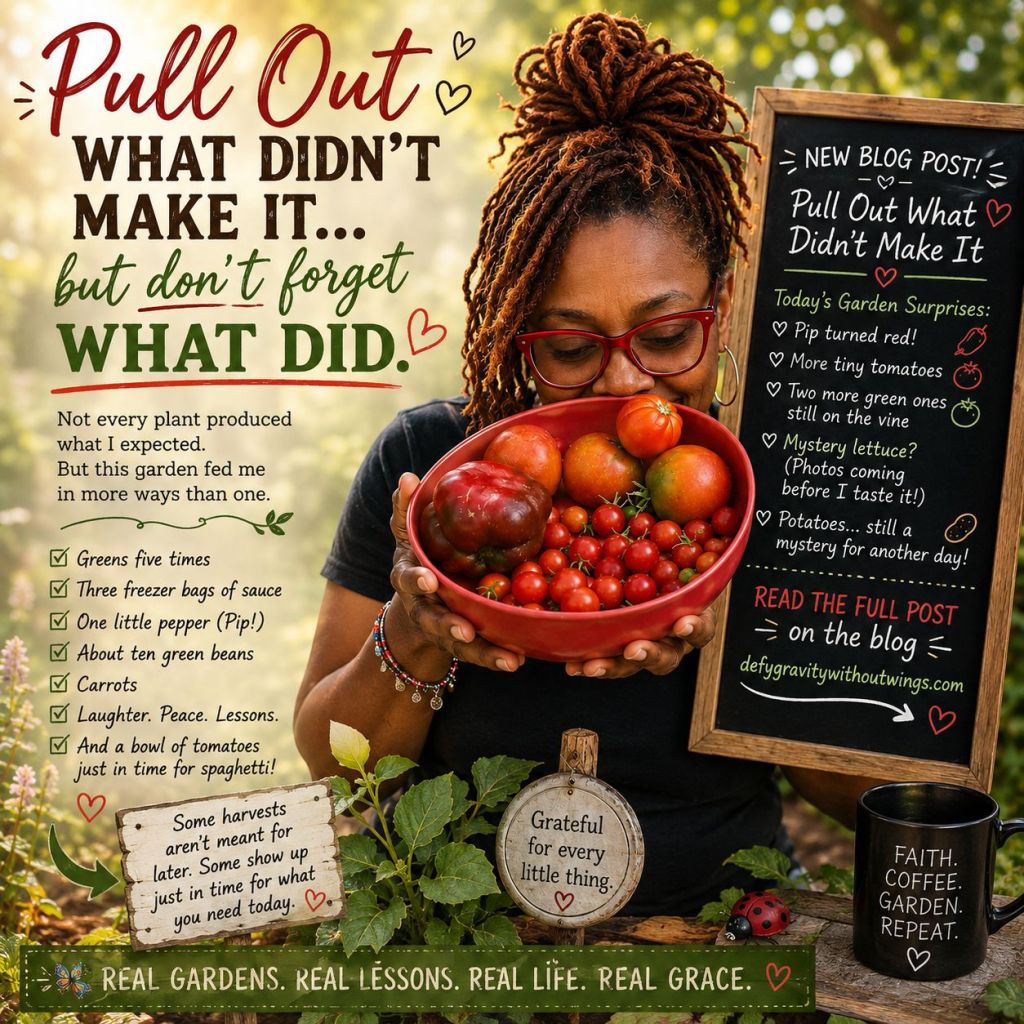
We harvested greens five times.
There are three gallon-sized bags of tomato sauce in my freezer, made from tomatoes that grew right here in this garden.
There was one little green pepper.
There were about ten green beans—not exactly enough to open a produce stand.
There were carrots.
And basil, radishes and beets we would never eat, but were pretty and make novice gardeners feel like experts.
And there were more social-media-worthy pictures than I can count.
There was laughter. There was anticipation. There were lessons I didn’t know I was planting. There were mornings when I walked outside just to see what had changed. There were days when checking on something growing gave my mind somewhere peaceful to go when life was doing entirely too much.
Not everything the garden produced could be put on a plate.
Some of the harvest fed me differently.
Funny how quickly disappointment can make us forget the harvest.
We can become so focused on what died, what got eaten, what never produced, and what didn’t turn out the way we planned that we overlook all the evidence that something did grow.
So no, this garden was not a total failure.
Neither was this season.
And neither am I.
I don’t have to throw away the whole garden just because everything in it didn’t make it.
I can pull out what is finished.
I can clean up what was damaged.
I can keep what still has life.
I can remember what already fed me.
I can refresh depleted soil.
And I can plant again.
There’s even one Brussels sprout plant that’s been hanging around since last November.
She never produced one identifiable Brussels sprout.
By the original expectation, I could call her a failure.
Except we discovered that her leaves were delicious mixed with our greens.
She didn’t produce what I expected.
She still fed us.
And maybe that’s a word for more than my garden.
There are seasons in life that don’t produce everything we expected either. Goals don’t get reached. Plans get interrupted. Things we carefully planted get attacked by circumstances we never saw coming. Energy gets spent dealing with things we never intended to carry.
It’s easy to stare at what didn’t happen until disappointment convinces us that nothing happened.
But that’s not always the truth.
Sometimes there are three bags of sauce sitting in the freezer while we’re mourning the squash.
Sometimes we are so busy counting the ten green beans that we forget the greens fed us five times.
Sometimes what we planted never becomes what we expected, but like my stubborn old Brussels sprout plant, it finds another way to feed us.
And sometimes the harvest isn’t something we can count at all.
Sometimes it is peace.
Sometimes it is laughter.
Sometimes it is a lesson.
Sometimes it is simply having somewhere to put our hands while God settles our hearts.
So today, I’m taking a lesson from my garden.
A disappointing harvest does not mean the soil has lost its purpose.
And an unmet expectation does not erase a harvest that has already happened.
Some things need to be pulled.
Some things deserve another season.
Some things may never become what I originally expected, yet still have value.
And some empty places are simply waiting for new seed.
So I’m not dragging everything that disappointed me into the next season.
I’m cleaning the bed.
I’m keeping what still has life.
I’m remembering what already fed me.
I’m refreshing the soil.
And, by the grace of God, I’m planting again.
And Then I Went Outside…
A few hours after writing those words, I finally made it to the garden.
I had gotten distracted. Life was still doing what life does. Both of my boys needed rides to work, and somewhere in there I stopped to get breakfast. The great potato excavation would have to wait.
But when I finally went outside, the garden had another lesson waiting for me.
There were tomatoes.
Lots of tiny ones. A couple of the last larger ones. Two more green ones still hanging on the vine that I decided to leave there and give a little more time.
And Pip—my little pepper plant that had managed to produce just one tiny green baby—had quietly ripened that baby all the way to red.
I had gone outside thinking about what needed to be cleaned up.
Meanwhile, the garden was still producing.
There I stood with a bowl of tomatoes and one little red pepper from plants I had already mentally begun wrapping up for the season.
And tonight, I’m making spaghetti.
These tomatoes won’t make it into another gallon freezer bag. They’ll be chopped up and added to the jarred sauce we’re eating tonight.
And suddenly there was another lesson.
Some harvest isn’t meant to be stored for later. Some of it shows up just in time for what you need today.
Maybe that’s why we have to be careful about declaring a season over simply because it didn’t produce the way we expected.
There may still be something growing that we haven’t noticed.
There may still be something ripening while we’re looking at what died.
There may still be provision hanging on a vine we were preparing to pull.
And sometimes God doesn’t give us enough to stock the freezer.
Sometimes He gives us enough for tonight’s spaghetti.
That’s still provision.
That’s still harvest.
That’s still something worth thanking Him for.
So perhaps today’s garden reset isn’t only about pulling out what didn’t make it.
Maybe it’s also about slowing down long enough to recognize what did.
What survived.
What fed me differently.
What is still growing.
And what showed up right on time.
Prayer
Lord, forgive me for the times disappointment has made me forget the harvest.
Thank You for every place where something grew, every provision I almost overlooked, every unexpected thing that still managed to feed me, and even the harvests I couldn’t put on a plate.
Thank You for what I was able to preserve for another season.
And thank You for what You provide simply because I need it today.
Give me wisdom to recognize what has finished its season and courage to release it.
Show me what still has life, even when it doesn’t look the way I expected.
Keep me from pulling up something You are still allowing to grow just because I decided its season should be over.
Restore the places in me that have been depleted. Refresh the soil of my heart. And prepare me for whatever You want to plant next.
Help me remember that a disappointing harvest is not the end of the garden.
There is still good soil here.
There may even be something still ripening on the vine.
And with You, there is always reason to look again before I call the season finished.
This week arrived carrying more heartache than I thought one heart could hold.
Hospital rooms. Goodbyes. A young life lost too soon. Family relationships strained to the breaking point. Watching people I love fight battles I cannot fight for them. Trying to keep working while my heart wanted to sit still for a while.
By the time the week reached Wednesday morning, I felt like I had been carrying far more than my share.
Then, at four o’clock this morning, the thunder woke me before the alarm ever had a chance.
As a little girl, my grandmother never called it a thunderstorm. She would smile and say, “Baby, that’s just Heaven moving furniture.”
I still think of her every time the windows rattle.
This morning, I lay there listening to the deep rumble overhead, tea waiting in the kitchen, rain tapping against the roof, and my stomach still reminding me that stress has a way of settling into places we never invited it.
Then I remembered my favorite scripture whenever the weather frightens me:
“He weighs the wind and measures the waters by measure. When He made a decree for the rain, and a way for the lightning of the thunder.” — Job 28:25–26
What an incredible thought.
The wind has weight. The rain has measure. The lightning has a path.
Nothing about the storm is accidental.
Every gust… Every drop… Every clap of thunder…
God already knows exactly where it belongs.
If He is careful enough to weigh something I cannot even see, then surely He has not lost sight of the burdens I carry.
If He measures every drop of rain, then He certainly measures every tear.
If He charts a path for lightning across the heavens, then He has already marked a path through every storm I will ever face.
Maybe that’s why my grandmother’s words still bring me comfort. Perhaps Heaven really is moving furniture.
Not because God is scrambling to fix what caught Him by surprise—but because He is always preparing what comes next. Rearranging what no longer belongs. Making room for blessings I cannot yet see. Moving things into place before I ever arrive.
Maybe He’s making room for healing where sickness has lived too long.
Maybe He’s making room for peace where grief has settled in.
Maybe He’s making room for restoration where relationships have been broken.
And maybe, just maybe, what sounds like thunder to us is simply the sound of God preparing tomorrow.
As I listened to the thunder this morning, I wondered if God was doing more than shaking the sky.
Maybe He was rearranging my perspective.
Maybe He was reminding me that what feels like chaos to me is still under His careful hand.
Maybe He was whispering that before He sends new mercies, He often makes room for them.
So instead of fearing the thunder, I listened.
And somewhere between the rumble of the sky and the whisper of God’s Word, I found peace. Enough to nod back off instead of my normal routine of rushing into my day.
The same God who weighs the wind is carrying me.
The same God who measures the waters is measuring out grace for today.
And the same God who makes a path for the lightning has already made a path for me.
Sometimes the storm isn’t announcing God’s absence.
Sometimes it’s simply the sound of Heaven moving furniture.
This month marks 24 or 25 years at my job. I always get confused. Let’s just say a quarter of a century.
I’m grateful. I really am.
This job has put food on my table, helped pay mortgages and medical bills, carried me through cancer, raised children, celebrated grandchildren, and kept the lights on through seasons I never saw coming.
It has been a gift. But if I’m honest…
The thought made me pull the blanket back over my head and wish I was in kindergarten again.
No sales quotas. No deadlines. No responsibilities.
Just nap time, chocolate milk, and somebody else deciding what came next.
Instead, I lay there thinking about twenty-five years. I was thankful. But I was grieving too.
Not because I hated my job. I didn’t. Well not exactly. Lol
I was mourning the woman I thought I would have become by now. The books I thought I would have written. The places I imagined speaking. The dreams I assumed would have happened “one day.”
Somewhere between providing for everyone else and simply surviving life, I quietly convinced myself those dreams could wait.
Then I looked up… and decades had passed.
As I lay there feeling sorry for myself, the Lord interrupted my thoughts with a simple question.
“Who told you I was finished writing your story?”
I couldn’t answer. Because the truth is…
Dead dreams don’t keep showing up. They don’t whisper while you’re driving to work. They don’t find you while you’re digging in a garden. They don’t keep tapping you on the shoulder through devotionals, stories, and moments that won’t leave you alone.
Maybe I wasn’t mourning dead dreams. Maybe I was grieving the timeline I had written for God.
The older I get, the more I’m discovering that God isn’t nearly as concerned with my schedule as I am. He wastes nothing. Not the years. Not the detours.
Not the job that faithfully provided while quietly teaching me lessons I couldn’t have learned anywhere else. Looking back, maybe I wasn’t just building a career.
Maybe God was building a writer. A storyteller. A woman with enough life behind her to recognize His fingerprints in places she once overlooked.
This morning I wanted to hide under the covers like a kindergartener hoping the day would go away. Instead, God reminded me that I’m not in kindergarten anymore.
I’m still in His classroom.
And apparently…
The lesson isn’t over yet.
“Being confident of this very thing, that He who began a good work in you will carry it on to completion until the day of Christ Jesus.” — Philippians 1:6
Trigger Warning: This reflection discusses grief, youth violence, childhood trauma, emotional neglect, and the long-term impact of silence within families and communities.
I thought I was just there to sing.
Instead, after my last song, I sat listening to a mother whose 19-year-old son had been killed less than five minutes from home. She described him as the good kid. The one who checked on his parents. The one who helped people. The one who stayed connected.
And somehow, despite all of that goodness, she now lives with the reality that she had to bury him.
What shook me even more was not just her pain, but her posture.
As she spoke about the young man responsible receiving a 46-year sentence, I heard both grief and forgiveness in her voice. Not weakness. Not denial. Just a heartbreaking understanding that tragedy had swallowed more than one life that night.
She spoke about childhood trauma. About children carrying pain nobody stops to address until it explodes into violence in the streets. And then she said something that settled heavily in my spirit. She talked about the dangerous things we normalize in our homes:
“Children are to be seen and not heard.”
“What happens in this house stays in this house.”
For generations, many of us were taught those sayings as discipline, respect, or family loyalty. But sometimes those same words teach children something else entirely:
Your feelings do not matter here.
Your pain is inconvenient here.
Your truth is unsafe here.
So children learn to survive by swallowing emotions they were never meant to carry alone. Fear gets buried. Anger gets buried. Shame gets buried. Hurt gets buried.
But buried pain does not disappear.
Eventually it leaks somewhere.
Sometimes it leaks into addiction. Sometimes into rage. Sometimes into depression. Sometimes into violence. Sometimes into emotional numbness. Sometimes into streets filled with children trying to release emotions nobody allowed them to safely process at home.
As I listened to her speak, a familiar phrase rose in my spirit so strongly that I walked up and shared it with her afterward.
I told her, “I call it silent screaming.”
Because that is exactly what so many people are doing.
They are screaming internally while functioning externally.
Smiling. Working. Going to church. Posting selfies. Making jokes. Serving others. Showing up every Sunday while quietly unraveling inside.
And honestly, the church should be leading the effort to erase silent screaming.
Not by becoming a place where people perfect appearances, but by becoming safe enough for honesty again.
Too many people have mastered church behavior while still bleeding emotionally underneath the surface. We know how to shout over pain, dance over pain, quote Scripture over pain, and hide pain behind ministry titles.
But Jesus always stopped for what was underneath.
He noticed the overlooked. He listened to the hurting. He saw what everybody else missed.
And maybe that is part of our assignment too.
To hear people before they become headlines.
To create homes where children feel emotionally safe enough to speak.
To remind people that silence is not always strength.
Sometimes silence is survival.
And some children end up on the 6 o’clock news because nobody heard them when they whispered.
“There is a time to be silent and a time to speak.” — Ecclesiastes 3:7
Some mornings I wake up already arguing. Not out loud. Just internally. With bills. With fear. With people. With timelines. With memories. With disappointment. With exhaustion.
Before my feet even hit the floor, my spirit already feels like somebody shook the snow globe and forgot to let it settle.
And if I am not careful, whatever fills my heart first starts leaking out my mouth next.
Sharp answers. Heavy sighs. Sarcasm dressed up as humor. Silence that punishes. Worry disguised as “being realistic.”
And whew… some folks can turn one bad mood into a ministry of misery before breakfast.
The older I get, the more I realize peace is not just a feeling God gives me. Sometimes peace is a discipline God teaches me.
Because anybody can speak panic. Anybody can repeat bitterness. Anybody can echo chaos. But it takes maturity to walk into a tense room and refuse to multiply the storm.
That does not mean pretending everything is fine.
Jesus calmed storms while acknowledging they were real storms.
What I am learning is this: I can tell the truth without setting fires. I can be tired without becoming cruel. I can be overwhelmed without making everybody around me drink from the same anxiety.
And honestly? Some days the prayer is not deep or fancy.
It is simply:
“Lord… before I answer this text, before I walk into this office, before I react to this situation, before I say something I cannot unsay, before my face says it before my mouth does… let peace come out my mouth.”
Not perfection. Not fake positivity. Peace.
The kind that pauses before speaking. The kind that softens hard words. The kind that leaves room for grace. The kind that remembers exhausted people often wound each other accidentally.
Because once words leave us, we do not get to gather them back like spilled sugar.
And some of us survived entire childhoods built from somebody else’s unhealed mouth.
So now I ask God to help mine become safer.
Not silent. Not weak. Safer.
Especially in seasons where my own heart feels stretched thin like a dollar menu meal feeding six people.
Scripture says:
“Let your speech always be gracious, seasoned with salt…” Colossians 4:6
Not bland. Not passive. Seasoned.
Truthful words with wisdom in them.
Maybe that is the real miracle some days. Not that the storm disappeared. But that peace came out of us anyway.
And in a loud world amplified by too many of the wrong words, that is holy.
I didn’t need a miracle with flashing lights. I didn’t need a breakthrough big enough for everybody else to recognize. Honestly, I just needed my mind to slow down. Because lately, it’s been doing that thing—running numbers, replaying conversations, trying to solve tomorrow before today even finishes. Not because anything is completely falling apart, but because enough has shifted that my spirit knows to pay attention. And if I’m honest, I was thinking a little too much.
So I tried to interrupt myself. Not with prayer this time. Not with a deep scripture study. Just something simple. I had seen a sermon about decluttering—move five things in five minutes. Nothing deep. Nothing dramatic. Just… move something. So I did. One thing, then another. By the time I got to the fifth thing, I reached into the pocket of a dress I hadn’t worn in at least a year—and there it was. Five dollars.
Now let’s be clear. Five dollars is not going to change anybody’s financial situation, but it changed my moment. Because it made me smile. And in a season where your mind is trying to run ahead of you, sometimes a smile is the interruption you didn’t know you needed. I didn’t think much more about it. I just tucked the moment away and kept moving.
On the way to church, I started going through my wallet. Receipts everywhere. Old ones, faded ones, the kind you keep just in case but never actually need. So I started sorting through them, one by one, making sure there wasn’t anything important I needed to hold on to. And that’s when I saw it—another five dollars. Then another. And then another. Three crisp five-dollar bills sitting where receipts should have been.
Now wait, because this is where my spirit leaned in—not my logic, my spirit. Because four five-dollar bills is still just twenty dollars, and twenty dollars, in the grand scheme of real-life responsibilities, is not fixing anything major. But something in me knew this wasn’t about fixing. This was about finding. God wasn’t solving my situation in that moment; He was steadying my heart in it. He was saying, without saying a word, “You don’t have to carry this the way you are carrying it.” And I sat there in that car, holding those little bills like they were something bigger than money, because they were. They were peace. All magnified by the number 5 being the number of grace denoting God’s unmerited favor
Church was good. I smiled through it—not because everything was handled, but because I felt handled. And when I got home, I thought the moment was over.
I got home, and there it was—a simple bag at my door. Inside were lemons. Not one or two, but five bags—bright, yellow, beautiful lemons. Thirty of them. I stood there looking at them like, “Okay Lord… now this feels personal.” Because you’ve heard the saying, “When life gives you lemons, make lemonade,” but this didn’t feel like life. Life gives lemons with pressure. Life gives lemons and expects you to figure it out. This felt like God.
And while I was trying to figure out what to do with so many lemons, I started giving them away. Nobody knew I had them. Nobody asked for them. I just… started gifting. If you showed up at the door, you left with some. LOL. And somewhere in that simple act, it settled in my spirit that maybe everything God places in your hands isn’t meant to stay there. Some things show up not just as provision, but as permission—to bless, to share, to lighten someone else’s day without needing a reason or an announcement.
Because He didn’t wait until I had everything figured out. He met me while I was trying not to spiral, while I was moving five small things, while I was clearing out what I didn’t need, while I was doing the little bit I could control. He didn’t flood me with answers. He didn’t overwhelm me with provision. He didn’t drop a solution big enough to remove every question. He just… found me.
He found me in a dress pocket I forgot about, in a wallet I almost ignored, in a moment where I chose not to overthink. And then He made me laugh, because who sends somebody thirty lemons unless they are trying to say something?
“Your Father knows what you need before you ask Him.” — Matthew 6:8
So no, it wasn’t about twenty dollars, and it wasn’t about lemons. It was about being reminded that I am not navigating this season by myself. That even when my thoughts start running ahead of me, God is already present where I’m trying to get to. And sometimes, He doesn’t calm your life all at once. He just leaves little confirmations along the way so your soul can rest while you walk it out.
So if your mind has been busy lately, if you’ve been trying not to worry but still feeling it creep in, if you’re doing the best you can with what’s in front of you—pay attention to the small things, the found things, the unexpected things, the things that make you smile before you can explain them. Because God doesn’t always show up loud. Sometimes, He shows up in fives.
Gently reminded that God meets you in the middle, not just at the outcome.
My son-in-love, Kamau, posted that he was booking a flight to Africa. There was a storm coming, he said, and somebody needed to build shelters for the giraffes.
He displayed a picture like it was urgent. Dark sky. Lightning splitting it wide open. Giraffes standing tall in the open plain.
He might have been joking (hard to tell with him.) Because that is Kamau. Compassion wrapped in comedy. Protection tucked inside a punchline. A heart that sees danger and immediately asks, Who needs covering? I love that about him. ( Don’t tell him I said that.)
But when I looked closer at the picture, those giraffes were not panicking. They were not lowering themselves to the ground. They were not scattering. They were standing.
Unshakable. Unmovable. Storm pressing in. Mortal danger possible. And yet their necks were lifted. Their legs planted. Their bodies steady in the wind.
It made me think of Psalm 91: “He who dwells in the secret place of the Most High shall abide under the shadow of the Almighty. Under His feathers you will find refuge.”
Those giraffes looked uncovered. But they were not unprotected. They looked exposed. But they were not outside of shadow. Psalm 91 does not promise the absence of storms. It promises covering in the middle of them.
And then Psalm 46:10 settles it: “Be still, and know that I am God.”
Not be frantic. Not be consumed. Not be undone. Be still. Still like you trust the One who commands the sky. Still like you believe the storm does not get the final word. Still like your roots run deeper than what threatens you.
We are living in days where thunder travels across oceans. International conflict crackles like lightning. Voices rise. Fear spreads.
But maybe faith looks like a giraffe in a storm. Not dramatic. Not reckless. Just anchored. Unshakable. Unmovable.
And I smiled again. Because my son-in-love thought he was just telling a joke. Instead… he helped me write a sermon about faith standing firm in adversity.
He is going to be so embarrassed when he reads this. Make sure you tease him for me.
Before the acclaim. Before the syllabus. Before the rediscovery.
There was a girl in Eatonville, Florida. One of the first all-Black incorporated towns in America. A place where Black men held office. Black businesses lined the streets. Black authority was ordinary. Zora did not grow up learning inferiority. She grew up witnessing Black self-governance.She later said she only felt “colored” when she left Eatonville. That foundation mattered.
Her mother told her to “jump at the sun.” Then her mother died when Zora was thirteen. Stability fractured. She was sent away. She worked as a maid. She fought for schooling. She even shaved years off her age to qualify for education she refused to surrender. She made her way to Howard University. Then to Barnard College — the only Black woman in her class.
Zora did not enter literature quietly. During the Great Depression, she worked under the Works Progress Administration, a federal New Deal program created to provide jobs for unemployed Americans. Through its Federal Writers’ Project, writers were paid to document American life.
Zora used that platform to travel the South collecting Black folklore. She sat on porches recording stories, sermons, songs, dialect. She preserved language as it was spoken — not polished for respectability. That was civil rights work.
She treated everyday Black life as worthy of scholarship at a time when much of the country treated it as caricature. But Zora did not always align with the popular script.
She did not write protest novels on demand. She did not center white oppression in every paragraph. She resisted narratives that reduced Black identity to suffering alone. And when the Supreme Court decided Brown v. Board of Education in 1954 — declaring segregated public schools unconstitutional — Zora publicly criticized aspects of the ruling.
Not because she supported segregation. But because she rejected the quiet assumption that proximity to whiteness was the only path to equality. She believed integration should not come at the cost of Black institutional pride or self-determination. She worried that dependence on white approval could weaken Black autonomy.
That stance placed her at odds with much of the civil rights leadership of her time. Some admired her independence. Some felt she undermined the movement. Some labeled her out of step. She kept writing anyway.
Their Eyes Were Watching God centered a Black woman’s voice, love, desire, and interior life. Not as political slogan — but as full humanity. Joy, for Zora, was not a distraction from struggle. Joy was defiance.
And then — she died in 1960, poor and largely forgotten. Buried in an unmarked grave in Florida. No parade. No national mourning. No bestseller comeback.
Years later, her work was rediscovered. Her grave was marked. Her voice returned to classrooms and conversations. Forgotten in her time. Found again by the next.
Zora reminds us that civil rights is not only marches and lawsuits. It is also narrative. It is who defines Black life. It is the refusal to shrink complexity for acceptance. She was brilliant and sometimes difficult. Independent and sometimes misunderstood. Unapologetic when it cost her.
CARRY THIS WITH YOU Where have you been told that success requires you to leave something of yourself behind? Zora teaches us that preserving who you are — even when misunderstood — is its own form of resistance.
BREADCRUMB Not all revolution is loud. Some of it sounds like porch laughter, a stubborn pen, and a woman refusing to be edited by her era.
We see you, Zora Neale Hurston — for telling our stories without apology. Bread Crumbs — for those coming after us. Victorious without reward. Still here.