
Before food trucks. Before catering contracts.
Before pop-up kitchens. There was a formerly enslaved Black woman pushing a baby carriage filled with pickled pig’s feet.
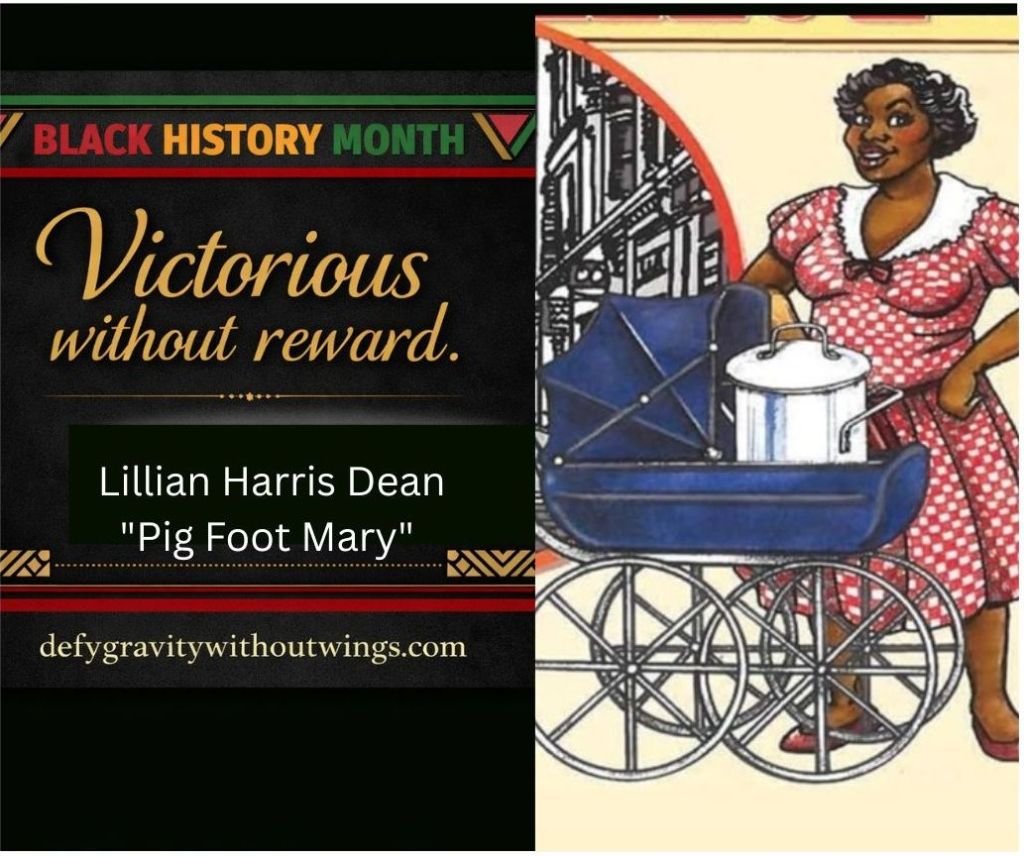
Her name was Lillian Harris Dean. History remembers her as Pig Foot Mary. And what some would have called scraps, she called strategy.
Born in Mississippi around 1870. She migrated north during the Great Migration era. She was reported a woman of large stature (striking fear in even some men).
THE BABY CARRIAGE BEGINNING
After emancipation, economic opportunity for Black women was painfully narrow. Formal loans were not available. Property ownership was rare. Protection under the law was inconsistent at best.
So Mary did what resilient women have always done. She looked at what she had.
She cooked pig’s feet — inexpensive cuts that working people could afford — and loaded them into a baby carriage. That’s right no baby, just a baby carriage purchased with two of the five dollars she arrived with and a tin pot she brought with her.
Then she walked the streets of Washington, D.C., selling directly to laborers, porters, and government workers who had migrated from the South but desperate for a taste of home cooking lacking in the industrial north.
No storefront. No investors. No safety net.
Just legs, grit, and a carriage. That carriage gave her mobility. Mobility gave her customers. Customers gave her capital.
Capital gave her options. Consistency built reputation. Reputation built revenue.
From those early street sales, though unable to read, she negotiated contracts with suppliers, opened restaurants, operated boarding houses, acquired property, and became one of the wealthiest Black women in New York City during her time. She later married a prominent black lawyer she had hired to keep her financial empire safe.
Later in life, she faced legal troubles that interrupted her business, a common vulnerability for Black entrepreneurs in that era. When her power and influence started to invade beyond the black community and into white upper Manhattan, a racist court system convicted her of running a disorderly house. After her release from prison, she retired to California.
She did not inherit influence. She built it.
She did not wait for approval. She moved.
Pig Foot Mary represents a pattern we see over and over in Black history:
Innovation born from restriction.
Mobility created from limitation.
Enterprise rising from overlooked ingredients.
She took something humble and made it sustaining.
“She considers a field and buys it; out of her earnings she plants a vineyard.” — Proverbs 31:16
Mary did not own fields at first. She owned a route. But the principle is the same.
Use what you have. Work what you have.
Move what you have.
CARRY THIS WITH YOU
You may be waiting for a storefront when all you have is a carriage. Push anyway.
You may be waiting for funding when all you have is a recipe. Cook anyway.
You may be waiting for someone to validate the vision. Walk anyway.
BREADCRUMB
Sometimes the business plan is wrapped in something people underestimate. And sometimes the thing you’re pushing… is actually pushing you into destiny.
We see you, Lillian Harris Dean for turning a baby carriage into a business model. We see you for feeding working hands and building wealth from what others discarded.
Bread Crumbs — for those coming after us.
Victorious without reward. Still here.

 defygravitywithoutwings.com