Image

Pull Out What Didn’t Make It.

“To every thing there is a season, and a time to every purpose under the heaven.” — Ecclesiastes 3:1 (KJV)

This morning, I decided it was time to reset my garden.

Life had gotten in the way, and honestly, so had disappointment.

Some things I planted never became what I imagined. The squash bed became the scene of what I jokingly call the vine borer massacre. The kale and collards eventually lost their battle with the beetles. There are potato bags I am almost afraid to open because I don’t know whether there is a harvest underneath all that dirt—or evidence of an experiment gone terribly wrong.

But before I call the season a failure, I need to tell the whole story.

We harvested greens five times.

There are three gallon-sized bags of tomato sauce in my freezer, made from tomatoes that grew right here in this garden.

There was one little green pepper.

There were about ten green beans—not exactly enough to open a produce stand.

There were carrots.

And basil, radishes and beets we would never eat, but were pretty and make novice gardeners feel like experts.

And there were more social-media-worthy pictures than I can count.

There was laughter. There was anticipation. There were lessons I didn’t know I was planting. There were mornings when I walked outside just to see what had changed. There were days when checking on something growing gave my mind somewhere peaceful to go when life was doing entirely too much.

Not everything the garden produced could be put on a plate.

Some of the harvest fed me differently.

Funny how quickly disappointment can make us forget the harvest.

We can become so focused on what died, what got eaten, what never produced, and what didn’t turn out the way we planned that we overlook all the evidence that something did grow.

So no, this garden was not a total failure.

Neither was this season.

And neither am I.

I don’t have to throw away the whole garden just because everything in it didn’t make it.

I can pull out what is finished.

I can clean up what was damaged.

I can keep what still has life.

I can remember what already fed me.

I can refresh depleted soil.

And I can plant again.

There’s even one Brussels sprout plant that’s been hanging around since last November.

She never produced one identifiable Brussels sprout.

By the original expectation, I could call her a failure.

Except we discovered that her leaves were delicious mixed with our greens.

She didn’t produce what I expected.

She still fed us.

And maybe that’s a word for more than my garden.

There are seasons in life that don’t produce everything we expected either. Goals don’t get reached. Plans get interrupted. Things we carefully planted get attacked by circumstances we never saw coming. Energy gets spent dealing with things we never intended to carry.

It’s easy to stare at what didn’t happen until disappointment convinces us that nothing happened.

But that’s not always the truth.

Sometimes there are three bags of sauce sitting in the freezer while we’re mourning the squash.

Sometimes we are so busy counting the ten green beans that we forget the greens fed us five times.

Sometimes what we planted never becomes what we expected, but like my stubborn old Brussels sprout plant, it finds another way to feed us.

And sometimes the harvest isn’t something we can count at all.

Sometimes it is peace.

Sometimes it is laughter.

Sometimes it is a lesson.

Sometimes it is simply having somewhere to put our hands while God settles our hearts.

So today, I’m taking a lesson from my garden.

A disappointing harvest does not mean the soil has lost its purpose.

And an unmet expectation does not erase a harvest that has already happened.

Some things need to be pulled.

Some things deserve another season.

Some things may never become what I originally expected, yet still have value.

And some empty places are simply waiting for new seed.

So I’m not dragging everything that disappointed me into the next season.

I’m cleaning the bed.

I’m keeping what still has life.

I’m remembering what already fed me.

I’m refreshing the soil.

And, by the grace of God, I’m planting again.

And Then I Went Outside…

A few hours after writing those words, I finally made it to the garden.

I had gotten distracted. Life was still doing what life does. Both of my boys needed rides to work, and somewhere in there I stopped to get breakfast. The great potato excavation would have to wait.

But when I finally went outside, the garden had another lesson waiting for me.

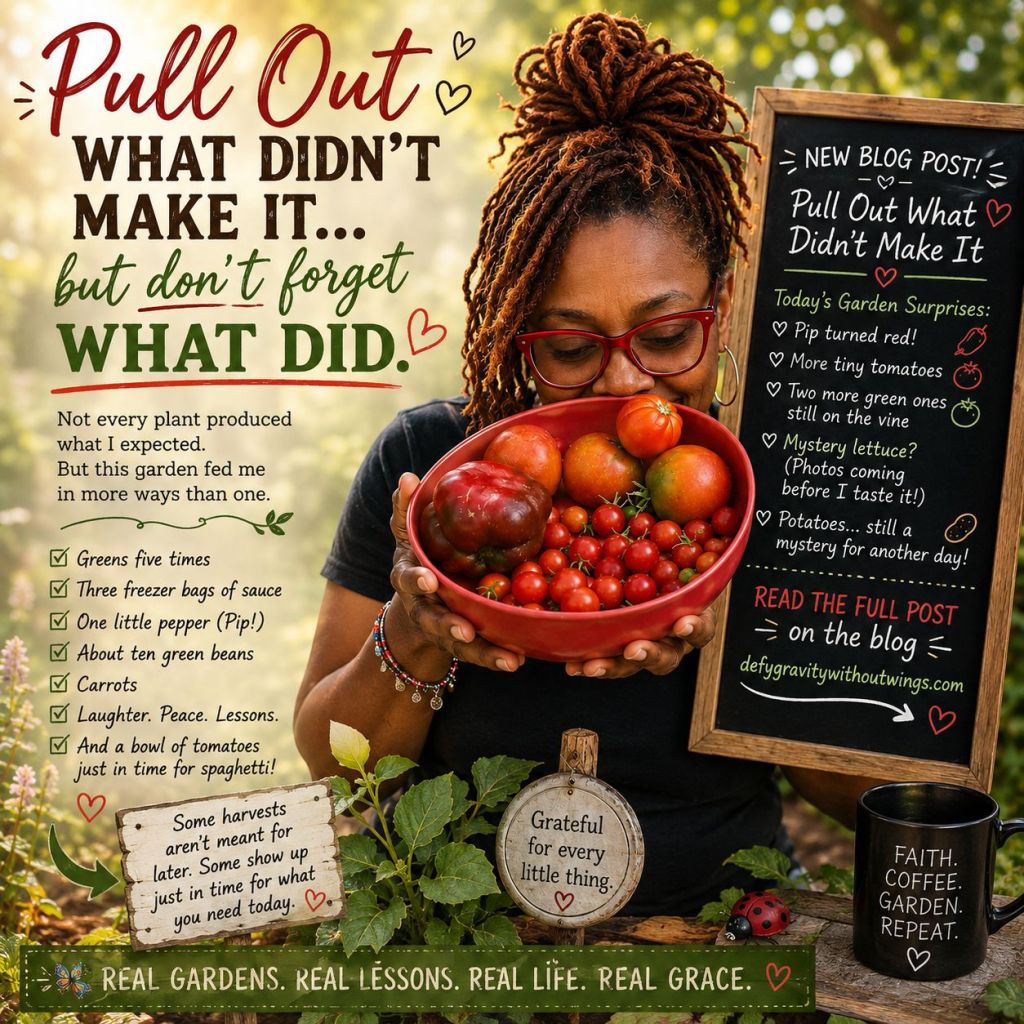
There were tomatoes.

Lots of tiny ones. A couple of the last larger ones. Two more green ones still hanging on the vine that I decided to leave there and give a little more time.

And Pip—my little pepper plant that had managed to produce just one tiny green baby—had quietly ripened that baby all the way to red.

I had gone outside thinking about what needed to be cleaned up.

Meanwhile, the garden was still producing.

There I stood with a bowl of tomatoes and one little red pepper from plants I had already mentally begun wrapping up for the season.

And tonight, I’m making spaghetti.

These tomatoes won’t make it into another gallon freezer bag. They’ll be chopped up and added to the jarred sauce we’re eating tonight.

And suddenly there was another lesson.

Some harvest isn’t meant to be stored for later. Some of it shows up just in time for what you need today.

Maybe that’s why we have to be careful about declaring a season over simply because it didn’t produce the way we expected.

There may still be something growing that we haven’t noticed.

There may still be something ripening while we’re looking at what died.

There may still be provision hanging on a vine we were preparing to pull.

And sometimes God doesn’t give us enough to stock the freezer.

Sometimes He gives us enough for tonight’s spaghetti.

That’s still provision.

That’s still harvest.

That’s still something worth thanking Him for.

So perhaps today’s garden reset isn’t only about pulling out what didn’t make it.

Maybe it’s also about slowing down long enough to recognize what did.

What survived.

What fed me differently.

What is still growing.

And what showed up right on time.

Prayer

Lord, forgive me for the times disappointment has made me forget the harvest.

Thank You for every place where something grew, every provision I almost overlooked, every unexpected thing that still managed to feed me, and even the harvests I couldn’t put on a plate.

Thank You for what I was able to preserve for another season.

And thank You for what You provide simply because I need it today.

Give me wisdom to recognize what has finished its season and courage to release it.

Show me what still has life, even when it doesn’t look the way I expected.

Keep me from pulling up something You are still allowing to grow just because I decided its season should be over.

Restore the places in me that have been depleted. Refresh the soil of my heart. And prepare me for whatever You want to plant next.

Help me remember that a disappointing harvest is not the end of the garden.

There is still good soil here.

There may even be something still ripening on the vine.

And with You, there is always reason to look again before I call the season finished.

Amen.

Love, Chelle
defygravitywithoutwings.com

Image

$5 in My Pocket… Lemons at My Door

I didn’t need a miracle with flashing lights. I didn’t need a breakthrough big enough for everybody else to recognize. Honestly, I just needed my mind to slow down. Because lately, it’s been doing that thing—running numbers, replaying conversations, trying to solve tomorrow before today even finishes. Not because anything is completely falling apart, but because enough has shifted that my spirit knows to pay attention. And if I’m honest, I was thinking a little too much.

So I tried to interrupt myself. Not with prayer this time. Not with a deep scripture study. Just something simple. I had seen a sermon about decluttering—move five things in five minutes. Nothing deep. Nothing dramatic. Just… move something. So I did. One thing, then another. By the time I got to the fifth thing, I reached into the pocket of a dress I hadn’t worn in at least a year—and there it was. Five dollars.

Now let’s be clear. Five dollars is not going to change anybody’s financial situation, but it changed my moment. Because it made me smile. And in a season where your mind is trying to run ahead of you, sometimes a smile is the interruption you didn’t know you needed. I didn’t think much more about it. I just tucked the moment away and kept moving.

On the way to church, I started going through my wallet. Receipts everywhere. Old ones, faded ones, the kind you keep just in case but never actually need. So I started sorting through them, one by one, making sure there wasn’t anything important I needed to hold on to. And that’s when I saw it—another five dollars. Then another. And then another. Three crisp five-dollar bills sitting where receipts should have been.

Now wait, because this is where my spirit leaned in—not my logic, my spirit. Because four five-dollar bills is still just twenty dollars, and twenty dollars, in the grand scheme of real-life responsibilities, is not fixing anything major. But something in me knew this wasn’t about fixing. This was about finding. God wasn’t solving my situation in that moment; He was steadying my heart in it. He was saying, without saying a word, “You don’t have to carry this the way you are carrying it.” And I sat there in that car, holding those little bills like they were something bigger than money, because they were. They were peace. All magnified by the number 5 being the number of grace denoting God’s unmerited favor

Church was good. I smiled through it—not because everything was handled, but because I felt handled. And when I got home, I thought the moment was over.

I got home, and there it was—a simple bag at my door. Inside were lemons. Not one or two, but five bags—bright, yellow, beautiful lemons. Thirty of them. I stood there looking at them like, “Okay Lord… now this feels personal.” Because you’ve heard the saying, “When life gives you lemons, make lemonade,” but this didn’t feel like life. Life gives lemons with pressure. Life gives lemons and expects you to figure it out. This felt like God.

And while I was trying to figure out what to do with so many lemons, I started giving them away. Nobody knew I had them. Nobody asked for them. I just… started gifting. If you showed up at the door, you left with some. LOL.  And somewhere in that simple act, it settled in my spirit that maybe everything God places in your hands isn’t meant to stay there. Some things show up not just as provision, but as permission—to bless, to share, to lighten someone else’s day without needing a reason or an announcement.

Because He didn’t wait until I had everything figured out. He met me while I was trying not to spiral, while I was moving five small things, while I was clearing out what I didn’t need, while I was doing the little bit I could control. He didn’t flood me with answers. He didn’t overwhelm me with provision. He didn’t drop a solution big enough to remove every question. He just… found me.

He found me in a dress pocket I forgot about, in a wallet I almost ignored, in a moment where I chose not to overthink. And then He made me laugh, because who sends somebody thirty lemons unless they are trying to say something?

“Your Father knows what you need before you ask Him.” — Matthew 6:8

So no, it wasn’t about twenty dollars, and it wasn’t about lemons. It was about being reminded that I am not navigating this season by myself. That even when my thoughts start running ahead of me, God is already present where I’m trying to get to. And sometimes, He doesn’t calm your life all at once. He just leaves little confirmations along the way so your soul can rest while you walk it out.

So if your mind has been busy lately, if you’ve been trying not to worry but still feeling it creep in, if you’re doing the best you can with what’s in front of you—pay attention to the small things, the found things, the unexpected things, the things that make you smile before you can explain them. Because God doesn’t always show up loud. Sometimes, He shows up in fives.

Gently reminded that God meets you in the middle, not just at the outcome.

Love,
Chelle
DefyGravityWithoutWings.com

Image

When Praise Cost You A Toe ( and a Little Pride)

This morning was supposed to be simple.

Just me, a broom, and some soft worship music. Nothing dramatic. Nothing deep. Just cleaning the house and minding my business.

But somewhere between sweeping one corner and turning toward the next…
that broom turned into a rhythm.

And that rhythm turned into a sway.
And that sway turned into a little two-step.

Now listen… I have not truly praise danced since my early 30s. And even then, let’s be honest, even then,I was in the back of the sanctuary respectfully copying the professionals 😌

But this morning?
Oh, I was feeling it.
Clumsy? Yes.
Anointed? Also yes.

And for a moment, it felt free.
Like I could just stay right there…
moving, praising, forgetting everything else.

And that’s where it shifted.

Because instead of staying in the praise,
my mind wandered into the problems I was trying to outdance.

Like Peter stepping out on the water in Matthew 14:29–30. As long as his eyes were on Jesus, he was good. But the moment he looked at the wind? He started sinking.

Well…The moment I stopped focusing on the praise and started focusing on everything else… I didn’t sink.

I stubbed my pinky toe.

And not just a polite little tap either. No ma’am. The kind that makes you see your whole life flash before your eyes.

Which then threw me off balance…
which then reminded my knee about that old meniscus injury from my 30s…

So now I’m in the middle of my living room,
half praising, half limping, trying to decide if I need prayer or an ice pack.

But here’s the thing Even through the pain, my thoughts got corrected. Because I realized:

Praising your way through something will cost you if you stop mid-praise to pick your problems back up.

You can’t hold both.
Not well anyway.

And right there—in between the limp and the laughter— I had to laugh at myself. Because I know I looked like something.

Just me… off beat… off balance…
still trying to be faithful in the middle of it.
And while nobody else saw it…

God did. And I believe He smiled. Because it wasn’t perfect. But it was real.

And if you needed this today…

Go ahead and praise anyway.
Even if it’s off rhythm.
Even if it’s in your kitchen.
Even if it turns into a wobble instead of a dance. Just… keep your eyes in the right place.

And if you do happen to stumble? Laugh, reset, and keep moving. Because the goal was never perfection.

It was presence.

Love, Chelle
defygravitywithoutwings.com 💛

Image

They Grow While You’re Gone


It’s 5:30 a.m.
I’m sipping my coffee, staring out the window into the darkness… somehow convinced I can see trouble in my garden from 100 feet away.

Don’t judge me… but I really considered stepping out there in my robe in 35 degrees to go check on my plant babies.

And somewhere between that first sip and the silence… I caught myself.

This isn’t about seeds.

This is about how easily my mind will grab hold of something—anything—and worry it to death.

Work stress that doesn’t clock out when I do.
Money questions that don’t always have quick answers.
A newborn I just prayed over in the hospital,
with whispers of concern about her ability to thrive.
Friends walking through the slow, sacred heartbreak of losing their parents…
and me carrying pieces of that with them.

All real things. All things that matter. All things experienced before.
And yet…

Look how quickly my heart starts hovering over them, like it’s my job to make sure everything turns out alright. Like if I think about it enough, check it enough, replay it enough…

I can help God along.

But I can’t.

Because even when I am doing the work of God, it is still God who is working.
I am not the outcome.
I am not the fixer.
I am not the one holding it all together.

I am just… hands in the soil.
Faithful to plant.
Faithful to water.
Faithful to show up.

But the growing?
The healing?
The sustaining?

That was never mine.

And if I’m not careful, I will let the weight of what I care about pull me out of the very places God is calling me to be present.

Sitting here with my coffee, trying to manage what He already has in His hands…
while He’s already prepared a seat for me somewhere else today.

There is a time to plant.
A time to water.
And then… a time to trust.
Not anxious trust.
Not hovering trust.
Real trust.

The kind that finishes the coffee,
gets dressed, and walks into the day
without carrying what God never assigned me to hold.

So I’m going where I’m supposed to be.
And I’m leaving the garden…
and everything it represents…
right where it is.

Because what God has already taken responsibility for does not need my worry added to it.

Even the good things don’t get to compete
with obedience.

“To everything there is a season, and a time to every purpose under the heaven.”
— Ecclesiastes 3:1

Love, Chelle

DefyGravityWithoutWings.com

Image

Pig Foot Mary: The Woman Who Pushed Her Future Down the Street


Before food trucks.  Before catering contracts.
Before pop-up kitchens. There was a formerly enslaved Black woman  pushing a baby carriage filled with pickled pig’s feet.

Her name was Lillian Harris Dean. History remembers her as Pig Foot Mary. And what some would have called scraps, she called strategy.

Born in Mississippi around 1870. She migrated north during the Great Migration era. She was reported a woman of large stature (striking fear in even some men).

THE BABY CARRIAGE BEGINNING

After emancipation, economic opportunity for Black women was painfully narrow. Formal loans were not available. Property ownership was rare. Protection under the law was inconsistent at best.

So Mary did what resilient women have always done. She looked at what she had.
She cooked pig’s feet — inexpensive cuts that working people could afford — and loaded them into a baby carriage. That’s  right no baby, just a baby carriage purchased with two of the five dollars she arrived with and a tin pot she brought with her.

Then she walked the streets of Washington, D.C., selling directly to laborers, porters, and government workers who had migrated from the South but desperate for a taste of home cooking lacking in the industrial north.

No storefront. No investors. No safety net.
Just legs, grit, and a carriage. That carriage gave her mobility. Mobility gave her customers. Customers gave her capital.
Capital gave her options. Consistency built reputation. Reputation built revenue.

From those early street sales, though unable to read, she negotiated contracts with suppliers, opened restaurants, operated boarding houses, acquired property, and became one of the wealthiest Black women in New York City  during her time. She later married a prominent black lawyer she had hired to keep her financial empire safe.

Later in life, she faced legal troubles that interrupted her business, a common vulnerability for Black entrepreneurs in that era. When her power and influence started to invade beyond the black community and into  white upper Manhattan,  a racist court system convicted her of running a disorderly house.    After her release from prison, she retired to California.

She did not inherit influence. She built it.
She did not wait for approval. She moved.

Pig Foot Mary represents a pattern we see over and over in Black history:
Innovation born from restriction.
Mobility created from limitation.
Enterprise rising from overlooked ingredients.

She took something humble and made it sustaining.

“She considers a field and buys it; out of her earnings she plants a vineyard.” — Proverbs 31:16

Mary did not own fields at first. She owned a route. But the principle is the same.
Use what you have. Work what you have.
Move what you have.

CARRY THIS WITH YOU
You may be waiting for a storefront when all you have is a carriage. Push anyway.

You may be waiting for funding when all you have is a recipe. Cook anyway.

You may be waiting for someone to validate the vision. Walk anyway.

BREADCRUMB

Sometimes the business plan is wrapped in something people underestimate. And sometimes the thing you’re pushing… is actually pushing you into destiny.

We see you, Lillian Harris Dean for turning a baby carriage into a business model. We see you for feeding working hands and building wealth from what others discarded.

Bread Crumbs — for those coming after us.
Victorious without reward. Still here.

Image

Reframing The Heart

Somewhere along the way, many of us learned a quiet lie —
not from God, but from human interpretation.

We learned it from what was modeled, praised, or rewarded.
From homes, churches, systems, and relationships that mistook endurance for faithfulness and exhaustion for virtue.


Most people were doing the best they could with what they knew — but they were still human.
And without realizing it, we carried those lessons into our understanding of God.

I know this because I have done it myself.

I confused being loved with doing to be loved.
I mixed up belief with performance.
And I carried that misunderstanding into my faith and called it obedience.

But that is not God’s heart.

God does not delight in depletion.
He delights in wholeness.

Jesus did not invite people to follow Him so they could replace Him.
He did not ask them to become saviors, fixers, or endless wells.
He asked them to come — as they were — and to unlearn what fear had taught them about love.

Scripture never praises burnout.
It praises obedience rooted in love, not fear.
It honors service that flows from being seen — not from trying to be noticed.

When Jesus said, “Come to Me, all who are weary and burdened, and I will give you rest,”
He was not offering a reward for those who gave the most.
He was correcting what people had been taught about God.

If your kindness comes from feeling unseen,
if your faith feels like constant output,
if your love has slowly turned into self-erasure —
that may be something you learned, but it is not something God requires.

God does not need you emptied to be faithful.
He desires you rooted, restored, and whole.

Being needed is not the same as being loved.
And God’s love has never required you to disappear.

God, help me separate Your voice from the voices that shaped me.
Heal what I learned in survival mode.
Teach me Your heart — not a human version of it.

Love, Chelle
DefyGravityWithoutWings.com

Image

Powder, Not Prison (and Apparently Winter Storms Have Names Now)

So here’s something I learned this week:
winter storms have names.
I was today-years-old when I found out they name winter storms the same way they name summer hurricanes. And wouldn’t you know it—the one that iced me into my house and blocked me from my greenhouse was named Fern.
Fern.
A plant name.
A green thing.
A symbol of life.
Make it make sense.
Winter Storm Fern didn’t just bring cold—she brought audacity. It was so cold one day that my front door wouldn’t even open. Not stuck—sealed. As if the house itself said, “Nope. You live here now.”
When the door finally did open the next day, I stepped outside and immediately thought,
“Oh. I was happier not knowing.”
That kind of cold doesn’t invite you out.
It humbles you back inside.
Now here we are again. More snow coming Saturday—and again on Wednesday. But this time, they’re calling for powder, not ice.
And apparently, there’s a difference.
Ice traps you.
Powder covers you.
Ice shuts doors.
Powder rests gently on what’s still alive underneath.
Some seasons don’t stop growth—they insulate it.
Under the white blanket, the soil is still breathing. Roots haven’t resigned. Seeds aren’t panicking. They know winter may come labeled and official, but it never gets the final word.
“Though the fig tree does not bud and there are no grapes on the vines… yet I will rejoice in the Lord.”
— Habakkuk 3:17–18
Faith isn’t pretending winter isn’t winter.
It’s recognizing the difference between what freezes you and what simply passes through.
Winter Storm Fern may have sealed my door for a day.
She may have iced the path to the greenhouse.
But she didn’t cancel the harvest.
Dead and dormant are not the same.
Covered and defeated are not synonyms.
Spring is not offended by powder.
And I’ve learned not to argue with doors God temporarily keeps shut.

Love, Chelle

Image

When the Tool Ate the Manuscript (and Almost My Heart)

Let me tell you what almost took me out.

For weeks—WEEKS—I have been doing the holy, unglamorous work of editing and reorganizing a soon-to-be book.
Moving chapters.
Fixing commas that think they run things.
Re-threading stories.
Listening for where God was nudging—and where I was just rambling.

This was faithful work. Quiet work.
The kind nobody claps for.

And then…
The tool I use to assist and “catch mistakes” decided to eat my manuscript.

Not nibble.
Not misplace a paragraph.
Eat it.

I have survived cancer, grief, caregiving, deadlines, and ice storms—but watching weeks of careful labor vanish off a screen?
That will make your chest tighten and your salvation flicker for a hot second.

I sat there spiraling:
Did I just lose half a book?
Am I behind now?
Did I just waste weeks of my life arguing with chapter headings?

Cue the dramatic sigh.
Cue me talking to my laptop like it had personally betrayed the family.

And then—grace, wearing sneakers—slid in sideways and whispered:

Your work is not gone.
You are not behind.
We did not lose half a book.

Because real work doesn’t live only in files.
It lives in muscle memory, lived experience, and a heart that’s been steeped in the message.

And Scripture backs this up.

“So I will restore to you the years that the swarming locust has eaten…”
— Joel 2:25

God restores years, not just results.
Restoration doesn’t always look like retrieval.
What God restores often comes back stronger.

So breathe.
Roll your shoulders.
Open a new document.

The words still know how to find you.
And the story is very much alive.

Love, Chelle
defygravitywithoutwings.com

Image

The Woman At The Table

Sometimes I miss the house in the middle of the corn fields with no indoor plumbing.
The pot-belly stove that decided when we were warm enough.
The way night fell heavy and close, and everyone settled where they could—sharing rooms, beds, blankets, breath.

I say my room, but that’s a loose word.
Privacy was a luxury we didn’t own.
Still, there was one place that felt like mine:
the narrow view through the keyhole.

Almost every night, after the fires were dampened and the house full of children finally stilled, I would watch my grandmother at her writing table. Her hands folded. Her Bible open. A pen moving slowly, deliberately.

Women of the Bible were her favorite.
Deborah. Ruth. Esther. Mary.
Women who listened closely and lived bravely.

She wrote sermons—real ones. Thoughtful. Scripturally sound. Insightful in ways people did not expect from a woman in those days. Especially a woman who cleaned other people’s houses for a living.

But it was her prayer ritual that marked me.

She prayed in whispers—not because God was quiet, but because love was.
She didn’t want to wake a house full of children.
Except, apparently, the little girl at the keyhole.

I couldn’t hear the words.
But I could see her face.

Sometimes she smiled.
Sometimes she laughed—like she and God shared a private joke.
Sometimes she cried. The kind of crying that doesn’t fall apart, just falls down.

And as I watched—hidden, still, unnoticed—I was learning.
Learning how faith looks when no one is applauding.
Learning that prayer does not need volume to have weight.
Learning that God listens closely to whispers.

When she finished praying, she always reached for the same thing.

A small plastic bread loaf.
One of those coin banks from organizations that fed “poor kids in Africa.”

She would slip a coin inside.
Sometimes a dollar.
Hard-earned. Scrubbed-for. Long-hours-standing money.

Money from a woman the world might have called poor—
but who never believed she was exempt from generosity.

I didn’t understand it then.
But I do now.

That table was a pulpit.
That whispering was power.
That plastic loaf was faith that refused to shrink.
And that keyhole?
It was my first seminary.

And that little girl at the keyhole?
She’s still watching.
Still learning how to pray without performing.
Still believing a few faithful offerings can touch a wide world.

“She opens her mouth with wisdom, and the teaching of kindness is on her tongue.” — Proverbs 31:26
“Your Father, who sees what is done in secret, will reward you.” — Matthew 6:6

Some of the strongest sermons are whispered after bedtime, preached without microphones, and learned by children watching through keyholes.

Love, Chelle


Image

Stone Soup For A Restless World

(Inspired by the traditional folktale “Stone Soup”)
There is an old folktale—often called Stone Soup—with roots in European oral tradition, passed from voice to voice long before it ever lived on a printed page. No single author can claim it, because it belongs to the people. To grandmothers. To kitchens. To cold evenings and tired hearts.
My grandma told me this story when I was a child.
In it, strangers arrive in a village with nothing but a pot, water, and a stone. The villagers insist they have nothing to give. Nothing extra. Nothing to spare. But as the pot begins to simmer, curiosity loosens fists. A carrot appears. Then an onion. A potato. A handful of herbs. What begins as nothing becomes a feast—not because of the stone, but because everyone adds what they already had.
“All the believers were together and had everything in common.”
— Acts 2:44
What my grandmother made sure I understood wasn’t cleverness or trickery.
It was this: waste nothing, because even the smallest thing can become enough.
That lesson followed me into adulthood and straight into my freezer.
I freeze the little bits.
The half cup of vegetables left after dinner.
The last spoonful of beans.
The scraps that don’t look like a meal on their own.
And on nights like this—when the world feels heavy, when the news is loud, when unrest simmers hotter than any stove—I pull out those frozen fragments. I drop my own version of a stone into broth. I add spices. I stir. And somehow, once again, there is soup.
Scripture reminds us that when we bring what we have—no matter how small—God knows how to make it enough.
“Each of you should use whatever gift you have received to serve others.”
— 1 Peter 4:10
Nothing fancy.
Nothing wasteful.
Nothing done alone.
Wouldn’t it be lovely—
in a world so divided, so guarded, so afraid of scarcity—
if we could remember how to do this together?
Not fix everything.
Not agree on everything.
Just show up with what we have.
A carrot. A story. A pot. A willingness.
Stone Soup reminds us that abundance doesn’t start with excess.
It starts with shared heat.
With open hands.
With the quiet decision to believe that together is still possible.
Tonight, I’ll keep stirring.
And I’ll keep believing.
Love, Chelle

DefyGravityWithoutWings.com