Image

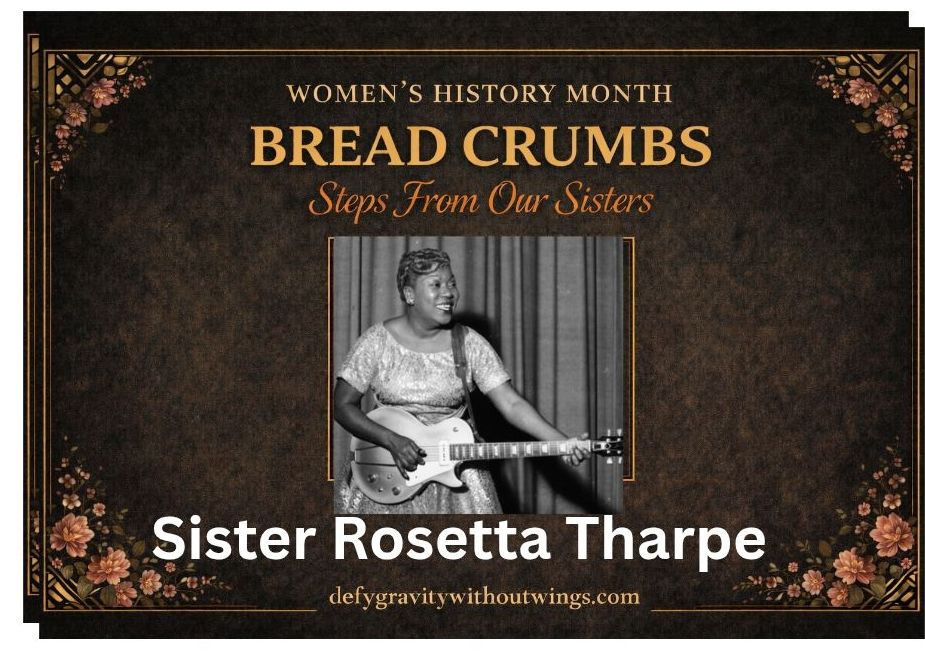
Sister Rosetta Tharpe — Godmother of Rock And Roll

Before rock & roll had a king… there was a woman with a guitar in church. Before They Called It Rock
Sister Rosetta Tharpe was born in 1915 in Cotton Plant, Arkansas. By 6 years old she was already traveling with her mother, performing in churches across the country. A little girl with a guitar and something on her life that didn’t wait for permission.
By the 1930s, she had moved to Chicago and New York, recording gospel music that didn’t sound like what people expected. Her 1938 recording of “Rock Me” carried gospel into spaces folks said it didn’t belong.
Sometimes God will let you sound different before the world catches up.
She played electric guitar. Loud. Joyful. Unapologetic. Too church for the world. Too worldly for the church. But she didn’t split herself to make others comfortable. She carried both.
By the 1940s she was touring, recording hits, and drawing crowds.
In 1951, she turned her wedding into a concert at a baseball stadium in Washington, D.C., with over 20,000 people in attendance.
She was not standing on the front lines of a march, but make no mistake, Sister Rosetta Tharpe was pushing against every line drawn around her. In a time when Black women were expected to be quiet, when stages were dominated by men, and when gospel music was supposed to stay inside church walls, she stepped forward with an electric guitar and refused to shrink. She played to integrated audiences, carried Black gospel into mainstream spaces, and stood fully in her calling without asking permission to belong. She didn’t organize protests, but every note she played disrupted something that said she should not be there.
“Do not conform to the pattern of this world, but be transformed…” — Romans 12:2
Her guitar style helped shape what became rock & roll. Artists like Chuck Berry, Little Richard, and Elvis Presley drew from that sound. But her name was not always given its place.
Because sometimes history doesn’t forget. Sometimes it just misplaces.
“For nothing is hidden that will not be revealed.” — Luke 8:17
She  later settled in Richmond, Virginia and lived in the  Barton Avenue area. No spotlight. Just legacy waiting. But Heaven Kept the Records. In March 2026, the city council of Richmond, Virginia voted to rename a portion of Barton Avenue in her honor, recognizing her contributions to music and culture.
She didn’t wait to be understood. She played anyway. And maybe what feels unseen in you is not buried — just early.
“In due season we shall reap, if we do not lose heart.” — Galatians 6:9
In her later years, Sister Rosetta Tharpe carried both the weight of her health and the quiet of a life that had already poured so much out. She passed in 1973 in Philadelphia after complications from a stroke, having lived a life that did not follow straight lines—married three times, with no children to carry her name forward in the traditional sense.
And yet, her legacy did not fade. It waited. Thirty-four years after her death, she was finally inducted into the Rock & Roll Hall of Fame, a long-overdue recognition for a sound she helped birth. Even Johnny Cash once recalled hearing her records in shops, noting how her music left an imprint before many even understood what they were hearing.
What About You? Maybe what you’ve poured out feels unseen. Maybe it feels like it didn’t matter. But what if it’s not gone just waiting what heaven records earth will eventually recognize.
Breadcrumbs From Our Sisters Who Marched Before Us.
— Love, Chelle
DefyGravityWithoutWings.com
Image

They Grow While You’re Gone


It’s 5:30 a.m.
I’m sipping my coffee, staring out the window into the darkness… somehow convinced I can see trouble in my garden from 100 feet away.

Don’t judge me… but I really considered stepping out there in my robe in 35 degrees to go check on my plant babies.

And somewhere between that first sip and the silence… I caught myself.

This isn’t about seeds.

This is about how easily my mind will grab hold of something—anything—and worry it to death.

Work stress that doesn’t clock out when I do.
Money questions that don’t always have quick answers.
A newborn I just prayed over in the hospital,
with whispers of concern about her ability to thrive.
Friends walking through the slow, sacred heartbreak of losing their parents…
and me carrying pieces of that with them.

All real things. All things that matter. All things experienced before.
And yet…

Look how quickly my heart starts hovering over them, like it’s my job to make sure everything turns out alright. Like if I think about it enough, check it enough, replay it enough…

I can help God along.

But I can’t.

Because even when I am doing the work of God, it is still God who is working.
I am not the outcome.
I am not the fixer.
I am not the one holding it all together.

I am just… hands in the soil.
Faithful to plant.
Faithful to water.
Faithful to show up.

But the growing?
The healing?
The sustaining?

That was never mine.

And if I’m not careful, I will let the weight of what I care about pull me out of the very places God is calling me to be present.

Sitting here with my coffee, trying to manage what He already has in His hands…
while He’s already prepared a seat for me somewhere else today.

There is a time to plant.
A time to water.
And then… a time to trust.
Not anxious trust.
Not hovering trust.
Real trust.

The kind that finishes the coffee,
gets dressed, and walks into the day
without carrying what God never assigned me to hold.

So I’m going where I’m supposed to be.
And I’m leaving the garden…
and everything it represents…
right where it is.

Because what God has already taken responsibility for does not need my worry added to it.

Even the good things don’t get to compete
with obedience.

“To everything there is a season, and a time to every purpose under the heaven.”
— Ecclesiastes 3:1

Love, Chelle

DefyGravityWithoutWings.com

Image

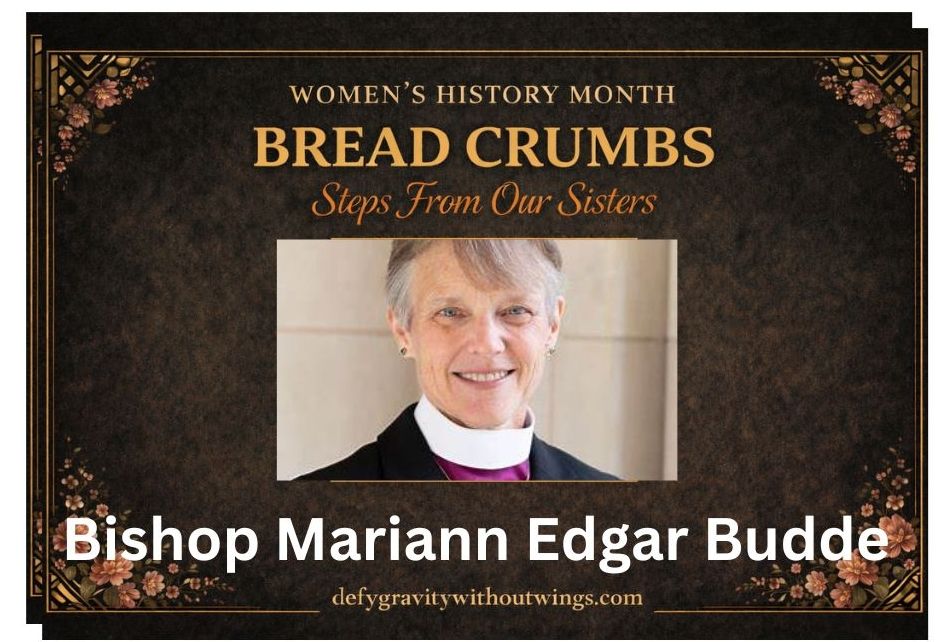
Bishop Mariann Edgar BuddeShe Brought Mercy Into a Room Built for Power

Some women do not raise their voices.
They raise the standard.

She was born in Summit, New Jersey, in 1959, and grew up in the Flanders section of Mount Olive Township, carrying both small-town roots and a wider view of the world.


After her parents’ divorce, she spent time living with her father in Colorado before returning to New Jersey and graduating from West Morris Mount Olive High School, a path that suggests early lessons in change, resilience, and finding your footing more than once.


Before she became known as an Episcopal bishop, she was shaped by an evangelical Christian upbringing, a background that helps explain the clear moral language and steady conviction people would one day hear from her in public life.

Bishop Mariann Edgar Budde became the first woman elected bishop of the Episcopal Diocese of Washington in 2011 after serving 18 years as rector of St. John’s Episcopal Church in Minneapolis.

In January 2025, during a prayer service at Washington National Cathedral attended by President Donald Trump, she spoke directly about mercy for immigrants, LGBTQ people, and others living in fear. What made the moment powerful was not volume. It was clarity. She stood in a sacred place, looked power in the face, and made room for compassion anyway.

That kind of courage belongs in Women’s History Month.

Not only the courage of women who marched with signs or shattered ceilings with applause behind them, but also the courage of women who held their ground in rooms built to intimidate. Women who spoke with steadiness when spectacle would have been easier. Women who understood that conviction does not have to be cruel to be strong.

Mariann Edgar Budde reminded the country that mercy is not frail. Mercy is not timid. Mercy is not a soft substitute for truth. Real mercy has a backbone. It knows exactly what it is doing. It steps into hard places and refuses to surrender its humanity.

She did not need rage to make history.
She did not need performance to make her point.
She did not need to wound anyone to be unforgettable.

She stood there as a woman, a leader, and a witness. Calm, clear, and unwilling to let fear have the final word.

That is how some women leave footprints.
Not by shouting over the room.
But by changing the temperature in it.

Speak up for those who cannot speak for themselves,
for the rights of all who are destitute.”
Proverbs 31:8

May we remember Bishop Mariann Edgar Budde not simply as the woman who unsettled a president, but as a woman who stood before power and still chose mercy. In a world that too often mistakes cruelty for strength, that witness matters.

We see you.

Steps From Our Sisters
Honoring the Women Who Marched Before Us

Curated by
Michelle Gillison-Robinson
DefyGravityWithoutWings.com
.

Image

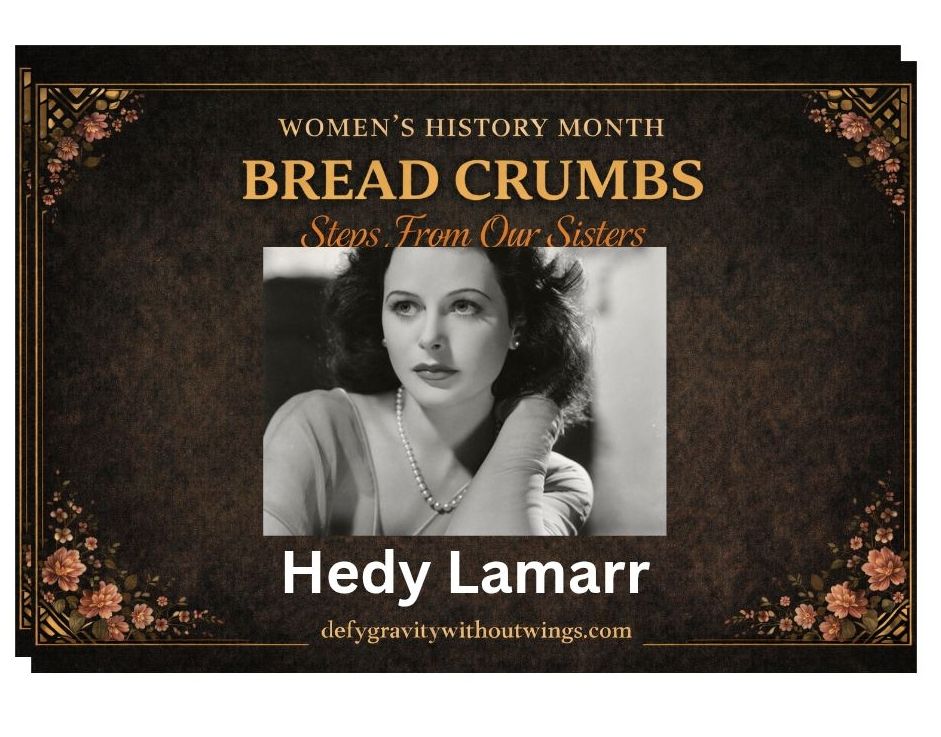
Hedy Lamarr – The Beauty Who Invented The Future

(November 9, 1914 – January 19, 2000)

Sometimes the world notices the wrong thing first.

Hedy Lamarr was known throughout Hollywood as one of the most beautiful actresses of the 1940s. Her face appeared on movie posters and magazine covers, and audiences admired her elegance and glamour.

But behind the fame lived a restless and brilliant mind.

During World War II, Lamarr watched the rise of Nazi power in Europe and wanted to help the Allied cause. Working with composer George Antheil, she developed a communication system designed to guide torpedoes without enemy interference.

Their invention used a method called frequency hopping, where radio signals constantly changed channels so they could not be jammed.

At the time, the military dismissed the idea.

Years later, however, the technology behind Lamarr’s invention became the foundation for modern wireless communication. Today the same principle supports Wi-Fi, Bluetooth, and GPS systems used around the world.

There is a verse in Proverbs that reminds us, “The Lord gives wisdom; from His mouth come knowledge and understanding.”

Hedy Lamarr reminds us that wisdom often lives quietly beneath the labels the world places on us.

Sometimes the person everyone admires for one gift is carrying another gift powerful enough to shape the future.

The world may decide who you are before it knows your whole story.

Hedy Lamarr was celebrated for beauty, but her mind helped build technology that connects billions of people today.

Sometimes the gifts God gives us are not immediately recognized. But that does not make them any less powerful.

We see you, Hedy. All of you.

Steps From Our Sisters

Honoring the Women Who Marched Before Us

Curated by

Michelle Gillison-Robinson

DefyGravityWithoutWings.com
Image

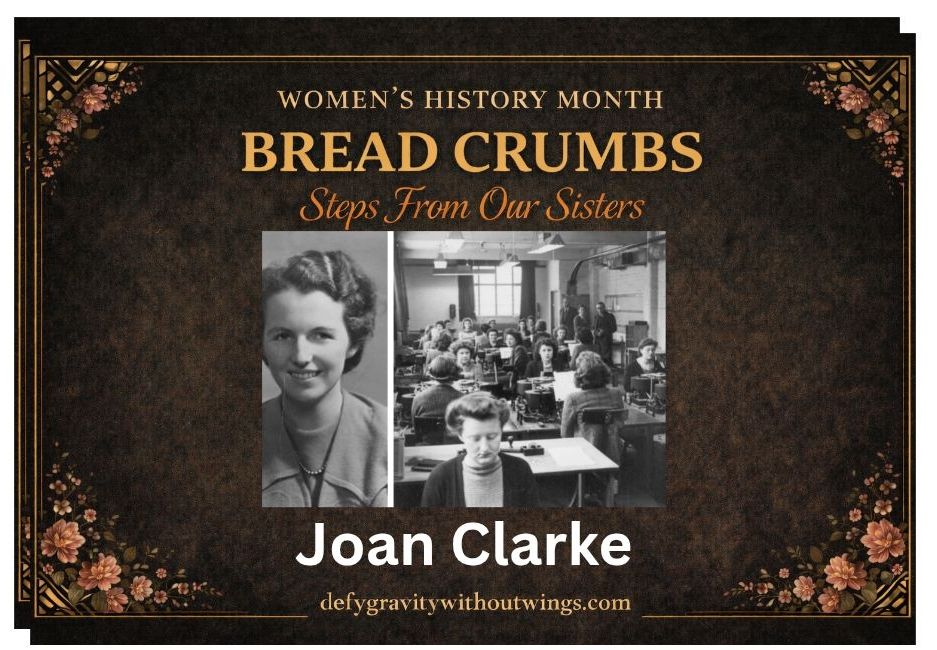
The Woman Who Helped Crack the Enemy’s Code  – Joan Clarke


(June 24, 1917 – September 4, 1996)

Sometimes the fate of nations depends on someone solving a puzzle.

During World War II, the British government gathered mathematicians, linguists, and puzzle solvers at a secret intelligence center called Bletchley Park. Their mission was to break the encrypted messages sent by Nazi Germany through the Enigma machine.

Among those brilliant minds was Joan Clarke.

Clarke had a remarkable talent for mathematics and logical reasoning. Despite her skill, she was initially placed in a clerical role because few people believed women belonged among the leading cryptanalysts.

But her brilliance soon became impossible to ignore.

Working alongside other codebreakers, including Alan Turing, Clarke helped decipher German military communications. The intelligence gathered from those messages allowed Allied forces to anticipate enemy movements and strategies.

Historians believe the success of the Bletchley Park team shortened World War II by several years and saved millions of lives.

There is a verse in Ecclesiastes that says, “Wisdom is better than weapons of war.”

Joan Clarke proved that truth in the quietest way possible.

Sometimes the mind that changes history
is sitting silently at a desk, pencil in hand.

Bread Crumbs

Not every hero stands on a battlefield.

Some sit in quiet rooms, solving problems others cannot see.

Joan Clarke reminds us that intelligence, patience, and perseverance can protect lives just as surely as strength or weapons.

Sometimes the wisdom God places in one mind
can help guide the safety of millions.

Steps From Our Sisters
Honoring the Women Who Marched Before Us

Curated by
Michelle Gillison-Robinson
DefyGravityWithoutWings.com


Image

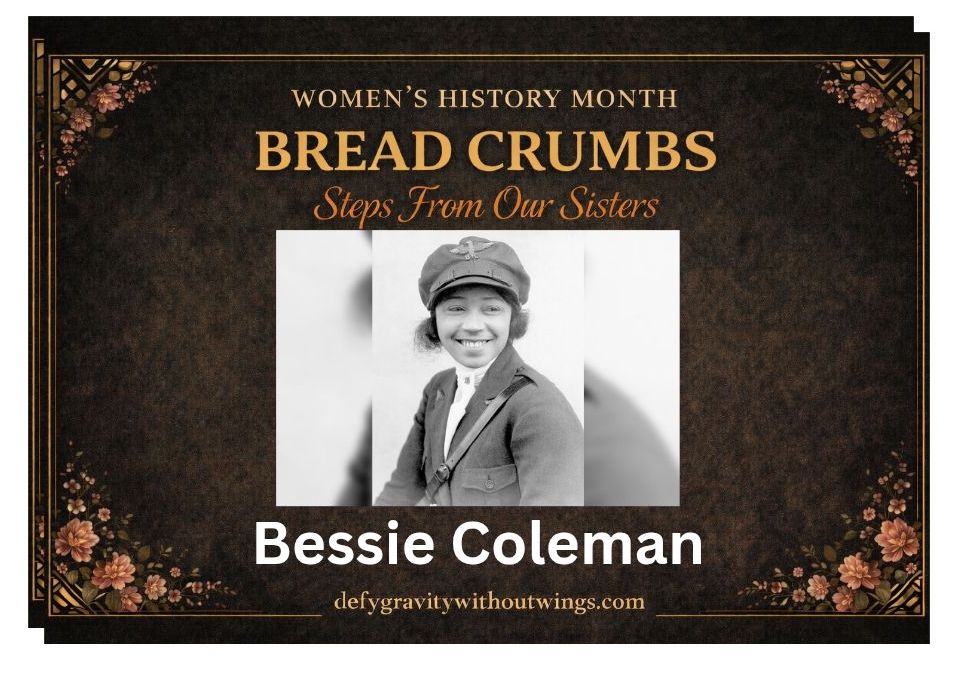
Bessie Coleman – The Woman Who Refused to Stay Grounded

(January 26, 1892 – April 30, 1926)

Sometimes the sky becomes the only place left to prove you belong.

Bessie Coleman grew up in Texas at a time when both race and gender limited opportunity. When she dreamed of becoming a pilot, every flight school in the United States refused to teach her.

She was Black.
She was a woman.

So Bessie Coleman did something extraordinary.

She learned French and traveled to France, where she earned her pilot’s license in 1921, becoming the first African American and Native American woman in the world to hold an international pilot’s license.

When she returned to the United States, crowds came to watch her fly. Coleman became a famous stunt pilot, performing breathtaking aerial tricks that left audiences amazed.

But she used her platform for something deeper.

She refused to perform at air shows that did not allow Black audiences to attend. To her, flight was not just entertainment.

It was dignity.

There is a verse in Isaiah that says, “They will soar on wings like eagles.”

Bessie Coleman lived that promise with courage and determination.

Sometimes the first person to break a barrier
must build the runway herself.


Breadcrumb
The world may close doors in front of you.

Bessie Coleman did not accept the doors that were closed.

She crossed an ocean instead.

Sometimes God places a dream in your heart that cannot grow where you started.

And sometimes the path forward begins
with the courage to leave the ground.

Steps From Our Sisters
Honoring the Women Who Marched Before Us

Image

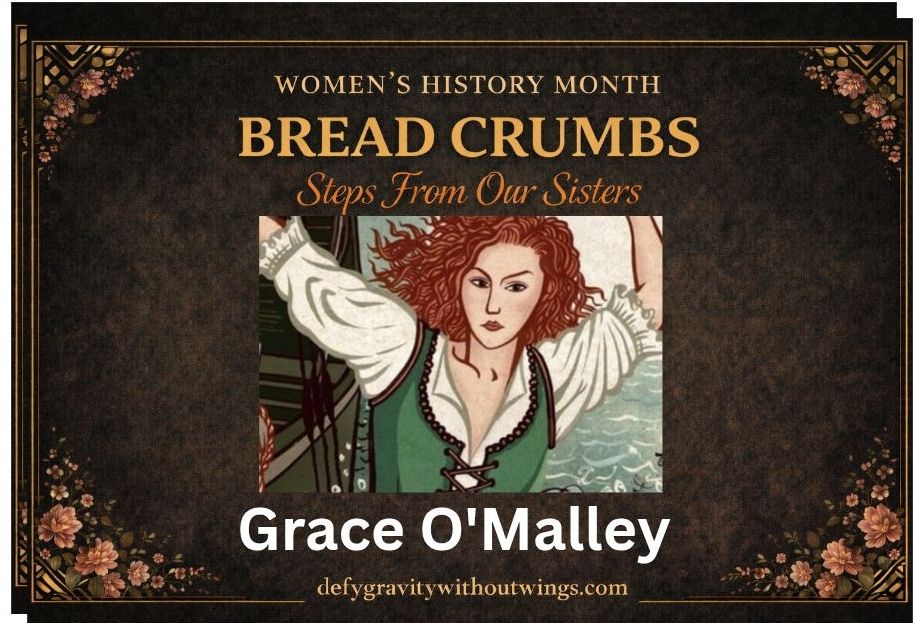
Grace O’Malley – Pirate Queen

(c.1530 – 1603)
Sometimes history remembers kings. But occasionally the sea belongs to a queen.
Grace O’Malley, known in Ireland as Gráinne Mhaol, was born into a powerful maritime clan along Ireland’s western coast. From a young age she refused the expectations placed upon women of her time.
She learned the sea instead. Grace commanded ships, led sailors, and controlled trade routes along the rugged Irish coastline. Her fleets became legendary, and her name was spoken with both admiration and caution.
When English forces threatened her family and territory, Grace O’Malley did something almost unheard of. She sailed to England and met Queen Elizabeth I face to face.
The two women spoke as equals, negotiating the freedom of O’Malley’s son and the restoration of her lands.
There is a verse in Psalm 93 that says, “The Lord reigns… the seas have lifted up their voice.”
Grace O’Malley’s life seemed to echo that image—strong, fearless, and unafraid of powerful waters.
Sometimes courage does not wait for permission.
Sometimes it sets sail.
Strength often begins with refusing the limits others place on you.
Grace O’Malley was expected to live quietly. Instead she commanded ships and negotiated with queens.
Her story reminds us that leadership can emerge from the most unexpected places.
Sometimes the waves that try to block your path are the very waters meant to carry you forward.
Steps From Our Sisters
Honoring the Women Who Marched Before Us

Image

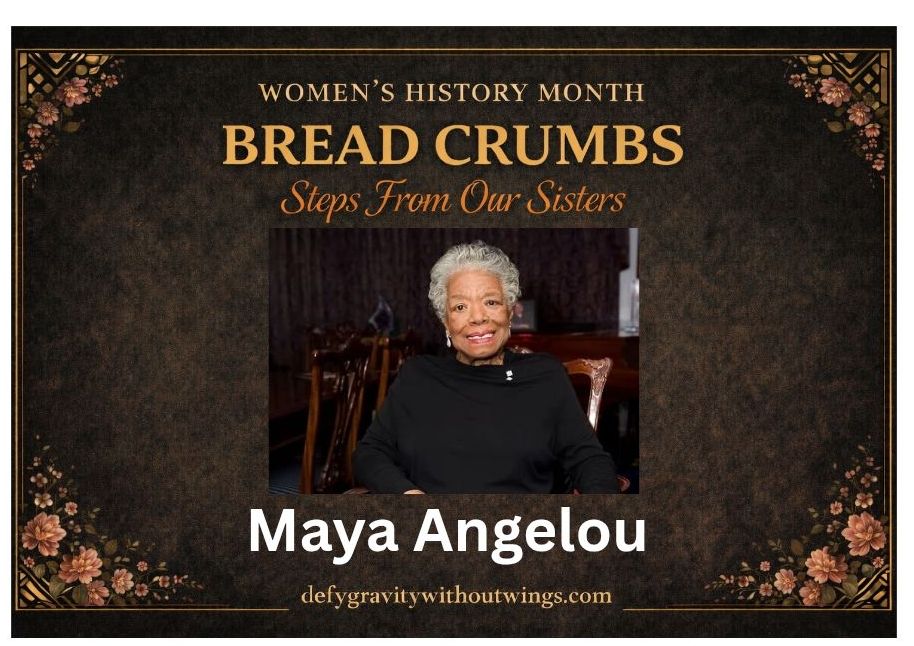
Maya Angelou: When a Voice Becomes Courage

She carried many lives before the world called her a poet.
Maya Angelou was born in St. Louis, April 4, 1928 as Marguerite Annie Johnson.   The name Maya was derived from her brother Bailey who just could not pronounce her name and would call her “My Sister” . It morphed into Maya which stuck. Angelou came from her first husband,  Enistasios Angelos, a Greek sailor. She adapted the surname slightly to Angelou when she began performing as a dancer and singer so it would sound more lyrical on stage.

She was  raised in the segregated South where dignity was often denied but never fully destroyed. Her childhood held both silence and survival, experiences that would later shape the voice the world came to know.
She refused to stay one thing. Angelou worked as a streetcar conductor, dancer, singer, journalist, and organizer long before the world recognized her literary voice. Her life moved through many stages, but each experience added depth to the perspective she would later bring to her writing.
Her voice extended beyond stages and books. During the Civil Rights Movement she worked alongside Martin Luther King Jr. and Malcolm X, helping organize, write, and advocate for justice. In 1964, after years living and working in Africa, Angelou returned to the United States at the invitation of Malcolm X to help him build a new civil rights organization focused on global Black unity.
Before that work could fully take shape, Malcolm X was assassinated.
The loss shook her deeply, but Angelou continued writing, speaking, and advocating for dignity and equality. Only a few years later the movement suffered another devastating loss when Dr. King was assassinated on April 4, Angelou’s own birthday.
Still she wrote.
In 1969, I Know Why the Caged Bird Sings gave voice to stories the world rarely allowed Black women to tell out loud. Stories of trauma, identity, and the quiet power of rising again. Her words did not whisper. They lifted.
As she once wrote: “Still I rise.” Three simple words that carried generations.
But the voice the world came to love was not always easy for her to use.
As a young girl Maya Angelou endured a violent assault. When she spoke the truth about what had happened, the man responsible was later killed. In her young mind she believed her words had caused it.
So she stopped speaking.
For years she lived in silence, afraid that her voice carried too much power. It was a teacher, Mrs. Bertha Flowers, who slowly led her back to language through books, poetry, and the music of words.
The voice that would one day move a nation had to be reclaimed first.
In 1993 she stood at the inauguration of President Bill Clinton and read On the Pulse of Morning, becoming only the second poet in American history to deliver a poem at a presidential inauguration.
But her greatest legacy was simpler.
She gave language to survival.
Her life echoes a truth older than any poem:
“We are hard pressed on every side, but not crushed; perplexed, but not in despair.” — 2 Corinthians 4:8

I once saw Maya Angelou in concert. In a packed 1000 plus  seat  theater she sang “God Sent a Rainbow” without a microphone. The room fell completely silent as her voice carried to every corner. It felt as if the walls themselves were listening.
In that moment I understood something about courage. Voices like Maya Angelou’s do more than speak. They remind us that we are not meant to stay silent either. Somewhere in our own lives there is a truth waiting to be spoken, a kindness waiting to be offered, a step waiting to be taken.
And that is how Bread Crumbs are made.
Poet. Witness. Voice for generations.
We see you, Maya Angelou — for giving language to survival and wings to truth.
Bread Crumbs — from those still marching forward.
Steps From Our Sisters. Still here.
What step might be waiting for you?

Image

My Rib Struggles To Breathe

March 1, 2026

God of dirt under fingernails, of headlines and heartbeats, of babies born into chaos
and mamas who don’t sleep.
Lord hear our prayer
Sit with us in sackcloth and ash.

Hear the Latina scream for her familia.
Hear the Black mama beat her chest
from the weight of knees and crushed souls
Hear the confused person of no color
whisper, “Am I next?”

See my father’s shadow.
The brown father working double shifts
with documents that feel like paper shields.
The Black father teaching his son
how to survive a traffic stop.
The father from somewhere else
trying to sound less foreign
so his children sound more safe.

The one who has never been taught how to weep, but learns that privileged skin
offers no protection.

Watch how they swallow fear so their families can eat.
Watch how they stand tall while history presses down.
Do not turn Your face from the trembling.

Is Abraham’s argument still valid?
Is there still one worth saving?
If there are fifty…
If there are forty…
If there are ten…
Will mercy outrun destruction?

Because we be something else.
We invent vaccines and vendettas.
We cure disease and cultivate grudges.
We build greenhouses and graveyards
in the same generation.

We scream “save the babies” while demanding their mothers bleed in parking lots outside buildings bearing neon  crosses and snakes on stakes.

And if that little bundle of hope
takes breath….. we ration mercy.
We starve truth. We feed them fear.
We hand them a system and call it destiny.

Forgive us for mistaking loud for strong,
revenge for justice,
power for wisdom,
money for mattering.

Slow the hands hovering over buttons.
Cool the tongues that set nations on fire.
Remind the mighty that bleeding does not discriminate.

When leaders puff up,
deflate egos with a firm hand.
When citizens rage-scroll at 3:33 a.m.,
tuck them back into cradles of mercy.

Teach us that being right is not the same thing as being righteous.

And teach us this, Lord –
That Holy is set apart, not divided asunder.

Set apart does not mean split down the middle.
It does not mean camps or corners
or color-coded salvation.

Holy is not red. Holy is not blue. Holy is not loud.

Holy is careful. Holy is weighty.
Holy is handled like heirloom glass passed from trembling hands.

Do not let us carve You up to fit our arguments.
Do not let us drape Your name over fear and call it faith.

If we must be set apart, let it be in compassion.
If we must be different, let it be in mercy.
Separate us from cruelty.
Separate us from arrogance.
Separate us from the need to win
at the cost of one another.

But do not divide us beyond repair.
Remind us that what is sacred is never meant to be torn.

Lord Hear Our Prayer

For the refugee in the cold,
the soldier on watch,
the child learning history from a textbook that left something out —
Cover them.

Guard democracy like a fragile seedling in late frost.
Guard dignity like Grandma’s good china.
Guard hope like a porch light left on for whoever comes home late.

When we start thinking the sky is falling,
Whisper,
“Dead and dormant are not the same thing.”

Let wars stall. Let hatred get tired. Let truth outlive the loud.

And if we must walk through fire, let it burn off what is false and leave what is faithful.

While presidents posture and pundits perform
Let ordinary people sleep.
Let Nama rest. Let grandchildren dream of gardens instead of sirens.

My bladed pen is hot. It does not drip ink.
It draws blood from silence. It refuses anesthesia. I tire  of gentle prayers that never name the wound.

If my words burn, let them cauterize.
If they cut, let them carve truth
from marble lies.

Out of all the people in this great big world,
please hear me. Please know my voice.
Hear me when I pray.
For I will not whisper  when my rib struggles to breathe.

Amen.  Ameen. Aṣẹ̀ Olódùmarè. Selah. Shanti. Alafia. Tathāstu. Ubuntu

from Poems My Mama Would Have Wrote ( If She Had Been Allowed”
Althea’s Daughter: Michelle Gillison-Robinson