Image

A Season Of Miracles Of Rest (Even When We Can’t Sleep Yet)

Every new year arrives carrying declarations.
More. Faster. Bigger. Better.

But this year, something different is echoing through pulpits and prayers alike:
a quiet but radical declaration—
this is a season of miracles of rest.

Ironically, many of us are hearing that message while lying awake at night…
thinking about rest.
Planning rest.
Wondering why rest feels like another assignment we’re failing.
(Ask me how I know.)

Still, Scripture reminds us that some of God’s most powerful work happens when we stop striving—even when stopping doesn’t come easily.

“Come to Me, all who labor and are heavy laden, and I will give you rest.”
— Matthew 11:28

Rest is not a reward for finishing.
It is often the starting place—even if our bodies haven’t caught up with the invitation yet.

Renew Me
Renewal isn’t about becoming someone new.
It’s about being refreshed into who God already designed us to be.

Sometimes renewal looks holy and quiet.
Other times it looks like admitting,
“I’m exhausted… and still awake.”

God is not offended by that honesty.

“He restores my soul.”
— Psalm 23:3

Revive Me
To revive is to bring life back to what looks dormant.
Not dead—just tired.
Just worn thin by years of pushing through.

If you’ve ever felt like your spirit hit the snooze button even while your faith stayed intact, you’re not alone.

“Will You not revive us again, that Your people may rejoice in You?”
— Psalm 85:6

Restore Me
Restoration is holy repair.
It is God returning what was lost, broken, or depleted—not always in the same form, but with deeper wisdom attached.

Including the ability to rest without guilt.

“I will restore to you the years the locust has eaten.”
— Joel 2:25

Room to Breathe
Not rushing into the next assignment.
Not proving the miracle worked.
But giving yourself permission to exhale—even if sleep comes later.

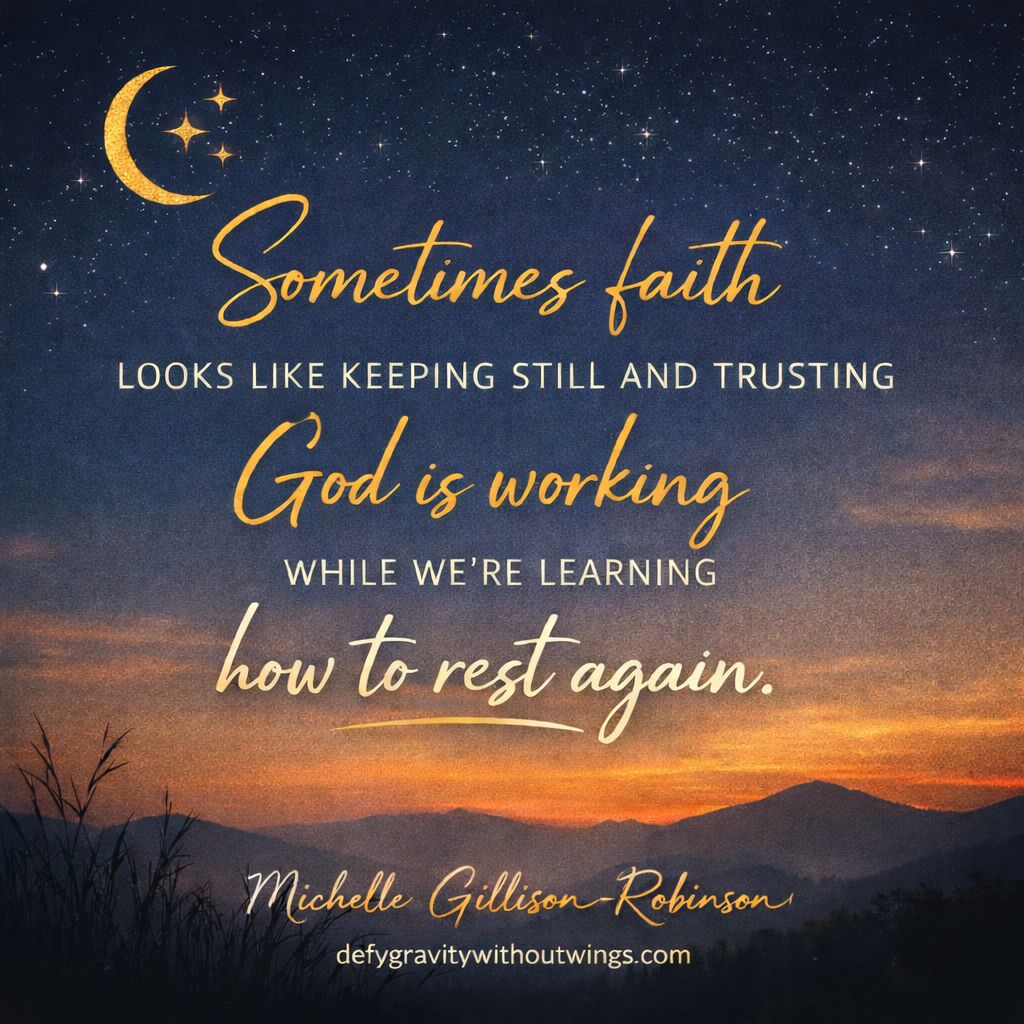
Sometimes faith looks like lying still and trusting God is working while we’re learning how to rest again.

“In returning and rest you shall be saved;
in quietness and trust shall be your strength.”
— Isaiah 30:15

God, as this year begins, renew us where we are weary—even when we can’t quiet our minds yet.
Revive what has grown tired within us.
Restore what life has worn down.
And teach us how to rest without guilt, trusting that You are still moving, even while we lie awake learning how to breathe again.
Amen.

Love Chelle
Image

Watch Night Reflection: Auld Lang Syne in a Colder World

“Auld Lang Syne” (yes… I had to look up how to spell it) is often sung on nights like this, though many of us don’t quite know what we’re saying. The phrase comes from old Scots and simply means “times long past” or “old long since.”


It’s really a question—Should old acquaintance be forgot?


Tonight, we know the answer is no.
Some traditions look different now.
Watch Night doesn’t stretch to midnight anymore.
Candles burn a little shorter.
Doors close earlier than they used to—not because faith has failed, but because the world has grown colder, louder, and less safe.
And yet… here we are.


We gather not to mourn what’s changed, but to remember what still matters.


“Because of the Lord’s great love we are not consumed,
for His compassions never fail.
They are new every morning;
great is Your faithfulness.”
— Lamentations 3:22–23 (NIV)


“Auld Lang Syne” isn’t about nostalgia—it’s about honoring the bonds that carried us through. It invites us to pause, look back, and say: We made it. Together.
So tonight, before we step into a new year, let us do a few holy things:
• Give thanks for the days behind us—both joyful and hard
• Release what no longer serves our spirit
• Recommit to the people God placed in our care
• Check on family, even the ones who don’t answer right away
• And if you really love me… bake the baker  a pineapple upside-down cake, because my birthday is in a few days (amen and thank you in advance)


Because in a world that feels colder, connection is resistance.
Community is courage.
And faith—quiet, steady faith—still keeps watch.
So even if we leave before midnight,
even if the song fades early,
we carry the meaning with us:


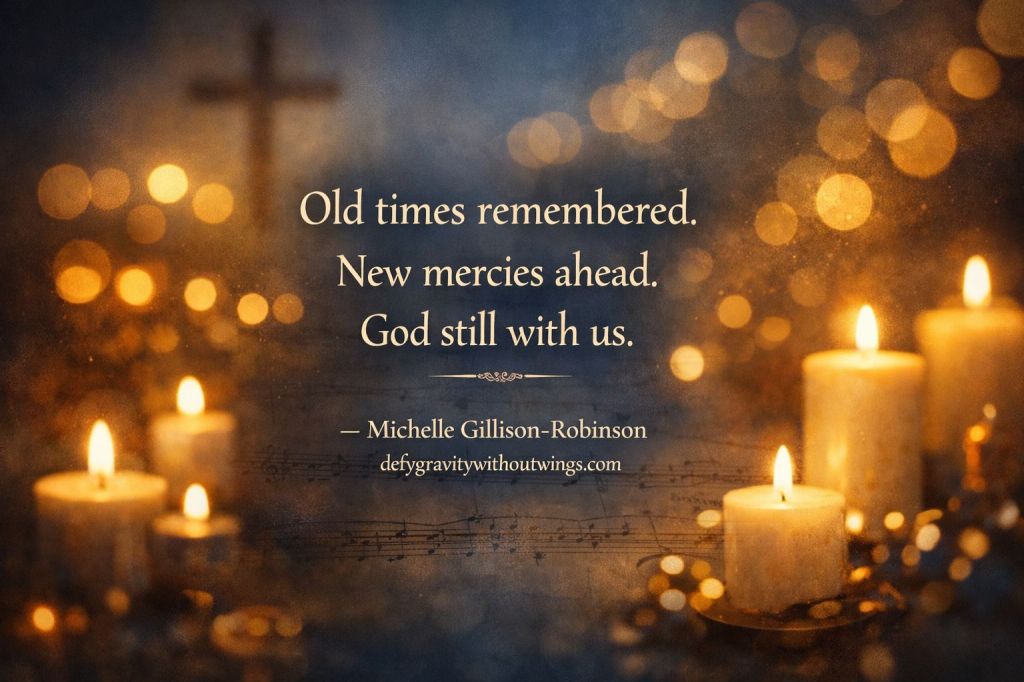
Old times remembered.
New mercies ahead.
God still with us.
Amen.

Loving you right into our next adventure,  Chelle


Michelle Gillison-Robinson

defygravitywithoutwings.com

Image

When Joy Waits

I’ve been sitting with these thoughts since Christmas Eve, wanting to honor tender hearts.


During this season, I know several people walking through fresh grief — the loss of parents, spouses, siblings, children, grandchildren.

Others carry a different kind of ache: childhoods that hold no warm memories to return to. One person even whispered that they weren’t sure they wanted to live to see the New Year.


That kind of pain deserves reverence, not rush.


I was determined not to meet their sorrow with well-meaning clichés — “volunteer,” “adopt a family,” “stay busy,” “choose joy.” Those things can be beautiful, and I do them now. But it took me years of sitting inside my own grief before I could get there. Years before someone else’s smile softened the sting instead of feeling like salt in the wound.
So I don’t beat people over the head with happiness.


Sometimes the greatest gift we can give is not advice, not solutions, not silver linings — but presence. To sit. To be quiet. To resist the urge to fix. To simply watch and wait with someone.


Scripture tells us:
“The Lord is close to the brokenhearted and saves those who are crushed in spirit.”
— Psalm 34:18


Notice what it doesn’t say.
It doesn’t say God rushes the brokenhearted.
It doesn’t say He lectures them into joy.
It says He is close.


Jesus did come to bring joy to the world — but grief, like the ocean, comes in waves. And the return to joy doesn’t arrive all at once. It comes in stages.


That truth surprised me again while watching Disney’s “Inside Out 2”. When Joy tried to take over too quickly — before the main character was ready — it didn’t heal her. It pushed her deeper into despair. What she needed wasn’t forced positivity. She needed permission to sit with sorrow and memory for a while without being rushed toward “better.”


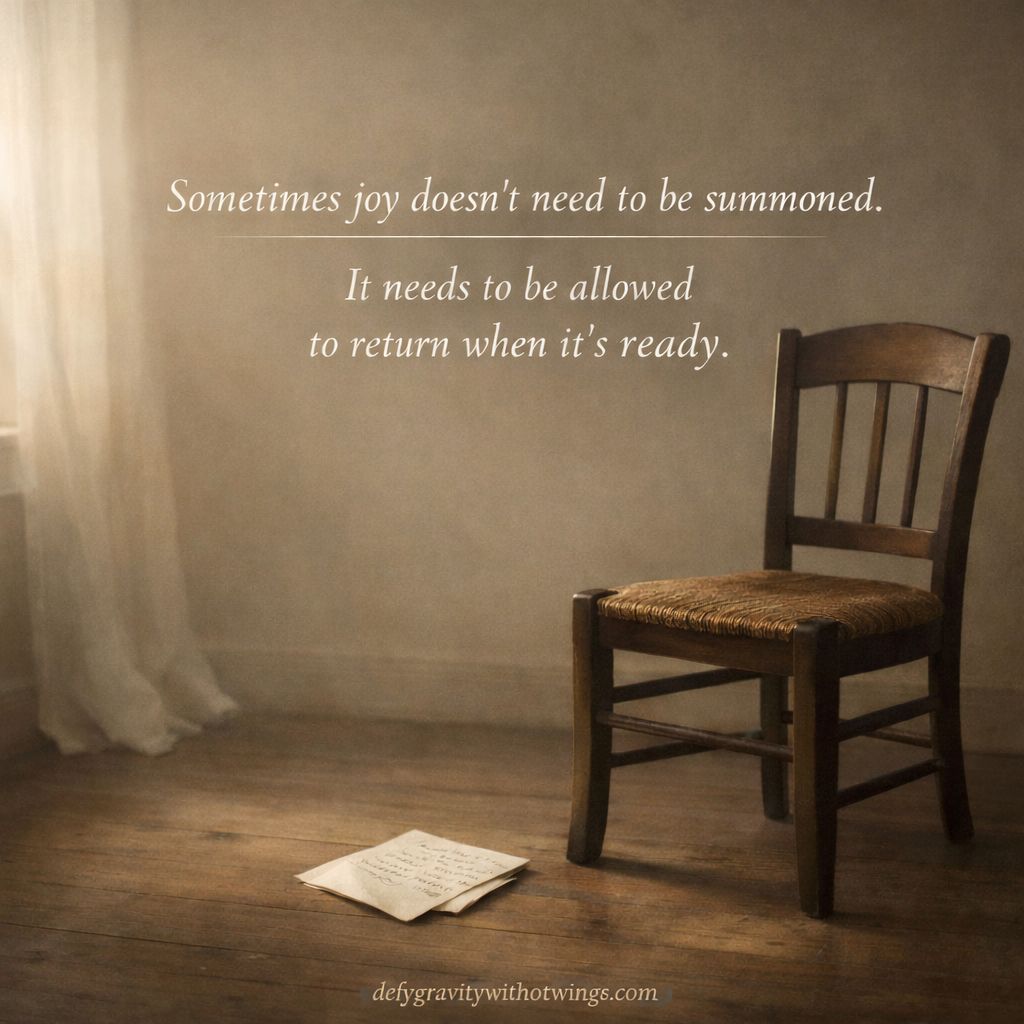
Sometimes joy doesn’t need to be summoned.
It needs to be allowed to come back when it’s ready.


If this season finds you heavy, please hear this:
You are not failing because you aren’t cheerful.
You are not weak because you’re tired.
You are not faithless because joy hasn’t returned yet.


Jesus is close to the tenderhearted — not waiting on the other side of your healing, but sitting with you right in the middle of it.
And sometimes, that quiet companionship is the most sacred gift of all.

Can we pray?
Jesus,
You who are close to the brokenhearted,
draw near to every tender soul reading this.

For those carrying fresh grief,
sit with them in the quiet where words fall short.
For those whose memories ache instead of comfort,
hold them without asking them to explain.

Guard them from the pressure to perform joy
before it has found its way home again.
Give permission for tears, for pauses, for breathing slowly.

Where sorrow comes in waves,
be the steady presence that does not leave.
And when joy is ready to return — even in small, fragile ways —
let it arrive gently, without force or fear.

Until then, be enough.
Be near.
Be kind to the tenderhearted.

Amen.

For Shelby. Heaven makes noise a 3 a.m. just for you.

Love, Chelle

Image

Faith With A Yawn

(Or: When Christmas Finally Got Me)


I did something yesterday that I almost never do.
I fell asleep at the table.

Not the polite, chin-in-hand, “I’m listening” kind of sleepy.
The real kind. The head-dip. The eyelids surrendering mid-conversation.
The kind that scared me just enough to notice.

Christmas finally got me.

I had planned for rest. I needed rest.
But life — and love — had other things lined up.

A quick visit to the nursing home turned into three hours because they were short-staffed. Again.
I stayed — because love doesn’t clock out when it’s inconvenient.

Somewhere in between, there was also chasing down folks to drop off gifts.
“Let me just swing by real quick.”
“One more stop.”
One more smile. One more bag. One more moment of making sure nobody felt forgotten.

By the time I made it home, I barely had enough energy to pivot to the next thing — visiting my mother-in-love.

Bless her — she cooked.
I ate.
And somewhere between gratitude and exhaustion, my body simply said, “That’s enough now.”

I nodded off at the table.

I laughed about it later, because it was funny.
But it also scared me — because I don’t do that.
I’m usually the one pushing through, powering up, showing up.

What I realized later is this:
That moment wasn’t weakness.
It was honesty.

My body told the truth before my mouth ever would.

We talk a lot about rest, but rarely about what happens when we don’t get it — when we keep pouring, keep visiting, keep delivering, keep caring, and assume adrenaline and responsibility will carry us through.

Sometimes they do.
Sometimes… they don’t.

And God doesn’t shame us for that.

“It is useless for you to work so hard from early morning until late at night, anxiously working for food to eat; for God gives rest to His loved ones.” — Psalm 127:2

That verse doesn’t scold.
It exhales.

Maybe falling asleep at the table wasn’t failure.
Maybe it was permission.

Permission to admit that Christmas — the beauty, the chaos, the caregiving, the gift-chasing, the expectations — costs something.
Permission to stop pretending we’re machines.
Permission to rest without first earning it.

Today, I’m still tired.
Still booting up.
Still faithful — just slower.

And that’s okay.

If you’ve nodded off emotionally, spiritually, or physically this season — you’re not broken.
You’re human.

Pull up a chair.
Take a breath.
God is not offended by your yawn.


Image

The Gift That Keeps Showing Up

Every morning — and sometimes as early as 3 a.m. — there’s a small sacred ritual that happens on our phones.


A text thread.
Women connected by blood, history, humor, and habit.
Aunts. Nieces. Sisters. Cousins.


It usually starts with a simple greeting. A prayer emoji or a sermon link. . A “Love y’all.”


And yes… sometimes it starts because one of us can’t sleep and assumes nobody else should be sleeping either. (That one might be on me.)


This is how we stay connected now.
Because age has a way of rearranging life, schedules don’t always line up, and seeing each other as often as we’d like isn’t always possible. But love? Love adapts.


Yesterday, my Aunt Lenora changed the subject in our group text. You know how the family matriarchy does — when wisdom rises up and gently says, Pay attention.


She shared something God had revealed to her about Great-Grandma Martha and Grandma Alice.
They used to say it often around holidays and birthdays:
“I don’t want y’all to give me any gifts this time. Thank you, but I really don’t need any more.”


At the time, we smiled. Sometimes, we insisted anyway.
Because giving is how we show love.
But after they passed, we found something that stopped us in our tracks —
gifts still in their packages.
Closets holding love that had already been received in the heart.


And suddenly, the words made sense.
It wasn’t that they had everything.
It was that satisfaction had settled in.
Gratitude had overflowed.
Hearts were full. Closets were full.
And the desire for more stuff had quietly faded.


Aunt Lenora put it beautifully in the text:
“It’s not that we have everything that could be had. It’s just that at a certain point, satisfaction sets in, gratitude is overflowing, hearts are filled… and even though you’re still grateful for expressions of love, there’s no more desire for stuff.”


And then came the revelation that wrapped everything together:
“We finally understand the real meaning of Christmas.
The Father gave the Son.
The Son gave the Spirit.
The Spirit gives us life —
so we can give the gift of love.
And that gift goes on and on and on.”


That’s it.
That’s Christmas.
Not the packages.
Not the receipts.
Not the pressure to perform joy.
Just love — passed down like an inheritance no one can lose.


This season has reminded me that our worth today is not measured by who shows up for us, but by who we show up as.
Great-Grandma Martha showed up with wisdom.
Grandma Alice showed up with contentment.
Aunt Lenora shows up with revelation.
And the women in that early-morning text thread show up — faithfully, lovingly, imperfectly.


And I show up with a pen — so that my daughter, Paula, will never forget the legacy of these women.
So she will know where she comes from.
So she will recognize the holy inheritance of faith, gratitude, and love that flows through her name.


Sometimes love looks like gifts.
Sometimes it looks like unopened packages.
And sometimes it looks like a 3 a.m. text that says, I’m thinking about you. I’m grateful for you. You’re not alone.


Scripture reminds us:
“A generous person will be enriched, and one who gives water will get water.” — Proverbs 11:25
That may be the gift that never stops giving.

Merry Christmas ,

Chelle

Image

When Christmas Doesn’t Recognize Itself

I’ll admit it—I chuckled at first.
I saw a video of a broke Hispanic father joking with his young son that ICE had taken Santa. It was meant to be humorous, a dark joke wrapped in the language of survival. I laughed… and then I stopped.


Because once the laughter faded, the weight of it settled in.


How awful to place that kind of fear on a child. How heartbreaking that this joke even works in our current climate. And then it hit me—harder than I expected.


Under the prevailing American mindset of 2025, the very figures we celebrate at Christmas wouldn’t be welcome here.
Santa would be questioned.
Mary and Joseph would be detained.
Jesus would be born into a system already suspicious of Him.
The wise men would be asked to self-deport.
The angels would be accused of violating airspace.
And the shepherds—unhoused, roaming, living off the land—would likely be jailed for existing outside the rules.


Yes, I know—it sounds like a stretch.


And yes, there must be laws. There must be order. There must be boundaries and systems and responsibility. Scripture never denies that.


But Scripture also never allows us to weaponize law against love.
Because the story of Christmas—the real one—is not clean, controlled, or credentialed. It is a story of displacement. Of vulnerability. Of outsiders. Of God choosing to arrive without papers, privilege, or protection.


Mary wasn’t prepared.
Joseph wasn’t powerful.
Jesus wasn’t safe.
And none of them fit the mold of who society typically makes room for.


Yet this is the story we retell every year with lights and carols and nativity scenes that have grown far too tidy.
Somewhere along the way, we learned to celebrate the symbols of Christmas while quietly opposing everything they stand for.
We sing about peace while nurturing fear.
We speak of joy while guarding our comfort.
We proclaim love while questioning who deserves it.


And that should sober us.
Because Jesus Himself said,
“I was a stranger, and you invited me in.”
Not you vetted me.
Not you verified my worth.
Not you made sure I belonged first.
He didn’t ask us to solve immigration policy.
He asked us to recognize people.


The question Christmas asks us—every year, relentlessly—is not whether we believe in Christ, but whether we resemble Him.
Would we make room for Him now?
Or would we ask Him to prove He belongs?
If the answer makes us uncomfortable, maybe that discomfort is holy. Maybe it’s an invitation to return—not to tradition, but to truth.
Because Christmas has always been about God crossing borders.
And love, by nature, refuses to stay contained.

Love Chelle

Love Chelle

Image

The Light Still Works


I’ve always told people this—and I’ll keep telling it until somebody takes my peppermint tea away:


Christmas, Hanukkah, and Kwanzaa do not cancel each other out.
They don’t compete.
They don’t substitute.
They don’t need a theological cage match.
They simply tell different parts of the human story.


Christmas celebrates His birth—God choosing skin and breath and inconvenience


Hanukkah reminds us of tradition, remembrance, and light that refused to go out, even when logic said it should.


Kwanzaa lifts up principles that look suspiciously Christ-like—unity, purpose, responsibility, faith lived out loud.


Different languages.
Same longing for light.


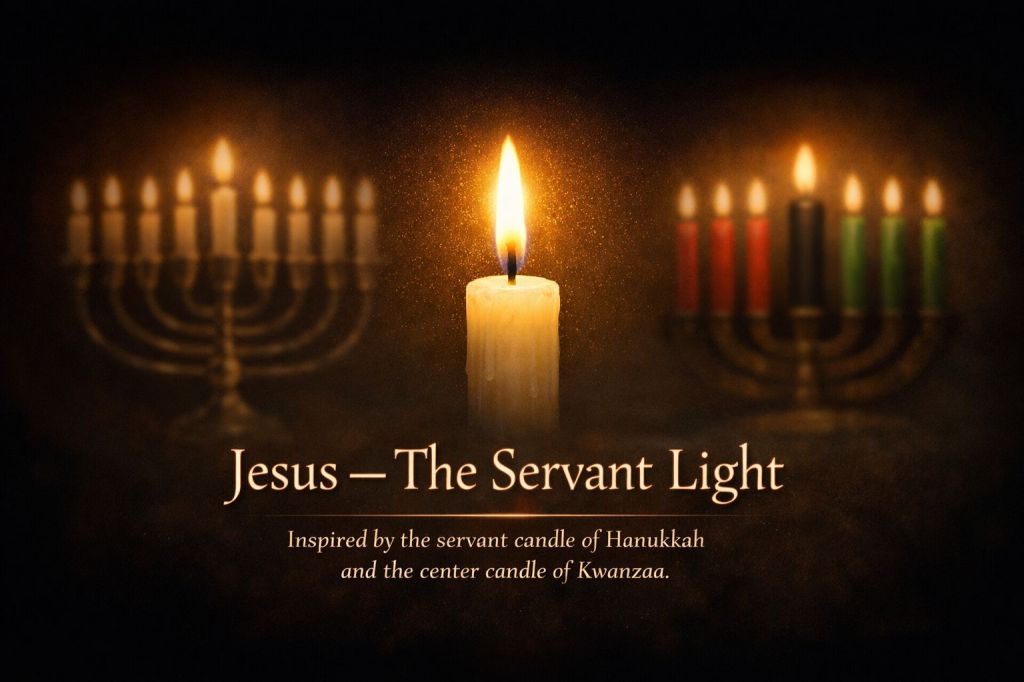
In Hanukkah, there is a center candle called the shamash—the servant candle.
It’s set apart.
It’s lit first.
And it doesn’t shine for itself.
Its whole purpose is to light all the others.


That image has always stayed with me. Because in Christianity, that’s Jesus.
He didn’t arrive demanding attention.
He didn’t come to be admired from a distance.
He came to serve, to ignite, to give light away—even when it cost Him everything.
Jesus is the Servant Candle.
Lifted up not for status, but for sacrifice.
Set apart not for glory, but for love.


Kwanzaa, too, places a center candle—the black candle—knowing who the people are, grounding everything else in identity and purpose. Not a servant candle, but a reminder that light means little if you forget who you are while holding it.


Different meanings.
Same truth: light is meant to be shared.


This conviction was born years ago when a young friend looked at me like I’d grown a second head because I knew what the symbols on a dreidel meant. He had just given it to me—a gift from a Jewish friend—and suddenly panic set in.
“Is that… disrespectful to your Christian beliefs?”


I smiled. Because fear usually shows up when faith hasn’t been fully introduced to trust yet.
Accepting that gift didn’t weaken my faith.
It revealed it.


Jesus never seemed nervous around other people’s traditions.
He showed up where He was invited.
He honored faith wherever He found it.
He let light come from unexpected places.


And if I’m honest—any faith that collapses because it encountered someone else’s story probably needed better roots.


This is the Scripture I come back to when the debates get loud and the lines get drawn too tight:
“The light shines in the darkness, and the darkness has not overcome it.”
— John 1:5
Notice it doesn’t say whose darkness.
Or which calendar.
Or what kind of candle.
It just says light still works.


And if a tradition, a candle, or a principle reminds us to live more faithfully, love more generously, or serve more humbly—then maybe the question isn’t “Is this disrespectful?:
Maybe the better question is:
“Did the light reach you?


Because when it does, you don’t argue about the source.
You’re just grateful you can see.

Love Chelle

Image

The Mad Not Wrapper

1 Samuel 16:7 — People look at the outward appearance, but the Lord looks at the heart.


I am known in my family as “The Mad Not Wrapper.”

Not because I’m angry.
Not because I don’t care.
But because I refuse—*REFUSE*—to wrestle with wrapping paper, tape that sticks to itself, and bows that look like they were sat on.

Instead, I use Christmas-printed trash bags and gift bags.
Festive. Functional. Honest.

If you’re lucky, you might get tissue paper.
If you’re really lucky, the bag won’t have a knot.

And yet… somehow… every year…
There are tears.
There is laughter.
There is joy.

Which tells me something important:
The magic was never in the wrapping.

Jesus never wrapped the loaves and fishes.
No parchment.
No ribbon.
No “presentation matters” speech.

There were no matching baskets or branded packaging.
Just a boy’s lunch.
Bread. Fish.
Ordinary. Bare. Exposed.

And here’s the part we often rush past:

Jesus saw the need.
He received what was offered.
And He gave thanks before anything multiplied.

That gratitude—before the miracle—was the wrapping.

He didn’t disguise the lack.
He didn’t pretend it was enough on its own.
He simply acknowledged it fully and thanked God anyway.

And thanksgiving?
That’s where miracles breed.

We live in a world obsessed with wrapping.

We wrap our lives in filters.
Our faith in pretty words.
Our pain in silence.
Our generosity in explanations.

We size people up by their packaging:
how they speak
how they dress
how polished their testimony sounds

We even do it to ourselves.

“I’d offer more if I had it together.”
“I’d serve if my life wasn’t such a mess.”
“I’d show up if I looked the part.”

But Jesus never asked for polished packaging.
He asked for **what you have**.

Unwrapped.
Unfiltered.
Still smelling like fish.

Some of the most powerful gifts I’ve ever received weren’t wrapped at all:
* a hand held in a hospital room
* a meal dropped off in a grocery bag
* a prayer whispered when words ran out

None of them were pretty.
All of them were holy.

And I wonder how many miracles we miss because we’re too busy critiquing the container instead of receiving the gift.

Here’s the truth the Mad Not Wrapper has learned:

Love doesn’t need lace.
Faith doesn’t need bows.
Purpose doesn’t need perfection.

What God multiplies is what’s inside —
when it’s offered honestly
and thanked for fully.

So this season, maybe we stop evaluating:
our worth
others’ value
our readiness
based on the wrapping.

Maybe we learn to see the gift.

Because Jesus still takes ordinary things, gives thanks, and feeds multitudes.
No wrapping required.

And if He can do that with bread and fish…

He can surely do something beautiful
with you.

Merry Christmas. May your lack of wrapping bring you joy.

Love Chelle

Image

When The Living Room Is Empty

Faith With Hospital Wristbands, Holiday Chaos, and Learning to Rest Without Guilt

Normally, this is my season.
From Thanksgiving to Christmas, my house is supposed to look like
Mrs. Claus and Oprah teamed up and ignored every fire code.
For almost 21 years, I’ve carried on what my grandma started —
“You get a gift. You get a coat. You get a toy.”
Everybody gets something.
No background check. No budget meeting. Just love.


We weren’t rich growing up — not even a little —
but my grandma taught me that giving is sacrifice
with beautiful returns and terrible timing.
She made generosity feel like oxygen:
you don’t hoard it, you breathe it out.
But the last two years?
Chaos said, “Oh, you like traditions? Cute.”


Last year, I nearly exited the planet
thanks to an emergency gallbladder infection —
which, for the record, did not come with a warning email.
This year — almost to the day —
my husband decided to add a cardiac episode
to the holiday calendar.
Nothing says Merry Christmas like hospital wristbands
and vending-machine dinners.


So instead of my living room being stacked with toys and coats
to the point of requiring alternate routes and safety briefings,
it stayed… walkable.
No piles.
No rerouting.
No “don’t trip, that’s for the kids” warnings.


And I hated how much that hurt.


Because when chaos is my idea, I thrive.
I can organize mess.
I can schedule generosity.
I can turn madness into ministry.


But this chaos?
This one flipped the table and said,
“You’re going to sit down now.”


The guilt tried to convince me I’d lost my purpose.
That I’d failed Mrs. Claus school.
That someone else stepping up meant I’d been replaced.


But Jesus doesn’t measure faithfulness in square footage or stack height.
And He doesn’t shame people whose bodies clock out before their hearts do.


“God loves a cheerful giver.” — 2 Corinthians 9:7


And some seasons, cheer looks like wrapping gifts.
Some seasons, it looks like sacrifice.


And some seasons — the loud, scary, unplanned ones —
it looks like surviving, laughing anyway,
and whispering thank You from a hospital chair.


An empty living room doesn’t mean an empty calling.
It just means love changed outfits this year.
Someone else stepping up isn’t proof I’ve been replaced —
it’s proof the lesson worked.
And maybe this season,
the most generous thing I can give
is rest without guilt
and faith with hospital wristbands.


Pocket Peace:
Jesus, meet me in the chaos —
the ER lights, the interrupted plans, the traditions on pause.
Remind me that purpose doesn’t disappear when life goes sideways —
it adapts, it waits, it trusts You
to keep the giving going
even when my hands are shaking
and my living room is suspiciously clean.
Amen.

Image

The Muddy Jesus


“The Word became flesh and made His dwelling among us.” — John 1:14 (NIV)

There are few places where patience is tested more than a medical waiting room.
The chairs are uncomfortable. The clock is loud. And the results take exactly as long as they need to — never as long as I want.

Waiting is not my spiritual gift.
I am a doer. A fixer. A let’s-handle-this-now kind of woman.
So when all I can do is sit and wait for medical results, my faith feels exposed.

That’s where I picture Jesus.

Not standing with answers.
Not hovering with a clipboard.
But sitting beside me — mud on His hands, calm in His posture, completely unbothered by the clock.

I remember the story where He knelt in the dirt, mixed mud with His own saliva, and used it to heal a blind man.
Healing didn’t come through cleanliness or speed —
it came through touch, obedience, and trust in the process.

John tells us the Word became flesh.
Jesus didn’t float above uncertainty — He stepped into it.
He understood human time. Delays. Pauses. Moments when answers didn’t come right away.

The mud on His hands reminds me He’s been working long before I ever sat down in this chair.
Even when I can’t see it.
Especially when I can’t rush it.

And yes… I’d still prefer a fast answer.
But there is something holy happening in the waiting — even if I grumble a little while it happens.

Reflecting Mud

If patience were a muscle, mine would need physical therapy.

But maybe reflecting Jesus isn’t about mastering patience.
Maybe it’s about staying present long enough for healing to unfold.

We reflect the muddy Jesus when we:
• sit with someone waiting for test results instead of filling the silence
• admit we’re anxious without pretending we’re fine
• trust that God can use imperfect moments for holy work

Sometimes faith isn’t tidy.
Sometimes it looks like dirt and delay and trust.

The same hands that once held mud for healing
are still at work today.


Jesus,
You healed with mud and patience and presence.
Sit with me while I wait for answers I can not control.
Help me trust the work of Your hands —
even when they are muddy
and mine are empty.
Teach me to stay.
Amen.

Love Chelle