Image

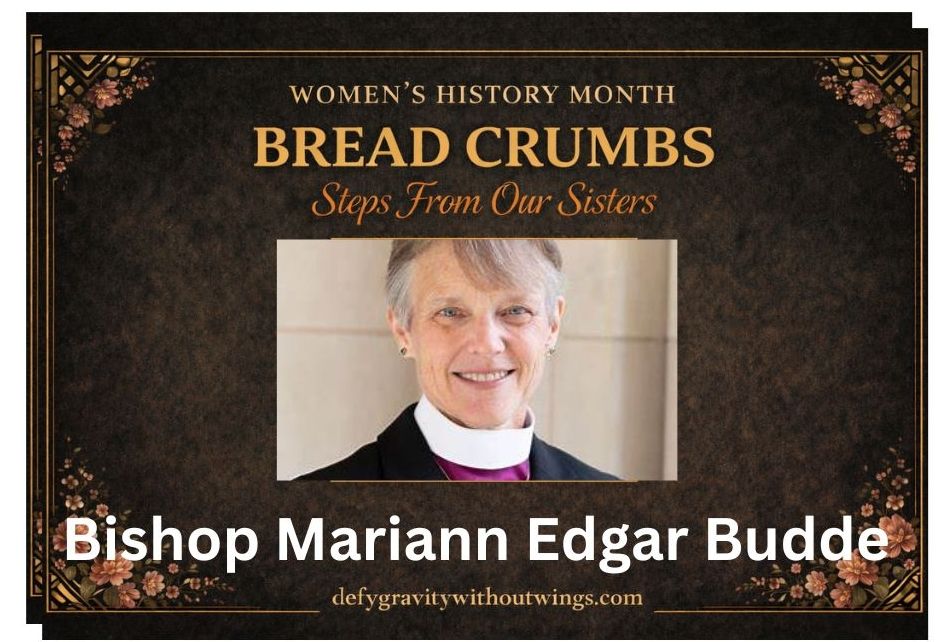
Bishop Mariann Edgar BuddeShe Brought Mercy Into a Room Built for Power

Some women do not raise their voices.
They raise the standard.

She was born in Summit, New Jersey, in 1959, and grew up in the Flanders section of Mount Olive Township, carrying both small-town roots and a wider view of the world.


After her parents’ divorce, she spent time living with her father in Colorado before returning to New Jersey and graduating from West Morris Mount Olive High School, a path that suggests early lessons in change, resilience, and finding your footing more than once.


Before she became known as an Episcopal bishop, she was shaped by an evangelical Christian upbringing, a background that helps explain the clear moral language and steady conviction people would one day hear from her in public life.

Bishop Mariann Edgar Budde became the first woman elected bishop of the Episcopal Diocese of Washington in 2011 after serving 18 years as rector of St. John’s Episcopal Church in Minneapolis.

In January 2025, during a prayer service at Washington National Cathedral attended by President Donald Trump, she spoke directly about mercy for immigrants, LGBTQ people, and others living in fear. What made the moment powerful was not volume. It was clarity. She stood in a sacred place, looked power in the face, and made room for compassion anyway.

That kind of courage belongs in Women’s History Month.

Not only the courage of women who marched with signs or shattered ceilings with applause behind them, but also the courage of women who held their ground in rooms built to intimidate. Women who spoke with steadiness when spectacle would have been easier. Women who understood that conviction does not have to be cruel to be strong.

Mariann Edgar Budde reminded the country that mercy is not frail. Mercy is not timid. Mercy is not a soft substitute for truth. Real mercy has a backbone. It knows exactly what it is doing. It steps into hard places and refuses to surrender its humanity.

She did not need rage to make history.
She did not need performance to make her point.
She did not need to wound anyone to be unforgettable.

She stood there as a woman, a leader, and a witness. Calm, clear, and unwilling to let fear have the final word.

That is how some women leave footprints.
Not by shouting over the room.
But by changing the temperature in it.

Speak up for those who cannot speak for themselves,
for the rights of all who are destitute.”
Proverbs 31:8

May we remember Bishop Mariann Edgar Budde not simply as the woman who unsettled a president, but as a woman who stood before power and still chose mercy. In a world that too often mistakes cruelty for strength, that witness matters.

We see you.

Steps From Our Sisters
Honoring the Women Who Marched Before Us

Curated by
Michelle Gillison-Robinson
DefyGravityWithoutWings.com
.

Image

Some Breaks Bring New Growth

I told myself I would not cry.


I said it out loud. Twice.

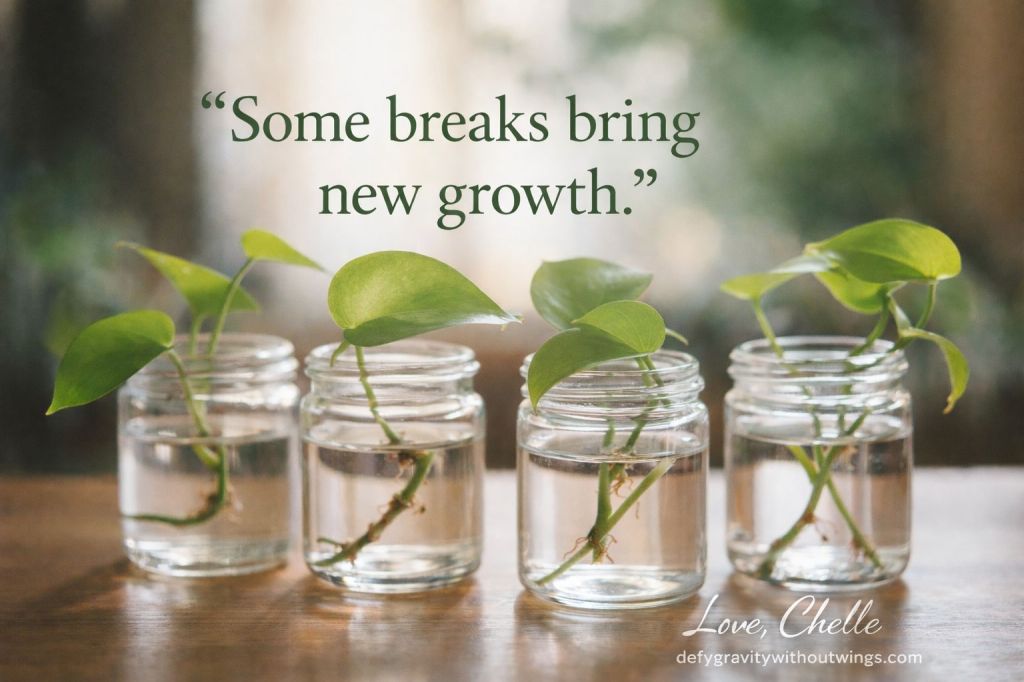
Then I heard the soft, unmistakable sound of soil shifting where it shouldn’t, followed by the sight every plant-loving heart knows too well — one of my pothos vines snapped clean away from the rest of the plant.

Just like that.
An accident.
A break.

My first thought wasn’t theological. It was maternal.
Can it be saved?

I picked it up gently, turning the broken vine over in my hands, looking for signs of life. And there they were — tiny nodes, already formed. Places where roots could grow, even though they hadn’t yet.

What looked like damage was actually possibility.

I learned something standing there in my living room with dirt on the floor and a vine in my hand:
Not every break is a loss. Some breaks are an invitation.

The plant wasn’t ruined. It was multiplied.
What separated didn’t die — it prepared to grow again, just differently, in a new place.

And isn’t that how it goes with us?

We panic when something breaks — a plan, a season, a relationship, a version of ourselves we worked hard to protect. We assume broken means finished. But God has a way of seeing roots where we only see separation.

Scripture whispers this truth gently:

“There is a time for everything… a time to plant and a time to uproot.”
— Ecclesiastes 3:1–2

Uprooting feels violent when it happens unexpectedly.
But uprooting isn’t destruction — it’s movement.

That vine didn’t know it was about to be replanted.
It didn’t resist the separation.
It just carried what it needed inside itself and waited for water.

Maybe that’s where we are too.

Maybe what snapped didn’t end us.
Maybe it exposed what was already capable of growing.

So I didn’t lose a plant today.
I gained four jars of hope sitting on my counter.

What broke didn’t disappear — it multiplied.
And maybe that’s the part we forget when something snaps in our hands.

Waiting isn’t wasted.
It’s where roots decide to show up.

“Those who wait for the Lord shall renew their strength.”
— Isaiah 40:31

Some breaks bring new growth.
They just need water… and a little time.

With love,
Chelle
defygravitywithoutwings.com

Image

Popcorn Isn’t Dinner


I own a microwave. Nothing earth shattering in that announcement.


It lives near my fancy cooktop and mostly functions as a glorified popcorn popper and an occasional emergency coffee reheater. It’s efficient, dependable, and excellent at handling immediate needs.


But it has never fed my soul.


I grew up in a time when food took time. Things were simmered, stewed, braised, and watched. You didn’t just make dinner—you tended it.


I still carry evidence of that kind of cooking: little cuts on my fingers from dull knives, small burns from forgetting pot holders, and an instinct to hover near the stove because something important is happening here.


That’s the kind of faith formation I recognize.
Microwave food is fast. Slow cooking is faithful.


The microwave satisfies a craving. The slow pot answers a hunger.


Scripture reminds us that faith was never meant to be instant. “Let perseverance finish its work so that you may be mature and complete, not lacking anything” (James 1:4, NIV). Perseverance doesn’t microwave. It simmers. It stays. It waits for the work to be done.


We live in a world that loves microwave spirituality: – quick verses – instant breakthroughs – tidy testimonies – three easy steps and a closing prayer.


And listen—I’m not mad at the microwave. Sometimes popcorn is necessary.
But popcorn isn’t dinner.


Faith that matures—faith that holds when life burns, cuts, and bruises—comes from staying near the stove. From paying attention. From trusting the heat even when it’s uncomfortable.


Slow-cooked faith smells different. It fills the house. It draws people in before it’s finished.
And yes, it might leave a mark or two.
But those marks aren’t failures. They’re proof you stayed long enough for God to finish His work.


So if your faith feels like it’s taking longer than expected… If you’re still simmering when you wanted to be served… If you’ve got a few burns and nicks to show for the journey…
Take heart.
You’re not being microwaved.
You’re being made.

Love,Chelle

Prayer
Father, thank You for not rushing what You are forming in me. Help me stay near the heat without growing bitter, impatient, or afraid. Teach me to trust the slow work of Your hands, even when I want instant results. And when I’m tempted to settle for spiritual snacks, remind me that You are preparing something that truly satisfies.
In Jesus’ name, Amen.

Image

The Third Pie

I wasn’t trying to be deep.
I was just trying to bake.

One sweet potato pie for my husband.
One for my brother-in-law who has been begging for one like it’s his spiritual gift.
I followed the recipe to the letter. Measured. Mixed. Poured.

And somehow… there was a full third pie.

Not a baker’s bite.
Not a “let me scrape the bowl and see what happens.”
A whole, mind-your-business, respectable third pie.

What makes this even better is this:
I hadn’t made a sweet potato pie in almost a year.

Not because I didn’t want to.
Not because I forgot how.
But because life was lifing — loudly — at almost every holiday when joy normally shows up wrapped in foil and tradition. Some seasons don’t leave room for extra, only endurance.

So when I finally baked again, I wasn’t expecting anything special.
Just two pies.
Just getting back to myself.

And still — there was extra.

I didn’t stretch the recipe.
I didn’t short the pies.
I didn’t hustle or improvise.

I simply did what was in front of me.

Later that day, the third pie didn’t wait for a plan.
Two of my teenage grandsons devoured it like it was made just for them — laughing, grabbing seconds, completely unaware they were standing in the quiet, perfect timing of God’s provision.

And that’s when it settled in.

Sometimes, provision doesn’t shout.
Sometimes grace shows up finished.
Sometimes, abundance waits patiently for us to notice.

I planned for two.
Grace planned for three.

“The Lord will open for you His good storehouse, the heavens, to bless all the work of your hands.”
— Deuteronomy 28:12

And this morning, with coffee in hand and crumbs on the counter, I’m reminded:
Even after long pauses, God’s timing is still generous.

Love, Chelle

Image

The Gift That Keeps Showing Up

Every morning — and sometimes as early as 3 a.m. — there’s a small sacred ritual that happens on our phones.


A text thread.
Women connected by blood, history, humor, and habit.
Aunts. Nieces. Sisters. Cousins.


It usually starts with a simple greeting. A prayer emoji or a sermon link. . A “Love y’all.”


And yes… sometimes it starts because one of us can’t sleep and assumes nobody else should be sleeping either. (That one might be on me.)


This is how we stay connected now.
Because age has a way of rearranging life, schedules don’t always line up, and seeing each other as often as we’d like isn’t always possible. But love? Love adapts.


Yesterday, my Aunt Lenora changed the subject in our group text. You know how the family matriarchy does — when wisdom rises up and gently says, Pay attention.


She shared something God had revealed to her about Great-Grandma Martha and Grandma Alice.
They used to say it often around holidays and birthdays:
“I don’t want y’all to give me any gifts this time. Thank you, but I really don’t need any more.”


At the time, we smiled. Sometimes, we insisted anyway.
Because giving is how we show love.
But after they passed, we found something that stopped us in our tracks —
gifts still in their packages.
Closets holding love that had already been received in the heart.


And suddenly, the words made sense.
It wasn’t that they had everything.
It was that satisfaction had settled in.
Gratitude had overflowed.
Hearts were full. Closets were full.
And the desire for more stuff had quietly faded.


Aunt Lenora put it beautifully in the text:
“It’s not that we have everything that could be had. It’s just that at a certain point, satisfaction sets in, gratitude is overflowing, hearts are filled… and even though you’re still grateful for expressions of love, there’s no more desire for stuff.”


And then came the revelation that wrapped everything together:
“We finally understand the real meaning of Christmas.
The Father gave the Son.
The Son gave the Spirit.
The Spirit gives us life —
so we can give the gift of love.
And that gift goes on and on and on.”


That’s it.
That’s Christmas.
Not the packages.
Not the receipts.
Not the pressure to perform joy.
Just love — passed down like an inheritance no one can lose.


This season has reminded me that our worth today is not measured by who shows up for us, but by who we show up as.
Great-Grandma Martha showed up with wisdom.
Grandma Alice showed up with contentment.
Aunt Lenora shows up with revelation.
And the women in that early-morning text thread show up — faithfully, lovingly, imperfectly.


And I show up with a pen — so that my daughter, Paula, will never forget the legacy of these women.
So she will know where she comes from.
So she will recognize the holy inheritance of faith, gratitude, and love that flows through her name.


Sometimes love looks like gifts.
Sometimes it looks like unopened packages.
And sometimes it looks like a 3 a.m. text that says, I’m thinking about you. I’m grateful for you. You’re not alone.


Scripture reminds us:
“A generous person will be enriched, and one who gives water will get water.” — Proverbs 11:25
That may be the gift that never stops giving.

Merry Christmas ,

Chelle

Image

Fourteen Ounces

My kitchen cabinet is full of mugs.
Tall ones.
Short ones.
Skinny ones and fat ones.
Plain white. Red ones (my fav).

Loud sayings. Funny ones. Spiritual ones that make visitors pause mid-sip.


Some are glass. Some ceramic. Some insulated steel meant to keep things hot long past my capacity to remember when I made its contents.


Every day—sometimes several times a day—I reach in and choose one. Not based on worth, but on need. Coffee when I need courage. Cocoa when I need comfort. Tea when I need calm.


Over the years, some of them have lost their tops.
Okay… I lost their tops.
And without those lids, the heat doesn’t last as long. But here’s what I noticed one quiet morning while waiting for the kettle to whistle:
Almost every single one of them holds fourteen ounces.
Despite the differences.
Despite the wear.
Despite the missing pieces.
Same capacity.
No mug holds more because it’s taller.
No mug holds less because it’s chipped.
No mug is disqualified because it doesn’t match the rest.
They were all made to receive.


And I wondered when the Church forgot that.
Somewhere along the way, we started ranking the mugs.
Preferring certain shapes.
Deciding which ones looked “right” on the shelf.
We forgot that Jesus never measured vessels by appearance.
He poured Himself out freely—into fishermen, skeptics, women with reputations, men with questions, people missing lids.


“But we have this treasure in jars of clay to show that this all-surpassing power is from God and not from us.”
— 2 Corinthians 4:7


That’s muddy ministry.
Muddy ministry is faith that doesn’t stay clean.
It’s Jesus kneeling in the dirt.
Touching the untouchable.
Lingering with grief.
Showing up before fixing anything.
Muddy ministry doesn’t inspect the vessel.
It just pours.
It understands that people—like mugs—come in different shapes, carry different scars, and hold warmth differently, yet bear the same image of God and the same capacity for grace.


Religion becomes abusive when it starts inspecting mugs instead of filling them.
When it withholds the pour because the vessel doesn’t look familiar.
When it mistakes uniformity for holiness.
But Jesus?
Jesus keeps pouring.
Fourteen ounces of mercy.
Fourteen ounces of patience.
Fourteen ounces of love.
Enough for each of us.


And the mugs without lids?
They know to drink while it’s hot.
They don’t waste the moment.
Maybe that’s the real lesson.
Not to become a “better mug.”
Not to match the cabinet.
Just to stay open…
and let Him pour.


And maybe that’s why this truth found me so suddenly.
Because once upon a time, fourteen ounces wasn’t just a measurement in my kitchen.
It was my grandson, Emmanuel Langston Gillison.
Barely more than fourteen ounces at birth, his life gathered hundreds into prayer—family, friends, strangers—hoping for a miracle.
We prayed boldly.
We hoped desperately.
We trusted God with everything we had.
And when the miracle didn’t come the way we longed for, Emmanuel’s life still poured out.
His brief presence became muddy ministry in its purest form—
a ministry of grief, honesty, and learning to trust God when faith doesn’t get what it hoped for.


Fourteen ounces was enough.
Enough to draw people together.
Enough to change us.
Enough to teach us that capacity is not measured by size or by how long something lasts.
Some vessels are filled fully…
even if they are held only briefly.

Dedication
In loving memory of my grandson,
Emmanuel Langston Gillison—
Fourteen ounces of life,
and a lifetime of grace.                                  Some children grow old in years.
Some grow old in impact.

Loving you always Nama Chelle

Image

DEAR GOD… THESE BULBS AIN’T BULBING

SCRIPTURE
“The light shines in the darkness, and the darkness has not overcome it.” — John 1:5


There is nothing quite like a Christmas tree to expose the truth about your spiritual maturity. All year long you can love people, show grace, pray faithfully, encourage the saints… but let one strand of lights refuse to light, and suddenly you’re two seconds from throwing the whole tree — and half of your Christianity — out the window.

I stood there staring at a section of lights that worked perfectly last year. This morning? Dead. Dim. Uncooperative. Just like some seasons in my life.

I kept tugging, twisting, tapping, and praying under my breath — the kind of “Jesus help me before I say something” prayer. Because I could feel the frustration rising, not just from the tree, but from everything I’ve been carrying these past few days.

And right in the middle of the chaos, God whispered:

“All light isn’t broken… Some of it just needs to be reconnected.”

It stopped me. Because that’s exactly how I’ve been feeling: 
Tired in spots. 
Dim in places. 
Still trying to shine, but not nearly as bright as I used to.

Sometimes we’re not broken — we’re just overwhelmed. 
Sometimes we’re not out of faith — we’re out of energy. 
Sometimes the problem isn’t the whole strand — it’s just one little place that needs a reset.

And here’s the good news: 
God knows how to find the bulb that’s not bulbing. 
And He knows how to restore the light.

Even when we don’t have the patience. 
Even when we want to throw everything back in the box until next Christmas. 
Even when we’re standing there with tears, peppermint tea, and attitude.

Purpose doesn’t disappear because one section went dark. 
Your life is still lit. 
Your calling is still glowing. 
Your hope is still wired into Him.

And if I need to add a new string of lights on top? God isn’t offended. Sometimes grace looks like “make it easier for yourself, daughter.”

-Love Chelle

Image

Bloom Baby Bloom A Christmas Cactus Sermon I Didn’t Ask For


So listen… this morning I’m minding my business, sipping my coffee, scrolling Facebook, and everyone and their Grandma is posting pictures of these big, full, show-off Christmas cactuses blooming like they’re auditioning for The Voice.


And then there’s mine.
Sitting in my living room.
Looking like it’s thinking about blooming, but hasn’t quite made a decision.
One tiny blush of color like, “Don’t rush me, sis. I’m processing.”


I’m looking at this plant like, “Ma’am… it is almost Christmas. I need you to get it together. Shine for the people.”


So I start Googling tips. Because I refuse to be the only one with a cactus that looks like it has low iron. And baby… what I found? A whole WORD. A sermon. A Bible study. A TED Talk.


Apparently, if you want a Christmas cactus to bloom, you have to do something called “darkening to bloom.”


Yes. You literally put that plant in the dark 12–16 hours a day like it’s grounded.
Then! You’re supposed to pluck off the long, lazy leaves (but don’t you dare use scissors).
Keep it a little colder.
Restrict its comfort.
Limit its light.
Disrupt its cozy routine.
And after all that?
…It blooms.
It blooms brighter because of the dark.
Not the light.
Not the pampering.
Not the perfect conditions.
THE DARK.


And I said, “Well God… if You wanted to speak to me directly, you didn’t have to drag my plant into this.”
Because sometimes life puts us into a “darkening to bloom” season.
Not because we’re failing.
Not because we did anything wrong.
Not because God forgot us.
But because the bloom requires it.


Sometimes He limits our distractions.
Sometimes He cuts off excess.
Sometimes He cools the room so we stop running and finally rest.
Sometimes He hides us away long enough to develop something deep, strong, and beautiful.


And just like that cactus, you won’t even notice the change happening…until a day, somebody walks past you and says: “Oh wow… look at you shining.”
And you’ll realize the dark didn’t break you —
It prepared you.
It strengthened you.
It sharpened you.
It positioned you.
It pushed your bloom right to the edge of the breakthrough.
So if you’re in a season that feels cold, quiet, hidden, or clipped…
Baby, don’t panic.
You’re not dying.
You’re developing.
And when the time comes?
Listen…
You’re gonna bloom so hard folks will swear you’re a Christmas cactus on the front page of Facebook.
Amen and amen.

With Love Chelle

Image

As Long As Someone Remembers

It was one of the oddest days of my life. Was sitting at my desk frozen when I got the call from my hometown, sherrif. My brain went into autopilot, and I kept trying to work with tears streaming down my face. My then boss had to force me to breathe and go home. The love my co-workers showed was unmatched. Could not have made it through the coming days and the funeral without them.

He was a complicated man that I did not get to know until he was an old man in need of redemption and forgiveness. In the beginning, I was an abandoned child, looking for answers, who only served him out of obedience to my God, and the Word said to honor thy father. In the end, I became the child thru whom he wanted to give answers and ask forgiveness from his other children thru.

We didn’t have time to become father/daughter in the traditional sense. What we did have was card games, sweet potato pies, road trips, old Navy stories, testaments of the grandparents I didn’t get to meet, and a soft spot for healing to begin. He became my Pop, and I became his church mother. LOL and inside joke between us.

I figure sometimes that I was the “Moses” baby. … shipped off with no knowledge of him…so I could return and become a path to his need for freedom. Though I 💯 validate it, I am blessed to never quite have known the anger my sisters and brothers felt for him. I suppose my heart was kept in reserve for the old man and young child of God he would become.

Still missing you, Pop. I thank you for the gift of the crazy brood of sisters and brothers I inherited 9 years ago.

I hope amongst the milk and honey that there is strong coffee and sweet potato pie!!

Edgar Jerome “Jerry” Franklin-Bradshaw
March 1, 1944 – February 5, 2015


Never Really Gone As Long As Someone Remembers.

Am I A Magician?

Yesterday, I had an elderly woman who had been raising her son alone for 42 years call seeking to place a help wanted ad. Her son is extreme on the spectrum, non-verbal, rigid and combative. She was desperately in need of help but kept saying nobody will want this job. Her husband had even left her 30 years ago when she would not institutionalize the son. I let her talk and took notes as I went.

After she composed herself, she apologized and I let her know that no apologies were necessary. I then proceeded to read to her the ad copy I crafted while I had been listening. She was surprised and asked me how I could possibly read her mind like that. ” Was I a magician?”

After my chuckle, I explained to her that though my situation is not as extreme as hers, I have two special needs adult sons in my home and I have understood the challenges, the fears, the isolations, but also the hopes, loves and joys.

We went on to talk about an hour for what should have taken 5 minutes. But I knew this customer was going to be the most important one of the day. As, we finally got to the conclusion, she tells me that her son gives her one bright spot everyday, he refuses to go to bed without giving her a gentle kiss on the cheek. She then told me that God had sent me to be her extra bright spot for the day.

It took me an extra 5 minutes after we hung up to pull myself together. She has no clue that God sent her to remind me that I am more than just a worker bee or a hamster on a wheel. I needed to know at that very moment that I have purpose beyond the bottom line.