Image

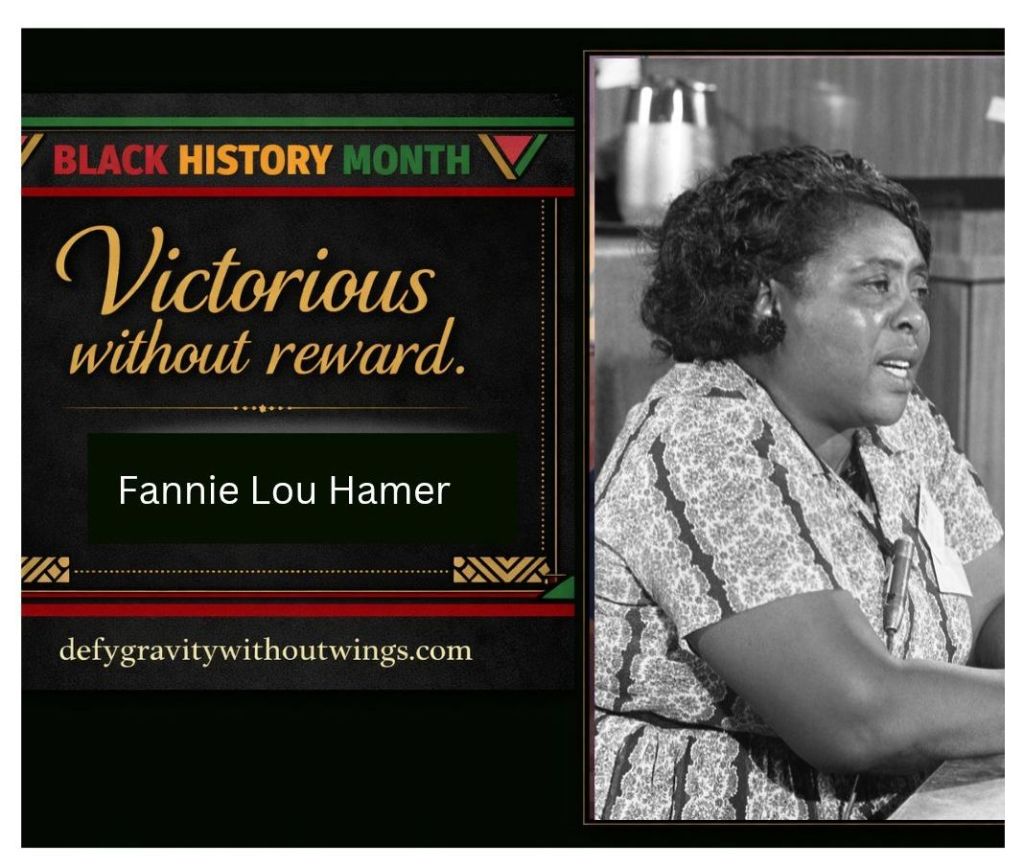
Fannie Lou Hamer: She Was Sick and Tired

Fannie Lou Hamer did not come to the movement polished, protected, or prepared.

She came poor.
She came uneducated by the world’s standards.
She came with a body already worn down by hard labor and injustice.

And still — she came.

Born in rural Mississippi in 1917, the youngest of twenty children, Fannie Lou Hamer spent her life working land she did not own, under a system designed to keep her dependent, invisible, and quiet. She began picking cotton as a child. Not for character. For survival.

When she attempted to register to vote in 1962 — after attending a voter education meeting — she failed the literacy test that was never meant to be passed. For that attempt alone, she was fired from the plantation where she had lived and worked for nearly two decades. Her family was later threatened at gunpoint for her decision to try again.

All for trying to do what should have been ordinary.

In 1963, while jailed in Winona, Mississippi, law enforcement ordered inmates to beat her. She was left with permanent injuries, chronic pain, and internal damage that followed her for the rest of her life.

She was not famous when she began.
She was not invited.
She was not protected.

But she was awake.

She helped form the Mississippi Freedom Democratic Party because the state’s official party was all white — and called America to account for segregation hiding inside democracy itself. At the 1964 Democratic National Convention, she testified on national television about voter suppression and racial violence so plainly that the President of the United States attempted to interrupt the broadcast.

It didn’t work.

“I’m sick and tired of being sick and tired.”

Those words didn’t come from anger alone.
They came from truth-telling — the kind that costs something.

She refused token representation. She rejected symbolic seats. She demanded full dignity, not crumbs dressed up as compromise.

And when the nation listened, it did not immediately change.

She was heard, but not always heeded.
She was visible, but rarely protected.
She was victorious without reward.

Still, she kept going — organizing, feeding families, helping build Freedom Farms so people could eat, vote, and live with dignity. Her fight was never only about ballots. It was about daily bread.

“Let justice roll down like waters, and righteousness like a mighty stream.” — Amos 5:24

She didn’t control the stream.
She didn’t shape the river.

She stood in it anyway.

Faith sometimes looks like prayer.
Sometimes it looks like protest.
And sometimes it looks like telling the truth even when your body is already tired.

If you have ever spoken up and paid a price,
felt worn down by doing the right thing,
told the truth without being spared the consequences,
or wondered if faithfulness was worth the cost —

Fannie Lou Hamer stands with you.

She reminds us that God often chooses voices the world underestimates — and uses them to shake foundations.

We see you, Fannie.
We honor your truth.

Bread Crumbs — for those coming after us.
Victorious without reward. Still here.

Love, Chelle

Image

James Hemings: He Changed the Taste

James Hemings shaped a nation’s palate while the nation refused to speak his name.


Born enslaved in the 18th century, James Hemings lived and worked at Monticello under Thomas Jefferson.

He was trained as a chef in France, mastering techniques most Americans had never seen or tasted. He learned sauces, pastries, ice creams, and refined methods that transformed how food was prepared and served.


When he returned to America, those techniques came with him.
They became American.
Macaroni and cheese.
Refined sauces.
Elegant plating.
Desserts meant to be lingered over.
These weren’t trends.
They were foundations.
And James Hemings was the hands behind them.


James Hemings cooked at the highest tables — yet he did not own himself.
He was expected to create beauty while living without freedom.
To refine taste while enduring injustice.
To elevate others while remaining invisible.


He was also the older brother of Sally Hemings.
Both siblings lived under the same roof at Monticello.
Both were bound to the same man.
Both carried different burdens of the same system.
James navigated his captivity through skill, restraint, and intellect.
And still — he negotiated his freedom.


He didn’t storm the kitchen.
He didn’t burn it down.
He bargained carefully, strategically, and bravely — securing his release in exchange for training his replacement, his brother, Peter


Freedom came late.
Recognition never really came at all.
He died young. Just two months after securing his freedom.
His influence lived on without attribution.
He was victorious without reward.


James Hemings reminds us that culture is often shaped by people whose names history forgets — but whose work it cannot erase.


“Give us this day our daily bread.” — Matthew 6:11
Bread is sustenance.
Bread is culture.
Bread is memory.


What we eat carries history — whether we name it or not.
James Hemings fed a nation that did not know his name.


If you have ever poured skill into work that bore someone else’s signature,
created beauty in a place that did not fully see you,
shaped something lasting without receiving credit,
or learned excellence under pressure and restraint,
James Hemings stands with you.


God sees the hands that prepare nourishment — not just for bodies, but for culture itself.


We see you, James.
We honor the way you changed the taste.


Bread Crumbs — for those coming after us.
Victorious without reward. Still here.


Love, Chelle

Historical Context & Image Note:
This reflection draws from documented Monticello and Hemings family records; no verified historical photograph of James Hemings exists, so a respectful illustration is used in place of a photographic image.

Image

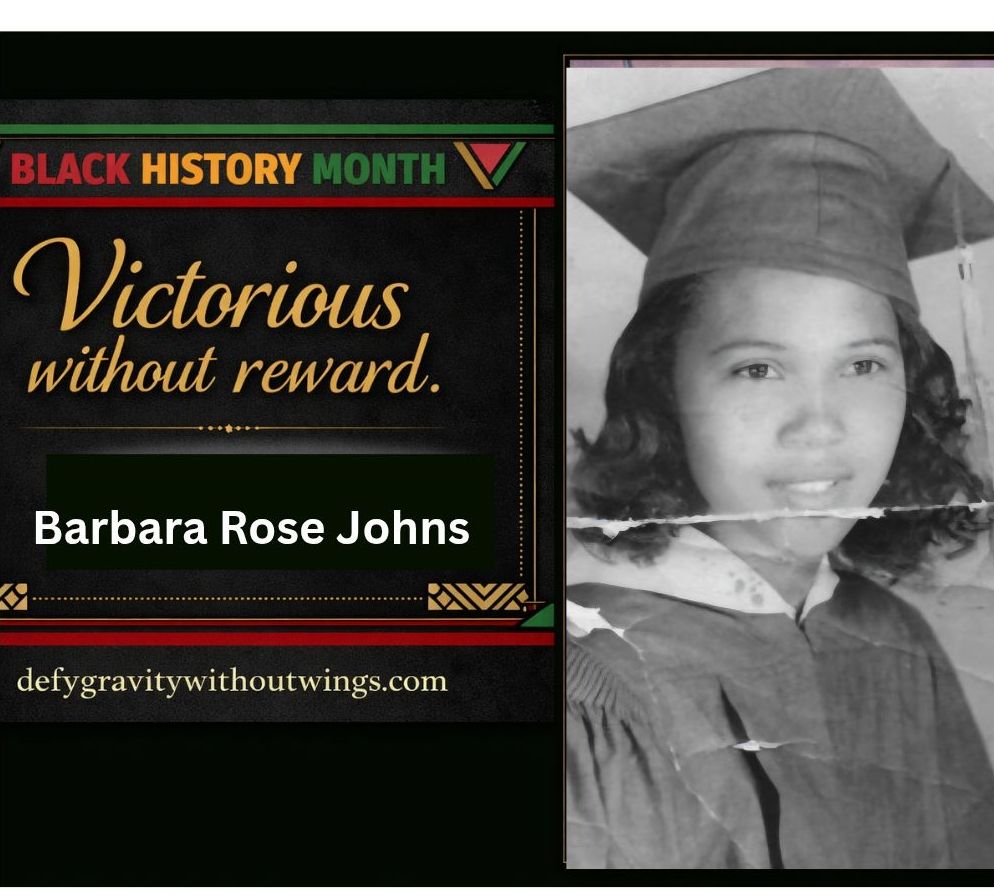
Barbara Johns: She Was Fifteen and Would Not Wait

Barbara Johns was fifteen years old when she decided that waiting politely for justice was no longer an option.


In 1951, in Prince Edward County, Virginia, Barbara was a student at Robert Russa Moton High School — a segregated Black school with no gym, no cafeteria, overcrowded classrooms, and tar-paper shacks used as makeshift buildings. Meanwhile, white students nearby learned in brick schools with resources and space.


Barbara saw it.
Barbara lived it.


And Barbara refused to accept it.


Without permission from adults, administrators, or movement leaders, she organized a student strike. She convinced her classmates to walk out, not knowing if anyone would listen — only knowing that staying silent was no longer an option.


Adults were furious.
Leaders were nervous.
Teachers were afraid they would lose their jobs.


Barbara’s name was almost removed from the complaint.
But the case moved forward anyway.
Her courage became part of Davis v. County School Board of Prince Edward County, one of the five cases folded into Brown v. Board of Education.


History changed.
And Barbara Johns?
She received death threats.
She had to leave her hometown.
She lived the rest of her life quietly.
Her name was rarely spoken when Brown was celebrated.
She was victorious without reward.


Barbara Johns teaches us something uncomfortable and holy:
Sometimes the people who force history to move are the ones most quickly pushed out of the picture.
She was young.
She was female.
She was uncompromising.
And she was inconvenient.


“Let no one despise you for your youth.” — 1 Timothy 4:12


Barbara didn’t wait to be older.
She didn’t wait to be chosen.
She didn’t wait to be safe.
She acted — and the system scrambled to catch up.


If you have ever been told you were too young to understand, spoken truth that made adults uncomfortable, sparked change and then watched others take credit, or paid a personal cost for doing the right thing early — Barbara Johns stands with you.


She reminds us that courage does not require credentials — only conviction.
She lit the match.
The world tells the story without her name.
But God remembers.


We see you, Barbara.
We tell it right.


Bread Crumbs — for those coming after us.
Victorious without reward. Still here.


Love, Chelle

Image

Charles Hamilton Houston: He Built the Road

Charles Hamilton Houston believed something radical for his time:

That the law — when disciplined, prepared, and forced to tell the truth — could be used to dismantle injustice.

He was not a march leader.
He was not a headline.
He was a builder.

Born in 1895, Houston became a lawyer and educator who saw segregation not just as wrong, but as structural. He believed it had to be taken apart piece by piece, case by case, classroom by classroom.

So he did the slow work.

As a professor at Howard University School of Law, Houston trained a generation of Black lawyers to be precise, relentless, and morally clear. Among them was a young man named Thurgood Marshall.

Houston taught his students that excellence was not optional — because lives depended on it.

“A lawyer is either a social engineer or a parasite on society.”

Houston chose to be a social engineer.

Long before Brown v. Board of Education reached the Supreme Court, Charles Hamilton Houston was already laying the groundwork.

He challenged unequal pay for Black teachers.
He dismantled segregation in graduate and professional schools.
He forced courts to confront the lie of “separate but equal.”

Case by case, brick by brick, he weakened the foundation of legalized segregation.

Others would stand in front of the nation when the walls finally fell.

Houston would not.

His health deteriorated under the strain of the work.
He died young.
And when history celebrated the victory, his name was often missing from the story.

He was victorious without reward.

Charles Hamilton Houston reminds us that some people are called to prepare the way, not walk through the door themselves.

“Prepare the way of the Lord; make straight paths for Him.” — Isaiah 40:3

Houston prepared paths others would walk — paths that led to justice, dignity, and opportunity for generations he would never meet.

If you have ever done work that made someone else visible,
labored behind the scenes while others stood at the microphone,
poured yourself into something you knew you might not live to see finished,
or believed faithfulness mattered more than credit,

Charles Hamilton Houston stands with you.

He built the road.
Others crossed it.

And God saw every stone he laid.

We see you, Charles.
We honor the work you did quietly.

Bread Crumbs — for those coming after us.
Victorious without reward. Still here.

Love, Chelle

Image

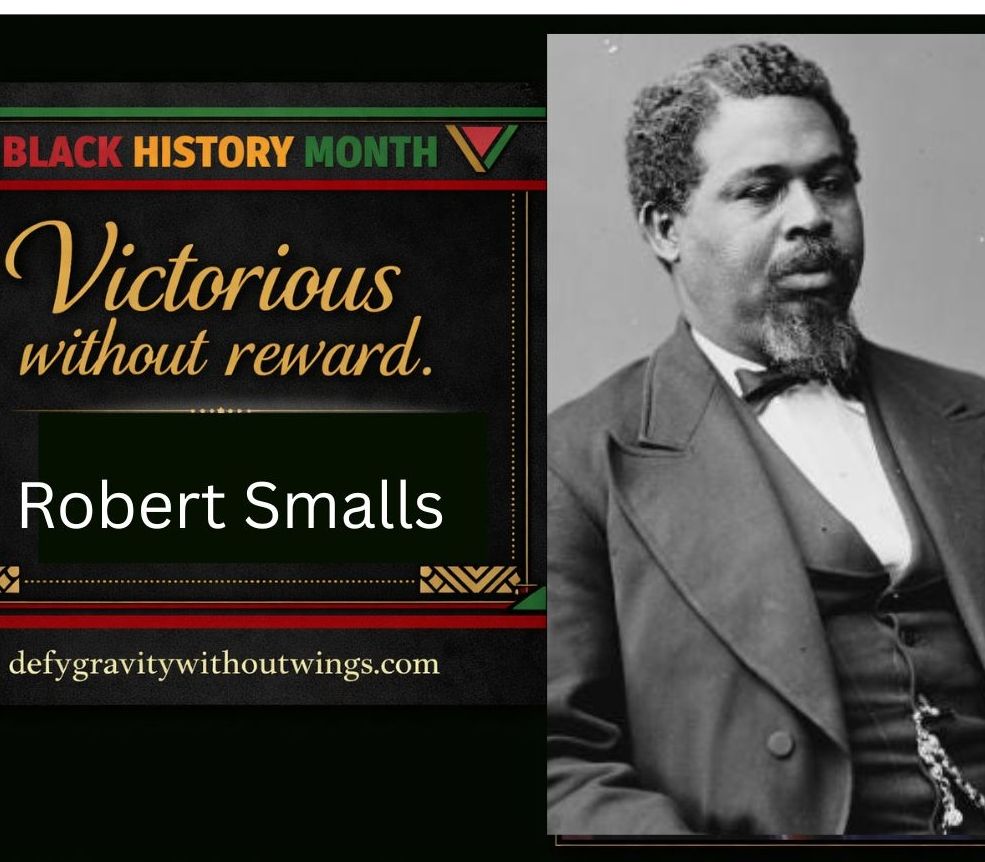
Robert Smalls: He Knew the Way Through

Robert Smalls was born enslaved in South Carolina, in a world where freedom was forbidden and intelligence was dangerous.


But Robert learned the waterways.
He learned the tides.
He learned the rhythms of ships and schedules and signals.
And when the moment came, he used what he knew.


In 1862, Robert Smalls did something no one thought possible. He commandeered a Confederate ship, the CSS Planter, disguised himself in the captain’s uniform, navigated past enemy forts using the correct signals — and delivered himself, his family, and others to freedom.


He did not fire a single shot.
He trusted knowledge.
He trusted timing.
And he trusted that God had already made a way through the water.


In my own family, there are those who make a “not quite”  substantiated claim to Robert Smalls — simply because his last name appears in our family line.
I don’t have records to prove it or disprove it.
I don’t make the claim as fact. But who can deny greatness.


However, the instinct matters.
Because sometimes what we are really claiming is not blood —
but admiration.
Not lineage —
but legacy.


Robert Smalls didn’t stop with freedom.
He went on to serve in the U.S. Navy, help recruit Black soldiers, become a U.S. Congressman, and fight for education, voting rights, and dignity for formerly enslaved people.


And still — he faced resistance.
He was pushed aside.
His leadership was minimized.
His voice was not always welcomed in the halls he helped open.


He was victorious without reward in more ways than one.


More than a century after his courage changed the course of history, the nation finally spoke his name aloud.
In 2023, the U.S. Navy commissioned a ship in his honor — the USS Robert Smalls.


It did not restore what had been denied.
It did not erase the years of resistance he faced.
It did not repay the cost of standing firm in a country slow to remember.
But it did stand as a quiet admission.
The Navy knew who led that ship long before history said it plainly.


And eventually, even delayed recognition had to follow truth.


Robert Smalls teaches us that God often prepares people long before the moment arrives.
“I will make a way in the wilderness and rivers in the desert.” — Isaiah 43:19


Robert didn’t create the river.
He learned it.
He didn’t invent the escape.
He recognized the opening.


Faith sometimes looks like courage.
Sometimes it looks like preparation.


And sometimes it looks like steering calmly through danger because you know where the water leads.

For the One Reading This Today

If you have ever:

prepared quietly for something no one else saw coming

felt drawn to a story because it felt familiar in your spirit

honored someone not because they were yours — but because they were right

trusted God to guide you through impossible terrain

Robert Smalls stands with you.


You don’t have to claim someone as family to carry their courage forward.
Legacy travels deeper than blood.


We see you, Robert.
We honor the way you led others through.


Bread Crumbs — for those coming after us.
Victorious without reward. Still here.


Love, Chelle
Image

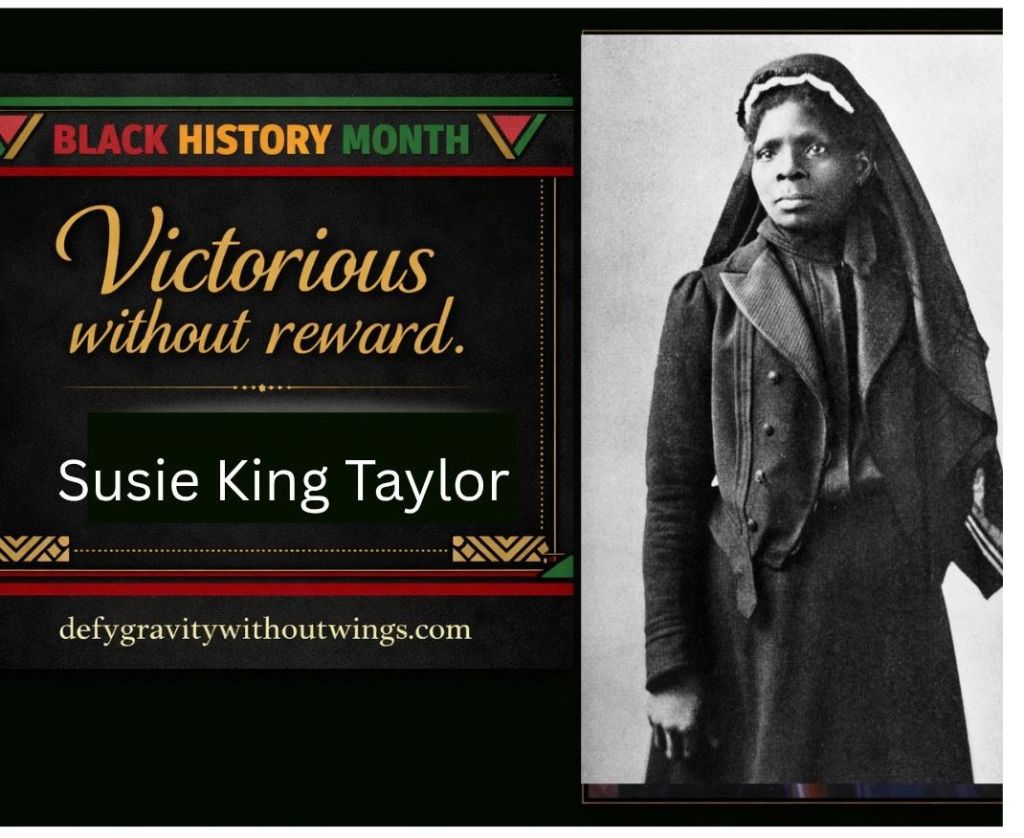
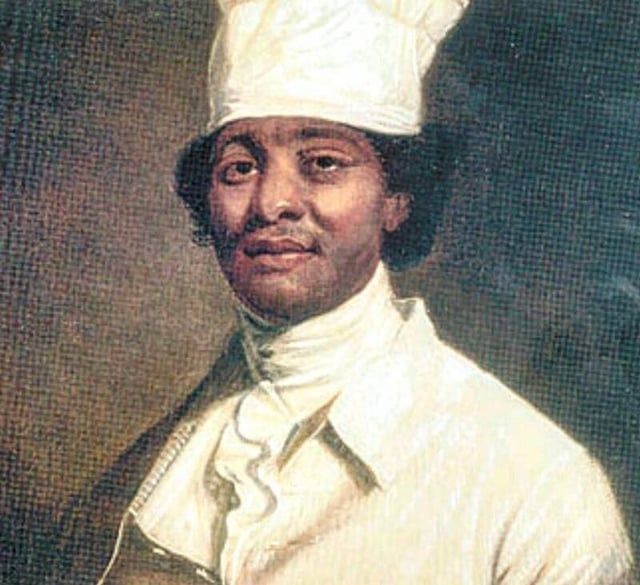
Susie King Taylor: She Served Anyway


Susie King Taylor was born enslaved in Georgia in 1848, in a world where teaching Black people to read was a crime and Black women’s labor was expected but never honored.


From a young age, Susie learned to read and write in secret. She was taught quietly, moving from place to place so no one would notice. Knowledge, for her, was not just education—it was resistance.


When the Civil War came, Susie did not wait to be invited into history.


She followed Union troops, and at just fourteen years old, she began teaching formerly enslaved soldiers and children how to read. She became the first Black woman known to openly teach formerly enslaved people in a Union camp.


She did not stop there.
Susie served as a teacher, a nurse, a laundress, and a caregiver to wounded Black soldiers. She worked in field hospitals. She tended infections. She cleaned wounds. She buried the dead. She did the work that kept soldiers alive long enough to keep fighting.


She did this without rank.
Without formal pay.
Without protection.
Without promise of recognition.
And when the war ended, the men she served alongside received pensions.
Susie did not.


Her body carried the cost of years of labor and exposure. Her hands had held dying boys. Her back bore the weight of war. Yet the government decided her service did not count.
She was victorious without reward.


In 1902, Susie King Taylor published Reminiscences of My Life in Camp with the 33rd United States Colored Troops—one of the only Civil War memoirs written by a Black woman.

She wrote because she knew that if she did not tell the story, it would be told wrong—or not at all.


She documented unequal treatment, exhaustion, racism within the Union Army, and the quiet strength required to keep serving anyway.


Recognition did not follow.
She died poor.
Her contributions remained footnotes.
Her name was largely absent from textbooks.


And yet, without women like Susie King Taylor, the war would not have been survivable for Black soldiers.


Susie King Taylor teaches us that some people do the work because it needs doing, not because they expect to be thanked.
She was not disguised like Cathay Williams.
She was not sidelined like Claudette Colvin.
She was fully visible—and still denied.


“Whatever you do, work at it with all your heart, as working for the Lord, not for human masters.” — Colossians 3:23


If you have ever done essential work no one wanted to name, given care without credentials, served faithfully while others were promoted, or known your contribution mattered even when systems said it didn’t—Susie King Taylor stands with you.
She served anyway.
History followed later.


We see you, Susie.
We honor you now.


Bread Crumbs — for those coming after us.
Victorious without reward. Still here.
Love, Chelle

Image

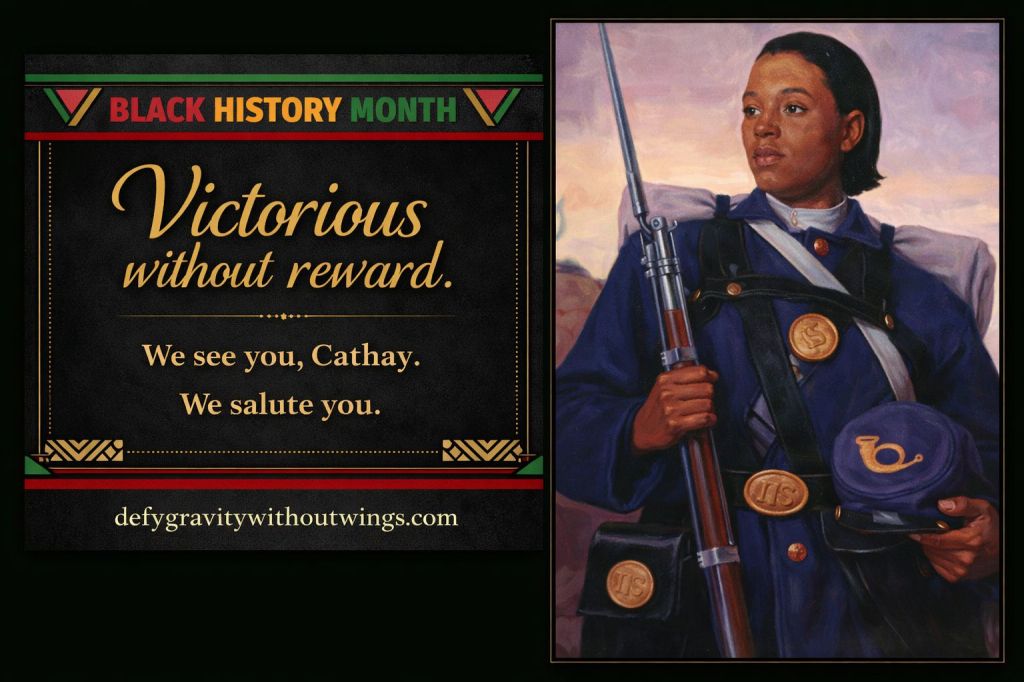
Cathay Williams: Known By God. Hidden By History

Cathay Williams is one of my favorite Black history figures — not because she is well known, but because she is not.


I was first introduced to her by my nephew, Remmie, during one of the hardest seasons of my life — while I was going through breast cancer. He told me her story and then said something that stopped me cold.


He said I reminded him of her.


Like Cathay, I hid some of the pain I was really going through — not out of denial, but out of love.
Not because the fight wasn’t real, but because I wanted to encourage others who were fighting too.


Cathay Williams was born enslaved in Missouri around 1844. During the Civil War, she followed the Union Army as a cook and laundress. But when the war ended and the Army opened its ranks to Black men only, Cathay did something unthinkable.


She cut her hair,

wrapped her body,

changed her name to William Cathay

— and enlisted.


For nearly two years, she served as a soldier in the 38th U.S. Infantry, one of the original Buffalo Soldier regiments. She marched. She guarded. She endured brutal conditions — all while hiding her identity in a world that would not make space for who she truly was.


Eventually, illness exposed what society refused to imagine:
a Black woman had carried a rifle, worn the uniform, and served her country faithfully.


She was discharged — not for lack of courage, but for daring to exist outside the rules.


Cathay Williams lived a life where survival required disguise.
Not because she lacked strength — but because the world lacked vision.


There are seasons when God calls people to serve before the world is ready to name them correctly.
Cathay was known as William by the Army.
But she was known fully by God.
“The Lord does not see as mortals see; they look on the outward appearance, but the Lord looks on the heart.” — 1 Samuel 16:7


History overlooked her.
The Army dismissed her.
But heaven recorded her obedience.
Some call her story deception.
Others call it desperation.


But I call it courage under constraint.


And here is the part history often whispers instead of says out loud:
Cathay Williams never received military honors.
She never received a pension.
In 1891, after her health had been permanently damaged by her service, she applied for a military disability pension. It was denied. She died poor and largely forgotten.


She was victorious without reward.


Cathay Williams did everything she was asked to do — and more.
She served faithfully.
She endured quietly.
She finished her assignment.


Her story reminds us that victory and recognition are not the same thing.
“Well done” does not always come from the systems we serve — but it is always recorded by God.
She didn’t fight for history.
She fought through it.
And God did not waste a single step she took.


She did not live to see her story told.
But her life still speaks.


And for those who have ever given their strength, their hope, or their encouragement without guarantee of return:
You may be unrewarded by the world —
but you are not unseen by God.


We see you, Cathay.
We salute you.


Love, Chelle

About the History in Bread Crumbs
Bread Crumbs reflections are grounded in documented historical records, including archives from the U.S. National Archives, Library of Congress, court records, contemporaneous newspapers, and first-person accounts. Spiritual reflections and personal connections are clearly marked as such and are offered with respect for the historical record.

.

Image

My Survivor Song Knows My Name.

I was listening to one of my favorite songs—“He Knows My Name”—and my emotions spilled out before I could stop them.
It happens like that sometimes.
After a rough moment.
After allowing myself—again—to be hurt by someone who never really took the time to know me.
Not my heart.
Not my story.
Not the way I learned to survive.


I didn’t even realize how much I was carrying until that song started playing.
And suddenly, there it was—grief, relief, truth—all at once.


Because here’s the greatest thing about God:
He knows my name.
And not just my name—He knows my nickname too.
The one spoken by people who love me.
The one I only answer to when I feel safe.


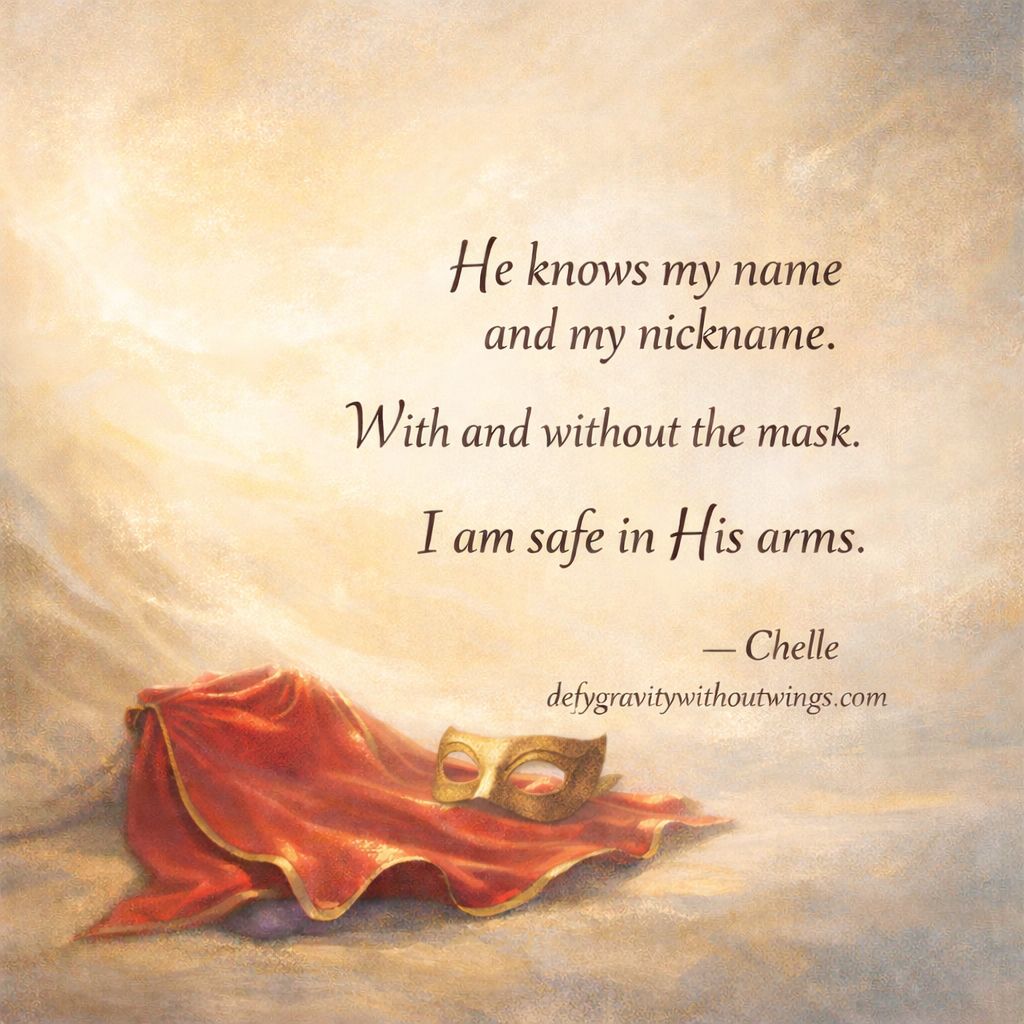
He knows me with the mask—the strong one, the capable one, the superhero version that keeps showing up.


And He knows me without it—the tired, tender, still-hoping version I don’t always let the world see.


The real me.
Not the performance.
Not the usefulness.
Not the resilience résumé.


This song reminds me that I don’t confuse God.
I don’t disappoint Him by being human.
I don’t have to explain myself into being worthy of love.
It’s my Survivor Song because it tells the truth I forget when I’m hurting:
I am already known.
Already named.
Already held.
And when I rest in His arms, I don’t need armor.
I don’t need a script.
I don’t need to be brave for one more minute.
I am safe.


With and without the mask.
With and without the cape.
Somewhere along the way, I learned to confuse being needed with being known.
But God never made that mistake.


So today, if you’re feeling unseen—
if you’re nursing the quiet ache of being misunderstood—
let the reminder rise up like a song in your chest.
You are known by name.
You are held without pretending.
You are safe in His arms.
And sometimes… surviving looks like letting yourself be known—first by God, and then by yourself.
“I have called you by name; you are Mine.” — Isaiah 43:1


Love, Chelle


Image

Reframing The Heart

Somewhere along the way, many of us learned a quiet lie —
not from God, but from human interpretation.

We learned it from what was modeled, praised, or rewarded.
From homes, churches, systems, and relationships that mistook endurance for faithfulness and exhaustion for virtue.


Most people were doing the best they could with what they knew — but they were still human.
And without realizing it, we carried those lessons into our understanding of God.

I know this because I have done it myself.

I confused being loved with doing to be loved.
I mixed up belief with performance.
And I carried that misunderstanding into my faith and called it obedience.

But that is not God’s heart.

God does not delight in depletion.
He delights in wholeness.

Jesus did not invite people to follow Him so they could replace Him.
He did not ask them to become saviors, fixers, or endless wells.
He asked them to come — as they were — and to unlearn what fear had taught them about love.

Scripture never praises burnout.
It praises obedience rooted in love, not fear.
It honors service that flows from being seen — not from trying to be noticed.

When Jesus said, “Come to Me, all who are weary and burdened, and I will give you rest,”
He was not offering a reward for those who gave the most.
He was correcting what people had been taught about God.

If your kindness comes from feeling unseen,
if your faith feels like constant output,
if your love has slowly turned into self-erasure —
that may be something you learned, but it is not something God requires.

God does not need you emptied to be faithful.
He desires you rooted, restored, and whole.

Being needed is not the same as being loved.
And God’s love has never required you to disappear.

God, help me separate Your voice from the voices that shaped me.
Heal what I learned in survival mode.
Teach me Your heart — not a human version of it.

Love, Chelle

DefyGravityWithoutWings.com

Image

Powder, Not Prison (and Apparently Winter Storms Have Names Now)

So here’s something I learned this week:
winter storms have names.
I was today-years-old when I found out they name winter storms the same way they name summer hurricanes. And wouldn’t you know it—the one that iced me into my house and blocked me from my greenhouse was named Fern.
Fern.
A plant name.
A green thing.
A symbol of life.
Make it make sense.
Winter Storm Fern didn’t just bring cold—she brought audacity. It was so cold one day that my front door wouldn’t even open. Not stuck—sealed. As if the house itself said, “Nope. You live here now.”
When the door finally did open the next day, I stepped outside and immediately thought,
“Oh. I was happier not knowing.”
That kind of cold doesn’t invite you out.
It humbles you back inside.
Now here we are again. More snow coming Saturday—and again on Wednesday. But this time, they’re calling for powder, not ice.
And apparently, there’s a difference.
Ice traps you.
Powder covers you.
Ice shuts doors.
Powder rests gently on what’s still alive underneath.
Some seasons don’t stop growth—they insulate it.
Under the white blanket, the soil is still breathing. Roots haven’t resigned. Seeds aren’t panicking. They know winter may come labeled and official, but it never gets the final word.
“Though the fig tree does not bud and there are no grapes on the vines… yet I will rejoice in the Lord.”
— Habakkuk 3:17–18
Faith isn’t pretending winter isn’t winter.
It’s recognizing the difference between what freezes you and what simply passes through.
Winter Storm Fern may have sealed my door for a day.
She may have iced the path to the greenhouse.
But she didn’t cancel the harvest.
Dead and dormant are not the same.
Covered and defeated are not synonyms.
Spring is not offended by powder.
And I’ve learned not to argue with doors God temporarily keeps shut.

Love, Chelle