Image

Eviction Notices ( Without the Panic)

As I pack up the end of one year to experience the wonders of the next, I was reminded of how many times I was evicted. Not in the natural sense but by God.


I’ve learned that God’s eviction notices don’t come with flashing lights or raised voices.
They don’t sound like “You’re fired.”
They don’t arrive with chaos or fear.
They feel like stability that no longer fits.


I call it an eviction notice when God begins to unsecure me in a place He never intended to be my final address. Provision is present. The lights are on. The ground is steady. And yet—peace quietly taps me on the shoulder and whispers, “This isn’t home.”


For people like me—faithful to a fault, a true “Stable Mabel”—dependable, steady, the one who shows up no matter what—God doesn’t shove.
He anchors.
He makes sure the floor doesn’t drop out.
He removes the threat of free-fall.
He rearranges just enough, so survival is no longer the distraction.
And that’s when it gets confusing.
Because when panic leaves, clarity arrives.
And clarity is harder to ignore.
An eviction notice from God doesn’t say leave now.
It gently says, don’t give this place your last.
It shows up as: – security without satisfaction
– provision without peace
– competence without calling
It feels like gratitude… mixed with restlessness.
I used to think eviction meant loss.
But I’m learning it often means permission.
Permission to stop confusing loyalty with assignment.
Permission to admit that faithfulness has a future—and it doesn’t always look like staying.


Scripture gives me a different picture of how God moves His children:
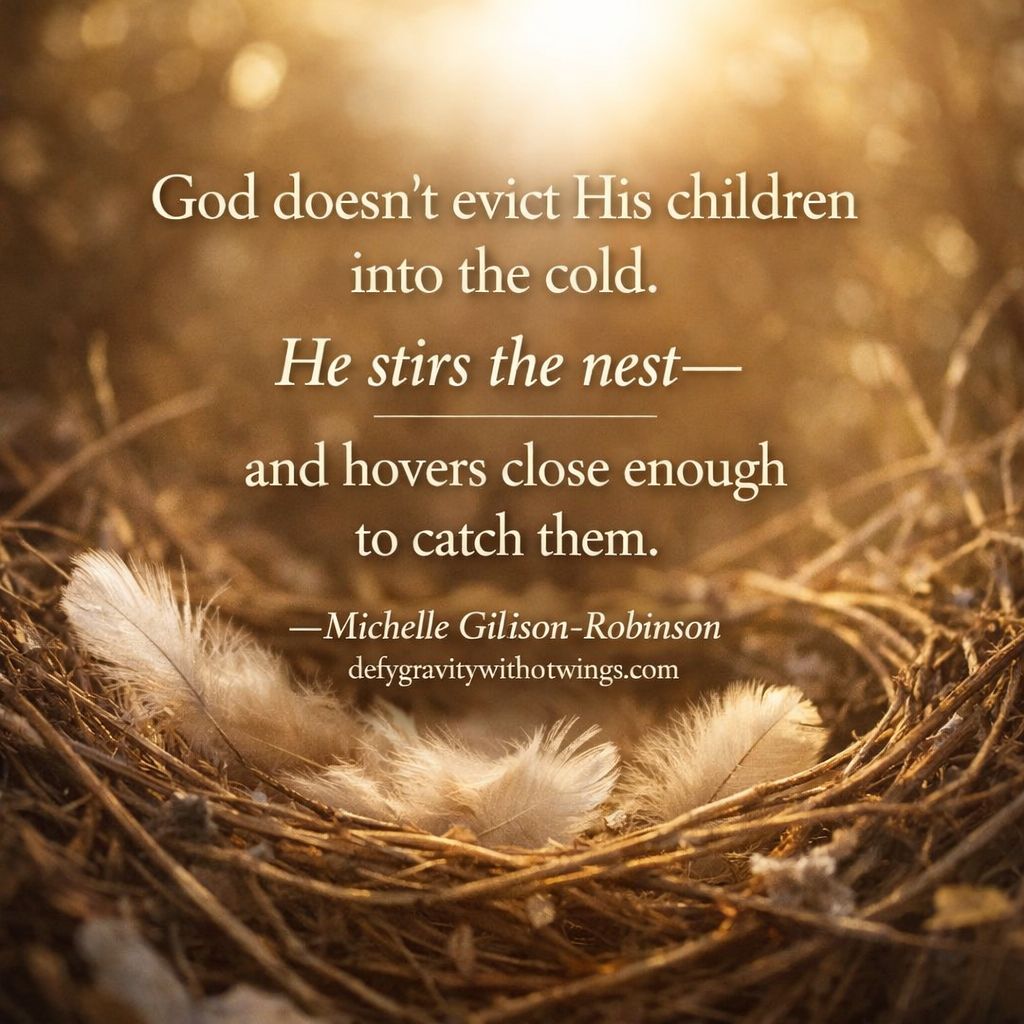
“Like an eagle that stirs up its nest
and hovers over its young,
that spreads its wings to catch them
and carries them aloft…”
(Deuteronomy 32:11)


When I think of God’s eviction notices now, I don’t picture being thrown out.
I picture a nest that has grown too comfortable—warm feathers, familiar edges.
God stirs the nest not to harm, but to wake.
There is a push, yes—but there is also hovering.
There is a letting go, but never abandonment.
Before the feathers can be too ruffled,
before fear turns into free fall,
the same wings that nudged are the wings that catch.
That’s what this season feels like.
Not panic.
Not loss.
But the unsettling grace of being lifted by a God who refuses to let me stay small—and refuses to let me crash while I learn.
Here is the grounding truth I’m holding close:
God is not asking me to burn down my life.
He is inviting me to build the next one alongside it—until it’s strong enough to stand.
No rushing.
No scorched earth.
No fear-driven decisions.
Just a quiet understanding that a holding pen is not a home—and that noticing the gate is unlocked is already movement.
If this is an eviction notice, it isn’t cruel.
It’s merciful.
Because God doesn’t evict His children into the cold.
He prepares the next place before He asks us to pack.
And peace—real peace—always goes with us.
— Love. Chelle

Image

New Year’s Eve Eve – When I woke up, but my brain did not.

Every writer’s fully awake nightmare: a block.
A brain fart.
Nothing profound to say.
Nothing book-worthy for the new year.

For a brief moment, panic tried to convince me that silence meant failure.
But even this—this momentary panic—became permission.

Permission to pause.
Permission to breathe.
Permission to simply exhale.

Truth be told, I sat there staring at the blinking cursor, waiting for something deep, prophetic, and Watch Night-worthy to appear.
Nothing came.
Not a sermon. Not a quote. Not even a clever churchy acronym.
Just me… and the cursor… judging each other.

This morning I woke up—but my brain did not.
And I’m choosing not to wrestle it into submission.

It’s New Year’s Eve Eve.
There’s still much to do.
Watch Night services to prepare for.
Lives to show up for.
And the familiar hum of New Year’s resolutions floating around everywhere.

Everywhere I turn, people are declaring what they’re going to do in the new year.
Gym memberships. Journals. Green smoothies.
And while I applaud the optimism, I already know February is coming… with receipts.

I’ve come to call them Reso-lies—
because so many of them don’t survive past February 1st.

Yes, I have goals.
Yes, I will aim.
But no, I will not condemn myself or pressure myself into a failure complex when things don’t go according to plan.

This year, I’m elevating two truths instead of a checklist:

Let the Lord be magnified,
who takes pleasure in the prosperity of His servant.”
— Psalm 35:27

Delight yourself also in the Lord,
and He shall give you the desires of your heart.”
— Psalm 37:4

I wave both scriptures like a banner—
not as entitlement,
but as alignment.

I wish I could tell you this message came together neatly—
that I woke up inspired, organized, and spiritually glowing.
But the truth is, this word came together the same way my life usually does:
honest, a little tired, and fully dependent on grace.

My prayer for the upcoming stroke of midnight is simple and surrendered:

Lord, take pleasure in this servant
as I magnify You.
Give me the desires of my heart
that line up with the delights of Yours.

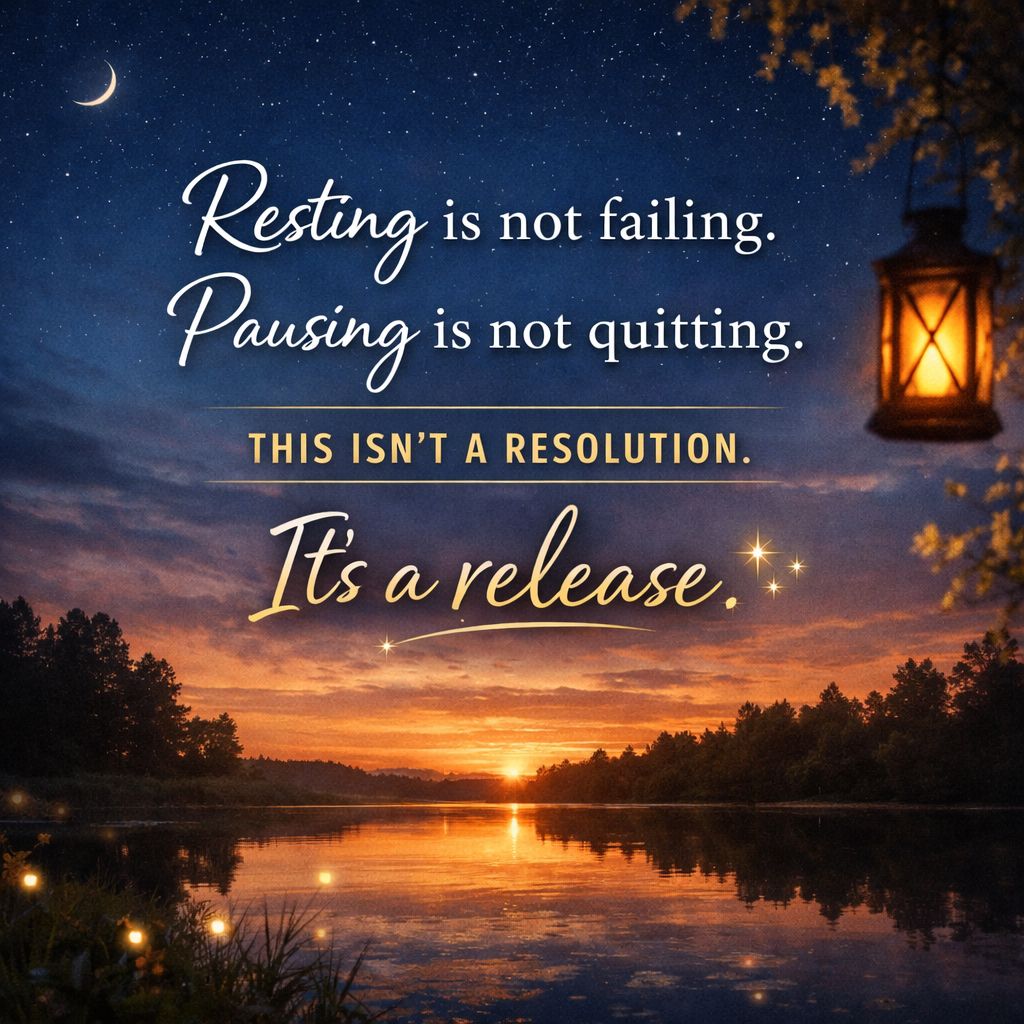
Resting is not failing.
Pausing is not quitting.
And waking up—even when my brain didn’t
still counts as showing up.

May the Lord Find You In A Delightful Place!!!!

Love, Chelle

Image

Seven Days Of Light

Honoring cultural tradition, affirming shared values, and weaving Scripture with care.

A Gentle Word Before We Begin:

There was a time when I didn’t know what Kwanzaa was. And if I’m honest, there were years when the Christian church around me misunderstood it—labeling it as something it was never meant to be.

Kwanzaa is not a religion. It does not replace faith. It does not compete with Christ. It is an intentional celebration of values—principles that strengthen family, community, character, and responsibility.

Kwanzaa was established in 1966 by Dr. Maulana Karenga, in the aftermath of the Watts uprising, to reaffirm African American cultural identity and restore community-centered values rooted in family, culture, and collective responsibility.

Scripture tells us that “the law is fulfilled in one word: love” (Galatians 5:14), and that “against such things there is no law” (Galatians 5:23). When values cultivate love of God and neighbor, they deserve reflection—not fear.

This study honors the Nguzo Saba (the Seven Principles of Kwanzaa) with respect, while gently weaving Scripture for those who follow Jesus and recognize His fingerprints in every good and life-giving value.

The traditional greeting for Kwanzaa is:

“Habari Gani?”

(hah-BAH-ree GAH-nee)

It’s Swahili and means:
“What’s the news?” or “What’s happening?”

When someone says: Habari Gani? Your response is the principle of the day:

Day 1 – Umoja (Unity)

Unity is not sameness; it is commitment. It is choosing one another again and again—especially when it would be easier to withdraw. Umoja reminds us that fractured families and divided communities heal when we decide to stand together.

Scripture Reflection:
“How good and pleasant it is when God’s people live together in unity.” – Psalm 133:1

Prayer Thought:
Lord, teach us how to guard unity without erasing truth, and to love without condition.

Day 2 – Kujichagulia (Self-Determination)

Kujichagulia is about reclaiming voice and agency. It is refusing to let others define our worth or our future. In Christ, we are not mislabeled—we are named.

Scripture Reflection:
“You are a chosen people…” – 1 Peter 2:9

Prayer Thought:
God, help us walk boldly in who You created us to be.

Day 3 – Ujima (Collective Work & Responsibility)

Ujima reminds us that community is not a spectator sport. We are responsible for one another—not out of obligation, but out of love.

Scripture Reflection:
“Carry each other’s burdens…” – Galatians 6:2

Prayer Thought:
Jesus, make us aware of where we can show up with presence.

Day 4 – Ujamaa (Cooperative Economics)

Ujamaa calls us to steward resources with communal care. Where we invest reflects what we value.

Scripture Reflection:
“Each of you should use whatever gift you have received…” – 1 Peter 4:10

Prayer Thought:
Lord, teach us to circulate generosity.

Day 5 – Nia (Purpose)

Purpose is not always loud. Sometimes, it is faithful consistency. Our lives are not random.

Scripture Reflection:
“For we are God’s handiwork…” – Ephesians 2:10

Prayer Thought:
God, align our gifts with the needs around us.

Day 6 – Kuumba (Creativity)

Creativity is holy work. Kuumba calls us to leave what we touch more beautiful.

Scripture Reflection:
“See, I am doing a new thing…” – Isaiah 43:19

Prayer Thought:
Creator God, let us partner with You.

Day 7 – Imani (Faith)

Imani is faith with memory. For believers, it ultimately rests in God.

Scripture Reflection:
“Now faith is confidence in what we hope for…” – Hebrews 11:1

Prayer Thought:
Lord, anchor our faith for generations to come.

So, if you have learned something today, then I have done my job for today. If nothing else, please know that Kwanzaa does not ask us to abandon faith. It invites us to practice values—many of which Scripture has been teaching all along. Unity. Responsibility. Purpose. Creativity. Faith. Against these, there is no law—only love.

Habari Gani?

Love, Chelle

Image

When Christmas Doesn’t Recognize Itself

I’ll admit it—I chuckled at first.
I saw a video of a broke Hispanic father joking with his young son that ICE had taken Santa. It was meant to be humorous, a dark joke wrapped in the language of survival. I laughed… and then I stopped.


Because once the laughter faded, the weight of it settled in.


How awful to place that kind of fear on a child. How heartbreaking that this joke even works in our current climate. And then it hit me—harder than I expected.


Under the prevailing American mindset of 2025, the very figures we celebrate at Christmas wouldn’t be welcome here.
Santa would be questioned.
Mary and Joseph would be detained.
Jesus would be born into a system already suspicious of Him.
The wise men would be asked to self-deport.
The angels would be accused of violating airspace.
And the shepherds—unhoused, roaming, living off the land—would likely be jailed for existing outside the rules.


Yes, I know—it sounds like a stretch.


And yes, there must be laws. There must be order. There must be boundaries and systems and responsibility. Scripture never denies that.


But Scripture also never allows us to weaponize law against love.
Because the story of Christmas—the real one—is not clean, controlled, or credentialed. It is a story of displacement. Of vulnerability. Of outsiders. Of God choosing to arrive without papers, privilege, or protection.


Mary wasn’t prepared.
Joseph wasn’t powerful.
Jesus wasn’t safe.
And none of them fit the mold of who society typically makes room for.


Yet this is the story we retell every year with lights and carols and nativity scenes that have grown far too tidy.
Somewhere along the way, we learned to celebrate the symbols of Christmas while quietly opposing everything they stand for.
We sing about peace while nurturing fear.
We speak of joy while guarding our comfort.
We proclaim love while questioning who deserves it.


And that should sober us.
Because Jesus Himself said,
“I was a stranger, and you invited me in.”
Not you vetted me.
Not you verified my worth.
Not you made sure I belonged first.
He didn’t ask us to solve immigration policy.
He asked us to recognize people.


The question Christmas asks us—every year, relentlessly—is not whether we believe in Christ, but whether we resemble Him.
Would we make room for Him now?
Or would we ask Him to prove He belongs?
If the answer makes us uncomfortable, maybe that discomfort is holy. Maybe it’s an invitation to return—not to tradition, but to truth.
Because Christmas has always been about God crossing borders.
And love, by nature, refuses to stay contained.

Love Chelle

Love Chelle