Image

Robert Smalls: He Knew the Way Through

Robert Smalls was born enslaved in South Carolina, in a world where freedom was forbidden and intelligence was dangerous.


But Robert learned the waterways.
He learned the tides.
He learned the rhythms of ships and schedules and signals.
And when the moment came, he used what he knew.


In 1862, Robert Smalls did something no one thought possible. He commandeered a Confederate ship, the CSS Planter, disguised himself in the captain’s uniform, navigated past enemy forts using the correct signals — and delivered himself, his family, and others to freedom.


He did not fire a single shot.
He trusted knowledge.
He trusted timing.
And he trusted that God had already made a way through the water.


In my own family, there are those who make a “not quite”  substantiated claim to Robert Smalls — simply because his last name appears in our family line.
I don’t have records to prove it or disprove it.
I don’t make the claim as fact. But who can deny greatness.


However, the instinct matters.
Because sometimes what we are really claiming is not blood —
but admiration.
Not lineage —
but legacy.


Robert Smalls didn’t stop with freedom.
He went on to serve in the U.S. Navy, help recruit Black soldiers, become a U.S. Congressman, and fight for education, voting rights, and dignity for formerly enslaved people.


And still — he faced resistance.
He was pushed aside.
His leadership was minimized.
His voice was not always welcomed in the halls he helped open.


He was victorious without reward in more ways than one.


More than a century after his courage changed the course of history, the nation finally spoke his name aloud.
In 2023, the U.S. Navy commissioned a ship in his honor — the USS Robert Smalls.


It did not restore what had been denied.
It did not erase the years of resistance he faced.
It did not repay the cost of standing firm in a country slow to remember.
But it did stand as a quiet admission.
The Navy knew who led that ship long before history said it plainly.


And eventually, even delayed recognition had to follow truth.


Robert Smalls teaches us that God often prepares people long before the moment arrives.
“I will make a way in the wilderness and rivers in the desert.” — Isaiah 43:19


Robert didn’t create the river.
He learned it.
He didn’t invent the escape.
He recognized the opening.


Faith sometimes looks like courage.
Sometimes it looks like preparation.


And sometimes it looks like steering calmly through danger because you know where the water leads.

For the One Reading This Today

If you have ever:

prepared quietly for something no one else saw coming

felt drawn to a story because it felt familiar in your spirit

honored someone not because they were yours — but because they were right

trusted God to guide you through impossible terrain

Robert Smalls stands with you.


You don’t have to claim someone as family to carry their courage forward.
Legacy travels deeper than blood.


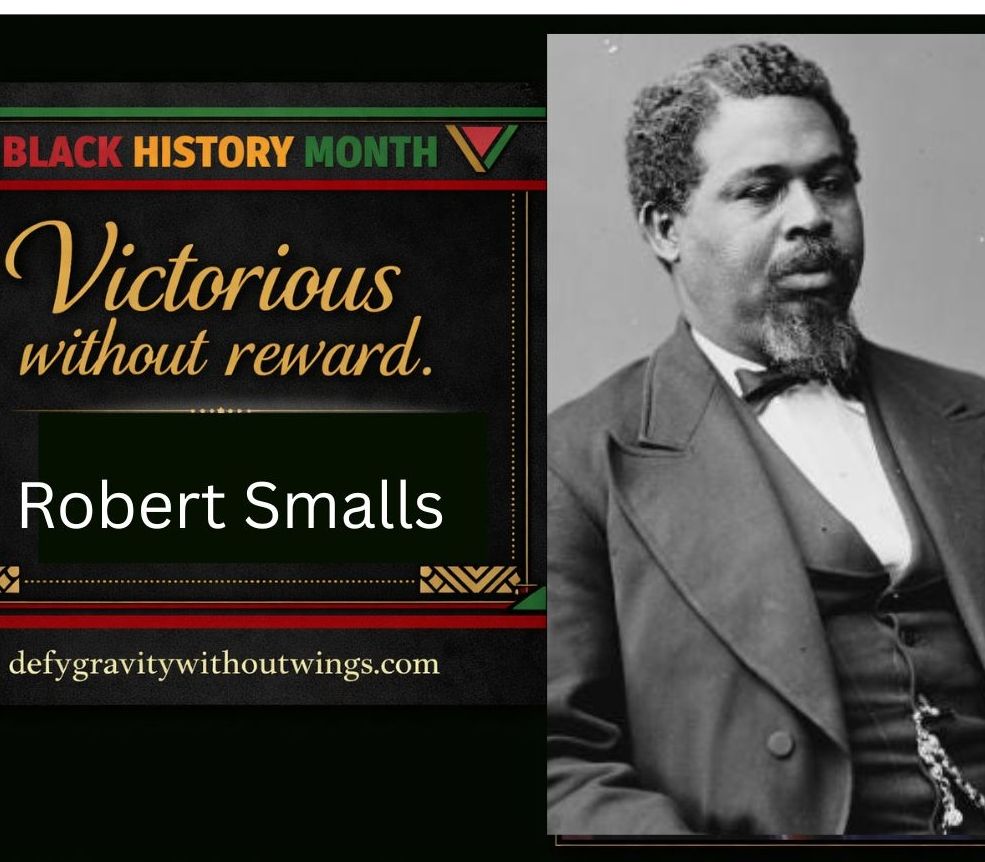
We see you, Robert.
We honor the way you led others through.


Bread Crumbs — for those coming after us.
Victorious without reward. Still here.


Love, Chelle
Image

Cathay Williams: Known By God. Hidden By History

Cathay Williams is one of my favorite Black history figures — not because she is well known, but because she is not.


I was first introduced to her by my nephew, Remmie, during one of the hardest seasons of my life — while I was going through breast cancer. He told me her story and then said something that stopped me cold.


He said I reminded him of her.


Like Cathay, I hid some of the pain I was really going through — not out of denial, but out of love.
Not because the fight wasn’t real, but because I wanted to encourage others who were fighting too.


Cathay Williams was born enslaved in Missouri around 1844. During the Civil War, she followed the Union Army as a cook and laundress. But when the war ended and the Army opened its ranks to Black men only, Cathay did something unthinkable.


She cut her hair,

wrapped her body,

changed her name to William Cathay

— and enlisted.


For nearly two years, she served as a soldier in the 38th U.S. Infantry, one of the original Buffalo Soldier regiments. She marched. She guarded. She endured brutal conditions — all while hiding her identity in a world that would not make space for who she truly was.


Eventually, illness exposed what society refused to imagine:
a Black woman had carried a rifle, worn the uniform, and served her country faithfully.


She was discharged — not for lack of courage, but for daring to exist outside the rules.


Cathay Williams lived a life where survival required disguise.
Not because she lacked strength — but because the world lacked vision.


There are seasons when God calls people to serve before the world is ready to name them correctly.
Cathay was known as William by the Army.
But she was known fully by God.
“The Lord does not see as mortals see; they look on the outward appearance, but the Lord looks on the heart.” — 1 Samuel 16:7


History overlooked her.
The Army dismissed her.
But heaven recorded her obedience.
Some call her story deception.
Others call it desperation.


But I call it courage under constraint.


And here is the part history often whispers instead of says out loud:
Cathay Williams never received military honors.
She never received a pension.
In 1891, after her health had been permanently damaged by her service, she applied for a military disability pension. It was denied. She died poor and largely forgotten.


She was victorious without reward.


Cathay Williams did everything she was asked to do — and more.
She served faithfully.
She endured quietly.
She finished her assignment.


Her story reminds us that victory and recognition are not the same thing.
“Well done” does not always come from the systems we serve — but it is always recorded by God.
She didn’t fight for history.
She fought through it.
And God did not waste a single step she took.


She did not live to see her story told.
But her life still speaks.


And for those who have ever given their strength, their hope, or their encouragement without guarantee of return:
You may be unrewarded by the world —
but you are not unseen by God.


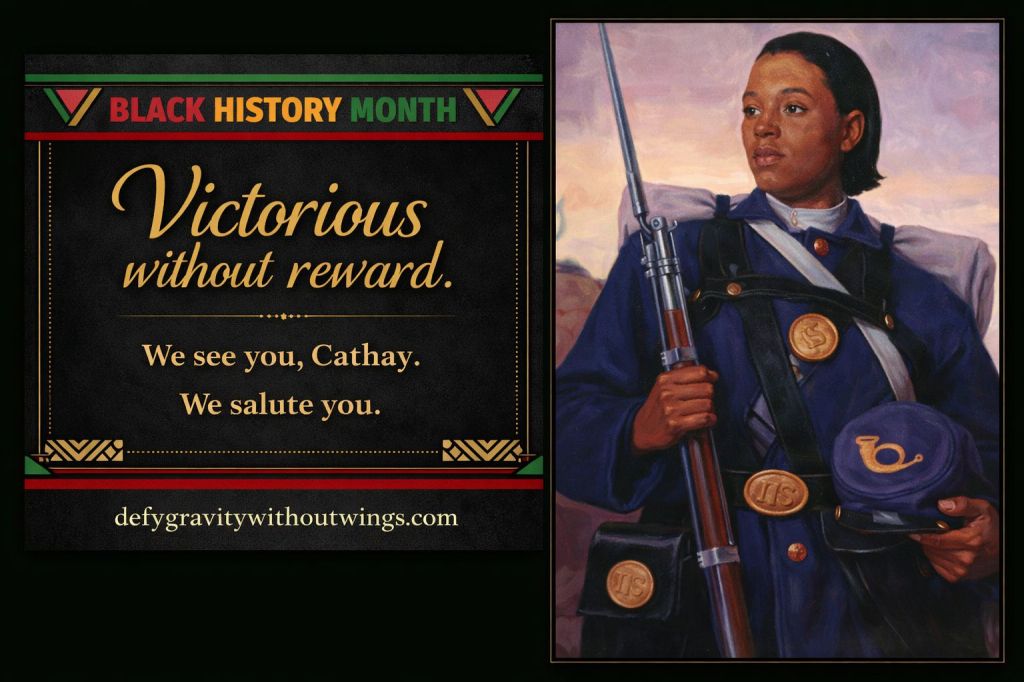
We see you, Cathay.
We salute you.


Love, Chelle

About the History in Bread Crumbs
Bread Crumbs reflections are grounded in documented historical records, including archives from the U.S. National Archives, Library of Congress, court records, contemporaneous newspapers, and first-person accounts. Spiritual reflections and personal connections are clearly marked as such and are offered with respect for the historical record.

.

Image

Before Dawn Breaks


Dear Martin,

Thank you for the courage it took
to love loudly
in a world fluent in hate.

Believing the long work could move
even when your hands were tired
from holding up the gate.

Our marching turned to sleepwalking.
Scars.
Stains.
Graves faded into parades.

Why teach us to love our crayoned brothers
when our sisters are heard passing
on streets made of rumor and rage.

We mastered resistance
only to trade it in
for the soft, comfy
quiet chairs of apathy.

Economic empowerments
became the next big sale,
freedom measured in discounts—
forgetting life ain’t free.

I wonder if you are proud us
I wonder if pride and grief
can do a sit-in
at the same table.

Laws need courage.
Platforms for voices.
Access breeds action.
Dream me not a fable.

I hope you see both things—
two things true at once
what we protected
and what we neglected.

The laws we guarded fiercely.
The people we forgot quietly.
What we defended,
then defected.

Still—
there are mornings when children march
without knowing your name
but carrying your dream
in their bones.

There are hands that reach back.
Feet that refuse silence.
Hearts that choose love—
to  let live  and to be left alone.

So if you are watching,
there are still some of us trying,
avoiding rose-colored glasses
and wide-angled scopes.

I hope you notice
some of us straining
to answer  the silence you were buried in
with shaking hands,
quiet prayers,
and stubborn hope.

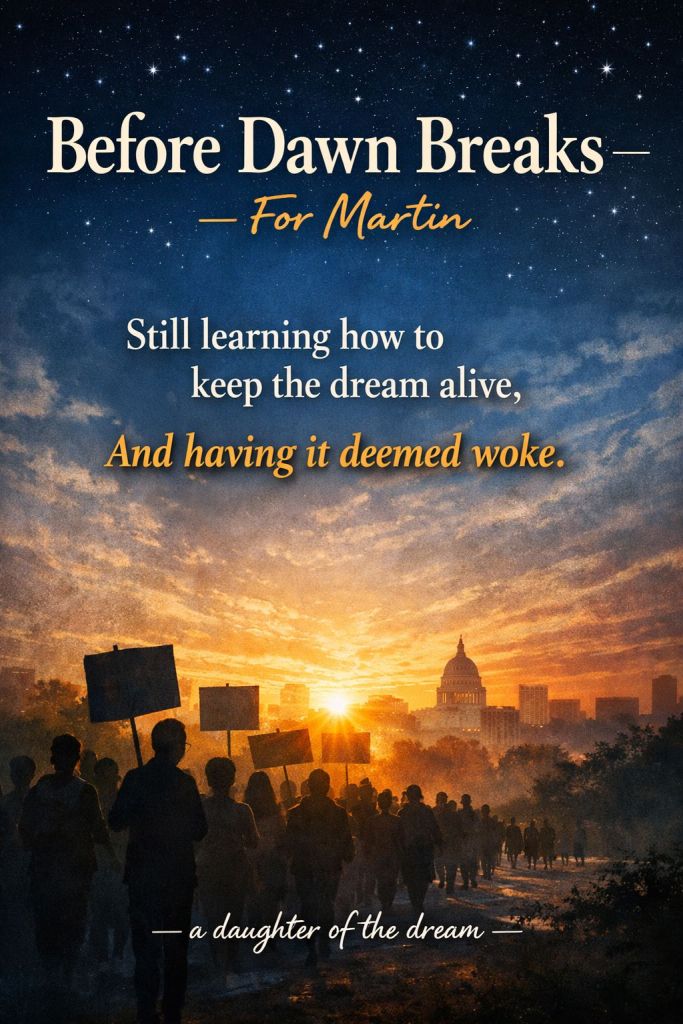
Sincerely
a daughter of the dream
still learning how to keep it alive,
while  having it deemed woke.

Penned January 2026 – Michelle Gillison-Robinson

Image

When Christmas Doesn’t Recognize Itself

I’ll admit it—I chuckled at first.
I saw a video of a broke Hispanic father joking with his young son that ICE had taken Santa. It was meant to be humorous, a dark joke wrapped in the language of survival. I laughed… and then I stopped.


Because once the laughter faded, the weight of it settled in.


How awful to place that kind of fear on a child. How heartbreaking that this joke even works in our current climate. And then it hit me—harder than I expected.


Under the prevailing American mindset of 2025, the very figures we celebrate at Christmas wouldn’t be welcome here.
Santa would be questioned.
Mary and Joseph would be detained.
Jesus would be born into a system already suspicious of Him.
The wise men would be asked to self-deport.
The angels would be accused of violating airspace.
And the shepherds—unhoused, roaming, living off the land—would likely be jailed for existing outside the rules.


Yes, I know—it sounds like a stretch.


And yes, there must be laws. There must be order. There must be boundaries and systems and responsibility. Scripture never denies that.


But Scripture also never allows us to weaponize law against love.
Because the story of Christmas—the real one—is not clean, controlled, or credentialed. It is a story of displacement. Of vulnerability. Of outsiders. Of God choosing to arrive without papers, privilege, or protection.


Mary wasn’t prepared.
Joseph wasn’t powerful.
Jesus wasn’t safe.
And none of them fit the mold of who society typically makes room for.


Yet this is the story we retell every year with lights and carols and nativity scenes that have grown far too tidy.
Somewhere along the way, we learned to celebrate the symbols of Christmas while quietly opposing everything they stand for.
We sing about peace while nurturing fear.
We speak of joy while guarding our comfort.
We proclaim love while questioning who deserves it.


And that should sober us.
Because Jesus Himself said,
“I was a stranger, and you invited me in.”
Not you vetted me.
Not you verified my worth.
Not you made sure I belonged first.
He didn’t ask us to solve immigration policy.
He asked us to recognize people.


The question Christmas asks us—every year, relentlessly—is not whether we believe in Christ, but whether we resemble Him.
Would we make room for Him now?
Or would we ask Him to prove He belongs?
If the answer makes us uncomfortable, maybe that discomfort is holy. Maybe it’s an invitation to return—not to tradition, but to truth.
Because Christmas has always been about God crossing borders.
And love, by nature, refuses to stay contained.

Love Chelle

Love Chelle

Image

Entertained By Angels

My God, My God.

After my very good doctor’s appt today, my husband & I went to a restaurant a bit out of our way, but I insisted because I wanted to see my fav waitress, Theresa Ann Hatch . Long story short, a couple from Columbus, Ohio were also drawn to detour and find Satterwhites. After they left, Theresa tells us that the gentleman said God told him to pay for our meal. When I ran out to find them in the parking lot he says she wasn’t supposed to tell me but since I was there……..he read all the mail in my heart from all the letters I have ever written to God. Had me crying in the parking lot. Talked my hearts desires and my need for rest and that God doesn’t expect a minster like me to try to rescue the whole world but do my part. He also said I need to get in my head how much God loves me and not just in a generic sense.

He never gave me a chance to say a word, so everything he said was 100% from God. They held on to me, and it brought a peace that I can not describe. Oddly my eyes were still dilated from my retina appt so I couldn’t get a grasp of what they looked like, just that they had a glow about them that wasn’t hurting my eyes like the sun does when your eyes are dilated. I don’t know if God will allow me to see them again in this life as they were just passing through, but My God, My God, I believe I entertained angels.

Erase Not

Virginia’s quest to erase the enslavement of human beings from memory will not make it cease to have existed. I don’t teach this to my children and to their children to foster hatred but rather to show them how incredible our people are to have survived and thrived despite circumstances forced on our ancestors by american greed. Yet no one asks my Jewish brothers to forget and water down the Holocaust. No one asks the american Japanese to deny the California concentration camps. No one asks my Indian heritage to dry the Trail of Tears.

We are watered down because whenever we choose to remember we become powerful. An attempt to drown us in engineered miseducation. Reminiscent of our bloodlines drowned in the Atlantic for being too strong to make passage.

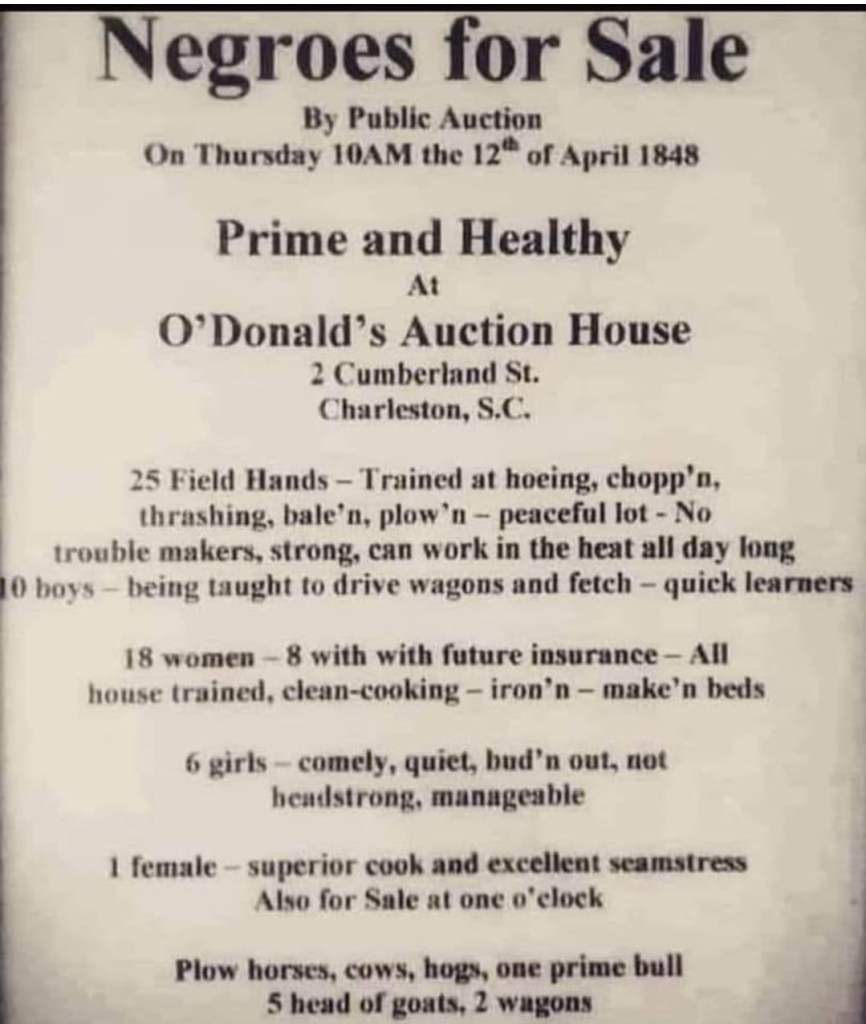
Fearful folks discriminate and suppress what and whom they are intimidated by most. Black History Month is about strength and success against incredible odds. Slavery is american history dripping in greed, oppression and supposed superiority. No need to sugar coat it or pad it with cotton. My ancestors cultivated both of those.

Oddly, the State of Virginia worried about a recent governor in “black face.” Need to be more worried about the one who has no problem showing who he really is.