Even though today is April Fool’s Day… for me, it marks something completely different.
Twenty-one years ago, I went from being a near-homeless divorcee with three kids in tow to becoming a homeowner in 90 days.
And I still smile when I think about it. Because I was so careful not to say anything that might disrupt what God was doing, that every time someone asked me, “Chelle, what are you going to do?” I would simply say, “I’ll tell you on Wednesday.”
There was nothing special about Wednesdays… except that it gave me somewhere to place my expectation.
And sure enough—every Wednesday— God gave me something to say. A step. A shift. A provision. A testimony.
So I kept showing up to Wednesdays. And when I finally walked into that house, on April Fools Day, I found a Bible waiting for me.
Inside was a note from the selling realtor that said: “Your bid was not the highest, but in 1955 this house was built for you. God has blessed it. Enjoy”
Confirmation of what I already knew. This wasn’t luck. This wasn’t timing. This was God.
And here I am, twenty-one years later… on another Wednesday. Still standing. Still provided for. Still carried.
And if I’m being honest… at 2 a.m. this morning, life tried to get loud again. Decisions. Pressure. Finances. The kind of weight that makes your head hurt and your chest feel tight.
But somewhere between the worry and the whisper, I found my footing again.
And this is what I stood on: Lord, I trust You more than this situation. Lord, I trust You more than what this situation is trying to tell me. Lord, I trust You more than how I feel right now. Lord, I trust You more than my need to control how this turns out. Lord, I trust You to take care of me… no matter what this becomes.
Because I’ve seen this before.
Different details… same God.
So no… I don’t really do April Fool’s. Because I’ve lived long enough to know that God doesn’t play about His promises.
This isn’t April Fool’s to me. This is “His April Faithfulness.” A reminder that no matter what I face, God has always had my back.
Not always my way. Not always my timing. But always… faithfully.
Before the doors open. Before the voices gather. Before the weight of it settles in your chest.
A quiet hour. The kind where time pauses just long enough for memory to walk in unannounced and sit beside you.
I went to prepare myself to show up for someone else’s loss… and found myself standing in the doorway of my own.
Because grief does not stay in its lane. It recognizes itself. It echoes across years. It gently taps your shoulder and whispers, “You remember this.”
And in that quiet hour…before the final hour… when a casket tries to close a chapter in a well read life…. I remembered something sacred:
My mother never really left.
I see her… in the mirror when my face catches the light just right.
I hear her in my voice when I’m talking to my children and don’t even realize it at first.
And lately… I feel her in the way I beam at my grandchildren. That deep, undeniable joy that doesn’t ask permission to show up on your face. The kind that says, “This love didn’t start with me.”
She shows up in the kitchen. In the way I don’t reach for measuring cups…but trust a palm and a pinch of two fingers to decide what salt and sugar ought to do. Somewhere along the way, her tongue for spices became mine.
She shows up in the way I clean. Because a house is not clean unless there’s a cap of bleach poured into a small tub basin in the sink… and oh the smell of Pine-Sol rising up like proof. That sharp, honest scent that says, “Now it’s done right.”
She shows up in my music. Because cleaning without music? That’s just work. But cleaning with Aretha Franklin? That turns into a whole moment.
And somehow… the dance is not right unless it happens in the living room. Not the kitchen. Not the hallway. The living room. Like joy has a location memory.
She shows up in my mornings. In a cup that’s more cream than coffee.
In quiet writing hours before any rooster thinks about waking up. Discipline that looks like devotion. Routine that feels like inheritance.
And every now and then… when something stirs my spirit the wrong way, I catch myself standing with my hand on my hip, leaning just a little to one side, squinting my eyes like I can hold the tears back if I narrow the view.
It was intimidating on her six-foot frame. Not quite the same on my five-foot-three one… But I try. Oh, I still try
And now I realize what I thought was loss… started to look a lot like continuation.
“As a mother comforts her child, so will I comfort you.” — Isaiah 66:13
Because God, in His mercy, doesn’t just take people home… He lets them leave themselves behind in us. In our habits. In our preferences. In our voice. In our love for the next generation.
So yes… there is a final earthly hour. A moment where everything becomes real.
But there is also this quiet, sacred truth: She is still here. In the mirror. In the movement. In the memory that turned into muscle.
In the love that keeps reaching forward.
Dear Lord, meet us in that quiet hour before everything becomes real. When memory rises and grief feels close enough to touch, let it carry comfort with it. Remind us that love does not end… it continues in us. In what we do without thinking. In what we carry without trying.
Sometimes the world notices the wrong thing first.
Hedy Lamarr was known throughout Hollywood as one of the most beautiful actresses of the 1940s. Her face appeared on movie posters and magazine covers, and audiences admired her elegance and glamour.
But behind the fame lived a restless and brilliant mind.
During World War II, Lamarr watched the rise of Nazi power in Europe and wanted to help the Allied cause. Working with composer George Antheil, she developed a communication system designed to guide torpedoes without enemy interference.
Their invention used a method called frequency hopping, where radio signals constantly changed channels so they could not be jammed.
At the time, the military dismissed the idea.
Years later, however, the technology behind Lamarr’s invention became the foundation for modern wireless communication. Today the same principle supports Wi-Fi, Bluetooth, and GPS systems used around the world.
There is a verse in Proverbs that reminds us, “The Lord gives wisdom; from His mouth come knowledge and understanding.”
Hedy Lamarr reminds us that wisdom often lives quietly beneath the labels the world places on us.
Sometimes the person everyone admires for one gift is carrying another gift powerful enough to shape the future.
The world may decide who you are before it knows your whole story.
Hedy Lamarr was celebrated for beauty, but her mind helped build technology that connects billions of people today.
Sometimes the gifts God gives us are not immediately recognized. But that does not make them any less powerful.
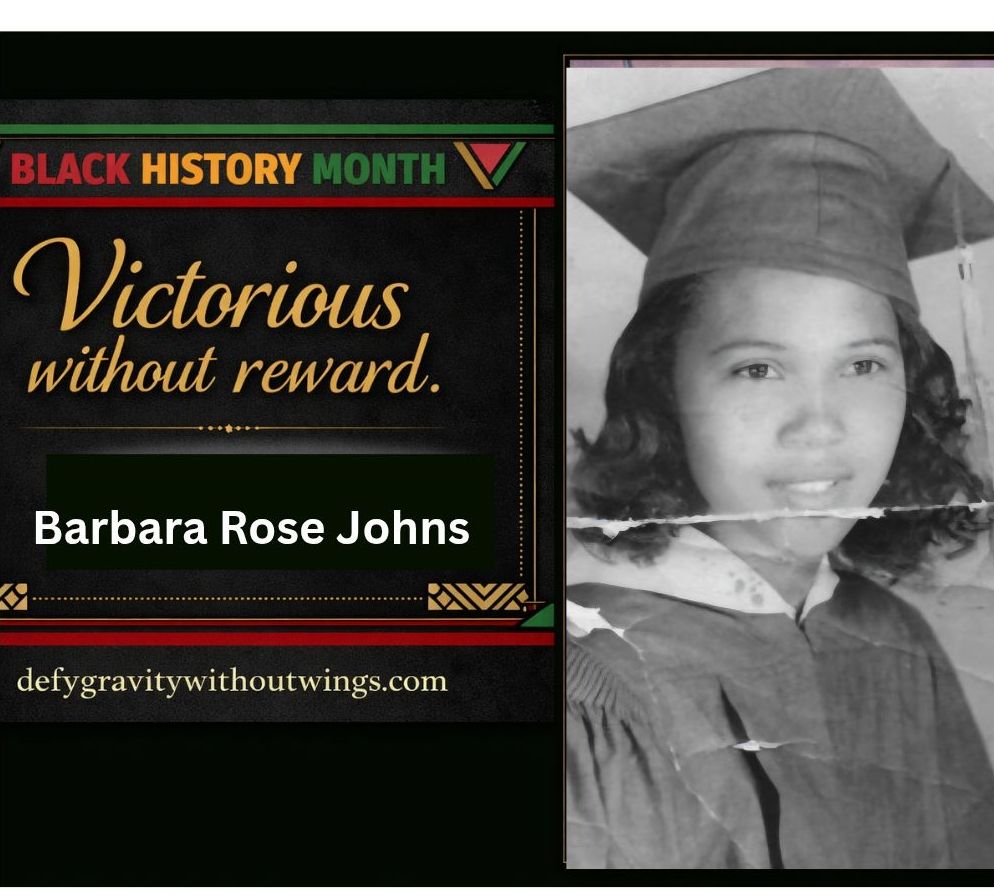
Barbara Johns was fifteen years old when she decided that waiting politely for justice was no longer an option.
In 1951, in Prince Edward County, Virginia, Barbara was a student at Robert Russa Moton High School — a segregated Black school with no gym, no cafeteria, overcrowded classrooms, and tar-paper shacks used as makeshift buildings. Meanwhile, white students nearby learned in brick schools with resources and space.
Barbara saw it. Barbara lived it.
And Barbara refused to accept it.
Without permission from adults, administrators, or movement leaders, she organized a student strike. She convinced her classmates to walk out, not knowing if anyone would listen — only knowing that staying silent was no longer an option.
Adults were furious. Leaders were nervous. Teachers were afraid they would lose their jobs.
Barbara’s name was almost removed from the complaint. But the case moved forward anyway. Her courage became part of Davis v. County School Board of Prince Edward County, one of the five cases folded into Brown v. Board of Education.
History changed. And Barbara Johns? She received death threats. She had to leave her hometown. She lived the rest of her life quietly. Her name was rarely spoken when Brown was celebrated. She was victorious without reward.
Barbara Johns teaches us something uncomfortable and holy: Sometimes the people who force history to move are the ones most quickly pushed out of the picture. She was young. She was female. She was uncompromising. And she was inconvenient.
“Let no one despise you for your youth.” — 1 Timothy 4:12
Barbara didn’t wait to be older. She didn’t wait to be chosen. She didn’t wait to be safe. She acted — and the system scrambled to catch up.
If you have ever been told you were too young to understand, spoken truth that made adults uncomfortable, sparked change and then watched others take credit, or paid a personal cost for doing the right thing early — Barbara Johns stands with you.
She reminds us that courage does not require credentials — only conviction. She lit the match. The world tells the story without her name. But God remembers.
We see you, Barbara. We tell it right.
Bread Crumbs — for those coming after us. Victorious without reward. Still here.
I was listening to one of my favorite songs—“He Knows My Name”—and my emotions spilled out before I could stop them. It happens like that sometimes. After a rough moment. After allowing myself—again—to be hurt by someone who never really took the time to know me. Not my heart. Not my story. Not the way I learned to survive.
I didn’t even realize how much I was carrying until that song started playing. And suddenly, there it was—grief, relief, truth—all at once.
Because here’s the greatest thing about God: He knows my name. And not just my name—He knows my nickname too. The one spoken by people who love me. The one I only answer to when I feel safe.
He knows me with the mask—the strong one, the capable one, the superhero version that keeps showing up.
And He knows me without it—the tired, tender, still-hoping version I don’t always let the world see.
The real me. Not the performance. Not the usefulness. Not the resilience résumé.
This song reminds me that I don’t confuse God. I don’t disappoint Him by being human. I don’t have to explain myself into being worthy of love. It’s my Survivor Song because it tells the truth I forget when I’m hurting: I am already known. Already named. Already held. And when I rest in His arms, I don’t need armor. I don’t need a script. I don’t need to be brave for one more minute. I am safe.
With and without the mask. With and without the cape. Somewhere along the way, I learned to confuse being needed with being known. But God never made that mistake.
So today, if you’re feeling unseen— if you’re nursing the quiet ache of being misunderstood— let the reminder rise up like a song in your chest. You are known by name. You are held without pretending. You are safe in His arms. And sometimes… surviving looks like letting yourself be known—first by God, and then by yourself. “I have called you by name; you are Mine.” — Isaiah 43:1
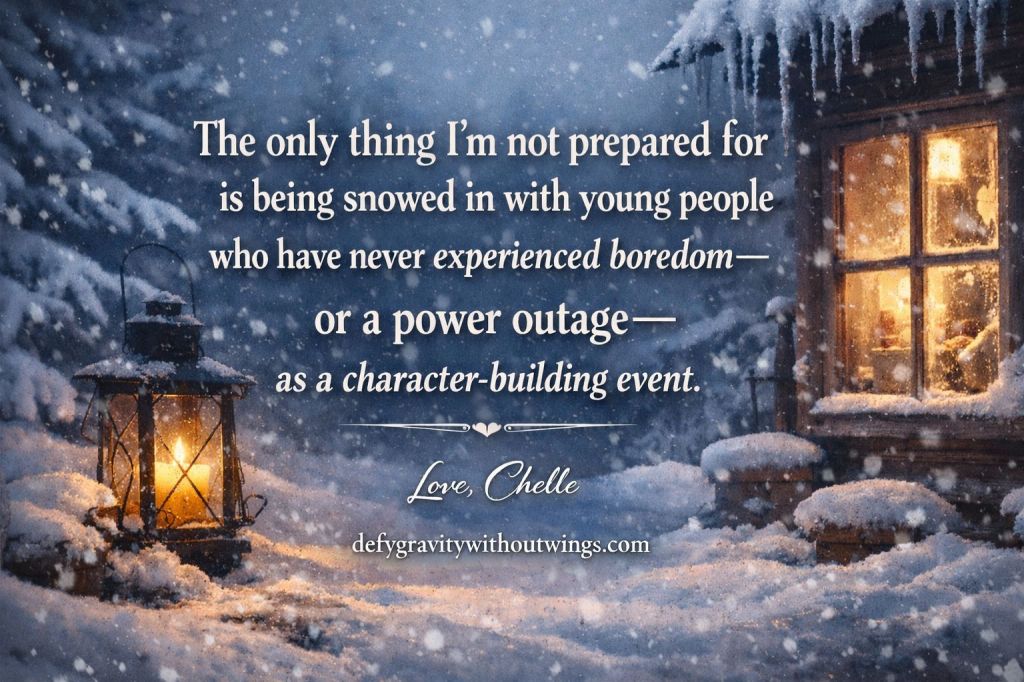
My favorite weather man is forecasting the first official Snowmaggedon of the season: six to twelve inches of snow, up to an inch of ice layered on top, and—because chaos loves company—the delightful possibility of losing power. Naturally planned for a post-work weekend, because rest is apparently negotiable. I’ve done my preps. Grandma’s provision list? Checked. Every extra blanket in the house washed, folded, and staged like we’re auditioning for Little House on the Prairie: Dominion Energy Edition. Candles. Tea lights. Batteries. Flashlights. The full “we will survive this living room” starter kit. I’ve been digging through storage bins to find the reflective cover for my greenhouse, determined to protect my plant babies outside. Because if the lights flicker and the world goes quiet, somebody still needs to be covered. We will endure together—warm-ish, faithful, and protected. This isn’t panic prepping. This is inheritance. This is what happens when you’re raised by women who trusted God and kept extra blankets. Women who understood that peace doesn’t come from pretending storms don’t happen—it comes from knowing you’re sheltered when they do. “He will cover you with His feathers, and under His wings you will find refuge.” — Psalm 91:4 That verse feels different when you’re pulling covers over tender things. When you’re choosing care over chaos. When you’re preparing not out of fear, but out of love. And when the work is done—when the candles are set and the covers are pulled tight—there’s permission to rest. “In peace I will lie down and sleep, for You alone, Lord, make me dwell in safety.” — Psalm 4:8 Now, the only thing I’m not prepared for is being snowed in with young people who have never experienced boredom—or a power outage—as a character-building event. Back in my day we stared at walls and survived… But even then… provision has already been made. And that, right there, is peace—with a little sass and a lot of covering. Love, Chelle
Then I heard the soft, unmistakable sound of soil shifting where it shouldn’t, followed by the sight every plant-loving heart knows too well — one of my pothos vines snapped clean away from the rest of the plant.
Just like that. An accident. A break.
My first thought wasn’t theological. It was maternal. Can it be saved?
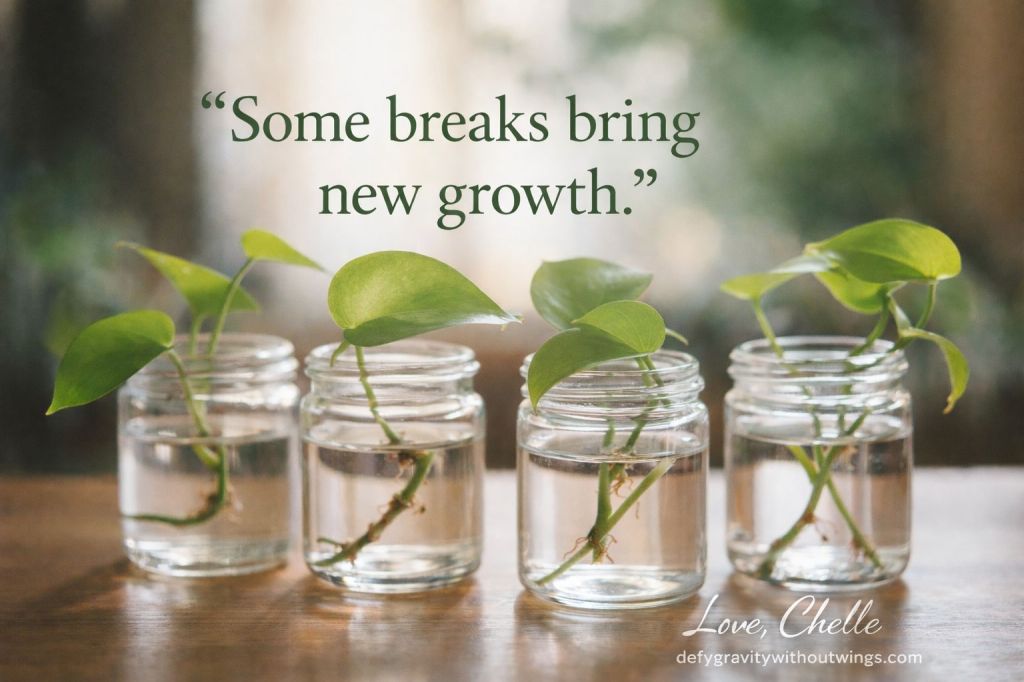
I picked it up gently, turning the broken vine over in my hands, looking for signs of life. And there they were — tiny nodes, already formed. Places where roots could grow, even though they hadn’t yet.
What looked like damage was actually possibility.
I learned something standing there in my living room with dirt on the floor and a vine in my hand: Not every break is a loss. Some breaks are an invitation.
The plant wasn’t ruined. It was multiplied. What separated didn’t die — it prepared to grow again, just differently, in a new place.
And isn’t that how it goes with us?
We panic when something breaks — a plan, a season, a relationship, a version of ourselves we worked hard to protect. We assume broken means finished. But God has a way of seeing roots where we only see separation.
Scripture whispers this truth gently:
“There is a time for everything… a time to plant and a time to uproot.” — Ecclesiastes 3:1–2
Uprooting feels violent when it happens unexpectedly. But uprooting isn’t destruction — it’s movement.
That vine didn’t know it was about to be replanted. It didn’t resist the separation. It just carried what it needed inside itself and waited for water.
Maybe that’s where we are too.
Maybe what snapped didn’t end us. Maybe it exposed what was already capable of growing.
So I didn’t lose a plant today. I gained four jars of hope sitting on my counter.
What broke didn’t disappear — it multiplied. And maybe that’s the part we forget when something snaps in our hands.
Waiting isn’t wasted. It’s where roots decide to show up.
“Those who wait for the Lord shall renew their strength.” — Isaiah 40:31
Some breaks bring new growth. They just need water… and a little time.
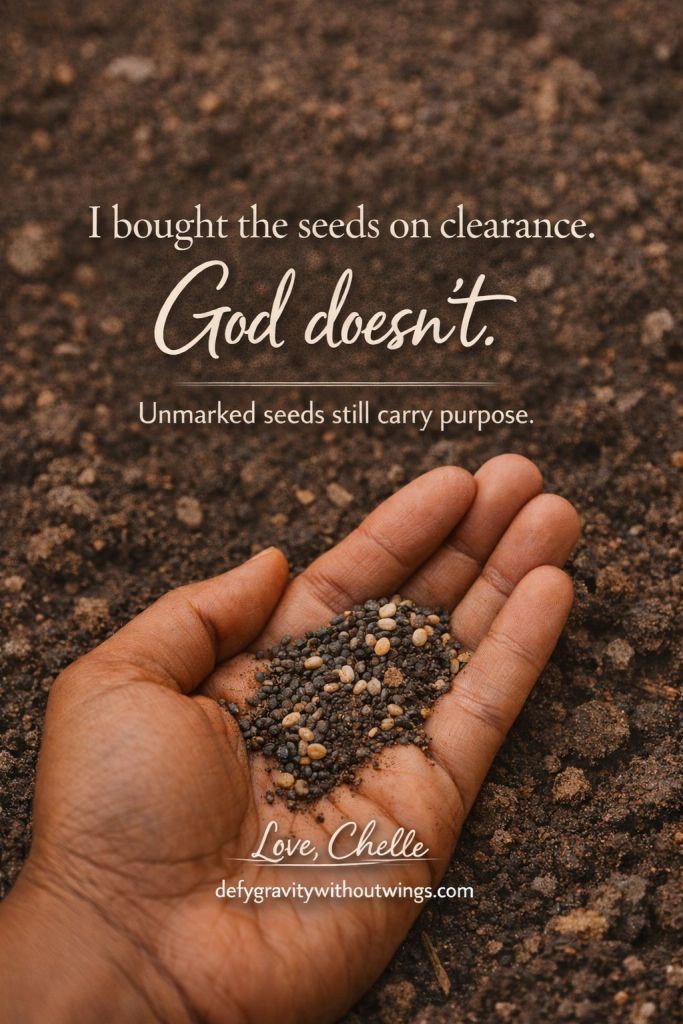
I was standing there with a handful of seeds and no idea what any of them were. No labels. No instructions. No promises. Just seeds.
Some were round. Some looked like dust. Some looked like… dirt pretending to be something important.
And full confession — I made the executive decision to buy them from a discount house online, which should have been my first clue that clarity was not included in the price.
Because planting unmarked seeds feels risky. You don’t know what you’re committing to. You don’t know how long it will take. You don’t know what kind of care it will need — or if you just planted hope, oregano, and disappointment all in the same row.
And that is where I had to repent of my disgust with not being able to see the seeds’ vision.
God has planted a lot of unmarked seeds in me. No timeline. No instruction card. No neat little packet that says “This will bloom in 90 days if watered weekly and protected from disappointment, other people’s opinions, and your own impatience.”
Just obedience. Just trust. Just dirt and hope. Some seeds He plants look insignificant — almost invisible. Some feel mislabeled by other people. Some feel like they were handed to us without explanation at all.
And yet… seeds don’t need labels to know what they are. They just need soil. Light. Time.
And a gardener who doesn’t dig them up every five minutes to check progress — which, for the record, I have learned is frowned upon in both gardening and faith.
I think that’s where I get tripped up. I keep wanting proof before growth. Confirmation before commitment. Fruit before faith.
But the seed already knows what it carries — even when I don’t.
“So neither he who plants nor he who waters is anything, but only God who gives the growth.” — 1 Corinthians 3:7
Maybe the confusion isn’t failure. Maybe it’s faith in its earliest form. Maybe God is saying: Plant it anyway. Water it anyway. Stop interrogating the soil. Because unmarked doesn’t mean unintentional. And unseen doesn’t mean unimportant. And dormant is not the same thing as dead.
Not because He was lazy. Not because the need was gone. Not because the work was finished.
But because He knew when to pour Himself out — and when to be filled again by the Father.
He stepped away while people still needed Him. He withdrew while expectations still waited. He rested even though the world would have gladly kept pulling.
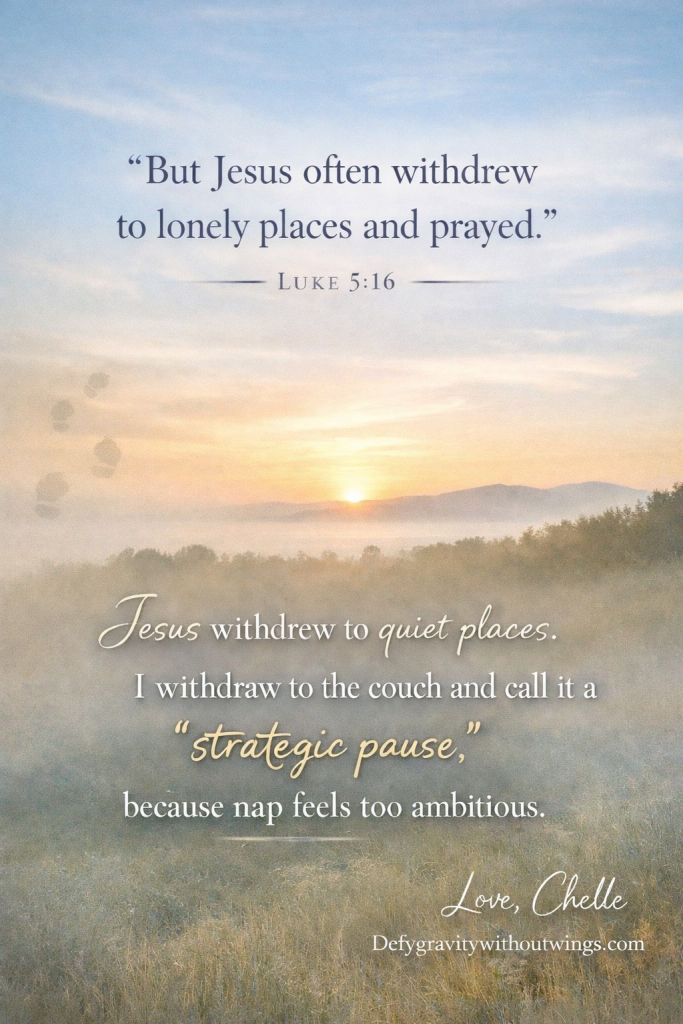
“But Jesus often withdrew to lonely places and prayed.” — Luke 5:16
(Jesus withdrew to quiet places. I withdraw to the couch and pretend I’m just “thinking.”)
Last night my body kept waking me up like it was tapping my shoulder saying, Hey. We’re done pretending.
Every hour on the hour. No deep rest. No drifting off.
Thoughts of what I needed to do today were keeping me awake, while those same thoughts were making me tired.
But, yet, there was a quiet insistence that something holy was being ignored.
(Jesus rested. I call it a “strategic pause,” because the word nap feels too optimistic.)
Here is the truth tired women rarely hear out loud:
Rest is not quitting. Pausing is not disobedience. Taking a break is not a lack of faith.
Sometimes it is the most faithful thing you can do.
Jesus didn’t withdraw because He didn’t care. He withdrew because He did — because love that lasts must return to its Source.
(Jesus took a break. I took one too once — accidentally, in the driveway, with the car still running.)
Today I will not apologize for being tired. I will not spiritualize exhaustion. I will not confuse availability with holiness.
I will follow Jesus — even if that means following Him somewhere quiet.
And if all I manage today is showing up gently, that will be enough.
Because Jesus took a break. And somehow… that sets me free.
So if you can’t find me today, I am on the couch with Jesus. Wake Him and ask permission to wake me.
Love, Chelle
Footstep Notes: Luke 5:16; Mark 1:35; Matthew 14:23
“I would have fainted, unless I had believed to see the goodness of the Lord in the land of the living.” — Psalm 27:13
1/7/18.
I will always remember that date like a star date in the Star Trek Captain’s Log.
It started as a normal Sunday setup. I had just finished cleaning around the sound booth and was adjusting everything to get ready for that morning’s praise and worship. Service was running a few minutes behind, but we were still riding the spiritual high of pre-worship hour prayer.
Then it happened. My phone rang.
I almost never answer my phone during service. In fact, just two minutes earlier, I had nudged one of our teenagers about using their phone during Sunday school.
But I recognized the number. That familiar 264 exchange—the one every “kidney family” in my region of Virginia knows by heart. Breathless. Full of anticipation. Almost terrified. Palms sweating, face flushed in seconds. I answered to the coordinator’s urgent voice:
“WHERE ARE YOU?”
You see, protocol dictates that when the organ sharing center receives a possible match, they must first confirm that the prospective recipient is within four hours of their chosen transplant hospital. Once your location is confirmed, they tell you they’ll call back—and promptly hang up.
Yes. You read that right.
In one of the shakiest moments of your life, they hang up with a promise to call you back within an hour… or so… if it’s a good match.
I was still in the sound booth. My son was seated in his usual spot, about six rows in front of me. I didn’t know whether to tell him that his life might be about to change. We had already been disappointed by calls like this—twice before.
So instead, I texted him: “Be ready to go when I tap you.”
His response was simple: “Ok.” He didn’t ask why. He didn’t question me. He just trusted that if I said go, we go.
For me, however, the next 59 minutes would be the longest of my entire life. Time and space seemed to stand still. The room suddenly felt too warm, the air too stale. I can’t even remember if I set the microphones correctly. The pastor could have been shouting and I wouldn’t have heard him. The praise team was faithfully belting out worship songs my impatient ears could not discern.
All I could distinguish was the steady rhythm of the drum—now matching my racing heartbeat.
About 45 minutes into the wait, I had to correct my course. Not on the soundboard. In myself.
I found myself apologizing—to God, to Jesus, to the Holy Spirit. I had become so consumed with the call that I had stopped truly worshiping. I had stopped listening to the Word being preached.
I was esteeming what I wanted from God more than I was esteeming God Himself. And in that moment, it felt as though the Holy Spirit was echoing the same question in my heart: “WHERE ARE YOU?”
I steadied myself. I readied myself. Through tears and trembling faith, I began to worship again—declaring that as desperately as I wanted this gift to free my son from five long years of agonizing dialysis, I wanted the Presence of the Lord even more.
As my spiritual hunger was met with the assurance that God was with me no matter what, I heard in my spirit, “Hang up.”
At that exact moment, I looked down at the phone I had been clutching in my hand—and it rang. With tears streaming, I answered. Joyfully, 58 minutes into the wait, the coordinator said: “HOW FAST CAN YOU GET HERE?”
And that is the stuff our walk with Christ is made of. How often do we approach God wanting—and even needing—something deeply tied to a promise we believe He made, only to find ourselves overwhelmed by the waiting? Too often, our “knock and the door shall be opened” faith quietly shifts into a heartsick lifestyle of disappointment, dissatisfaction, and even unbelief—unless we see the manifestation.
Hebrews 11:6 reminds us that “he who comes to God must believe that He is, and that He is a rewarder of those who diligently seek Him.” Notice it says seek Him. Not diligently seek it.
When God asks, “Where are you?” may we be found seeking Him—not just the thing we hope He’ll give us. When He seems to hang up, trust that He will call again. Trust God. Trust His goodness. Even when it feels distant—it is still His plan. Even when it unfolds differently than expected—it is still His plan. Even when the answer is no—for reasons greater than we understand—better is still His plan. Reset your need for control. Let God have His way.
One last question: Since we trust that God is always right on time… how fast can you get here?

























 defygravitywithoutwings.com