Image

A Meeting Place


This may not sound like me.


I’m usually the one who finds the humor, the metaphor, the small spark of light tucked inside the ordinary. I believe in joy — deeply. I still do.

But today, joy feels quieter, and sorrow feels closer to the surface .
The world feels fractured.
Nation against nation.
Neighbor against neighbor.
Families strained.
Friendships reduced to likes, views, and fleeting affirmations.


And somewhere in the middle of all this noise, what seems to be slipping away is our sense of community — the kind where people are known, not curated. Where connection doesn’t require a platform or performance.


Yesterday, as I mourned world events ,  all of this along with a side of opinions still wrapped with faith, I was told I was hiding behind God and the Bible.


That stayed with me.


Not because it shook my faith, but because it revealed something deeper about the times we’re living in — a world so uncomfortable with lament that even sacred language is suspect when it refuses to harden into arguments or slogans.


But my faith has never been a hiding place.
It has always been a meeting place — where grief and hope are allowed to sit together without rushing one another out of the room.


Today, I find myself weeping.
Not because faith has failed, but because love is still very much alive.
“Jesus wept.” — John 11:35
He stood in the presence of grief and loss and did not rush to fix it, explain it, or weaponize it. He allowed tears to speak where words fell short. If tears were worthy of Him, they are not beneath us.
Scripture doesn’t ask us to bypass sorrow — it calls us to enter it together.
“Rejoice with those who rejoice; mourn with those who mourn.” — Romans 12:15


This isn’t a departure from who I am.
It’s a refusal to pretend.
I still believe in hope. I still believe in resurrection. I still believe God has not lost the plot. But I also believe sorrow has a place in the story — not as an ending, but as an honest chapter.


So today, I show up softer. Quieter. More tender. Trusting that God can hold my tears just as faithfully as He holds my hope.


And believing that even here — especially here — grace is present.
Love Chelle

Image

Eviction Notices ( Without the Panic)

As I pack up the end of one year to experience the wonders of the next, I was reminded of how many times I was evicted. Not in the natural sense but by God.


I’ve learned that God’s eviction notices don’t come with flashing lights or raised voices.
They don’t sound like “You’re fired.”
They don’t arrive with chaos or fear.
They feel like stability that no longer fits.


I call it an eviction notice when God begins to unsecure me in a place He never intended to be my final address. Provision is present. The lights are on. The ground is steady. And yet—peace quietly taps me on the shoulder and whispers, “This isn’t home.”


For people like me—faithful to a fault, a true “Stable Mabel”—dependable, steady, the one who shows up no matter what—God doesn’t shove.
He anchors.
He makes sure the floor doesn’t drop out.
He removes the threat of free-fall.
He rearranges just enough, so survival is no longer the distraction.
And that’s when it gets confusing.
Because when panic leaves, clarity arrives.
And clarity is harder to ignore.
An eviction notice from God doesn’t say leave now.
It gently says, don’t give this place your last.
It shows up as: – security without satisfaction
– provision without peace
– competence without calling
It feels like gratitude… mixed with restlessness.
I used to think eviction meant loss.
But I’m learning it often means permission.
Permission to stop confusing loyalty with assignment.
Permission to admit that faithfulness has a future—and it doesn’t always look like staying.


Scripture gives me a different picture of how God moves His children:
“Like an eagle that stirs up its nest
and hovers over its young,
that spreads its wings to catch them
and carries them aloft…”
(Deuteronomy 32:11)


When I think of God’s eviction notices now, I don’t picture being thrown out.
I picture a nest that has grown too comfortable—warm feathers, familiar edges.
God stirs the nest not to harm, but to wake.
There is a push, yes—but there is also hovering.
There is a letting go, but never abandonment.
Before the feathers can be too ruffled,
before fear turns into free fall,
the same wings that nudged are the wings that catch.
That’s what this season feels like.
Not panic.
Not loss.
But the unsettling grace of being lifted by a God who refuses to let me stay small—and refuses to let me crash while I learn.
Here is the grounding truth I’m holding close:
God is not asking me to burn down my life.
He is inviting me to build the next one alongside it—until it’s strong enough to stand.
No rushing.
No scorched earth.
No fear-driven decisions.
Just a quiet understanding that a holding pen is not a home—and that noticing the gate is unlocked is already movement.
If this is an eviction notice, it isn’t cruel.
It’s merciful.
Because God doesn’t evict His children into the cold.
He prepares the next place before He asks us to pack.
And peace—real peace—always goes with us.
— Love. Chelle

Image

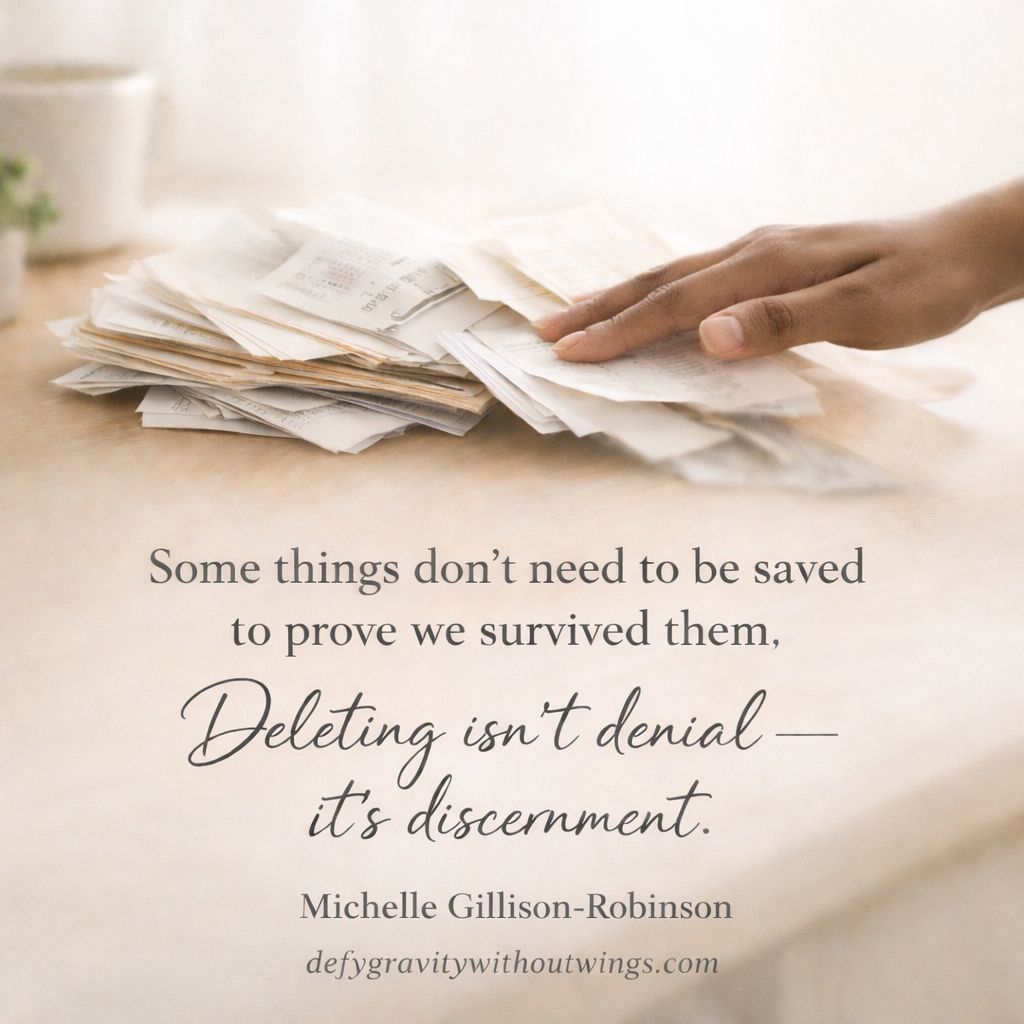
Deleting The Receipts

I didn’t plan on doing heart work this morning.
I was just trying to clear storage—make my phone run smoother, lighten the load, make room for what’s next.

I was deleting blurry screenshots, duplicate photos, and saved recipes I’ll probably never make—
right alongside hundreds of pictures of my grandchildren that I can’t bring myself to let go of.

And tucked in between it all were receipts I once needed to survive.
Thirty frames of words that bruised from an argument.
A disagreement that no longer makes sense.
Pain from a season that had already passed.

I kept them because I thought I might need proof.
Proof that I wasn’t imagining things.
Proof in case I ever needed to defend myself.

And for a while, that was okay.

But this morning, standing on the edge of a new season, I realized something had shifted.
I no longer needed protection from the past.
I needed permission to release it.

So I didn’t reread.
I didn’t rehearse the hurt.
I didn’t reopen the courtroom in my mind.

I deleted.

Not because it didn’t matter—
but because it doesn’t get to lead anymore.

Scripture says,
“Forget the former things; do not dwell on the past. See, I am doing a new thing!” — Isaiah 43:18–19

Forgetting doesn’t mean pretending it didn’t happen.
It means choosing not to live there anymore.

There’s a difference between wisdom and weight.
Between remembering and reliving.
Between holding truth and being held hostage by it.

“Let us throw off everything that hinders.” — Hebrews 12:1

Not everything that hinders is sinful.
Some things were necessary once—but become heavy later.

I didn’t erase the story.
I simply stopped carrying the evidence.

And as the year turns and the air feels fresh again, I’m learning this sacred truth:

Dead and done are not the same thing—but neither needs to be dragged into tomorrow.


Sometimes the holiest thing you can do
is delete what no longer serves the person you are becoming.


Prayer:
God, thank You for seasons of protection—and for the courage to release them when they’re no longer needed. Help me walk lighter into what’s next, trusting You with the truth I no longer need to carry. Amen.

Love, Chelle

Image

Faith With A Yawn

(Or: When Christmas Finally Got Me)


I did something yesterday that I almost never do.
I fell asleep at the table.

Not the polite, chin-in-hand, “I’m listening” kind of sleepy.
The real kind. The head-dip. The eyelids surrendering mid-conversation.
The kind that scared me just enough to notice.

Christmas finally got me.

I had planned for rest. I needed rest.
But life — and love — had other things lined up.

A quick visit to the nursing home turned into three hours because they were short-staffed. Again.
I stayed — because love doesn’t clock out when it’s inconvenient.

Somewhere in between, there was also chasing down folks to drop off gifts.
“Let me just swing by real quick.”
“One more stop.”
One more smile. One more bag. One more moment of making sure nobody felt forgotten.

By the time I made it home, I barely had enough energy to pivot to the next thing — visiting my mother-in-love.

Bless her — she cooked.
I ate.
And somewhere between gratitude and exhaustion, my body simply said, “That’s enough now.”

I nodded off at the table.

I laughed about it later, because it was funny.
But it also scared me — because I don’t do that.
I’m usually the one pushing through, powering up, showing up.

What I realized later is this:
That moment wasn’t weakness.
It was honesty.

My body told the truth before my mouth ever would.

We talk a lot about rest, but rarely about what happens when we don’t get it — when we keep pouring, keep visiting, keep delivering, keep caring, and assume adrenaline and responsibility will carry us through.

Sometimes they do.
Sometimes… they don’t.

And God doesn’t shame us for that.

“It is useless for you to work so hard from early morning until late at night, anxiously working for food to eat; for God gives rest to His loved ones.” — Psalm 127:2

That verse doesn’t scold.
It exhales.

Maybe falling asleep at the table wasn’t failure.
Maybe it was permission.

Permission to admit that Christmas — the beauty, the chaos, the caregiving, the gift-chasing, the expectations — costs something.
Permission to stop pretending we’re machines.
Permission to rest without first earning it.

Today, I’m still tired.
Still booting up.
Still faithful — just slower.

And that’s okay.

If you’ve nodded off emotionally, spiritually, or physically this season — you’re not broken.
You’re human.

Pull up a chair.
Take a breath.
God is not offended by your yawn.


Image

When Christmas Doesn’t Recognize Itself

I’ll admit it—I chuckled at first.
I saw a video of a broke Hispanic father joking with his young son that ICE had taken Santa. It was meant to be humorous, a dark joke wrapped in the language of survival. I laughed… and then I stopped.


Because once the laughter faded, the weight of it settled in.


How awful to place that kind of fear on a child. How heartbreaking that this joke even works in our current climate. And then it hit me—harder than I expected.


Under the prevailing American mindset of 2025, the very figures we celebrate at Christmas wouldn’t be welcome here.
Santa would be questioned.
Mary and Joseph would be detained.
Jesus would be born into a system already suspicious of Him.
The wise men would be asked to self-deport.
The angels would be accused of violating airspace.
And the shepherds—unhoused, roaming, living off the land—would likely be jailed for existing outside the rules.


Yes, I know—it sounds like a stretch.


And yes, there must be laws. There must be order. There must be boundaries and systems and responsibility. Scripture never denies that.


But Scripture also never allows us to weaponize law against love.
Because the story of Christmas—the real one—is not clean, controlled, or credentialed. It is a story of displacement. Of vulnerability. Of outsiders. Of God choosing to arrive without papers, privilege, or protection.


Mary wasn’t prepared.
Joseph wasn’t powerful.
Jesus wasn’t safe.
And none of them fit the mold of who society typically makes room for.


Yet this is the story we retell every year with lights and carols and nativity scenes that have grown far too tidy.
Somewhere along the way, we learned to celebrate the symbols of Christmas while quietly opposing everything they stand for.
We sing about peace while nurturing fear.
We speak of joy while guarding our comfort.
We proclaim love while questioning who deserves it.


And that should sober us.
Because Jesus Himself said,
“I was a stranger, and you invited me in.”
Not you vetted me.
Not you verified my worth.
Not you made sure I belonged first.
He didn’t ask us to solve immigration policy.
He asked us to recognize people.


The question Christmas asks us—every year, relentlessly—is not whether we believe in Christ, but whether we resemble Him.
Would we make room for Him now?
Or would we ask Him to prove He belongs?
If the answer makes us uncomfortable, maybe that discomfort is holy. Maybe it’s an invitation to return—not to tradition, but to truth.
Because Christmas has always been about God crossing borders.
And love, by nature, refuses to stay contained.

Love Chelle

Love Chelle

Image

When The Living Room Is Empty

Faith With Hospital Wristbands, Holiday Chaos, and Learning to Rest Without Guilt

Normally, this is my season.
From Thanksgiving to Christmas, my house is supposed to look like
Mrs. Claus and Oprah teamed up and ignored every fire code.
For almost 21 years, I’ve carried on what my grandma started —
“You get a gift. You get a coat. You get a toy.”
Everybody gets something.
No background check. No budget meeting. Just love.


We weren’t rich growing up — not even a little —
but my grandma taught me that giving is sacrifice
with beautiful returns and terrible timing.
She made generosity feel like oxygen:
you don’t hoard it, you breathe it out.
But the last two years?
Chaos said, “Oh, you like traditions? Cute.”


Last year, I nearly exited the planet
thanks to an emergency gallbladder infection —
which, for the record, did not come with a warning email.
This year — almost to the day —
my husband decided to add a cardiac episode
to the holiday calendar.
Nothing says Merry Christmas like hospital wristbands
and vending-machine dinners.


So instead of my living room being stacked with toys and coats
to the point of requiring alternate routes and safety briefings,
it stayed… walkable.
No piles.
No rerouting.
No “don’t trip, that’s for the kids” warnings.


And I hated how much that hurt.


Because when chaos is my idea, I thrive.
I can organize mess.
I can schedule generosity.
I can turn madness into ministry.


But this chaos?
This one flipped the table and said,
“You’re going to sit down now.”


The guilt tried to convince me I’d lost my purpose.
That I’d failed Mrs. Claus school.
That someone else stepping up meant I’d been replaced.


But Jesus doesn’t measure faithfulness in square footage or stack height.
And He doesn’t shame people whose bodies clock out before their hearts do.


“God loves a cheerful giver.” — 2 Corinthians 9:7


And some seasons, cheer looks like wrapping gifts.
Some seasons, it looks like sacrifice.


And some seasons — the loud, scary, unplanned ones —
it looks like surviving, laughing anyway,
and whispering thank You from a hospital chair.


An empty living room doesn’t mean an empty calling.
It just means love changed outfits this year.
Someone else stepping up isn’t proof I’ve been replaced —
it’s proof the lesson worked.
And maybe this season,
the most generous thing I can give
is rest without guilt
and faith with hospital wristbands.


Pocket Peace:
Jesus, meet me in the chaos —
the ER lights, the interrupted plans, the traditions on pause.
Remind me that purpose doesn’t disappear when life goes sideways —
it adapts, it waits, it trusts You
to keep the giving going
even when my hands are shaking
and my living room is suspiciously clean.
Amen.