Image

Numbers and Neighbors (and Why You May See Me Writing Quietly for a While)

Numbers and neighbors matter.
I’ve spent most of my life thinking numbers were for accountants, engineers, and people who enjoy spreadsheets far more than I ever will. But lately—especially in this season of writing—I’m learning that numbers aren’t really about math.


They’re about order.


Numbers tell you where something belongs.
They tell you what comes before and what comes after.
They keep things from floating around unfinished and untethered.


And then there are neighbors.
Neighbors are what give numbers meaning.
Nothing meaningful stands alone—not stories, not seasons, not faith, and not writing. What sits beside something shapes how it’s understood. Context matters. Timing matters. Placement matters.


Right now, my writing life looks a little different. Instead of posting every thought as soon as it forms, I’m learning to sit with them. To ask where they belong. What needs to come before. What needs to follow.
It turns out this is how a book is being built.


Isaiah reminds us:
“The Lord will guide you always… You will be like a well-watered garden.” (Isaiah 58:11)
Gardens grow by placement.
By timing.
By knowing what belongs next to what.


So if my writing shows up a little differently for a while, know this:
Nothing is disappearing.
It’s being ordered.
Numbers and neighbors matter.


Love, Chelle

Image

Snowmaggedon Has Entered the Chat

Well… here we are.


My favorite weather man is forecasting the first official Snowmaggedon of the season: six to twelve inches of snow, up to an inch of ice layered on top, and—because chaos loves company—the delightful possibility of losing power. Naturally planned for a post-work weekend, because rest is apparently negotiable.
I’ve done my preps.
Grandma’s provision list? Checked.
Every extra blanket in the house washed, folded, and staged like we’re auditioning for Little House on the Prairie: Dominion Energy Edition.
Candles. Tea lights. Batteries. Flashlights. The full “we will survive this living room” starter kit.
I’ve been digging through storage bins to find the reflective cover for my greenhouse, determined to protect my plant babies outside. Because if the lights flicker and the world goes quiet, somebody still needs to be covered. We will endure together—warm-ish, faithful, and protected.
This isn’t panic prepping.
This is inheritance.
This is what happens when you’re raised by women who trusted God and kept extra blankets. Women who understood that peace doesn’t come from pretending storms don’t happen—it comes from knowing you’re sheltered when they do.
“He will cover you with His feathers, and under His wings you will find refuge.” — Psalm 91:4
That verse feels different when you’re pulling covers over tender things.
When you’re choosing care over chaos.
When you’re preparing not out of fear, but out of love.
And when the work is done—when the candles are set and the covers are pulled tight—there’s permission to rest.
“In peace I will lie down and sleep, for You alone, Lord, make me dwell in safety.” — Psalm 4:8
Now, the only thing I’m not prepared for is being snowed in with young people who have never experienced boredom—or a power outage—as a character-building event. Back in my day we stared at walls and survived…
But even then… provision has already been made.
And that, right there, is peace—with a little sass and a lot of covering.
Love,
Chelle

Image

Some Breaks Bring New Growth

I told myself I would not cry.


I said it out loud. Twice.

Then I heard the soft, unmistakable sound of soil shifting where it shouldn’t, followed by the sight every plant-loving heart knows too well — one of my pothos vines snapped clean away from the rest of the plant.

Just like that.
An accident.
A break.

My first thought wasn’t theological. It was maternal.
Can it be saved?

I picked it up gently, turning the broken vine over in my hands, looking for signs of life. And there they were — tiny nodes, already formed. Places where roots could grow, even though they hadn’t yet.

What looked like damage was actually possibility.

I learned something standing there in my living room with dirt on the floor and a vine in my hand:
Not every break is a loss. Some breaks are an invitation.

The plant wasn’t ruined. It was multiplied.
What separated didn’t die — it prepared to grow again, just differently, in a new place.

And isn’t that how it goes with us?

We panic when something breaks — a plan, a season, a relationship, a version of ourselves we worked hard to protect. We assume broken means finished. But God has a way of seeing roots where we only see separation.

Scripture whispers this truth gently:

“There is a time for everything… a time to plant and a time to uproot.”
— Ecclesiastes 3:1–2

Uprooting feels violent when it happens unexpectedly.
But uprooting isn’t destruction — it’s movement.

That vine didn’t know it was about to be replanted.
It didn’t resist the separation.
It just carried what it needed inside itself and waited for water.

Maybe that’s where we are too.

Maybe what snapped didn’t end us.
Maybe it exposed what was already capable of growing.

So I didn’t lose a plant today.
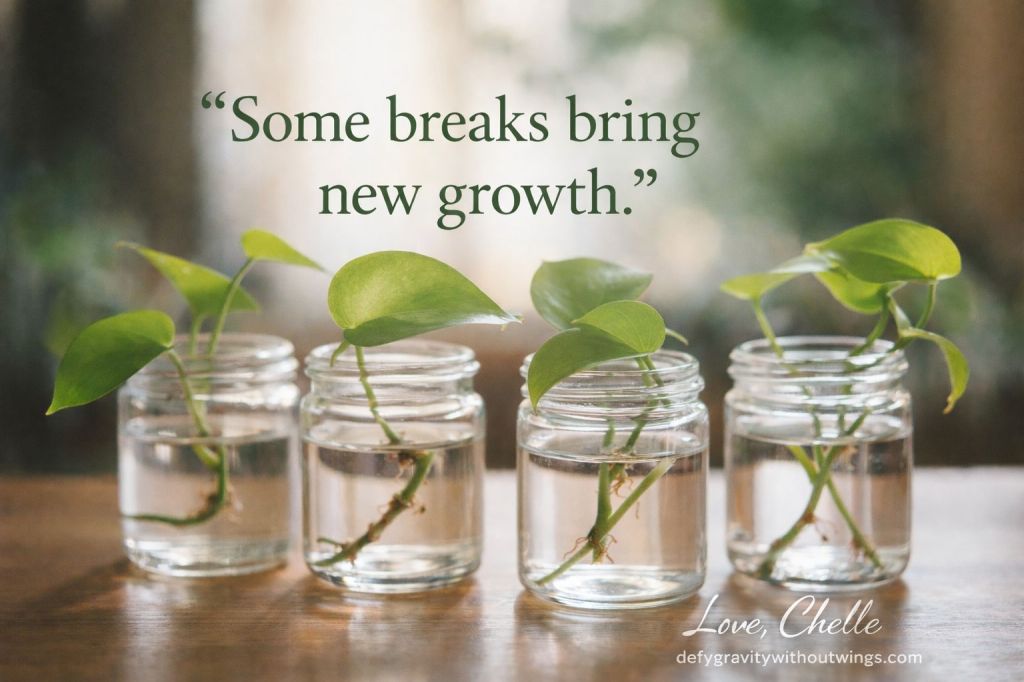
I gained four jars of hope sitting on my counter.

What broke didn’t disappear — it multiplied.
And maybe that’s the part we forget when something snaps in our hands.

Waiting isn’t wasted.
It’s where roots decide to show up.

“Those who wait for the Lord shall renew their strength.”
— Isaiah 40:31

Some breaks bring new growth.
They just need water… and a little time.

With love,
Chelle
defygravitywithoutwings.com
Image

Unmarked Seeds And  Clearance Rack Faith

I was standing there with a handful of seeds and no idea what any of them were.
No labels. No instructions. No promises.
Just seeds.


Some were round. Some looked like dust. Some looked like… dirt pretending to be something important.

And full confession — I made the executive decision to buy them from a discount house online, which should have been my first clue that clarity was not included in the price.


Because planting unmarked seeds feels risky.
You don’t know what you’re committing to.
You don’t know how long it will take.
You don’t know what kind of care it will need — or if you just planted hope, oregano, and disappointment all in the same row.


And that is where I had to repent of my disgust with not being able to see the seeds’ vision.


God has planted a lot of unmarked seeds in me.
No timeline.
No instruction card.
No neat little packet that says “This will bloom in 90 days if watered weekly and protected from disappointment, other people’s opinions, and your own impatience.”


Just obedience.
Just trust.
Just dirt and hope.
Some seeds He plants look insignificant — almost invisible.
Some feel mislabeled by other people.
Some feel like they were handed to us without explanation at all.


And yet… seeds don’t need labels to know what they are.
They just need soil.
Light.
Time.


And a gardener who doesn’t dig them up every five minutes to check progress — which, for the record, I have learned is frowned upon in both gardening and faith.


I think that’s where I get tripped up.
I keep wanting proof before growth.
Confirmation before commitment.
Fruit before faith.


But the seed already knows what it carries — even when I don’t.


“So neither he who plants nor he who waters is anything, but only God who gives the growth.”
— 1 Corinthians 3:7


Maybe the confusion isn’t failure.
Maybe it’s faith in its earliest form.
Maybe God is saying:
Plant it anyway.
Water it anyway.
Stop interrogating the soil.
Because unmarked doesn’t mean unintentional.
And unseen doesn’t mean unimportant.
And dormant is not the same thing as dead.

Love, Chelle

Image

Good Morning From Groot

When I went to make my coffee this morning, I noticed my Brazilian wood plant — the one I call Groot because of the ornament on him — is still growing from just one side.


He’s developing a beautiful arm branch, but only one. By all accounts, there should be two by now.


Most folks would give up on a plant like that.
But I can’t.


All my life, I’ve collected broken things — toys, dolls, records… sometimes even people. Things that seemed useless or pointless to others always found a home with me. I’d turn them into art, merge them with something else, or simply let them be what they were until their value showed itself.


This little Groot reminds me that everything has value exactly as it is, even when it doesn’t quite match the catalog pictures of society.


That one arm?
It’s raised like it’s in praise.
And the smile in the bark makes me happy.


I believe God sees our imperfections with grace and purpose — I know He’s done that for me.

My seasons of brokenness and feeling like a misfit produced music, plays, and even this writing.

Periods of pain with purpose… feeling like a fish out of water… all converted into unique brands of joy.


So if you’re feeling a little uneven today…
a little out of the mold…
a little unlike what you thought you were supposed to be…
You’re not broken.
You’re just growing differently.

Now go raise that arm!


“…everyone who is called by My name,
whom I created for My glory.” — Isaiah 43:7

Love, Chelle

Image

Timing Is Everything (Apparently So Are Berries)

I’ll admit it — I went into a little shock when I learned blueberries and strawberries operate on a two-to-three-year growth plan.
Years.
Plural.

I stood there staring at seeds like they had personally betrayed me.

Up until that moment, I genuinely thought I was being resourceful.
Frugal.
Garden-savvy.
A woman with a plan.

Turns out, I had signed up for a long-term relationship without reading the commitment clause.

That’s when I decided I’m not planting berries until I move into my forever home.
Because berries don’t do well with temporary addresses.
They want stability.
Consistency.
A place where nobody’s packing boxes just as the harvest shows up.

And honestly? I get it now.

I finally understand why blueberries and strawberries cost what they do at the store.
It’s not inflation — it’s time.
It’s patience.
It’s years of watering something that gives you nothing back except leaves and hope.

I really thought it was a good idea.
And it was — just not for this season.

Jesus talked a lot about seeds, soil, and timing.
He never rushed growth — He explained it.

“First the blade, then the ear, then the full grain in the ear.” (Mark 4:28)

Nothing about that process is instant.
Nothing about it is wasted.

Even Jesus waited.
Thirty years before public ministry.
Hidden seasons.
Quiet obedience.
Roots forming where no one was applauding.

So I’ll wait too.
Not because I lack faith — but because I’ve learned that timing matters.

Some things are worth planting when you know you can stay long enough to enjoy the fruit.

Until then, I’ll pay store prices with a little more humility…
and a lot more respect for the journey those berries have been on.

Because growth was never the problem.
Timing was the lesson.

Love, Chelle

Image

Thinning Is Not Killing (Even Though It Felt Like It)

I stood in my greenhouse clutching scissors like I was about to commit a felony.
These weren’t plants.
These were my plant babies.
I grew them.
I watered them.
I whispered encouragement like a slightly unhinged garden aunt.
And now I was being told they were “too crowded.”


Excuse me???
They looked happy.
Thriving.
Living their best leafy lives.
But apparently, love without boundaries leads to chaos.
Who knew.


The word thinning showed up—
and my heart heard destruction.
Because when you’re wired like me,
making room feels an awful lot like abandonment.


I mean, how do you explain to a perfectly healthy kale plant
that it’s not being rejected—
it’s just being relocated, harvested early, or “released into purpose”?


I felt like I was ruining everything.
Until I realized…
nothing was being wasted.
Some plants were transplanted.
Some were harvested and nourished something immediately.


And the ones left behind?
They finally had space to become what they were always meant to be.
That’s when it hit me.
Pruning doesn’t change who we are.
It reveals it.
God isn’t cutting us down—


He’s cutting away what keeps us from becoming strong, rooted, and fruitful.
Not every removal is punishment.
Not every loss is failure.
Some things leave so we can finally grow into ourselves.


“Every branch that bears fruit He prunes, that it may bear more fruit.” — John 15:2


Pruning feels personal when you’re emotionally attached to the leaves.
But it’s the very thing that shapes the harvest.
Thinning is not killing.
It’s the painful, purposeful process of becoming.


And if I’m honest…
I still apologized to my kale,
needed a moment of silence,
and may require counseling before the next round of thinning.


Because apparently God and gardening are both committed
to making us who we’re supposed to be—
even when we’re dramatic about it.


With love, Chelle,

Image

Don’t Miss The Baby Turnip


I couldn’t sleep, again, so I tuned into one of my favorite comfort-watch movies, Last Holiday (2006), starring Queen Latifah.

I’ve watched it more times than I’ll ever confess, but there is one scene I always slow down for.
It’s the kitchen scene. My favorite one.


When Chef Didier looks at Georgia and gently compares her to the baby turnip — the smallest one in the bin, often overlooked, passed by for something bigger or flashier… yet the most tender, the most flavorful, the one a true chef treasures.


That scene gets me every time.
Because the baby turnip isn’t flawed.
It isn’t unfinished.
It isn’t lacking.
It’s just quiet.
And early.
And easy to miss if you’re in a hurry.


And if I’m being honest — part of why that scene hits so hard is because I’ve felt like that turnip.
Overlooked. Passed by. Sitting there thinking, “Excuse me… I am organic, well-seasoned, and emotionally available.”
But folks keep grabbing the big, loud potatoes.

Meanwhile, God is in the kitchen like a five-star chef saying,
“Leave her. She’s tender. She’s not for everybody. And I don’t rush good ingredients.”


Whew.


That’s the holy pause in the story. Not the luxury. Not the bold declarations. But the moment when someone truly sees her.


And isn’t that what so many of us long for?
We grow underground — faithful, steady, consistent — while the world keeps reaching for whatever looks impressive on the surface. We’re not trying to be flashy. We’re just trying to be faithful.


Still, being overlooked can sting.
Especially when you know you’ve been planted, watered, and patient.


But the baby turnip reminds me of this truth: being passed over by people does not mean being passed by God.
God delights in roots.
He honors slow growth.
He protects what is tender until the right time and the right hands arrive.


Sometimes you’re not hidden because you’re insignificant.
You’re hidden because you’re delicate.
Because you’re reserved.
Because you’re meant for a table that understands flavor.


So yes — I may be under a blanket right now pretending I’m Queen Latifah — but I’m also believing, learning, and internalizing this:
I don’t need to audition for worth.
I don’t need to shout to be seen.
I don’t need to rush my growth just because someone else is loud.
If I’m being missed right now, maybe it’s because I’m being saved.
And when it’s my turn?
They’ll wish they hadn’t rushed past the produce section.


Lord, when I feel unseen, remind me that You see fully. Teach me to trust Your timing, even when I feel overlooked. Help me grow deep roots instead of loud leaves,and rest in the truth that being missed by people does not mean being missed by You.


Amen.
Love, Chelle

Image

Grossly Underqualified. Still Expecting A Harvest

I still don’t know what I’m doing.
The sweet potato in the jar in my window  can confirm it.

I stood it upright like a microphone instead of laying it down like a seed. Slips are forming anyway—which feels both rude and deeply grace-filled.

By every measurable standard, I am grossly underqualified for this harvest. I don’t garden with confidence — I garden with Google and apologies. I whisper encouragement to my plants like they’re on a faith journey too.

And yet… green keeps showing up.

Scripture says, “Do not despise these small beginnings, for the Lord rejoices to see the work begin.”
— Zechariah 4:10

Apparently, this applies to gardeners too.

The sweet potato didn’t ask for my credentials.
It didn’t wait for me to feel confident.
It just responded to warmth, light, and the fact that I didn’t give up on it.

That feels uncomfortably familiar.

God has never waited for my expertise before growing something in my care. He responds to availability, not mastery. To people who stay put long enough for growth to decide it’s safe.

I keep expecting God to say, “You’re not ready for this yet.”
Instead, He keeps saying, “Watch.”

Watch what grows when you stop over-correcting.
Watch what happens when you don’t uproot yourself every time doubt shows up.
Watch what slips free when the season is right.

Turns out God grows things even when the gardener is winging it.

I may be underqualified.
But I’m determined.
And apparently… that’s enough for a harvest.

Love, Chelle

Image

Seasonal Plants, Seasonal People

A Virgin Gardener’s Confession


I buy poinsettias every year for one reason and one reason only: color.
Not longevity.
Not horticultural excellence.
Certainly not because I have a long-term relationship with plants.
This year, they had an added job description:
Cover the bottom of the Christmas tree so nobody notices I ran out of lights.
Mission accomplished.


Until Christmas Day.
That’s when the leaves started dropping.
Now, let me be clear:
I am a virgin gardener.
I don’t pretend to know plant science.
I buy things for vibes and hope for the best.


So my first instinct was to feel accused.
What did I do wrong?
Did I overwater? Underwater? Look at it funny?
But then it hit me.
The poinsettias weren’t failing.
They were finished.
They had done exactly what they were created to do — bring color, warmth, and beauty to the season.


But I had quietly reassigned them.
I wanted them to hold weight they were never meant to carry.
And when Christmas arrived — when their purpose had been fulfilled — they began to let go.
Leaves dropping isn’t always a problem.
Sometimes it’s a release.


That’s when the Spirit gently tapped me and said,
You do this too.
We stretch ourselves past our assignment.
We keep covering gaps that were meant to be temporary.
We try to stay vibrant in seasons that are asking us to rest.
And then we panic when we feel ourselves dropping leaves.
But maybe we’re not dying.
Maybe we’re done.
We can’t force beyond purpose or season.
Not plants. Not people. Not souls.
Even Scripture reminds us:
To everything there is a season, and a time to every purpose under heaven.
— Ecclesiastes 3:1


The poinsettia doesn’t apologize for being seasonal.
It doesn’t strive to be evergreen.
It simply shows up, shines, and then releases.
There is wisdom in that.


So this Christmas, if you feel a little bare…
If something beautiful in you feels like it’s letting go…
If you’re tempted to label it failure —
Pause.


Ask instead:
Did I serve my season well?
Because sometimes the holiest thing you can do
is stop forcing bloom
and allow rest.


— Signed,
A Virgin Gardener
Learning to let things be what they were created to be 🌺

Love Chelle