Image

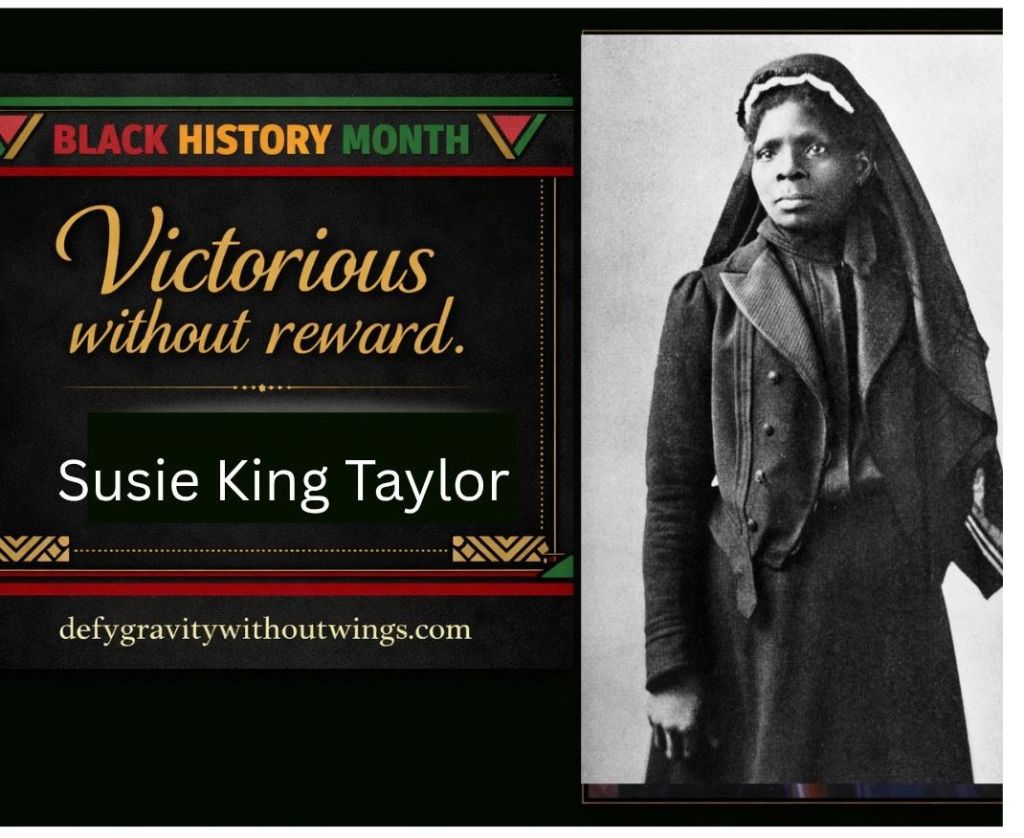
Susie King Taylor: She Served Anyway


Susie King Taylor was born enslaved in Georgia in 1848, in a world where teaching Black people to read was a crime and Black women’s labor was expected but never honored.


From a young age, Susie learned to read and write in secret. She was taught quietly, moving from place to place so no one would notice. Knowledge, for her, was not just education—it was resistance.


When the Civil War came, Susie did not wait to be invited into history.


She followed Union troops, and at just fourteen years old, she began teaching formerly enslaved soldiers and children how to read. She became the first Black woman known to openly teach formerly enslaved people in a Union camp.


She did not stop there.
Susie served as a teacher, a nurse, a laundress, and a caregiver to wounded Black soldiers. She worked in field hospitals. She tended infections. She cleaned wounds. She buried the dead. She did the work that kept soldiers alive long enough to keep fighting.


She did this without rank.
Without formal pay.
Without protection.
Without promise of recognition.
And when the war ended, the men she served alongside received pensions.
Susie did not.


Her body carried the cost of years of labor and exposure. Her hands had held dying boys. Her back bore the weight of war. Yet the government decided her service did not count.
She was victorious without reward.


In 1902, Susie King Taylor published Reminiscences of My Life in Camp with the 33rd United States Colored Troops—one of the only Civil War memoirs written by a Black woman.

She wrote because she knew that if she did not tell the story, it would be told wrong—or not at all.


She documented unequal treatment, exhaustion, racism within the Union Army, and the quiet strength required to keep serving anyway.


Recognition did not follow.
She died poor.
Her contributions remained footnotes.
Her name was largely absent from textbooks.


And yet, without women like Susie King Taylor, the war would not have been survivable for Black soldiers.


Susie King Taylor teaches us that some people do the work because it needs doing, not because they expect to be thanked.
She was not disguised like Cathay Williams.
She was not sidelined like Claudette Colvin.
She was fully visible—and still denied.


“Whatever you do, work at it with all your heart, as working for the Lord, not for human masters.” — Colossians 3:23


If you have ever done essential work no one wanted to name, given care without credentials, served faithfully while others were promoted, or known your contribution mattered even when systems said it didn’t—Susie King Taylor stands with you.
She served anyway.
History followed later.


We see you, Susie.
We honor you now.


Bread Crumbs — for those coming after us.
Victorious without reward. Still here.
Love, Chelle
Image

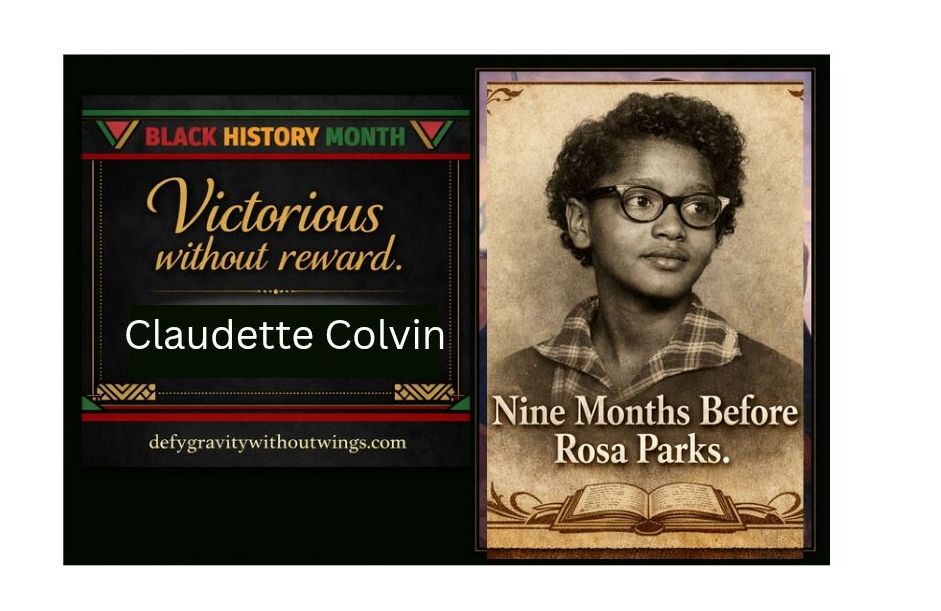
Claudette Colvin: Nine Months Before History Was Ready


Claudette Colvin, who died recently on January 13, 2026, was one of the last remaining living catalysts of the Montgomery Bus Boycott.


This must be said plainly:
Nine months before Rosa Parks,
a fifteen-year-old girl named Claudette Colvin refused to give up her seat on a segregated Montgomery bus.
Nine months before the cameras.
Nine months before the speeches.
Nine months before it was considered “safe.”
She was early — and she was right.


When police dragged her off the bus and arrested her, Claudette did not yet know she would be asked to step back from public view. But she would be.


Not because her courage was insufficient —
but because the movement decided she was not the face America would accept.
She was:
– a poor Black girl
– from a working-class family
– and soon after, pregnant
– struggling emotionally after trauma and arrest


Movement leaders made a strategic decision.
They chose respectability.
They chose optics.
And Claudette was quietly sidelined.
Yet her courage did not disappear.


She became one of the plaintiffs in Browder v. Gayle — the federal court case that ended bus segregation in Montgomery. The law changed because of the stand she took first, even though her name was not lifted alongside the victory.
She was victorious without reward.


Claudette Colvin teaches us a truth history often resists:
Being first does not mean being credited.
Being right does not mean being chosen.
And being faithful does not guarantee being celebrated.
A poor Black girl,
a pregnant teenager,
a traumatized child —
said no to injustice nine months before the nation was ready to listen.


That is not a footnote.
That is a foundation.
“For God chose what the world considers foolish to shame the wise.” — 1 Corinthians 1:27


If you have ever stood up too early,
told the truth before it was popular,
been asked to step aside so the story could be cleaner,
or watched others be celebrated for a door you opened,
hear this clearly:
Your timing was not wrong.
Your courage was not wasted.
And your obedience still counts.


Claudette Colvin stood first.
History followed later.
We see you, Claudette.
We tell it right now.
We honor you fully.


Bread Crumbs — for those coming after us.
Victorious without reward. Still here.


Love, Chelle

Image

Cathay Williams: Known By God. Hidden By History

Cathay Williams is one of my favorite Black history figures — not because she is well known, but because she is not.


I was first introduced to her by my nephew, Remmie, during one of the hardest seasons of my life — while I was going through breast cancer. He told me her story and then said something that stopped me cold.


He said I reminded him of her.


Like Cathay, I hid some of the pain I was really going through — not out of denial, but out of love.
Not because the fight wasn’t real, but because I wanted to encourage others who were fighting too.


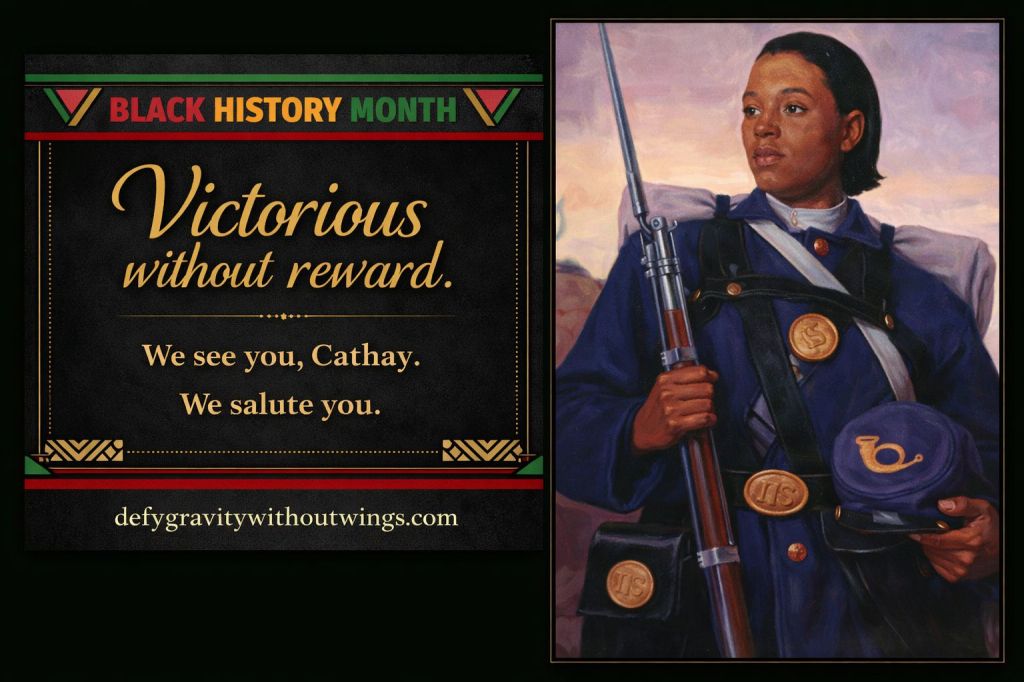
Cathay Williams was born enslaved in Missouri around 1844. During the Civil War, she followed the Union Army as a cook and laundress. But when the war ended and the Army opened its ranks to Black men only, Cathay did something unthinkable.


She cut her hair,

wrapped her body,

changed her name to William Cathay

— and enlisted.


For nearly two years, she served as a soldier in the 38th U.S. Infantry, one of the original Buffalo Soldier regiments. She marched. She guarded. She endured brutal conditions — all while hiding her identity in a world that would not make space for who she truly was.


Eventually, illness exposed what society refused to imagine:
a Black woman had carried a rifle, worn the uniform, and served her country faithfully.


She was discharged — not for lack of courage, but for daring to exist outside the rules.


Cathay Williams lived a life where survival required disguise.
Not because she lacked strength — but because the world lacked vision.


There are seasons when God calls people to serve before the world is ready to name them correctly.
Cathay was known as William by the Army.
But she was known fully by God.
“The Lord does not see as mortals see; they look on the outward appearance, but the Lord looks on the heart.” — 1 Samuel 16:7


History overlooked her.
The Army dismissed her.
But heaven recorded her obedience.
Some call her story deception.
Others call it desperation.


But I call it courage under constraint.


And here is the part history often whispers instead of says out loud:
Cathay Williams never received military honors.
She never received a pension.
In 1891, after her health had been permanently damaged by her service, she applied for a military disability pension. It was denied. She died poor and largely forgotten.


She was victorious without reward.


Cathay Williams did everything she was asked to do — and more.
She served faithfully.
She endured quietly.
She finished her assignment.


Her story reminds us that victory and recognition are not the same thing.
“Well done” does not always come from the systems we serve — but it is always recorded by God.
She didn’t fight for history.
She fought through it.
And God did not waste a single step she took.


She did not live to see her story told.
But her life still speaks.


And for those who have ever given their strength, their hope, or their encouragement without guarantee of return:
You may be unrewarded by the world —
but you are not unseen by God.


We see you, Cathay.
We salute you.


Love, Chelle

About the History in Bread Crumbs
Bread Crumbs reflections are grounded in documented historical records, including archives from the U.S. National Archives, Library of Congress, court records, contemporaneous newspapers, and first-person accounts. Spiritual reflections and personal connections are clearly marked as such and are offered with respect for the historical record.

.

Image

The Woman At The Table

Sometimes I miss the house in the middle of the corn fields with no indoor plumbing.
The pot-belly stove that decided when we were warm enough.
The way night fell heavy and close, and everyone settled where they could—sharing rooms, beds, blankets, breath.

I say my room, but that’s a loose word.
Privacy was a luxury we didn’t own.
Still, there was one place that felt like mine:
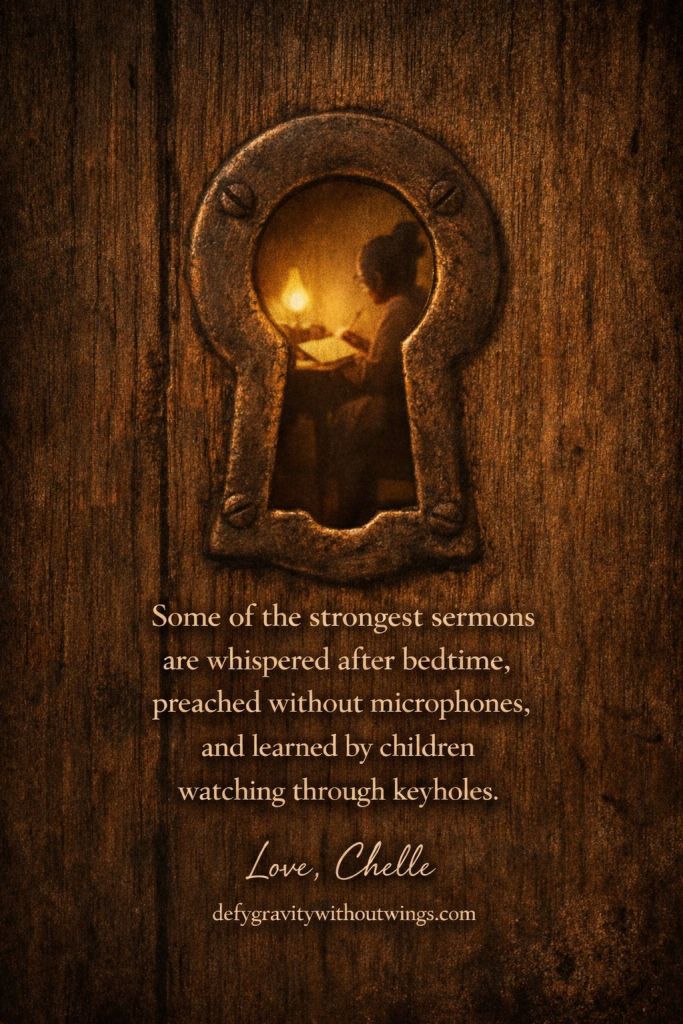
the narrow view through the keyhole.

Almost every night, after the fires were dampened and the house full of children finally stilled, I would watch my grandmother at her writing table. Her hands folded. Her Bible open. A pen moving slowly, deliberately.

Women of the Bible were her favorite.
Deborah. Ruth. Esther. Mary.
Women who listened closely and lived bravely.

She wrote sermons—real ones. Thoughtful. Scripturally sound. Insightful in ways people did not expect from a woman in those days. Especially a woman who cleaned other people’s houses for a living.

But it was her prayer ritual that marked me.

She prayed in whispers—not because God was quiet, but because love was.
She didn’t want to wake a house full of children.
Except, apparently, the little girl at the keyhole.

I couldn’t hear the words.
But I could see her face.

Sometimes she smiled.
Sometimes she laughed—like she and God shared a private joke.
Sometimes she cried. The kind of crying that doesn’t fall apart, just falls down.

And as I watched—hidden, still, unnoticed—I was learning.
Learning how faith looks when no one is applauding.
Learning that prayer does not need volume to have weight.
Learning that God listens closely to whispers.

When she finished praying, she always reached for the same thing.

A small plastic bread loaf.
One of those coin banks from organizations that fed “poor kids in Africa.”

She would slip a coin inside.
Sometimes a dollar.
Hard-earned. Scrubbed-for. Long-hours-standing money.

Money from a woman the world might have called poor—
but who never believed she was exempt from generosity.

I didn’t understand it then.
But I do now.

That table was a pulpit.
That whispering was power.
That plastic loaf was faith that refused to shrink.
And that keyhole?
It was my first seminary.

And that little girl at the keyhole?
She’s still watching.
Still learning how to pray without performing.
Still believing a few faithful offerings can touch a wide world.

“She opens her mouth with wisdom, and the teaching of kindness is on her tongue.” — Proverbs 31:26
“Your Father, who sees what is done in secret, will reward you.” — Matthew 6:6

Some of the strongest sermons are whispered after bedtime, preached without microphones, and learned by children watching through keyholes.

Love, Chelle


Image

As Long As Someone Remembers

It was one of the oddest days of my life. Was sitting at my desk frozen when I got the call from my hometown, sherrif. My brain went into autopilot, and I kept trying to work with tears streaming down my face. My then boss had to force me to breathe and go home. The love my co-workers showed was unmatched. Could not have made it through the coming days and the funeral without them.

He was a complicated man that I did not get to know until he was an old man in need of redemption and forgiveness. In the beginning, I was an abandoned child, looking for answers, who only served him out of obedience to my God, and the Word said to honor thy father. In the end, I became the child thru whom he wanted to give answers and ask forgiveness from his other children thru.

We didn’t have time to become father/daughter in the traditional sense. What we did have was card games, sweet potato pies, road trips, old Navy stories, testaments of the grandparents I didn’t get to meet, and a soft spot for healing to begin. He became my Pop, and I became his church mother. LOL and inside joke between us.

I figure sometimes that I was the “Moses” baby. … shipped off with no knowledge of him…so I could return and become a path to his need for freedom. Though I 💯 validate it, I am blessed to never quite have known the anger my sisters and brothers felt for him. I suppose my heart was kept in reserve for the old man and young child of God he would become.

Still missing you, Pop. I thank you for the gift of the crazy brood of sisters and brothers I inherited 9 years ago.

I hope amongst the milk and honey that there is strong coffee and sweet potato pie!!

Edgar Jerome “Jerry” Franklin-Bradshaw
March 1, 1944 – February 5, 2015


Never Really Gone As Long As Someone Remembers.

Erase Not

Virginia’s quest to erase the enslavement of human beings from memory will not make it cease to have existed. I don’t teach this to my children and to their children to foster hatred but rather to show them how incredible our people are to have survived and thrived despite circumstances forced on our ancestors by american greed. Yet no one asks my Jewish brothers to forget and water down the Holocaust. No one asks the american Japanese to deny the California concentration camps. No one asks my Indian heritage to dry the Trail of Tears.

We are watered down because whenever we choose to remember we become powerful. An attempt to drown us in engineered miseducation. Reminiscent of our bloodlines drowned in the Atlantic for being too strong to make passage.

Fearful folks discriminate and suppress what and whom they are intimidated by most. Black History Month is about strength and success against incredible odds. Slavery is american history dripping in greed, oppression and supposed superiority. No need to sugar coat it or pad it with cotton. My ancestors cultivated both of those.

Oddly, the State of Virginia worried about a recent governor in “black face.” Need to be more worried about the one who has no problem showing who he really is.