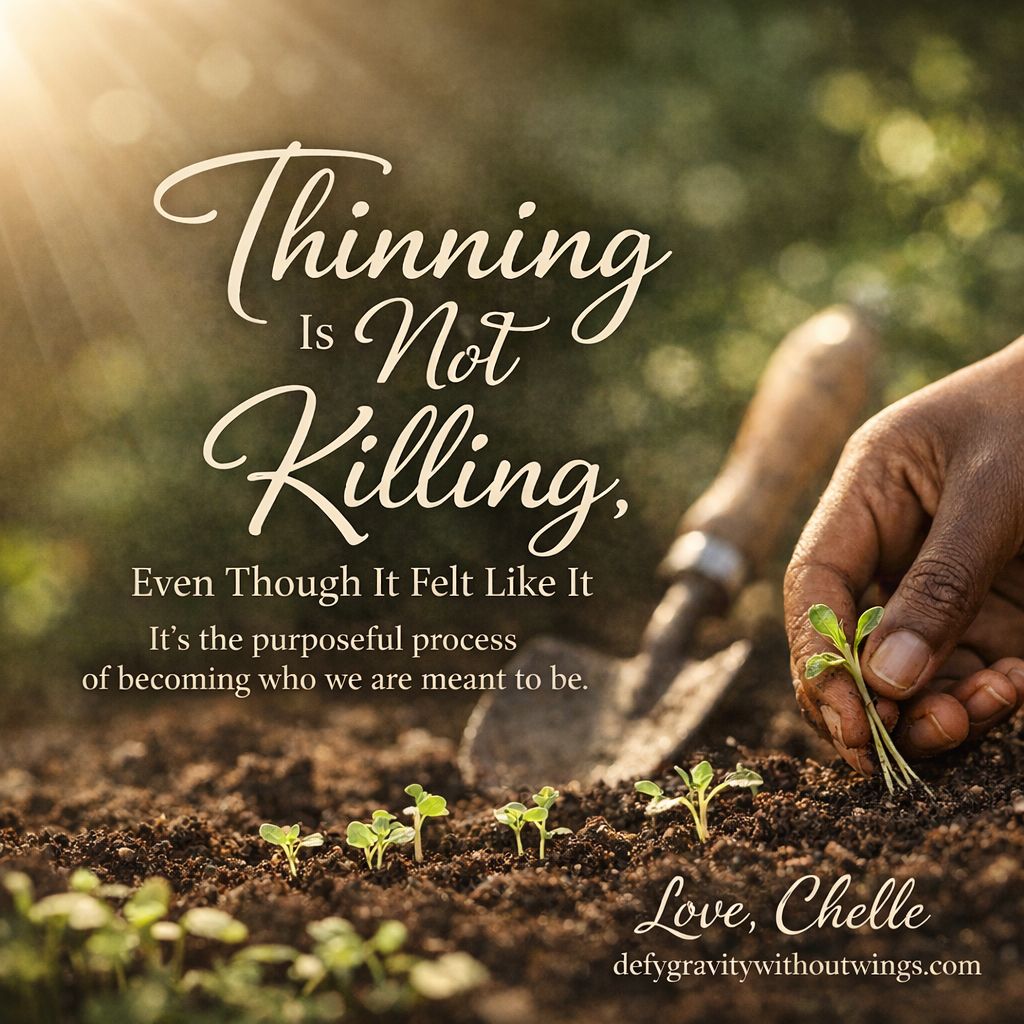
I stood in my greenhouse clutching scissors like I was about to commit a felony. These weren’t plants. These were my plant babies. I grew them. I watered them. I whispered encouragement like a slightly unhinged garden aunt. And now I was being told they were “too crowded.”
Excuse me??? They looked happy. Thriving. Living their best leafy lives. But apparently, love without boundaries leads to chaos. Who knew.
The word thinning showed up— and my heart heard destruction. Because when you’re wired like me, making room feels an awful lot like abandonment.
I mean, how do you explain to a perfectly healthy kale plant that it’s not being rejected— it’s just being relocated, harvested early, or “released into purpose”?
I felt like I was ruining everything. Until I realized… nothing was being wasted. Some plants were transplanted. Some were harvested and nourished something immediately.
And the ones left behind? They finally had space to become what they were always meant to be. That’s when it hit me. Pruning doesn’t change who we are. It reveals it. God isn’t cutting us down—
He’s cutting away what keeps us from becoming strong, rooted, and fruitful. Not every removal is punishment. Not every loss is failure. Some things leave so we can finally grow into ourselves.
“Every branch that bears fruit He prunes, that it may bear more fruit.” — John 15:2
Pruning feels personal when you’re emotionally attached to the leaves. But it’s the very thing that shapes the harvest. Thinning is not killing. It’s the painful, purposeful process of becoming.
And if I’m honest… I still apologized to my kale, needed a moment of silence, and may require counseling before the next round of thinning.
Because apparently God and gardening are both committed to making us who we’re supposed to be— even when we’re dramatic about it.
I couldn’t sleep, again, so I tuned into one of my favorite comfort-watch movies, Last Holiday (2006), starring Queen Latifah.
I’ve watched it more times than I’ll ever confess, but there is one scene I always slow down for. It’s the kitchen scene. My favorite one.
When Chef Didier looks at Georgia and gently compares her to the baby turnip — the smallest one in the bin, often overlooked, passed by for something bigger or flashier… yet the most tender, the most flavorful, the one a true chef treasures.
That scene gets me every time. Because the baby turnip isn’t flawed. It isn’t unfinished. It isn’t lacking. It’s just quiet. And early. And easy to miss if you’re in a hurry.
And if I’m being honest — part of why that scene hits so hard is because I’ve felt like that turnip. Overlooked. Passed by. Sitting there thinking, “Excuse me… I am organic, well-seasoned, and emotionally available.” But folks keep grabbing the big, loud potatoes.
Meanwhile, God is in the kitchen like a five-star chef saying, “Leave her. She’s tender. She’s not for everybody. And I don’t rush good ingredients.”
Whew.
That’s the holy pause in the story. Not the luxury. Not the bold declarations. But the moment when someone truly sees her.
And isn’t that what so many of us long for? We grow underground — faithful, steady, consistent — while the world keeps reaching for whatever looks impressive on the surface. We’re not trying to be flashy. We’re just trying to be faithful.
Still, being overlooked can sting. Especially when you know you’ve been planted, watered, and patient.
But the baby turnip reminds me of this truth: being passed over by people does not mean being passed by God. God delights in roots. He honors slow growth. He protects what is tender until the right time and the right hands arrive.
Sometimes you’re not hidden because you’re insignificant. You’re hidden because you’re delicate. Because you’re reserved. Because you’re meant for a table that understands flavor.
So yes — I may be under a blanket right now pretending I’m Queen Latifah — but I’m also believing, learning, and internalizing this: I don’t need to audition for worth. I don’t need to shout to be seen. I don’t need to rush my growth just because someone else is loud. If I’m being missed right now, maybe it’s because I’m being saved. And when it’s my turn? They’ll wish they hadn’t rushed past the produce section.
Lord, when I feel unseen, remind me that You see fully. Teach me to trust Your timing, even when I feel overlooked. Help me grow deep roots instead of loud leaves,and rest in the truth that being missed by people does not mean being missed by You.
“I would have fainted, unless I had believed to see the goodness of the Lord in the land of the living.” — Psalm 27:13
1/7/18.
I will always remember that date like a star date in the Star Trek Captain’s Log.
It started as a normal Sunday setup. I had just finished cleaning around the sound booth and was adjusting everything to get ready for that morning’s praise and worship. Service was running a few minutes behind, but we were still riding the spiritual high of pre-worship hour prayer.
Then it happened. My phone rang.
I almost never answer my phone during service. In fact, just two minutes earlier, I had nudged one of our teenagers about using their phone during Sunday school.
But I recognized the number. That familiar 264 exchange—the one every “kidney family” in my region of Virginia knows by heart. Breathless. Full of anticipation. Almost terrified. Palms sweating, face flushed in seconds. I answered to the coordinator’s urgent voice:
“WHERE ARE YOU?”
You see, protocol dictates that when the organ sharing center receives a possible match, they must first confirm that the prospective recipient is within four hours of their chosen transplant hospital. Once your location is confirmed, they tell you they’ll call back—and promptly hang up.
Yes. You read that right.
In one of the shakiest moments of your life, they hang up with a promise to call you back within an hour… or so… if it’s a good match.
I was still in the sound booth. My son was seated in his usual spot, about six rows in front of me. I didn’t know whether to tell him that his life might be about to change. We had already been disappointed by calls like this—twice before.
So instead, I texted him: “Be ready to go when I tap you.”
His response was simple: “Ok.” He didn’t ask why. He didn’t question me. He just trusted that if I said go, we go.
For me, however, the next 59 minutes would be the longest of my entire life. Time and space seemed to stand still. The room suddenly felt too warm, the air too stale. I can’t even remember if I set the microphones correctly. The pastor could have been shouting and I wouldn’t have heard him. The praise team was faithfully belting out worship songs my impatient ears could not discern.
All I could distinguish was the steady rhythm of the drum—now matching my racing heartbeat.
About 45 minutes into the wait, I had to correct my course. Not on the soundboard. In myself.
I found myself apologizing—to God, to Jesus, to the Holy Spirit. I had become so consumed with the call that I had stopped truly worshiping. I had stopped listening to the Word being preached.
I was esteeming what I wanted from God more than I was esteeming God Himself. And in that moment, it felt as though the Holy Spirit was echoing the same question in my heart: “WHERE ARE YOU?”
I steadied myself. I readied myself. Through tears and trembling faith, I began to worship again—declaring that as desperately as I wanted this gift to free my son from five long years of agonizing dialysis, I wanted the Presence of the Lord even more.
As my spiritual hunger was met with the assurance that God was with me no matter what, I heard in my spirit, “Hang up.”
At that exact moment, I looked down at the phone I had been clutching in my hand—and it rang. With tears streaming, I answered. Joyfully, 58 minutes into the wait, the coordinator said: “HOW FAST CAN YOU GET HERE?”
And that is the stuff our walk with Christ is made of. How often do we approach God wanting—and even needing—something deeply tied to a promise we believe He made, only to find ourselves overwhelmed by the waiting? Too often, our “knock and the door shall be opened” faith quietly shifts into a heartsick lifestyle of disappointment, dissatisfaction, and even unbelief—unless we see the manifestation.
Hebrews 11:6 reminds us that “he who comes to God must believe that He is, and that He is a rewarder of those who diligently seek Him.” Notice it says seek Him. Not diligently seek it.
When God asks, “Where are you?” may we be found seeking Him—not just the thing we hope He’ll give us. When He seems to hang up, trust that He will call again. Trust God. Trust His goodness. Even when it feels distant—it is still His plan. Even when it unfolds differently than expected—it is still His plan. Even when the answer is no—for reasons greater than we understand—better is still His plan. Reset your need for control. Let God have His way.
One last question: Since we trust that God is always right on time… how fast can you get here?
I didn’t wake up asking for a lesson. I woke up asking a question.
When, Lord? When will things be different? When will healing finally arrive?
A year has passed since surgery. By my own calendar, I decided I should be past this. Past the restrictions. Past the tenderness. Past the reminders that my body has its own pace.
But today, my belly disagrees with my timeline.
If I’m being honest, it may also disagree with my choices. Perhaps the third cup of coffee was ambitious. Perhaps chocolate and I — though still emotionally attached — are currently not on speaking terms. And perhaps I should have remembered the boatload of readily available internet wisdom that calmly, repeatedly explains the very misery I have managed to create for myself.
Still, I find myself asking God the same question Scripture has echoed for generations.
“How long, Lord? Will you forget me forever?” (Psalm 13)
That cry reminds me that impatience is not a lack of faith. It is often proof that we believe God hears us well enough to answer.
What if healing is not only about what is removed, but about what is relearned?
Without a gallbladder, my body asks for gentleness. Without certainty, my heart does the same.
Maybe the invitation today is not to rush healing, but to remember that restrictions are not punishment — they are protection still at work.
And maybe God isn’t offended by my when. Maybe He meets it with mercy.
“Because of the Lord’s great love we are not consumed, for his compassions never fail. They are new every morning.” (Lamentations 3:22–23)
That promise doesn’t say mercy arrives when I finally get it right — only that it shows up faithfully, even when I don’t.
So today, I loosen my self-imposed deadlines. I stop arguing with my body. I release the belief that progress must look linear to be real.
I may not control the timeline, but I can choose attentiveness over impatience.
And instead of asking, When will this be over? I ask a better question:
Lord, how do You want to meet me here?
Because even here — especially here — He is present.
I woke up smiling this morning. Not because everything is fixed. Not because the season has suddenly gotten easier. But because I was reminded—before my feet even hit the floor—that God still speaks.
An old friend texted me a few days ago wanting to send me a birthday gift. A cash offering. She said it might be late and she wasn’t sure how much.
I immediately told her no.
Not because I didn’t need it—but because I know her story. I know her struggles. I didn’t want her putting herself out for me. My heart was in the right place… or so I thought.
She gently stopped me and said, “God told me to sow—and I won’t interfere with God talking to me.”
Well then. Message received. Loud and clear.
Here’s the part I hadn’t said out loud to anyone: With a season of illness, deaths, job issues, a roof repair, and the bills that follow close behind, one of the quiet things I let go of was me. Specifically—my hair. Long twist locs reduced to a ponytail (which is no small feat), creative parting, strategic styling, and gray hairs hollering, “Didn’t you just get old?”
I was debating whether to cancel my usual four-hour appointment this weekend—or worse, swipe a credit card while praying over the interest rate.
But look at God.
With exactly what she sent, the Old Lady Rescue will be in full effect. No debt. No guilt. Just provision—with intention.
But the real miracle wasn’t the money.
“Not by might nor by power, but by my Spirit,” says the Lord Almighty. (Zechariah 4:6 (NIV)
It was confirmation—on both sides—that God still speaks. And He doesn’t just speak to pastors, prophets, or people with microphones. He speaks to friends. To women who listen. To hearts that say yes before they fully understand why.
I was reminded this morning that God provides for all things. Even the things we label as “extra.” Even Saturday-morning self-care. Even hair.
And I was reminded of something else: sometimes our well-meaning “no” gets in the way of someone else’s obedience.
I thought I was protecting her. Instead, I would’ve robbed us both— her of the joy of obedience, and me of the grace God had already assigned.
“My sheep listen to my voice; I know them, and they follow me.” John 10:27 (NIV)
There’s a line from the old sitcom Will & Grace that came rushing back to me this morning. One character is frustrated, asking why God doesn’t talk anymore. Another replies: “When having conversations with God, make sure you’re not doing all the talking.”
Lesson learned.
Sometimes God’s answer sounds like a text message. Sometimes provision looks like hair being restored before pride is. And sometimes Grace shows up laughing—right alongside gratitude, when we submit to His Will.
Today, I’m thankful. Not just for the gift—but for the reminder to listen… and not interfere when God speaks.
Love, Chelle
PS. A BIG thank you to my Christmas music loving, sugary named, millionaire by multiplication, friend who knows how to hear God !!!
I still don’t know what I’m doing. The sweet potato in the jar in my window can confirm it.
I stood it upright like a microphone instead of laying it down like a seed. Slips are forming anyway—which feels both rude and deeply grace-filled.
By every measurable standard, I am grossly underqualified for this harvest. I don’t garden with confidence — I garden with Google and apologies. I whisper encouragement to my plants like they’re on a faith journey too.
And yet… green keeps showing up.
Scripture says, “Do not despise these small beginnings, for the Lord rejoices to see the work begin.” — Zechariah 4:10
Apparently, this applies to gardeners too.
The sweet potato didn’t ask for my credentials. It didn’t wait for me to feel confident. It just responded to warmth, light, and the fact that I didn’t give up on it.
That feels uncomfortably familiar.
God has never waited for my expertise before growing something in my care. He responds to availability, not mastery. To people who stay put long enough for growth to decide it’s safe.
I keep expecting God to say, “You’re not ready for this yet.” Instead, He keeps saying, “Watch.”
Watch what grows when you stop over-correcting. Watch what happens when you don’t uproot yourself every time doubt shows up. Watch what slips free when the season is right.
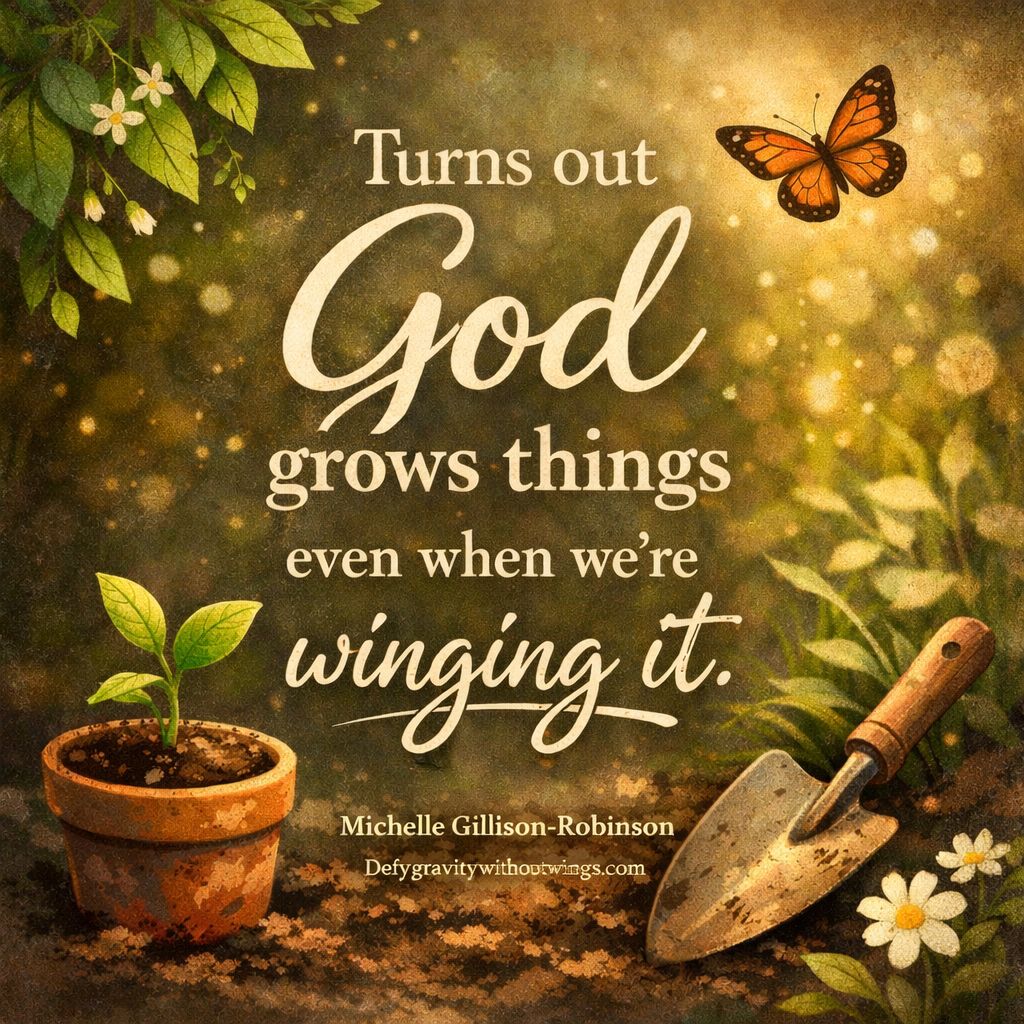
Turns out God grows things even when the gardener is winging it.
I may be underqualified. But I’m determined. And apparently… that’s enough for a harvest.
Disappointment doesn’t usually knock loudly. It just keeps adding weight.
Brick by brick, we pack the backpack: • unmet expectations • things we thought God would do by now • roles we keep carrying because “someone has to” • stories we tell ourselves about who we are and what’s possible
And if I’m honest, this is the same part of me that tries to carry all the groceries in one trip. Because clearly, asking for help would be admitting weakness… and making two trips would be a personal failure.
So there I am — keys dangling, bags cutting off circulation, dignity questionable — determined to prove I’ve got this. I call it independence. Heaven calls it unnecessary.
And somewhere between the car and the kitchen, I’m reminded that even Jesus sent the disciples out two by two.
Inevitably, something falls. Or worse… something gets left in the trunk.And a couple of days later, there’s a smell. A mysterious, soul-searching smell that forces a reckoning.
Nothing humbles you faster than realizing the real burden wasn’t the bags — it was the banana you refused to admit you dropped.
That’s how unexamined burdens work too. What we refuse to set down eventually announces itself. Some of the limits we feel aren’t placed by God — they’re placed by our own expectations of how we think He should move.
We overpack faith with control. We leave no room for surprise. No room for grace. No room for God to have His way — because the backpack is already full.
Jesus never asked us to be strong and burdened. He asked us to come — and let Him carry what we were never meant to hold.
“Cast your burden on the Lord, and He will sustain you.” — Psalm 55:22
Maybe today isn’t about pushing harder. Maybe it’s about making two trips. Or — heaven forbid — asking for help.
I own a microwave. Nothing earth shattering in that announcement.
It lives near my fancy cooktop and mostly functions as a glorified popcorn popper and an occasional emergency coffee reheater. It’s efficient, dependable, and excellent at handling immediate needs.
But it has never fed my soul.
I grew up in a time when food took time. Things were simmered, stewed, braised, and watched. You didn’t just make dinner—you tended it.
I still carry evidence of that kind of cooking: little cuts on my fingers from dull knives, small burns from forgetting pot holders, and an instinct to hover near the stove because something important is happening here.
That’s the kind of faith formation I recognize. Microwave food is fast. Slow cooking is faithful.
The microwave satisfies a craving. The slow pot answers a hunger.
Scripture reminds us that faith was never meant to be instant. “Let perseverance finish its work so that you may be mature and complete, not lacking anything” (James 1:4, NIV). Perseverance doesn’t microwave. It simmers. It stays. It waits for the work to be done.
We live in a world that loves microwave spirituality: – quick verses – instant breakthroughs – tidy testimonies – three easy steps and a closing prayer.
And listen—I’m not mad at the microwave. Sometimes popcorn is necessary. But popcorn isn’t dinner.
Faith that matures—faith that holds when life burns, cuts, and bruises—comes from staying near the stove. From paying attention. From trusting the heat even when it’s uncomfortable.
Slow-cooked faith smells different. It fills the house. It draws people in before it’s finished. And yes, it might leave a mark or two. But those marks aren’t failures. They’re proof you stayed long enough for God to finish His work.
So if your faith feels like it’s taking longer than expected… If you’re still simmering when you wanted to be served… If you’ve got a few burns and nicks to show for the journey… Take heart. You’re not being microwaved. You’re being made.
Love,Chelle
Prayer Father, thank You for not rushing what You are forming in me. Help me stay near the heat without growing bitter, impatient, or afraid. Teach me to trust the slow work of Your hands, even when I want instant results. And when I’m tempted to settle for spiritual snacks, remind me that You are preparing something that truly satisfies. In Jesus’ name, Amen.
I was born on a Sunday. The old poem says, “Sunday’s child is full of grace.” I believe that’s true — but grace doesn’t arrive in a vacuum.
I was a Sunday child who learned early about loss. About poverty that makes you grow up faster than your age. About grief that shows up uninvited and stays too long. About loneliness that teaches you how to be self-sufficient and insecurities that whisper you’d better be useful if you want to be loved.
So I learned to protect myself.
I learned how to make people laugh and have them sing along. How to lighten rooms before they noticed the weight I was carrying. How to read emotions faster than words. How to bring joy without asking for much in return.
What I didn’t know then was that God was watching all of it — not with disappointment, but with intention.
Scripture says: “But God chose the foolish things of the world to shame the wise; God chose the weak things of the world to shame the strong.” — 1 Corinthians 1:27
From that place of self-protection, something holy was being formed.
My ministry didn’t begin in confidence. It began in clown shoes — joy worn on holy ground, humor used as armor, Melodies offered as a bridge when I didn’t yet have language for my own pain.
For a long time, I thought joy meant I hadn’t been hurt enough. That if I laughed, my grief must not be legitimate. That holiness required heaviness.
But holy ground taught me otherwise.
Holy ground can handle pride that cracks, not joy. God was never offended by my antics. He was present in it.
Somewhere along the way, God redeemed my survival skills. What I once used to protect myself, He began using to comfort others.
I didn’t stop carrying sacred things — I just learned how to carry them without pretending they weren’t holy.
I still wear the clown shoes. Not because I don’t know sorrow, but because I do.
Joy is not denial. Joy is defiance. Joy is faith that has survived the night and still shows up in the morning.
So if you see me smiling, laughing, singing, softening the room —know this:
I am standing on holy ground. I am carrying sacred things. And God has always been in the business of using what the world dismisses to do His most meaningful work.
If you know me well, you know this: there is a Do Not Disturb sign on my whole being before my first cup of coffee.
Not because I’m mean — because I’m unfinished. Conversations are risky. Decisions are suspect. Eye contact is optional and not encouraged.
Coffee is not a luxury in my house. It’s a transition ritual — the bridge between sleep and sanity.
I’ve tried drinking it black. I respect the people who do. But I am not one of them.
I also refuse to pay six dollars for a cup of bean water served with foam, a wooden stir stick, and a side of financial regret.
So I do what most of us do in real life: I work with what I have.
A splash of cream. Sometimes thickened milk. Sometimes eggnog (non-alcoholic, of course). Always grace.
And somewhere between the mug and the quiet, God meets me.
Faith works the same way.
There’s a version of spirituality that insists you drink life black — no softness, no comfort, no pause. Just endure. Prove you’re strong. Push through.
There’s another version that says peace only comes if you buy it, chase it, or overspend your way into it.
But Scripture gives us a wiser prayer — not for excess, not for deprivation, but for enough:
“Give me neither poverty nor riches; feed me with the food that I need.” — Proverbs 30:8 (NRSV)
That is provision without punishment. Sufficiency without suffering.
Faith with cream doesn’t erase the bitterness — it makes it bearable. It doesn’t deny reality — it softens it enough to receive joy.
God has always provided daily bread — not to test us, but to sustain us.
So this morning, if you’re like me — still warming up, still waiting for the cream you forgot at the store to arrive — know this:
God is not offended by your need for gentleness. He honors prayers for enough.
Drink the coffee. Delay the noise. Let faith be tender today.






















 defygravitywithoutwings.com