Somewhere along the way, many of us learned a quiet lie — not from God, but from human interpretation.
We learned it from what was modeled, praised, or rewarded. From homes, churches, systems, and relationships that mistook endurance for faithfulness and exhaustion for virtue.
Most people were doing the best they could with what they knew — but they were still human. And without realizing it, we carried those lessons into our understanding of God.
I know this because I have done it myself.
I confused being loved with doing to be loved. I mixed up belief with performance. And I carried that misunderstanding into my faith and called it obedience.
But that is not God’s heart.
God does not delight in depletion. He delights in wholeness.
Jesus did not invite people to follow Him so they could replace Him. He did not ask them to become saviors, fixers, or endless wells. He asked them to come — as they were — and to unlearn what fear had taught them about love.
Scripture never praises burnout. It praises obedience rooted in love, not fear. It honors service that flows from being seen — not from trying to be noticed.
When Jesus said, “Come to Me, all who are weary and burdened, and I will give you rest,” He was not offering a reward for those who gave the most. He was correcting what people had been taught about God.
If your kindness comes from feeling unseen, if your faith feels like constant output, if your love has slowly turned into self-erasure — that may be something you learned, but it is not something God requires.
God does not need you emptied to be faithful. He desires you rooted, restored, and whole.
Being needed is not the same as being loved. And God’s love has never required you to disappear.
God, help me separate Your voice from the voices that shaped me. Heal what I learned in survival mode. Teach me Your heart — not a human version of it.
So here’s something I learned this week: winter storms have names. I was today-years-old when I found out they name winter storms the same way they name summer hurricanes. And wouldn’t you know it—the one that iced me into my house and blocked me from my greenhouse was named Fern. Fern. A plant name. A green thing. A symbol of life. Make it make sense. Winter Storm Fern didn’t just bring cold—she brought audacity. It was so cold one day that my front door wouldn’t even open. Not stuck—sealed. As if the house itself said, “Nope. You live here now.” When the door finally did open the next day, I stepped outside and immediately thought, “Oh. I was happier not knowing.” That kind of cold doesn’t invite you out. It humbles you back inside. Now here we are again. More snow coming Saturday—and again on Wednesday. But this time, they’re calling for powder, not ice. And apparently, there’s a difference. Ice traps you. Powder covers you. Ice shuts doors. Powder rests gently on what’s still alive underneath. Some seasons don’t stop growth—they insulate it. Under the white blanket, the soil is still breathing. Roots haven’t resigned. Seeds aren’t panicking. They know winter may come labeled and official, but it never gets the final word. “Though the fig tree does not bud and there are no grapes on the vines… yet I will rejoice in the Lord.” — Habakkuk 3:17–18 Faith isn’t pretending winter isn’t winter. It’s recognizing the difference between what freezes you and what simply passes through. Winter Storm Fern may have sealed my door for a day. She may have iced the path to the greenhouse. But she didn’t cancel the harvest. Dead and dormant are not the same. Covered and defeated are not synonyms. Spring is not offended by powder. And I’ve learned not to argue with doors God temporarily keeps shut.
For weeks—WEEKS—I have been doing the holy, unglamorous work of editing and reorganizing a soon-to-be book. Moving chapters. Fixing commas that think they run things. Re-threading stories. Listening for where God was nudging—and where I was just rambling.
This was faithful work. Quiet work. The kind nobody claps for.
And then… The tool I use to assist and “catch mistakes” decided to eat my manuscript.
Not nibble. Not misplace a paragraph. Eat it.
I have survived cancer, grief, caregiving, deadlines, and ice storms—but watching weeks of careful labor vanish off a screen? That will make your chest tighten and your salvation flicker for a hot second.
I sat there spiraling: Did I just lose half a book? Am I behind now? Did I just waste weeks of my life arguing with chapter headings?
Cue the dramatic sigh. Cue me talking to my laptop like it had personally betrayed the family.
And then—grace, wearing sneakers—slid in sideways and whispered:
Your work is not gone. You are not behind. We did not lose half a book.
Because real work doesn’t live only in files. It lives in muscle memory, lived experience, and a heart that’s been steeped in the message.
And Scripture backs this up.
“So I will restore to you the years that the swarming locust has eaten…” — Joel 2:25
God restores years, not just results. Restoration doesn’t always look like retrieval. What God restores often comes back stronger.
So breathe. Roll your shoulders. Open a new document.
The words still know how to find you. And the story is very much alive.
Sometimes I miss the house in the middle of the corn fields with no indoor plumbing. The pot-belly stove that decided when we were warm enough. The way night fell heavy and close, and everyone settled where they could—sharing rooms, beds, blankets, breath.
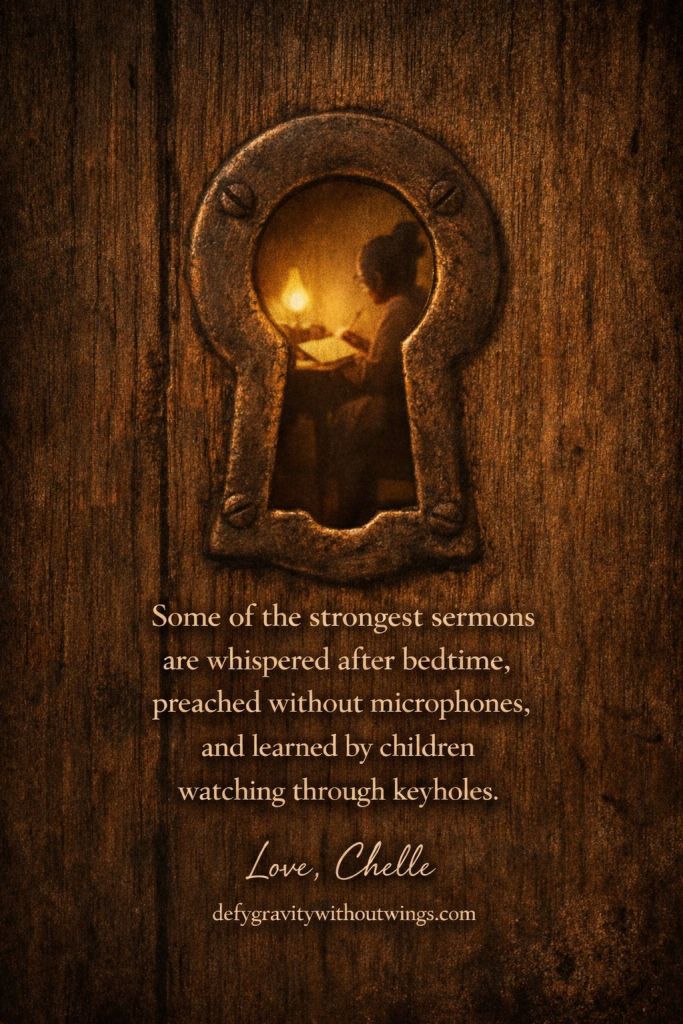
I say my room, but that’s a loose word. Privacy was a luxury we didn’t own. Still, there was one place that felt like mine: the narrow view through the keyhole.
Almost every night, after the fires were dampened and the house full of children finally stilled, I would watch my grandmother at her writing table. Her hands folded. Her Bible open. A pen moving slowly, deliberately.
Women of the Bible were her favorite. Deborah. Ruth. Esther. Mary. Women who listened closely and lived bravely.
She wrote sermons—real ones. Thoughtful. Scripturally sound. Insightful in ways people did not expect from a woman in those days. Especially a woman who cleaned other people’s houses for a living.
But it was her prayer ritual that marked me.
She prayed in whispers—not because God was quiet, but because love was. She didn’t want to wake a house full of children. Except, apparently, the little girl at the keyhole.
I couldn’t hear the words. But I could see her face.
Sometimes she smiled. Sometimes she laughed—like she and God shared a private joke. Sometimes she cried. The kind of crying that doesn’t fall apart, just falls down.
And as I watched—hidden, still, unnoticed—I was learning. Learning how faith looks when no one is applauding. Learning that prayer does not need volume to have weight. Learning that God listens closely to whispers.
When she finished praying, she always reached for the same thing.
A small plastic bread loaf. One of those coin banks from organizations that fed “poor kids in Africa.”
She would slip a coin inside. Sometimes a dollar. Hard-earned. Scrubbed-for. Long-hours-standing money.
Money from a woman the world might have called poor— but who never believed she was exempt from generosity.
I didn’t understand it then. But I do now.
That table was a pulpit. That whispering was power. That plastic loaf was faith that refused to shrink. And that keyhole? It was my first seminary.
And that little girl at the keyhole? She’s still watching. Still learning how to pray without performing. Still believing a few faithful offerings can touch a wide world.
“She opens her mouth with wisdom, and the teaching of kindness is on her tongue.” — Proverbs 31:26 “Your Father, who sees what is done in secret, will reward you.” — Matthew 6:6
Some of the strongest sermons are whispered after bedtime, preached without microphones, and learned by children watching through keyholes.
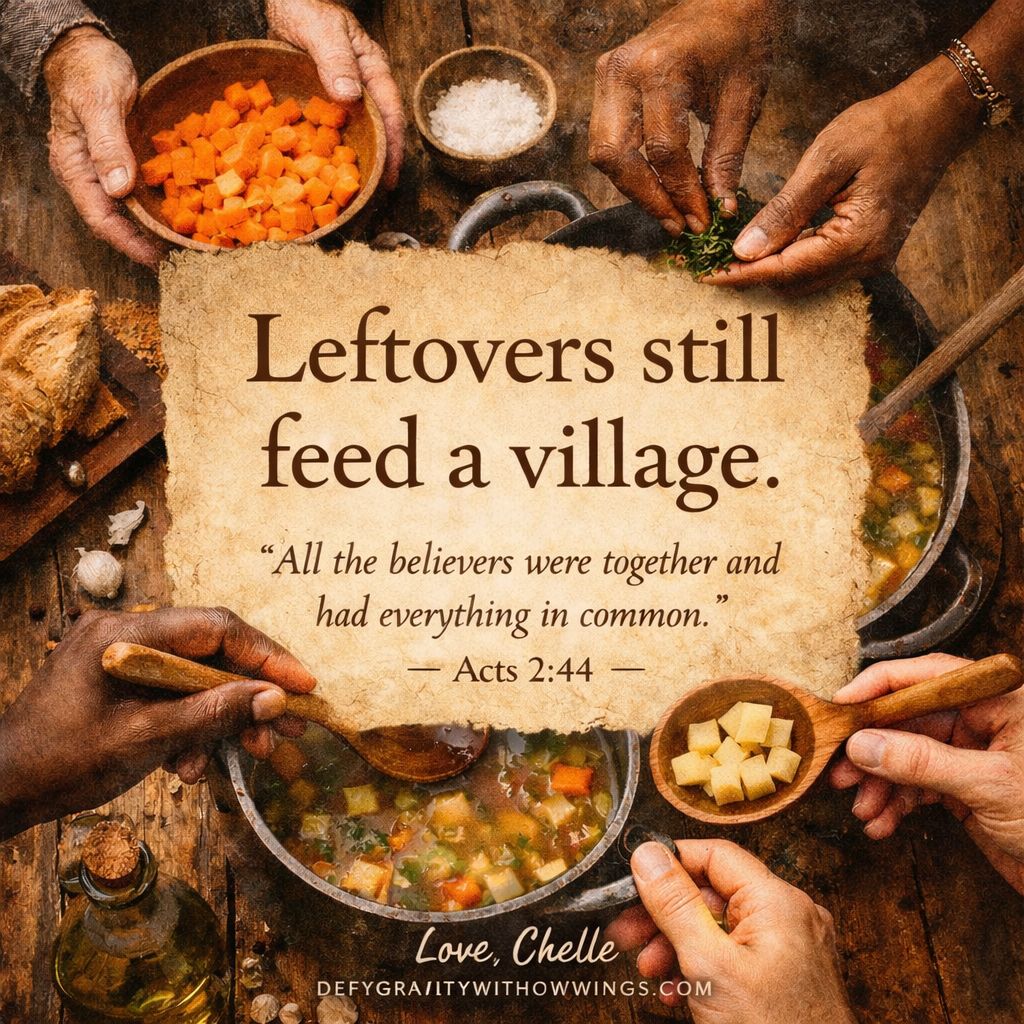
(Inspired by the traditional folktale “Stone Soup”) There is an old folktale—often called Stone Soup—with roots in European oral tradition, passed from voice to voice long before it ever lived on a printed page. No single author can claim it, because it belongs to the people. To grandmothers. To kitchens. To cold evenings and tired hearts. My grandma told me this story when I was a child. In it, strangers arrive in a village with nothing but a pot, water, and a stone. The villagers insist they have nothing to give. Nothing extra. Nothing to spare. But as the pot begins to simmer, curiosity loosens fists. A carrot appears. Then an onion. A potato. A handful of herbs. What begins as nothing becomes a feast—not because of the stone, but because everyone adds what they already had. “All the believers were together and had everything in common.” — Acts 2:44 What my grandmother made sure I understood wasn’t cleverness or trickery. It was this: waste nothing, because even the smallest thing can become enough. That lesson followed me into adulthood and straight into my freezer. I freeze the little bits. The half cup of vegetables left after dinner. The last spoonful of beans. The scraps that don’t look like a meal on their own. And on nights like this—when the world feels heavy, when the news is loud, when unrest simmers hotter than any stove—I pull out those frozen fragments. I drop my own version of a stone into broth. I add spices. I stir. And somehow, once again, there is soup. Scripture reminds us that when we bring what we have—no matter how small—God knows how to make it enough. “Each of you should use whatever gift you have received to serve others.” — 1 Peter 4:10 Nothing fancy. Nothing wasteful. Nothing done alone. Wouldn’t it be lovely— in a world so divided, so guarded, so afraid of scarcity— if we could remember how to do this together? Not fix everything. Not agree on everything. Just show up with what we have. A carrot. A story. A pot. A willingness. Stone Soup reminds us that abundance doesn’t start with excess. It starts with shared heat. With open hands. With the quiet decision to believe that together is still possible. Tonight, I’ll keep stirring. And I’ll keep believing. Love, Chelle DefyGravityWithoutWings.com
I couldn’t sleep, again, so I tuned into one of my favorite comfort-watch movies, Last Holiday (2006), starring Queen Latifah.
I’ve watched it more times than I’ll ever confess, but there is one scene I always slow down for. It’s the kitchen scene. My favorite one.
When Chef Didier looks at Georgia and gently compares her to the baby turnip — the smallest one in the bin, often overlooked, passed by for something bigger or flashier… yet the most tender, the most flavorful, the one a true chef treasures.
That scene gets me every time. Because the baby turnip isn’t flawed. It isn’t unfinished. It isn’t lacking. It’s just quiet. And early. And easy to miss if you’re in a hurry.
And if I’m being honest — part of why that scene hits so hard is because I’ve felt like that turnip. Overlooked. Passed by. Sitting there thinking, “Excuse me… I am organic, well-seasoned, and emotionally available.” But folks keep grabbing the big, loud potatoes.
Meanwhile, God is in the kitchen like a five-star chef saying, “Leave her. She’s tender. She’s not for everybody. And I don’t rush good ingredients.”
Whew.
That’s the holy pause in the story. Not the luxury. Not the bold declarations. But the moment when someone truly sees her.
And isn’t that what so many of us long for? We grow underground — faithful, steady, consistent — while the world keeps reaching for whatever looks impressive on the surface. We’re not trying to be flashy. We’re just trying to be faithful.
Still, being overlooked can sting. Especially when you know you’ve been planted, watered, and patient.
But the baby turnip reminds me of this truth: being passed over by people does not mean being passed by God. God delights in roots. He honors slow growth. He protects what is tender until the right time and the right hands arrive.
Sometimes you’re not hidden because you’re insignificant. You’re hidden because you’re delicate. Because you’re reserved. Because you’re meant for a table that understands flavor.
So yes — I may be under a blanket right now pretending I’m Queen Latifah — but I’m also believing, learning, and internalizing this: I don’t need to audition for worth. I don’t need to shout to be seen. I don’t need to rush my growth just because someone else is loud. If I’m being missed right now, maybe it’s because I’m being saved. And when it’s my turn? They’ll wish they hadn’t rushed past the produce section.
Lord, when I feel unseen, remind me that You see fully. Teach me to trust Your timing, even when I feel overlooked. Help me grow deep roots instead of loud leaves,and rest in the truth that being missed by people does not mean being missed by You.
“I would have fainted, unless I had believed to see the goodness of the Lord in the land of the living.” — Psalm 27:13
1/7/18.
I will always remember that date like a star date in the Star Trek Captain’s Log.
It started as a normal Sunday setup. I had just finished cleaning around the sound booth and was adjusting everything to get ready for that morning’s praise and worship. Service was running a few minutes behind, but we were still riding the spiritual high of pre-worship hour prayer.
Then it happened. My phone rang.
I almost never answer my phone during service. In fact, just two minutes earlier, I had nudged one of our teenagers about using their phone during Sunday school.
But I recognized the number. That familiar 264 exchange—the one every “kidney family” in my region of Virginia knows by heart. Breathless. Full of anticipation. Almost terrified. Palms sweating, face flushed in seconds. I answered to the coordinator’s urgent voice:
“WHERE ARE YOU?”
You see, protocol dictates that when the organ sharing center receives a possible match, they must first confirm that the prospective recipient is within four hours of their chosen transplant hospital. Once your location is confirmed, they tell you they’ll call back—and promptly hang up.
Yes. You read that right.
In one of the shakiest moments of your life, they hang up with a promise to call you back within an hour… or so… if it’s a good match.
I was still in the sound booth. My son was seated in his usual spot, about six rows in front of me. I didn’t know whether to tell him that his life might be about to change. We had already been disappointed by calls like this—twice before.
So instead, I texted him: “Be ready to go when I tap you.”
His response was simple: “Ok.” He didn’t ask why. He didn’t question me. He just trusted that if I said go, we go.
For me, however, the next 59 minutes would be the longest of my entire life. Time and space seemed to stand still. The room suddenly felt too warm, the air too stale. I can’t even remember if I set the microphones correctly. The pastor could have been shouting and I wouldn’t have heard him. The praise team was faithfully belting out worship songs my impatient ears could not discern.
All I could distinguish was the steady rhythm of the drum—now matching my racing heartbeat.
About 45 minutes into the wait, I had to correct my course. Not on the soundboard. In myself.
I found myself apologizing—to God, to Jesus, to the Holy Spirit. I had become so consumed with the call that I had stopped truly worshiping. I had stopped listening to the Word being preached.
I was esteeming what I wanted from God more than I was esteeming God Himself. And in that moment, it felt as though the Holy Spirit was echoing the same question in my heart: “WHERE ARE YOU?”
I steadied myself. I readied myself. Through tears and trembling faith, I began to worship again—declaring that as desperately as I wanted this gift to free my son from five long years of agonizing dialysis, I wanted the Presence of the Lord even more.
As my spiritual hunger was met with the assurance that God was with me no matter what, I heard in my spirit, “Hang up.”
At that exact moment, I looked down at the phone I had been clutching in my hand—and it rang. With tears streaming, I answered. Joyfully, 58 minutes into the wait, the coordinator said: “HOW FAST CAN YOU GET HERE?”
And that is the stuff our walk with Christ is made of. How often do we approach God wanting—and even needing—something deeply tied to a promise we believe He made, only to find ourselves overwhelmed by the waiting? Too often, our “knock and the door shall be opened” faith quietly shifts into a heartsick lifestyle of disappointment, dissatisfaction, and even unbelief—unless we see the manifestation.
Hebrews 11:6 reminds us that “he who comes to God must believe that He is, and that He is a rewarder of those who diligently seek Him.” Notice it says seek Him. Not diligently seek it.
When God asks, “Where are you?” may we be found seeking Him—not just the thing we hope He’ll give us. When He seems to hang up, trust that He will call again. Trust God. Trust His goodness. Even when it feels distant—it is still His plan. Even when it unfolds differently than expected—it is still His plan. Even when the answer is no—for reasons greater than we understand—better is still His plan. Reset your need for control. Let God have His way.
One last question: Since we trust that God is always right on time… how fast can you get here?
I didn’t wake up asking for a lesson. I woke up asking a question.
When, Lord? When will things be different? When will healing finally arrive?
A year has passed since surgery. By my own calendar, I decided I should be past this. Past the restrictions. Past the tenderness. Past the reminders that my body has its own pace.
But today, my belly disagrees with my timeline.
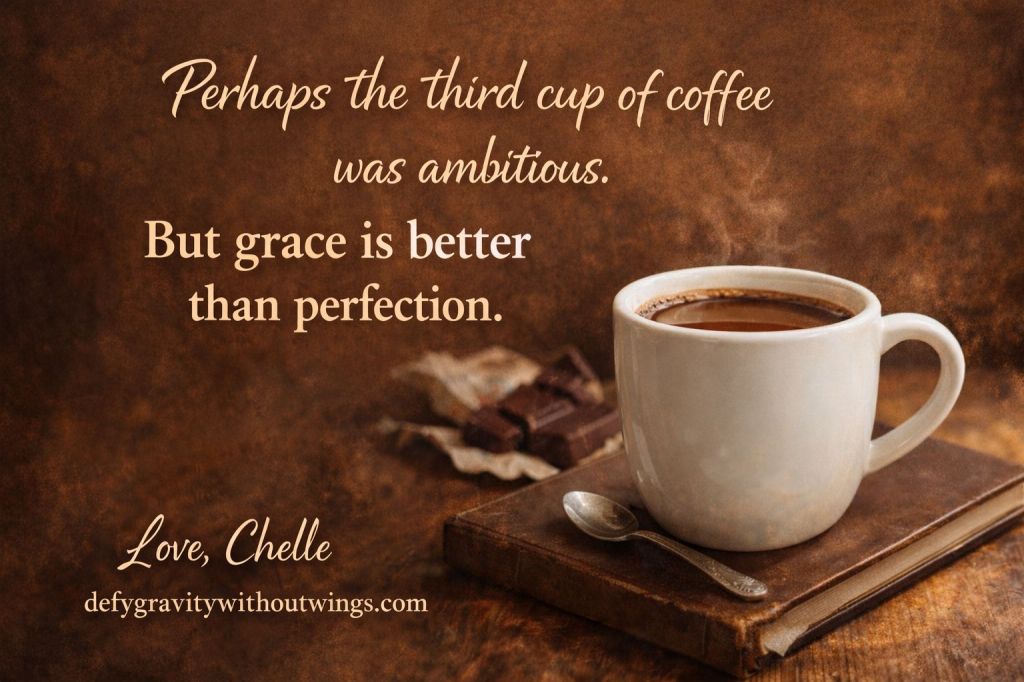
If I’m being honest, it may also disagree with my choices. Perhaps the third cup of coffee was ambitious. Perhaps chocolate and I — though still emotionally attached — are currently not on speaking terms. And perhaps I should have remembered the boatload of readily available internet wisdom that calmly, repeatedly explains the very misery I have managed to create for myself.
Still, I find myself asking God the same question Scripture has echoed for generations.
“How long, Lord? Will you forget me forever?” (Psalm 13)
That cry reminds me that impatience is not a lack of faith. It is often proof that we believe God hears us well enough to answer.
What if healing is not only about what is removed, but about what is relearned?
Without a gallbladder, my body asks for gentleness. Without certainty, my heart does the same.
Maybe the invitation today is not to rush healing, but to remember that restrictions are not punishment — they are protection still at work.
And maybe God isn’t offended by my when. Maybe He meets it with mercy.
“Because of the Lord’s great love we are not consumed, for his compassions never fail. They are new every morning.” (Lamentations 3:22–23)
That promise doesn’t say mercy arrives when I finally get it right — only that it shows up faithfully, even when I don’t.
So today, I loosen my self-imposed deadlines. I stop arguing with my body. I release the belief that progress must look linear to be real.
I may not control the timeline, but I can choose attentiveness over impatience.
And instead of asking, When will this be over? I ask a better question:
Lord, how do You want to meet me here?
Because even here — especially here — He is present.
Disappointment doesn’t usually knock loudly. It just keeps adding weight.
Brick by brick, we pack the backpack: • unmet expectations • things we thought God would do by now • roles we keep carrying because “someone has to” • stories we tell ourselves about who we are and what’s possible
And if I’m honest, this is the same part of me that tries to carry all the groceries in one trip. Because clearly, asking for help would be admitting weakness… and making two trips would be a personal failure.
So there I am — keys dangling, bags cutting off circulation, dignity questionable — determined to prove I’ve got this. I call it independence. Heaven calls it unnecessary.
And somewhere between the car and the kitchen, I’m reminded that even Jesus sent the disciples out two by two.
Inevitably, something falls. Or worse… something gets left in the trunk.And a couple of days later, there’s a smell. A mysterious, soul-searching smell that forces a reckoning.
Nothing humbles you faster than realizing the real burden wasn’t the bags — it was the banana you refused to admit you dropped.
That’s how unexamined burdens work too. What we refuse to set down eventually announces itself. Some of the limits we feel aren’t placed by God — they’re placed by our own expectations of how we think He should move.
We overpack faith with control. We leave no room for surprise. No room for grace. No room for God to have His way — because the backpack is already full.
Jesus never asked us to be strong and burdened. He asked us to come — and let Him carry what we were never meant to hold.
“Cast your burden on the Lord, and He will sustain you.” — Psalm 55:22
Maybe today isn’t about pushing harder. Maybe it’s about making two trips. Or — heaven forbid — asking for help.
When I think of the most important birthdays, I don’t start with cake or candles. I start with life.
I think of the 37th birthday when I helped deliver my grandson, Jayon — my eldest son’s first child. On that day, I didn’t just celebrate another year of my own life; I welcomed new life, new hopes, and new dreams into the world. In a way, our birthdays became twins. His arrival was proof that God was still creating, still trusting the future to fragile hands. And year after year, Jayon has never disappointed — not because he’s perfect, but because he has lived into the promise of that moment.
I think of my 50th birthday — the day I was scheduled to start chemotherapy for breast cancer. Fear tried to claim that day, but my husband gave me a birthday slumber party instead with the ladies in my crew.. Laughter showed up before dread could unpack its bags. It felt like God whispering through cupcakes and pajamas: Fight. Fight. You are not done.
On my 55th birthday, the fear shifted again. Instead of waiting anxiously for scan results, I stood on a stage wearing a crown and a “Drive 55” shirt — a playful, holy reminder to pace myself and keep going. Sometimes courage looks regal. Sometimes it looks ridiculous. Both can preach.
But my favorite birthdays are always the next one.
Whether they arrive loud and celebratory or quiet and reflective like today, they carry the same invitation. I call January 5th my second New Year — a moment to pause, look back at all that happened since last year, the good and the not-so-good. To thank God for the joys He brought us into, and for the things He delivered us out of.
“This is the day the Lord has made; let us rejoice and be glad in it.” — Psalm 118:24
Not the perfect day. Not the painless day. Just this one.
And today includes crumbs. Crumbs from a Kentucky Butter Cake I made with more butter than I’m fairly certain a woman of my age should publicly admit to.
But here’s the truth: butter makes things richer. Grace does too. And neither one asks permission before doing its work.
“The steadfast love of the Lord never ceases; His mercies never come to an end; they are new every morning.” — Lamentations 3:22–23
Even on birthdays. Especially on birthdays.
These years aren’t measured by candles alone. They’re marked by crumbs of grace — small evidences left behind that say I was fed, I was held, I was carried through
. And if that’s what this year leaves behind — crumbs, butter, joy, survival, and gratitude — then it has been a very good year indeed.