Image

Cathay Williams: Known By God. Hidden By History

Cathay Williams is one of my favorite Black history figures — not because she is well known, but because she is not.


I was first introduced to her by my nephew, Remmie, during one of the hardest seasons of my life — while I was going through breast cancer. He told me her story and then said something that stopped me cold.


He said I reminded him of her.


Like Cathay, I hid some of the pain I was really going through — not out of denial, but out of love.
Not because the fight wasn’t real, but because I wanted to encourage others who were fighting too.


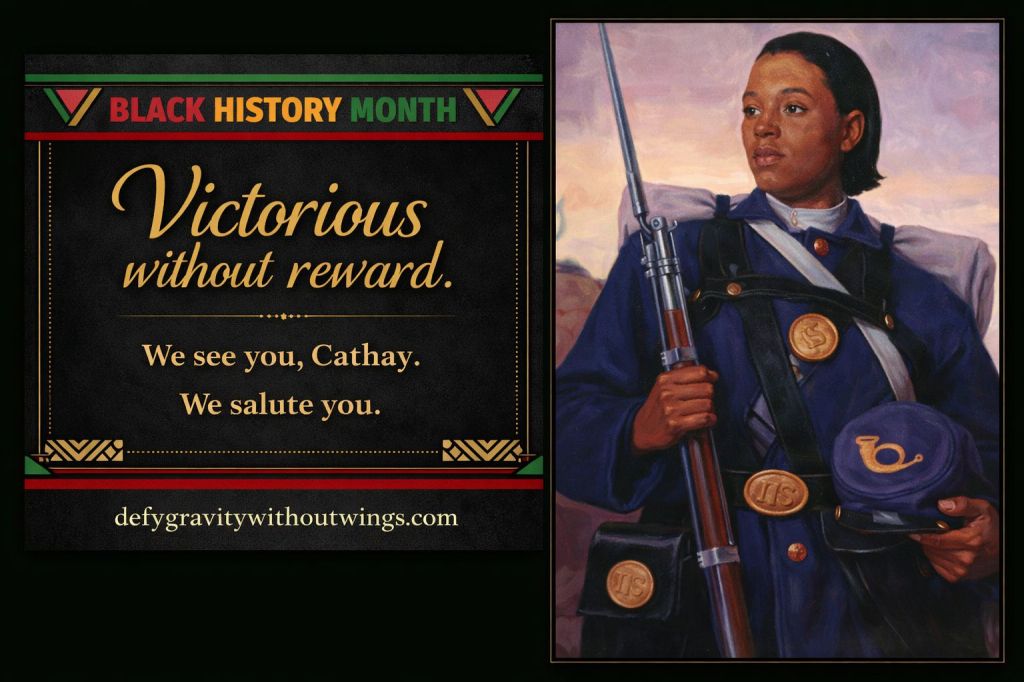
Cathay Williams was born enslaved in Missouri around 1844. During the Civil War, she followed the Union Army as a cook and laundress. But when the war ended and the Army opened its ranks to Black men only, Cathay did something unthinkable.


She cut her hair,

wrapped her body,

changed her name to William Cathay

— and enlisted.


For nearly two years, she served as a soldier in the 38th U.S. Infantry, one of the original Buffalo Soldier regiments. She marched. She guarded. She endured brutal conditions — all while hiding her identity in a world that would not make space for who she truly was.


Eventually, illness exposed what society refused to imagine:
a Black woman had carried a rifle, worn the uniform, and served her country faithfully.


She was discharged — not for lack of courage, but for daring to exist outside the rules.


Cathay Williams lived a life where survival required disguise.
Not because she lacked strength — but because the world lacked vision.


There are seasons when God calls people to serve before the world is ready to name them correctly.
Cathay was known as William by the Army.
But she was known fully by God.
“The Lord does not see as mortals see; they look on the outward appearance, but the Lord looks on the heart.” — 1 Samuel 16:7


History overlooked her.
The Army dismissed her.
But heaven recorded her obedience.
Some call her story deception.
Others call it desperation.


But I call it courage under constraint.


And here is the part history often whispers instead of says out loud:
Cathay Williams never received military honors.
She never received a pension.
In 1891, after her health had been permanently damaged by her service, she applied for a military disability pension. It was denied. She died poor and largely forgotten.


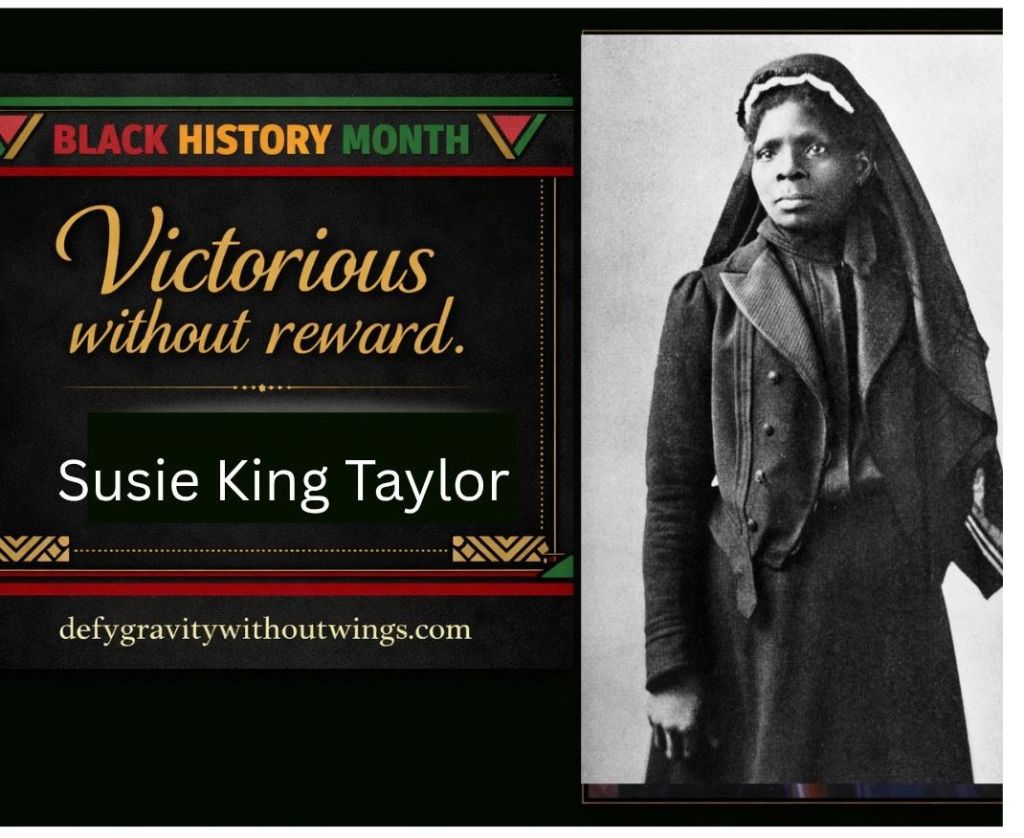
She was victorious without reward.


Cathay Williams did everything she was asked to do — and more.
She served faithfully.
She endured quietly.
She finished her assignment.


Her story reminds us that victory and recognition are not the same thing.
“Well done” does not always come from the systems we serve — but it is always recorded by God.
She didn’t fight for history.
She fought through it.
And God did not waste a single step she took.


She did not live to see her story told.
But her life still speaks.


And for those who have ever given their strength, their hope, or their encouragement without guarantee of return:
You may be unrewarded by the world —
but you are not unseen by God.


We see you, Cathay.
We salute you.


Love, Chelle

About the History in Bread Crumbs
Bread Crumbs reflections are grounded in documented historical records, including archives from the U.S. National Archives, Library of Congress, court records, contemporaneous newspapers, and first-person accounts. Spiritual reflections and personal connections are clearly marked as such and are offered with respect for the historical record.

.

Image

When the Tool Ate the Manuscript (and Almost My Heart)

Let me tell you what almost took me out.

For weeks—WEEKS—I have been doing the holy, unglamorous work of editing and reorganizing a soon-to-be book.
Moving chapters.
Fixing commas that think they run things.
Re-threading stories.
Listening for where God was nudging—and where I was just rambling.

This was faithful work. Quiet work.
The kind nobody claps for.

And then…
The tool I use to assist and “catch mistakes” decided to eat my manuscript.

Not nibble.
Not misplace a paragraph.
Eat it.

I have survived cancer, grief, caregiving, deadlines, and ice storms—but watching weeks of careful labor vanish off a screen?
That will make your chest tighten and your salvation flicker for a hot second.

I sat there spiraling:
Did I just lose half a book?
Am I behind now?
Did I just waste weeks of my life arguing with chapter headings?

Cue the dramatic sigh.
Cue me talking to my laptop like it had personally betrayed the family.

And then—grace, wearing sneakers—slid in sideways and whispered:

Your work is not gone.
You are not behind.
We did not lose half a book.

Because real work doesn’t live only in files.
It lives in muscle memory, lived experience, and a heart that’s been steeped in the message.

And Scripture backs this up.

“So I will restore to you the years that the swarming locust has eaten…”
— Joel 2:25

God restores years, not just results.
Restoration doesn’t always look like retrieval.
What God restores often comes back stronger.

So breathe.
Roll your shoulders.
Open a new document.

The words still know how to find you.
And the story is very much alive.

Love, Chelle
defygravitywithoutwings.com
Image

Porch Prayers & Weather-Wise Faith

On days like these, my mother would stand on the porch and ask for a Bermuda High to come down and turn the snow and ice away.


In the thick, sticky heat of summer, she’d pray for a Canadian Low to sweep through and cool the air.


She didn’t call it meteorology.
She called it faith.
And more often than not, the weather shifted.


When I got older, some of my friends picked up the same habit. We didn’t have robes or titles—just house shoes, coffee cups, and enough sense to know the porch was close enough to heaven for our prayers to travel. We called ourselves the Porch-Praying Sisters.


We prayed about the weather, yes—but also about children, marriages, money, bodies that wouldn’t cooperate, and news reports that made our stomachs knot. We spoke our requests into the open air like God might just be passing by and decide to stop and listen.


Today, we’re in the middle of a Virginia ice storm.
Freezing temperatures.
Sleet tapping the windows.
The quiet, low-grade anxiety of Will we lose power? humming beneath everything else.


And maybe that’s what storms still do best.
They set the altar.


They slow us down, pull us inward, strip away noise and options until all that’s left is warmth, breath, and the remembering that we are not in control—but we are not alone either.

“When you pass through the waters, I will be with you… when you walk through the fire, you will not be burned.” (Isaiah 43:2)


Over the years, we drifted. Life scattered us. Jobs, moves, losses, disagreements, silence. That happens.
But in this current environment—
with ice on the ground, tension in the air, and uncertainty pressing in—
I find myself praying again.
Not polished prayers.
Porch prayers.


The kind that believe faith doesn’t have to be loud to be effective. The kind that remember Jesus said even “faith as small as a mustard seed” can speak to what feels immovable and tell it to move. (Matthew 17:20)


Maybe the weather won’t always change.
Maybe the power will flicker.
Maybe the storm will linger longer than we’d like.
But when a storm sets the altar,
something always moves.
And sometimes…
that something is us.


— Love,  Chelle

Image

GOD’S UP. I MIGHT AS WELL BE TOO.

Like some kind of finely tuned timepiece, my internal alarm goes off —  clockwork faithful.
No snooze button negotiations. No grace period. Just “bing.”

And there it is… 3:00 a.m. glowing on my digital clock
(yes, I still have one — don’t judge).

I pull the comforter up like it might save me.
It does not.

My body says, up up up,
while my soul whispers, “Really, Lord? Again?”

There was a time I filled those early hours with “responsible things” —
finishing chores I ignored the night before,
paying bills that had been staring at me all day,
or letting the TV talk so I didn’t have to think.

Busy things.
Distracting things.
Things that looked productive but didn’t change me one bit.

But lately… I’m up writing.

Blog entries.
Poems.
Devotionals.

Words spilling out at a pace that tells me I’m not in charge of this schedule anymore.

And somewhere between the glow of that clock and the scratch of my pen, truth had my full attention.

I’ve moved from me cleaning house
to God housekeeping me.

Because once I’m fully awake, I go full steam —
fixing, managing, pushing, performing.
But at 3 a.m.?
I’m not impressive. I’m not polished. I’m barely caffeinated.

And that’s exactly when God starts pointing things out.

Things my soul was too tired to hear during the day,
my pen now faithfully records in the quiet.

Cleaning me.
Pruning me.
Digging around places I thought were “fine.”
Re-creating what I rushed past in daylight.

This isn’t insomnia.
This is divine interruption.

Early-morning housekeeping —
the kind where God gently rearranges what I’ve been tripping over inside
while I’m still wrapped in blankets and honesty.

And I’m reminded, softly, without accusation or demand:
“In quietness and trust is your strength.” (Isaiah 30:15)

Turns out, God doesn’t always wake us up to get more done.

Sometimes He wakes us up because He’s not finished with us yet.

Love, Chelle

Image

Clown Shoes On Holy Ground

I was born on a Sunday.
The old poem says, “Sunday’s child is full of grace.” I believe that’s true — but grace doesn’t arrive in a vacuum.

I was a Sunday child who learned early about loss.
About poverty that makes you grow up faster than your age.
About grief that shows up uninvited and stays too long.
About loneliness that teaches you how to be self-sufficient
and insecurities that whisper you’d better be useful if you want to be loved.

So I learned to protect myself.

I learned how to make people laugh and have them sing along.
How to lighten rooms before they noticed the weight I was carrying.
How to read emotions faster than words.
How to bring joy without asking for much in return.

What I didn’t know then was that God was watching all of it —
not with disappointment,
but with intention.

Scripture says:
“But God chose the foolish things of the world to shame the wise;
God chose the weak things of the world to shame the strong.”
— 1 Corinthians 1:27

From that place of self-protection, something holy was being formed.

My ministry didn’t begin in confidence.
It began in clown shoes —
joy worn on holy ground,
humor used as armor,
Melodies offered as a bridge when I didn’t yet have language for my own pain.

For a long time, I thought joy meant I hadn’t been hurt enough.
That if I laughed, my grief must not be legitimate.
That holiness required heaviness.

But holy ground taught me otherwise.

Holy ground can handle pride that cracks, not joy.
God was never offended by my antics.
He was present in it.

Somewhere along the way, God redeemed my survival skills.
What I once used to protect myself,
He began using to comfort others.

I didn’t stop carrying sacred things —
I just learned how to carry them without pretending they weren’t holy.

I still wear the clown shoes.
Not because I don’t know sorrow,
but because I do.

Joy is not denial.
Joy is defiance.
Joy is faith that has survived the night
and still shows up in the morning.

So if you see me smiling, laughing, singing,  softening the room —know this:

I am standing on holy ground.
I am carrying sacred things.
And God has always been in the business
of using what the world dismisses
to do His most meaningful work.

Clown shoes and all.

Image

Dear God – When Caregiving Hurts and Heals

DEAR GOD… WHEN CAREGIVING HURTS, HEALS, AND LEANS HEAVY ON MY SHOULDERS

“My grace is sufficient for you, for My strength is made perfect in weakness.” — 2 Corinthians 12:9

Today, I told myself I would wait until the temperature climbed to at least forty degrees before heading out to decorate my sister’s room at the nursing home for Christmas. I’m bringing her a case of pudding and picking up the dirty laundry — the usual “big sister doing what needs to be done” routine.

But before I even put my coat on, a familiar companion showed up… guilt.

Not guilt because I don’t want to help — I do, with all my heart.
But guilt because sometimes… Lord, I am just tired.

Tired from my own responsibilities.
Tired from my job, my husband’s appointments, my grandchildren, my writing, my own body acting up on me.
Tired from being pulled in ten different directions while trying to stay whole myself.

And there’s a special kind of guilt that comes with caregiving when you are exhausted.
A guilt that whispers, “You should be doing more.”
A guilt that berates you for needing a break.
A guilt that makes you feel like resting means failing.

Especially when the person you’re caring for is your younger sister.
Only 48.
Bed bound.
Multiple strokes.
Speech limited.
Taken down by a condition we didn’t even know existed until it barged into our family like a thief in the night.

Sometimes I walk into her room and see her lying there, and my heart squeezes because I remember who she used to be — strong, funny, quick-witted, full of that younger-sister attitude that kept me on my toes.
And then another wave hits:
How dare I complain about being tired when she would give anything to switch places with me for one day?

But Lord… that is not the truth You want me to carry.

Because even with her limitations, she and I still do what sisters do:
trash talk, laugh, joke, roll our eyes, and make the nurses wonder what on earth is going on in Room Whatever-It-Is-This-Week.
She’s still her, and I’m still me, and our sisterhood refuses to die.

And yet, the guilt still shows up when I catch myself sighing too hard, or wishing for one quiet weekend, or resenting the cold weather because caregiving is already heavy enough.

But today, Father, You whispered something to my heart:

“Guilt is not your assignment. Grace is.”

Caregiving is not a competition of strength.
It is not a performance for heaven.
It is not a test You are grading me on.

It is love lived out loud.
It is compassion with skin on it.
It is the ministry nobody sees but You.

Decorating her room today…
It’s not just Christmas décor.
It’s dignity.
It’s joy.
It’s a reminder that she is still here and still loved.
And it is a reminder that I am still allowed to be human.

So Lord, when the guilt rises because life is heavy,
when responsibilities pile up faster than I can carry them,
when I feel torn between caring for her and caring for myself,
remind me:

You never asked me to do this perfectly.
You only asked me to do it with love.
And love, even tired love, is still holy.

With Love,
Chelle

Image

Women With

They called it an issue, like giving it a polite name would make it, well, more polite.

Untouchable, unapproachable, unlovable.
Lifeforce hemorrhaging from the place of intimacy.  Touch denied, Touch prohibited, Touch blocked.

Trampled , hidden, gossiped.
Deactivated, demeaned, devalued
Thing she couldn’t control. Didn’t do. Couldn’t help.

Covenants with charlatans, witch doctors, healers. Other supposed lovers and brothers. Sisters with cupped ears.
Still drawing from the well alone

Promises broken. Spirit torn. Heart pounded to dust. Body begging to become ashes

Penniless, pointless, purposeless

Dragging the contents of her belly  through the dust deemed for the devil, perfected by the devil, designed by the devil.

Decided. Determined. Devoted.
Above the crush of sandals
Amongst the unwashed and unchanged delivering unclean verdicts

She heard of One in need of one
who would find virtue in just one
Hope, Healing, Whole .
A touch
to be touched
to release the touched
to touch the untouched.