Image

When the Tool Ate the Manuscript (and Almost My Heart)

Let me tell you what almost took me out.

For weeks—WEEKS—I have been doing the holy, unglamorous work of editing and reorganizing a soon-to-be book.
Moving chapters.
Fixing commas that think they run things.
Re-threading stories.
Listening for where God was nudging—and where I was just rambling.

This was faithful work. Quiet work.
The kind nobody claps for.

And then…
The tool I use to assist and “catch mistakes” decided to eat my manuscript.

Not nibble.
Not misplace a paragraph.
Eat it.

I have survived cancer, grief, caregiving, deadlines, and ice storms—but watching weeks of careful labor vanish off a screen?
That will make your chest tighten and your salvation flicker for a hot second.

I sat there spiraling:
Did I just lose half a book?
Am I behind now?
Did I just waste weeks of my life arguing with chapter headings?

Cue the dramatic sigh.
Cue me talking to my laptop like it had personally betrayed the family.

And then—grace, wearing sneakers—slid in sideways and whispered:

Your work is not gone.
You are not behind.
We did not lose half a book.

Because real work doesn’t live only in files.
It lives in muscle memory, lived experience, and a heart that’s been steeped in the message.

And Scripture backs this up.

“So I will restore to you the years that the swarming locust has eaten…”
— Joel 2:25

God restores years, not just results.
Restoration doesn’t always look like retrieval.
What God restores often comes back stronger.

So breathe.
Roll your shoulders.
Open a new document.

The words still know how to find you.
And the story is very much alive.

Love, Chelle
defygravitywithoutwings.com

Image

The Woman At The Table

Sometimes I miss the house in the middle of the corn fields with no indoor plumbing.
The pot-belly stove that decided when we were warm enough.
The way night fell heavy and close, and everyone settled where they could—sharing rooms, beds, blankets, breath.

I say my room, but that’s a loose word.
Privacy was a luxury we didn’t own.
Still, there was one place that felt like mine:
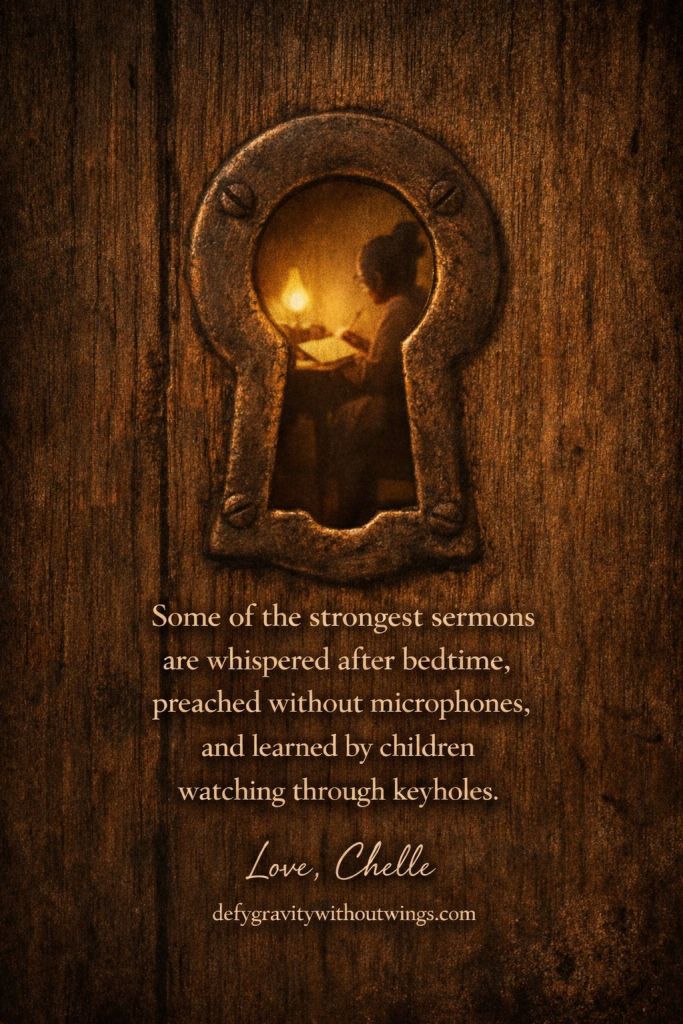
the narrow view through the keyhole.

Almost every night, after the fires were dampened and the house full of children finally stilled, I would watch my grandmother at her writing table. Her hands folded. Her Bible open. A pen moving slowly, deliberately.

Women of the Bible were her favorite.
Deborah. Ruth. Esther. Mary.
Women who listened closely and lived bravely.

She wrote sermons—real ones. Thoughtful. Scripturally sound. Insightful in ways people did not expect from a woman in those days. Especially a woman who cleaned other people’s houses for a living.

But it was her prayer ritual that marked me.

She prayed in whispers—not because God was quiet, but because love was.
She didn’t want to wake a house full of children.
Except, apparently, the little girl at the keyhole.

I couldn’t hear the words.
But I could see her face.

Sometimes she smiled.
Sometimes she laughed—like she and God shared a private joke.
Sometimes she cried. The kind of crying that doesn’t fall apart, just falls down.

And as I watched—hidden, still, unnoticed—I was learning.
Learning how faith looks when no one is applauding.
Learning that prayer does not need volume to have weight.
Learning that God listens closely to whispers.

When she finished praying, she always reached for the same thing.

A small plastic bread loaf.
One of those coin banks from organizations that fed “poor kids in Africa.”

She would slip a coin inside.
Sometimes a dollar.
Hard-earned. Scrubbed-for. Long-hours-standing money.

Money from a woman the world might have called poor—
but who never believed she was exempt from generosity.

I didn’t understand it then.
But I do now.

That table was a pulpit.
That whispering was power.
That plastic loaf was faith that refused to shrink.
And that keyhole?
It was my first seminary.

And that little girl at the keyhole?
She’s still watching.
Still learning how to pray without performing.
Still believing a few faithful offerings can touch a wide world.

“She opens her mouth with wisdom, and the teaching of kindness is on her tongue.” — Proverbs 31:26
“Your Father, who sees what is done in secret, will reward you.” — Matthew 6:6

Some of the strongest sermons are whispered after bedtime, preached without microphones, and learned by children watching through keyholes.

Love, Chelle


Image

Some Breaks Bring New Growth

I told myself I would not cry.


I said it out loud. Twice.

Then I heard the soft, unmistakable sound of soil shifting where it shouldn’t, followed by the sight every plant-loving heart knows too well — one of my pothos vines snapped clean away from the rest of the plant.

Just like that.
An accident.
A break.

My first thought wasn’t theological. It was maternal.
Can it be saved?

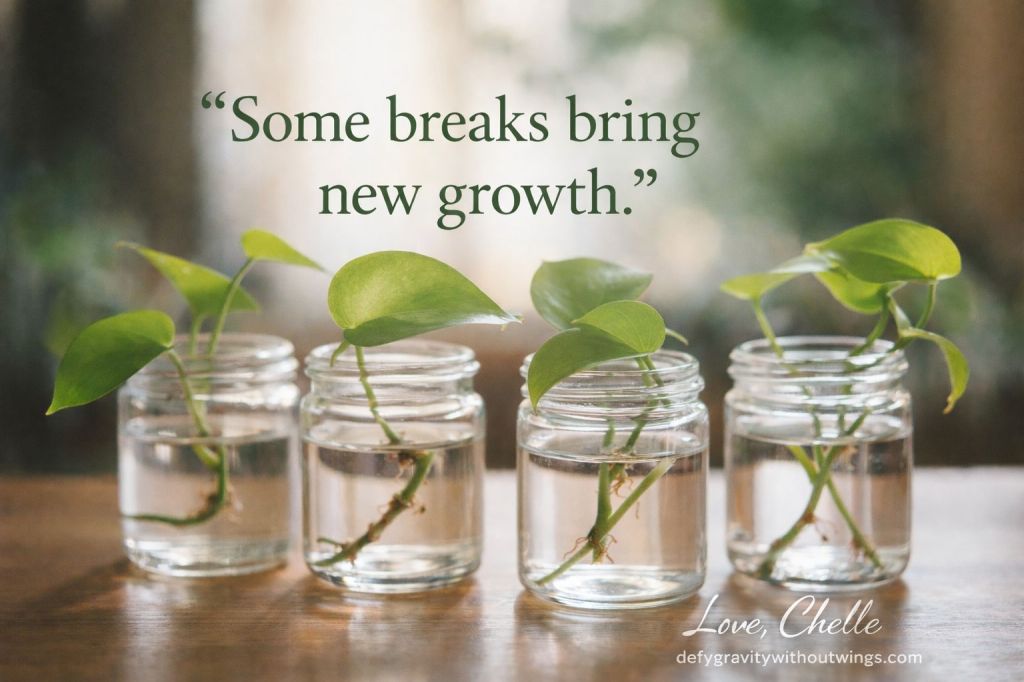
I picked it up gently, turning the broken vine over in my hands, looking for signs of life. And there they were — tiny nodes, already formed. Places where roots could grow, even though they hadn’t yet.

What looked like damage was actually possibility.

I learned something standing there in my living room with dirt on the floor and a vine in my hand:
Not every break is a loss. Some breaks are an invitation.

The plant wasn’t ruined. It was multiplied.
What separated didn’t die — it prepared to grow again, just differently, in a new place.

And isn’t that how it goes with us?

We panic when something breaks — a plan, a season, a relationship, a version of ourselves we worked hard to protect. We assume broken means finished. But God has a way of seeing roots where we only see separation.

Scripture whispers this truth gently:

“There is a time for everything… a time to plant and a time to uproot.”
— Ecclesiastes 3:1–2

Uprooting feels violent when it happens unexpectedly.
But uprooting isn’t destruction — it’s movement.

That vine didn’t know it was about to be replanted.
It didn’t resist the separation.
It just carried what it needed inside itself and waited for water.

Maybe that’s where we are too.

Maybe what snapped didn’t end us.
Maybe it exposed what was already capable of growing.

So I didn’t lose a plant today.
I gained four jars of hope sitting on my counter.

What broke didn’t disappear — it multiplied.
And maybe that’s the part we forget when something snaps in our hands.

Waiting isn’t wasted.
It’s where roots decide to show up.

“Those who wait for the Lord shall renew their strength.”
— Isaiah 40:31

Some breaks bring new growth.
They just need water… and a little time.

With love,
Chelle
defygravitywithoutwings.com

Image

Unmarked Seeds And  Clearance Rack Faith

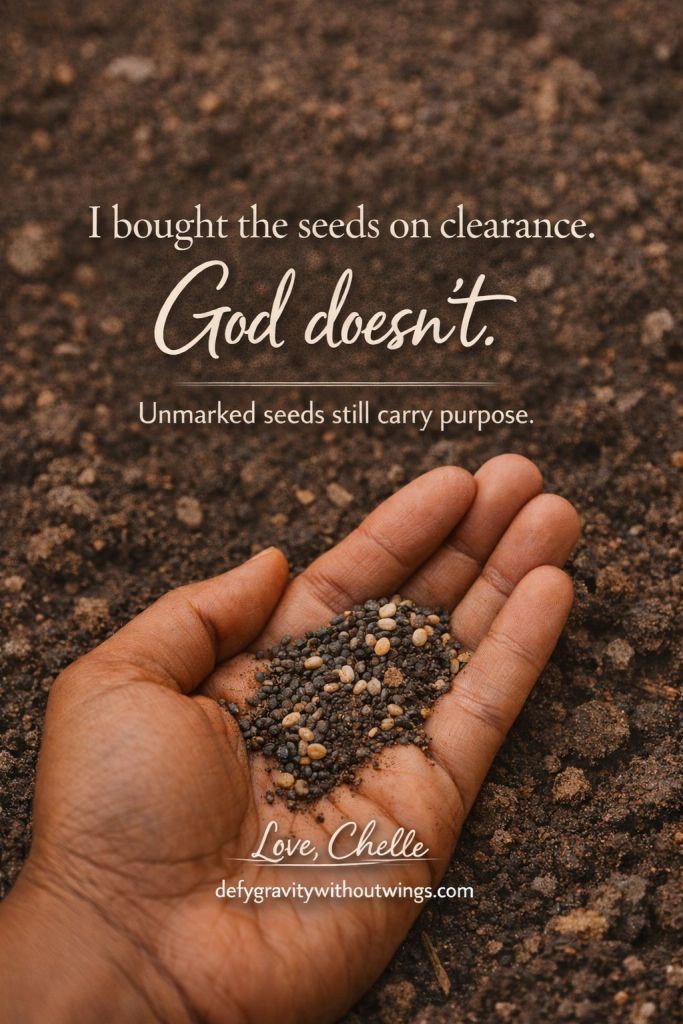
I was standing there with a handful of seeds and no idea what any of them were.
No labels. No instructions. No promises.
Just seeds.


Some were round. Some looked like dust. Some looked like… dirt pretending to be something important.

And full confession — I made the executive decision to buy them from a discount house online, which should have been my first clue that clarity was not included in the price.


Because planting unmarked seeds feels risky.
You don’t know what you’re committing to.
You don’t know how long it will take.
You don’t know what kind of care it will need — or if you just planted hope, oregano, and disappointment all in the same row.


And that is where I had to repent of my disgust with not being able to see the seeds’ vision.


God has planted a lot of unmarked seeds in me.
No timeline.
No instruction card.
No neat little packet that says “This will bloom in 90 days if watered weekly and protected from disappointment, other people’s opinions, and your own impatience.”


Just obedience.
Just trust.
Just dirt and hope.
Some seeds He plants look insignificant — almost invisible.
Some feel mislabeled by other people.
Some feel like they were handed to us without explanation at all.


And yet… seeds don’t need labels to know what they are.
They just need soil.
Light.
Time.


And a gardener who doesn’t dig them up every five minutes to check progress — which, for the record, I have learned is frowned upon in both gardening and faith.


I think that’s where I get tripped up.
I keep wanting proof before growth.
Confirmation before commitment.
Fruit before faith.


But the seed already knows what it carries — even when I don’t.


“So neither he who plants nor he who waters is anything, but only God who gives the growth.”
— 1 Corinthians 3:7


Maybe the confusion isn’t failure.
Maybe it’s faith in its earliest form.
Maybe God is saying:
Plant it anyway.
Water it anyway.
Stop interrogating the soil.
Because unmarked doesn’t mean unintentional.
And unseen doesn’t mean unimportant.
And dormant is not the same thing as dead.

Love, Chelle

Image

Thinning Is Not Killing (Even Though It Felt Like It)

I stood in my greenhouse clutching scissors like I was about to commit a felony.
These weren’t plants.
These were my plant babies.
I grew them.
I watered them.
I whispered encouragement like a slightly unhinged garden aunt.
And now I was being told they were “too crowded.”


Excuse me???
They looked happy.
Thriving.
Living their best leafy lives.
But apparently, love without boundaries leads to chaos.
Who knew.


The word thinning showed up—
and my heart heard destruction.
Because when you’re wired like me,
making room feels an awful lot like abandonment.


I mean, how do you explain to a perfectly healthy kale plant
that it’s not being rejected—
it’s just being relocated, harvested early, or “released into purpose”?


I felt like I was ruining everything.
Until I realized…
nothing was being wasted.
Some plants were transplanted.
Some were harvested and nourished something immediately.


And the ones left behind?
They finally had space to become what they were always meant to be.
That’s when it hit me.
Pruning doesn’t change who we are.
It reveals it.
God isn’t cutting us down—


He’s cutting away what keeps us from becoming strong, rooted, and fruitful.
Not every removal is punishment.
Not every loss is failure.
Some things leave so we can finally grow into ourselves.


“Every branch that bears fruit He prunes, that it may bear more fruit.” — John 15:2


Pruning feels personal when you’re emotionally attached to the leaves.
But it’s the very thing that shapes the harvest.
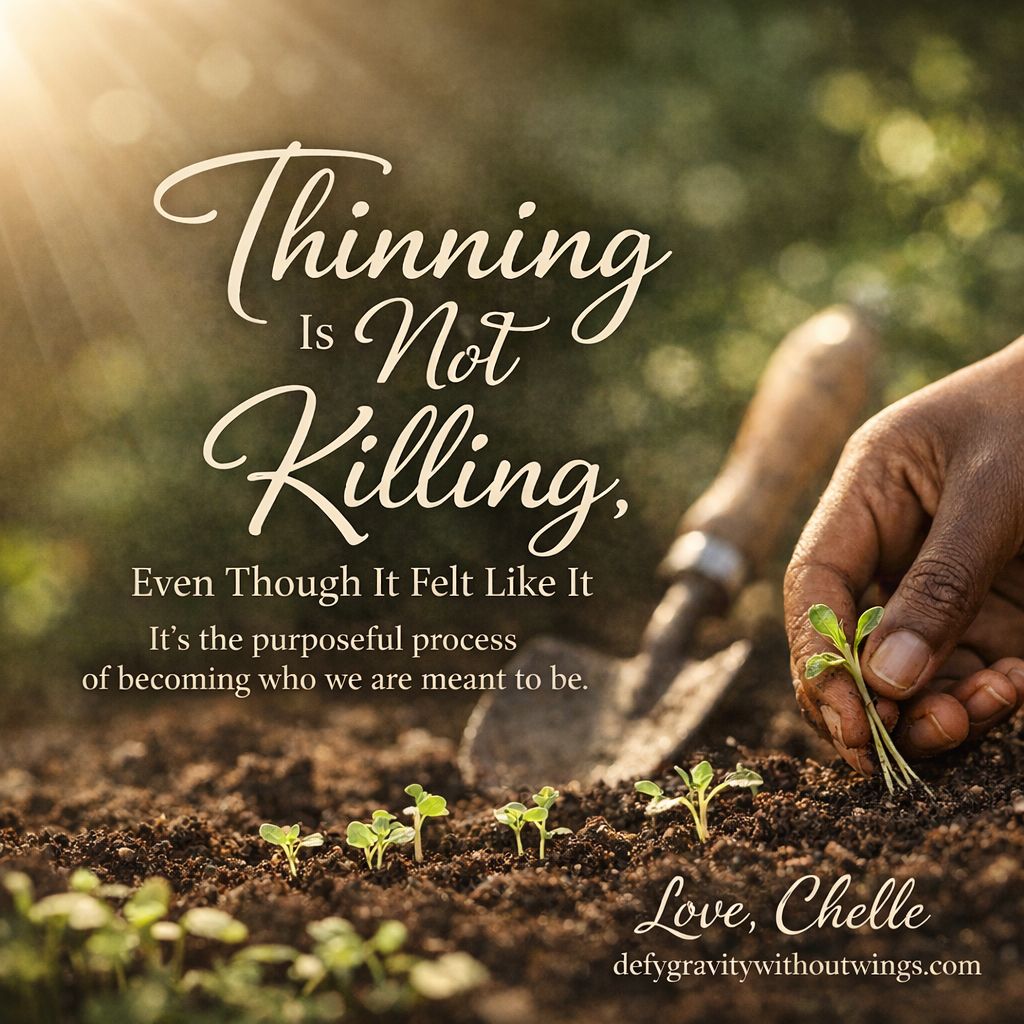
Thinning is not killing.
It’s the painful, purposeful process of becoming.


And if I’m honest…
I still apologized to my kale,
needed a moment of silence,
and may require counseling before the next round of thinning.


Because apparently God and gardening are both committed
to making us who we’re supposed to be—
even when we’re dramatic about it.


With love, Chelle,

Image

Clown Shoes On Holy Ground

I was born on a Sunday.
The old poem says, “Sunday’s child is full of grace.” I believe that’s true — but grace doesn’t arrive in a vacuum.

I was a Sunday child who learned early about loss.
About poverty that makes you grow up faster than your age.
About grief that shows up uninvited and stays too long.
About loneliness that teaches you how to be self-sufficient
and insecurities that whisper you’d better be useful if you want to be loved.

So I learned to protect myself.

I learned how to make people laugh and have them sing along.
How to lighten rooms before they noticed the weight I was carrying.
How to read emotions faster than words.
How to bring joy without asking for much in return.

What I didn’t know then was that God was watching all of it —
not with disappointment,
but with intention.

Scripture says:
“But God chose the foolish things of the world to shame the wise;
God chose the weak things of the world to shame the strong.”
— 1 Corinthians 1:27

From that place of self-protection, something holy was being formed.

My ministry didn’t begin in confidence.
It began in clown shoes —
joy worn on holy ground,
humor used as armor,
Melodies offered as a bridge when I didn’t yet have language for my own pain.

For a long time, I thought joy meant I hadn’t been hurt enough.
That if I laughed, my grief must not be legitimate.
That holiness required heaviness.

But holy ground taught me otherwise.

Holy ground can handle pride that cracks, not joy.
God was never offended by my antics.
He was present in it.

Somewhere along the way, God redeemed my survival skills.
What I once used to protect myself,
He began using to comfort others.

I didn’t stop carrying sacred things —
I just learned how to carry them without pretending they weren’t holy.

I still wear the clown shoes.
Not because I don’t know sorrow,
but because I do.

Joy is not denial.
Joy is defiance.
Joy is faith that has survived the night
and still shows up in the morning.

So if you see me smiling, laughing, singing,  softening the room —know this:

I am standing on holy ground.
I am carrying sacred things.
And God has always been in the business
of using what the world dismisses
to do His most meaningful work.

Clown shoes and all.

Image

The Third Pie

I wasn’t trying to be deep.
I was just trying to bake.

One sweet potato pie for my husband.
One for my brother-in-law who has been begging for one like it’s his spiritual gift.
I followed the recipe to the letter. Measured. Mixed. Poured.

And somehow… there was a full third pie.

Not a baker’s bite.
Not a “let me scrape the bowl and see what happens.”
A whole, mind-your-business, respectable third pie.

What makes this even better is this:
I hadn’t made a sweet potato pie in almost a year.

Not because I didn’t want to.
Not because I forgot how.
But because life was lifing — loudly — at almost every holiday when joy normally shows up wrapped in foil and tradition. Some seasons don’t leave room for extra, only endurance.

So when I finally baked again, I wasn’t expecting anything special.
Just two pies.
Just getting back to myself.

And still — there was extra.

I didn’t stretch the recipe.
I didn’t short the pies.
I didn’t hustle or improvise.

I simply did what was in front of me.

Later that day, the third pie didn’t wait for a plan.
Two of my teenage grandsons devoured it like it was made just for them — laughing, grabbing seconds, completely unaware they were standing in the quiet, perfect timing of God’s provision.

And that’s when it settled in.

Sometimes, provision doesn’t shout.
Sometimes grace shows up finished.
Sometimes, abundance waits patiently for us to notice.

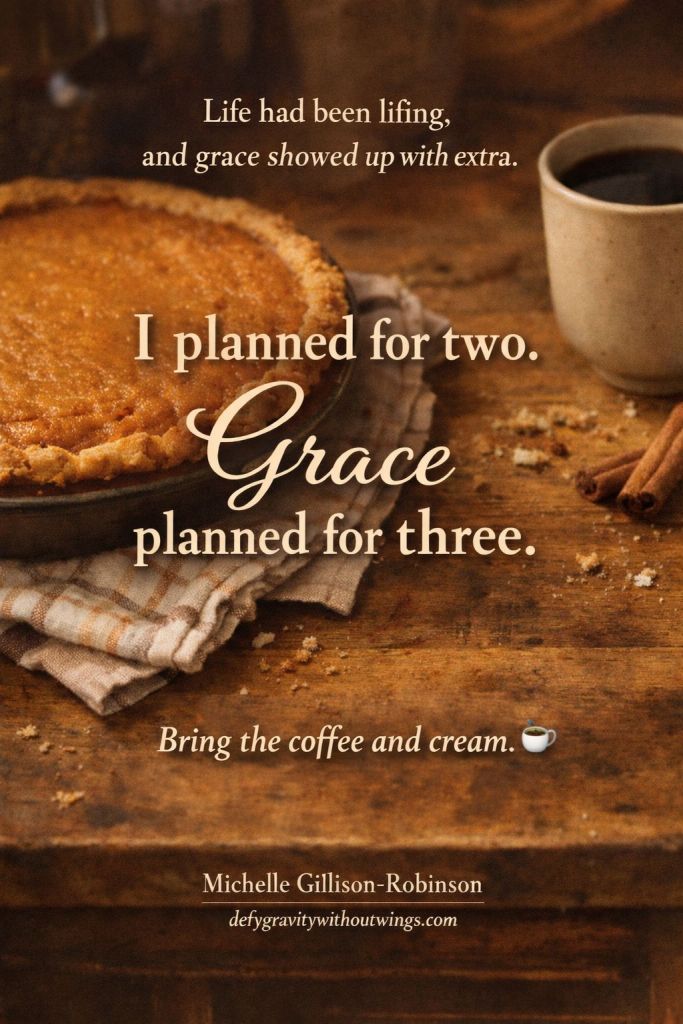
I planned for two.
Grace planned for three.

“The Lord will open for you His good storehouse, the heavens, to bless all the work of your hands.”
— Deuteronomy 28:12

And this morning, with coffee in hand and crumbs on the counter, I’m reminded:
Even after long pauses, God’s timing is still generous.

Love, Chelle

Image

Eviction Notices ( Without the Panic)

As I pack up the end of one year to experience the wonders of the next, I was reminded of how many times I was evicted. Not in the natural sense but by God.


I’ve learned that God’s eviction notices don’t come with flashing lights or raised voices.
They don’t sound like “You’re fired.”
They don’t arrive with chaos or fear.
They feel like stability that no longer fits.


I call it an eviction notice when God begins to unsecure me in a place He never intended to be my final address. Provision is present. The lights are on. The ground is steady. And yet—peace quietly taps me on the shoulder and whispers, “This isn’t home.”


For people like me—faithful to a fault, a true “Stable Mabel”—dependable, steady, the one who shows up no matter what—God doesn’t shove.
He anchors.
He makes sure the floor doesn’t drop out.
He removes the threat of free-fall.
He rearranges just enough, so survival is no longer the distraction.
And that’s when it gets confusing.
Because when panic leaves, clarity arrives.
And clarity is harder to ignore.
An eviction notice from God doesn’t say leave now.
It gently says, don’t give this place your last.
It shows up as: – security without satisfaction
– provision without peace
– competence without calling
It feels like gratitude… mixed with restlessness.
I used to think eviction meant loss.
But I’m learning it often means permission.
Permission to stop confusing loyalty with assignment.
Permission to admit that faithfulness has a future—and it doesn’t always look like staying.


Scripture gives me a different picture of how God moves His children:
“Like an eagle that stirs up its nest
and hovers over its young,
that spreads its wings to catch them
and carries them aloft…”
(Deuteronomy 32:11)


When I think of God’s eviction notices now, I don’t picture being thrown out.
I picture a nest that has grown too comfortable—warm feathers, familiar edges.
God stirs the nest not to harm, but to wake.
There is a push, yes—but there is also hovering.
There is a letting go, but never abandonment.
Before the feathers can be too ruffled,
before fear turns into free fall,
the same wings that nudged are the wings that catch.
That’s what this season feels like.
Not panic.
Not loss.
But the unsettling grace of being lifted by a God who refuses to let me stay small—and refuses to let me crash while I learn.
Here is the grounding truth I’m holding close:
God is not asking me to burn down my life.
He is inviting me to build the next one alongside it—until it’s strong enough to stand.
No rushing.
No scorched earth.
No fear-driven decisions.
Just a quiet understanding that a holding pen is not a home—and that noticing the gate is unlocked is already movement.
If this is an eviction notice, it isn’t cruel.
It’s merciful.
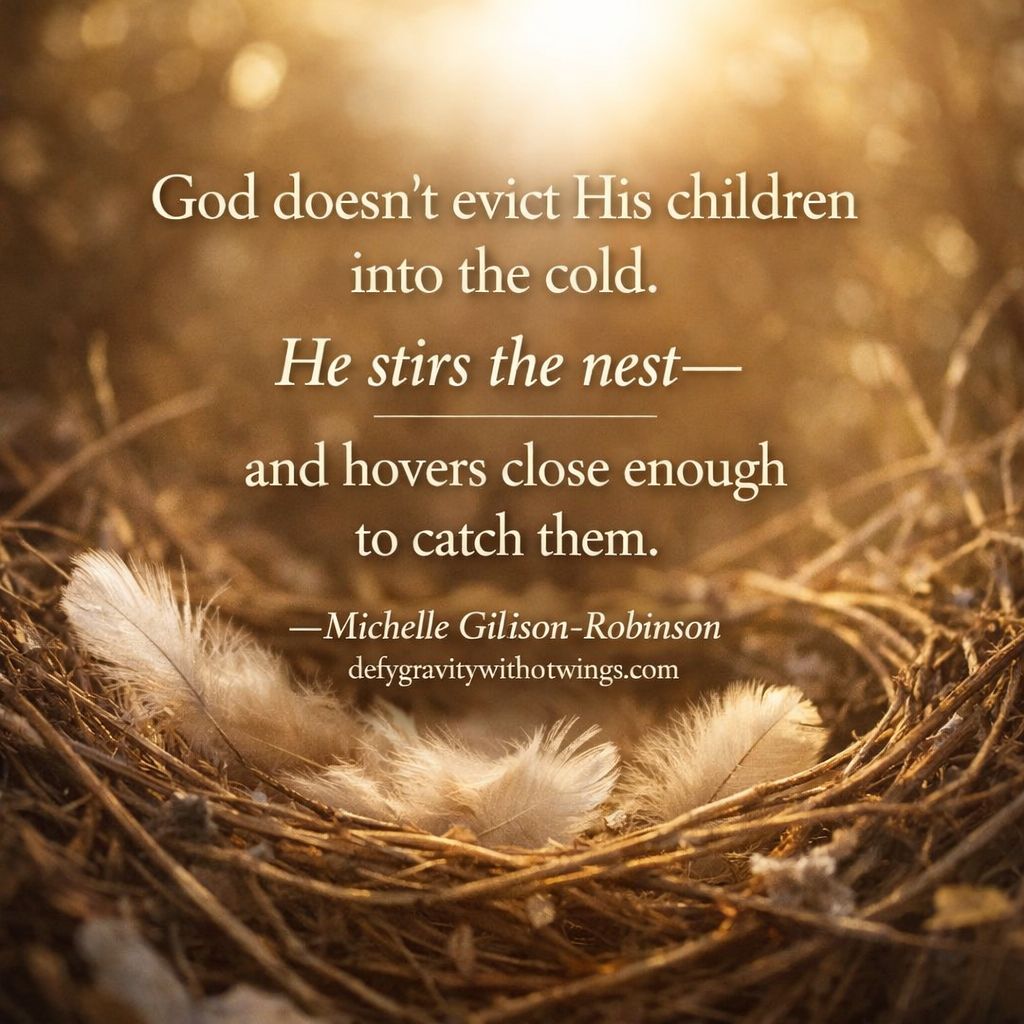
Because God doesn’t evict His children into the cold.
He prepares the next place before He asks us to pack.
And peace—real peace—always goes with us.
— Love. Chelle

Image

Watch Night Reflection: Auld Lang Syne in a Colder World

“Auld Lang Syne” (yes… I had to look up how to spell it) is often sung on nights like this, though many of us don’t quite know what we’re saying. The phrase comes from old Scots and simply means “times long past” or “old long since.”


It’s really a question—Should old acquaintance be forgot?


Tonight, we know the answer is no.
Some traditions look different now.
Watch Night doesn’t stretch to midnight anymore.
Candles burn a little shorter.
Doors close earlier than they used to—not because faith has failed, but because the world has grown colder, louder, and less safe.
And yet… here we are.


We gather not to mourn what’s changed, but to remember what still matters.


“Because of the Lord’s great love we are not consumed,
for His compassions never fail.
They are new every morning;
great is Your faithfulness.”
— Lamentations 3:22–23 (NIV)


“Auld Lang Syne” isn’t about nostalgia—it’s about honoring the bonds that carried us through. It invites us to pause, look back, and say: We made it. Together.
So tonight, before we step into a new year, let us do a few holy things:
• Give thanks for the days behind us—both joyful and hard
• Release what no longer serves our spirit
• Recommit to the people God placed in our care
• Check on family, even the ones who don’t answer right away
• And if you really love me… bake the baker  a pineapple upside-down cake, because my birthday is in a few days (amen and thank you in advance)


Because in a world that feels colder, connection is resistance.
Community is courage.
And faith—quiet, steady faith—still keeps watch.
So even if we leave before midnight,
even if the song fades early,
we carry the meaning with us:


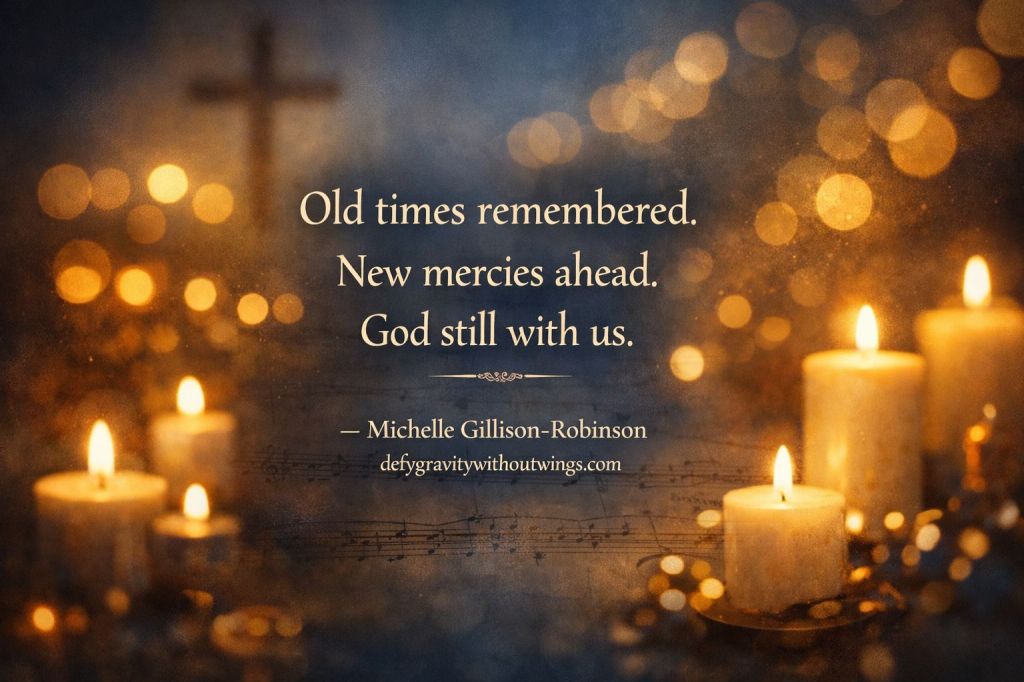
Old times remembered.
New mercies ahead.
God still with us.
Amen.

Loving you right into our next adventure,  Chelle


Michelle Gillison-Robinson

defygravitywithoutwings.com

Image

New Year’s Eve Eve – When I woke up, but my brain did not.

Every writer’s fully awake nightmare: a block.
A brain fart.
Nothing profound to say.
Nothing book-worthy for the new year.

For a brief moment, panic tried to convince me that silence meant failure.
But even this—this momentary panic—became permission.

Permission to pause.
Permission to breathe.
Permission to simply exhale.

Truth be told, I sat there staring at the blinking cursor, waiting for something deep, prophetic, and Watch Night-worthy to appear.
Nothing came.
Not a sermon. Not a quote. Not even a clever churchy acronym.
Just me… and the cursor… judging each other.

This morning I woke up—but my brain did not.
And I’m choosing not to wrestle it into submission.

It’s New Year’s Eve Eve.
There’s still much to do.
Watch Night services to prepare for.
Lives to show up for.
And the familiar hum of New Year’s resolutions floating around everywhere.

Everywhere I turn, people are declaring what they’re going to do in the new year.
Gym memberships. Journals. Green smoothies.
And while I applaud the optimism, I already know February is coming… with receipts.

I’ve come to call them Reso-lies—
because so many of them don’t survive past February 1st.

Yes, I have goals.
Yes, I will aim.
But no, I will not condemn myself or pressure myself into a failure complex when things don’t go according to plan.

This year, I’m elevating two truths instead of a checklist:

Let the Lord be magnified,
who takes pleasure in the prosperity of His servant.”
— Psalm 35:27

Delight yourself also in the Lord,
and He shall give you the desires of your heart.”
— Psalm 37:4

I wave both scriptures like a banner—
not as entitlement,
but as alignment.

I wish I could tell you this message came together neatly—
that I woke up inspired, organized, and spiritually glowing.
But the truth is, this word came together the same way my life usually does:
honest, a little tired, and fully dependent on grace.

My prayer for the upcoming stroke of midnight is simple and surrendered:

Lord, take pleasure in this servant
as I magnify You.
Give me the desires of my heart
that line up with the delights of Yours.

Resting is not failing.
Pausing is not quitting.
And waking up—even when my brain didn’t
still counts as showing up.

May the Lord Find You In A Delightful Place!!!!

Love, Chelle