Image

The Gift That Keeps Showing Up

Every morning — and sometimes as early as 3 a.m. — there’s a small sacred ritual that happens on our phones.


A text thread.
Women connected by blood, history, humor, and habit.
Aunts. Nieces. Sisters. Cousins.


It usually starts with a simple greeting. A prayer emoji or a sermon link. . A “Love y’all.”


And yes… sometimes it starts because one of us can’t sleep and assumes nobody else should be sleeping either. (That one might be on me.)


This is how we stay connected now.
Because age has a way of rearranging life, schedules don’t always line up, and seeing each other as often as we’d like isn’t always possible. But love? Love adapts.


Yesterday, my Aunt Lenora changed the subject in our group text. You know how the family matriarchy does — when wisdom rises up and gently says, Pay attention.


She shared something God had revealed to her about Great-Grandma Martha and Grandma Alice.
They used to say it often around holidays and birthdays:
“I don’t want y’all to give me any gifts this time. Thank you, but I really don’t need any more.”


At the time, we smiled. Sometimes, we insisted anyway.
Because giving is how we show love.
But after they passed, we found something that stopped us in our tracks —
gifts still in their packages.
Closets holding love that had already been received in the heart.


And suddenly, the words made sense.
It wasn’t that they had everything.
It was that satisfaction had settled in.
Gratitude had overflowed.
Hearts were full. Closets were full.
And the desire for more stuff had quietly faded.


Aunt Lenora put it beautifully in the text:
“It’s not that we have everything that could be had. It’s just that at a certain point, satisfaction sets in, gratitude is overflowing, hearts are filled… and even though you’re still grateful for expressions of love, there’s no more desire for stuff.”


And then came the revelation that wrapped everything together:
“We finally understand the real meaning of Christmas.
The Father gave the Son.
The Son gave the Spirit.
The Spirit gives us life —
so we can give the gift of love.
And that gift goes on and on and on.”


That’s it.
That’s Christmas.
Not the packages.
Not the receipts.
Not the pressure to perform joy.
Just love — passed down like an inheritance no one can lose.


This season has reminded me that our worth today is not measured by who shows up for us, but by who we show up as.
Great-Grandma Martha showed up with wisdom.
Grandma Alice showed up with contentment.
Aunt Lenora shows up with revelation.
And the women in that early-morning text thread show up — faithfully, lovingly, imperfectly.


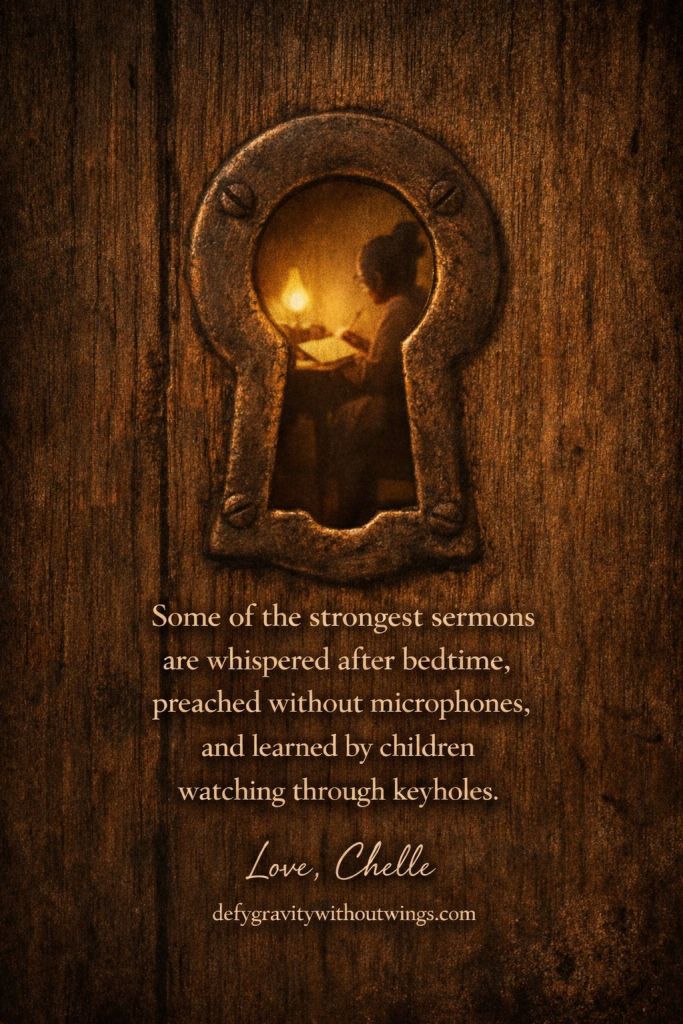
And I show up with a pen — so that my daughter, Paula, will never forget the legacy of these women.
So she will know where she comes from.
So she will recognize the holy inheritance of faith, gratitude, and love that flows through her name.


Sometimes love looks like gifts.
Sometimes it looks like unopened packages.
And sometimes it looks like a 3 a.m. text that says, I’m thinking about you. I’m grateful for you. You’re not alone.


Scripture reminds us:
“A generous person will be enriched, and one who gives water will get water.” — Proverbs 11:25
That may be the gift that never stops giving.

Merry Christmas ,

Chelle

Image

When Christmas Doesn’t Recognize Itself

I’ll admit it—I chuckled at first.
I saw a video of a broke Hispanic father joking with his young son that ICE had taken Santa. It was meant to be humorous, a dark joke wrapped in the language of survival. I laughed… and then I stopped.


Because once the laughter faded, the weight of it settled in.


How awful to place that kind of fear on a child. How heartbreaking that this joke even works in our current climate. And then it hit me—harder than I expected.


Under the prevailing American mindset of 2025, the very figures we celebrate at Christmas wouldn’t be welcome here.
Santa would be questioned.
Mary and Joseph would be detained.
Jesus would be born into a system already suspicious of Him.
The wise men would be asked to self-deport.
The angels would be accused of violating airspace.
And the shepherds—unhoused, roaming, living off the land—would likely be jailed for existing outside the rules.


Yes, I know—it sounds like a stretch.


And yes, there must be laws. There must be order. There must be boundaries and systems and responsibility. Scripture never denies that.


But Scripture also never allows us to weaponize law against love.
Because the story of Christmas—the real one—is not clean, controlled, or credentialed. It is a story of displacement. Of vulnerability. Of outsiders. Of God choosing to arrive without papers, privilege, or protection.


Mary wasn’t prepared.
Joseph wasn’t powerful.
Jesus wasn’t safe.
And none of them fit the mold of who society typically makes room for.


Yet this is the story we retell every year with lights and carols and nativity scenes that have grown far too tidy.
Somewhere along the way, we learned to celebrate the symbols of Christmas while quietly opposing everything they stand for.
We sing about peace while nurturing fear.
We speak of joy while guarding our comfort.
We proclaim love while questioning who deserves it.


And that should sober us.
Because Jesus Himself said,
“I was a stranger, and you invited me in.”
Not you vetted me.
Not you verified my worth.
Not you made sure I belonged first.
He didn’t ask us to solve immigration policy.
He asked us to recognize people.


The question Christmas asks us—every year, relentlessly—is not whether we believe in Christ, but whether we resemble Him.
Would we make room for Him now?
Or would we ask Him to prove He belongs?
If the answer makes us uncomfortable, maybe that discomfort is holy. Maybe it’s an invitation to return—not to tradition, but to truth.
Because Christmas has always been about God crossing borders.
And love, by nature, refuses to stay contained.

Love Chelle

Love Chelle

Image

Ministry In The Margins

When the year ends and life still feels unfinished

The end of a year has a funny way of demanding closure.
Wrap it up.
Sum it up.
Name the wins. Count the lessons. Post the highlight reel.


But some years don’t cooperate.
Some years limp to the finish line.
They end not with fireworks but with unanswered prayers, half-healed hearts, and a to-do list that spills right into January.


And that’s where I’ve learned something holy happens.


Ministry doesn’t wait for January 1st.
It lives in the margins between what was and what’s coming next.
That thin space between “I made it” and “I’m still standing.”
Between gratitude and grief.
Between hope and exhaustion.


I used to think ministry happened in neat rows — in quiet moments, with plenty of stillness and the right words.
But life didn’t wire me that way.


I’ve spent years feeling slightly unqualified — too busy to sit still, too restless to fit the mold.
Cancer didn’t simplify that. It complicated it.
Chemo brain stole words I used to reach for easily.
A speech impediment I thought I’d conquered as a child quietly returned — humbling me in ways I didn’t expect.
And the truth is, I’ve never quite fit into the version of “qualified” society seems most comfortable with.
Clear. Calm. Composed.
Tidy faith. Tidy testimony.
That hasn’t been my story.


And yet… God still showed up.
Not correcting my pace.
Not asking me to sound different.
Not waiting for me to feel confident or complete.


Jesus has always been comfortable in the margins.
He’s the Savior with mud on His hands, not a microphone.
The One who kneels in the dirt.
The One who notices the people others step around — and calls them.


The margins are where we stop pretending the year went as planned.
Where faith sounds less like a declaration and more like a whisper.
Where our prayers become, “Lord, carry me forward.”
And maybe that’s the truest kind of ministry there is.


As this year closes, I’m not interested in pretending it was tidy.
I’m grateful — deeply — but I’m also honest.
Some healing is still in progress.
Some clarity hasn’t returned on command.
Some strength showed up only one imperfect day at a time.
And yet… grace was there.
In the margins.


If you’re crossing into a new year feeling unfinished —
If your faith feels real but worn around the edges —
If you don’t feel polished, poised, or particularly qualified…
You’re not behind.
You’re standing exactly where God loves to work.
Right there.
Between the years.
In the margins.
I’m not entering the new year polished — I’m entering it carried.

Safe in His arms to Be Carried Into A New Year

Love, Chelle

Image

Store-Bought Crust, Real Filling

What Christmas chaos taught me about sincerity

It’s Christmas.
Which means the house isn’t quiet, the schedule isn’t kind, and nothing is quite as together as the Hallmark movies promised.

There are lists half-checked, boxes half-opened, and flour somehow in places flour should never be.

I used a box mix for the cookies.
No-bake “snow pies” pretending real hard to be cheesecake.
And the pie?
Well… the crust came from the store,
but the filling?
That part is 100% real.

Also—full disclosure—
there is a pile of tasting spoons in the sink.
Because no shortcut baker is licking a spoon and putting it back.
We are tired, not reckless.

Somewhere between the chaos, the Christmas music playing too loud, and me stepping over things I swear weren’t there five minutes ago, it hit me.

We spend a lot of time apologizing for our shortcuts.

“I didn’t make it from scratch.”
“I didn’t do as much as I wanted.”
“I don’t have it all together this year.”

But what if God isn’t inspecting the packaging—
what if He’s tasting the heart?

The crust might be store-bought, but the love is homemade.
The method might be quick, but the intention is honest.
The presentation might be simple, but the offering is real.

Jesus never demanded everything be handcrafted—
He asked that it be sincere.

He fed crowds with borrowed bread.
He healed with mud and spit.
He entered the world not in perfection, but in a mess of hay, noise, and interrupted plans.

Not fancy.
Not polished.
Just real.

So if your Christmas looks like box mix faith and no-bake prayers,
don’t disqualify it.

If your life feels like shortcuts and substitutions,
but the filling is still genuine—
grace counts that.

Scripture reminds us—right in the middle of our mess:

“The Lord does not see as man sees; for man looks at the outward appearance, but the Lord looks at the heart.”
— 1 Samuel 16:7

God isn’t grading your technique.
He’s receiving your offering.

And tonight, around a table of “good enough” desserts, Christmas clutter, and way too many spoons to wash,
there is more holiness than we realize.

Because what’s real on the inside
has always mattered more than how it was wrapped.

P.S.  If you come wash these spoons, I’ll save you a little something

Love Chelle

Image

When Life Blows Your Cover

The wind didn’t check my schedule.
It didn’t ask permission.
It didn’t care that I had already done enough for one week, much less one day.


It just came—
hard, sudden, unapologetic—
and ripped the cover right off my greenhouse.


Which, for a brief and dramatic moment, sent me spiraling into full bad plant mommy theology.
I immediately calculated the money I’ve spent on soil, seeds, trays, covers, optimism, and audacity.
I pictured myself explaining—again—how I tried one more time to grow food like a capable adult.
And somewhere in that panic, I accepted my future fate:
All this effort.
All this chaos.
And next spring… one carrot.
Crooked.
Probably bitter.
Judging me.


That’s when my heart did that drop it does when something precious feels exposed.
My babies.
Tender things.
Things still growing.


That’s the panic, really.
Not the storm itself—
but the fear of exposure.


But then grace slipped in quietly.
My son found the cover.
He put it back on.
And it was secured before the temperature dropped.
That timing matters.


Because sometimes life doesn’t destroy what we love—
it just startles us long enough to remind us how vulnerable we are.


The wind will come.
Covers will lift.
Plans will flap wildly in directions we didn’t approve.


But here’s what this moment taught me:
The roots were already stronger than I realized.
Protection returned before the damage reached what mattered most.
God doesn’t always stop the wind.
Sometimes He just makes sure the cold doesn’t get to the roots.


And when I go out later today to check on my babies,
I already know this truth will meet me there:
They survived not because conditions were perfect—
but because grace showed up in time.
So if life feels a little exposed right now…
If the wind rattled what you thought was secure…
Take heart.
The cover can be restored.


Help may already be on the way.
And what God planted in you was made to survive more than you think.
“The wind blew my cover, but it didn’t get my roots.”
“The Lord will keep you from all harm—
He will watch over your life.”
— Psalms 121:7
Sometimes grace doesn’t look like calm skies—
it looks like protection returning just in time.


Love,  Chelle

Image

The Mad Not Wrapper

1 Samuel 16:7 — People look at the outward appearance, but the Lord looks at the heart.


I am known in my family as “The Mad Not Wrapper.”

Not because I’m angry.
Not because I don’t care.
But because I refuse—*REFUSE*—to wrestle with wrapping paper, tape that sticks to itself, and bows that look like they were sat on.

Instead, I use Christmas-printed trash bags and gift bags.
Festive. Functional. Honest.

If you’re lucky, you might get tissue paper.
If you’re really lucky, the bag won’t have a knot.

And yet… somehow… every year…
There are tears.
There is laughter.
There is joy.

Which tells me something important:
The magic was never in the wrapping.

Jesus never wrapped the loaves and fishes.
No parchment.
No ribbon.
No “presentation matters” speech.

There were no matching baskets or branded packaging.
Just a boy’s lunch.
Bread. Fish.
Ordinary. Bare. Exposed.

And here’s the part we often rush past:

Jesus saw the need.
He received what was offered.
And He gave thanks before anything multiplied.

That gratitude—before the miracle—was the wrapping.

He didn’t disguise the lack.
He didn’t pretend it was enough on its own.
He simply acknowledged it fully and thanked God anyway.

And thanksgiving?
That’s where miracles breed.

We live in a world obsessed with wrapping.

We wrap our lives in filters.
Our faith in pretty words.
Our pain in silence.
Our generosity in explanations.

We size people up by their packaging:
how they speak
how they dress
how polished their testimony sounds

We even do it to ourselves.

“I’d offer more if I had it together.”
“I’d serve if my life wasn’t such a mess.”
“I’d show up if I looked the part.”

But Jesus never asked for polished packaging.
He asked for **what you have**.

Unwrapped.
Unfiltered.
Still smelling like fish.

Some of the most powerful gifts I’ve ever received weren’t wrapped at all:
* a hand held in a hospital room
* a meal dropped off in a grocery bag
* a prayer whispered when words ran out

None of them were pretty.
All of them were holy.

And I wonder how many miracles we miss because we’re too busy critiquing the container instead of receiving the gift.

Here’s the truth the Mad Not Wrapper has learned:

Love doesn’t need lace.
Faith doesn’t need bows.
Purpose doesn’t need perfection.

What God multiplies is what’s inside —
when it’s offered honestly
and thanked for fully.

So this season, maybe we stop evaluating:
our worth
others’ value
our readiness
based on the wrapping.

Maybe we learn to see the gift.

Because Jesus still takes ordinary things, gives thanks, and feeds multitudes.
No wrapping required.

And if He can do that with bread and fish…

He can surely do something beautiful
with you.

Merry Christmas. May your lack of wrapping bring you joy.

Love Chelle

Image

The Muddy Jesus


“The Word became flesh and made His dwelling among us.” — John 1:14 (NIV)

There are few places where patience is tested more than a medical waiting room.
The chairs are uncomfortable. The clock is loud. And the results take exactly as long as they need to — never as long as I want.

Waiting is not my spiritual gift.
I am a doer. A fixer. A let’s-handle-this-now kind of woman.
So when all I can do is sit and wait for medical results, my faith feels exposed.

That’s where I picture Jesus.

Not standing with answers.
Not hovering with a clipboard.
But sitting beside me — mud on His hands, calm in His posture, completely unbothered by the clock.

I remember the story where He knelt in the dirt, mixed mud with His own saliva, and used it to heal a blind man.
Healing didn’t come through cleanliness or speed —
it came through touch, obedience, and trust in the process.

John tells us the Word became flesh.
Jesus didn’t float above uncertainty — He stepped into it.
He understood human time. Delays. Pauses. Moments when answers didn’t come right away.

The mud on His hands reminds me He’s been working long before I ever sat down in this chair.
Even when I can’t see it.
Especially when I can’t rush it.

And yes… I’d still prefer a fast answer.
But there is something holy happening in the waiting — even if I grumble a little while it happens.

Reflecting Mud

If patience were a muscle, mine would need physical therapy.

But maybe reflecting Jesus isn’t about mastering patience.
Maybe it’s about staying present long enough for healing to unfold.

We reflect the muddy Jesus when we:
• sit with someone waiting for test results instead of filling the silence
• admit we’re anxious without pretending we’re fine
• trust that God can use imperfect moments for holy work

Sometimes faith isn’t tidy.
Sometimes it looks like dirt and delay and trust.

The same hands that once held mud for healing
are still at work today.


Jesus,
You healed with mud and patience and presence.
Sit with me while I wait for answers I can not control.
Help me trust the work of Your hands —
even when they are muddy
and mine are empty.
Teach me to stay.
Amen.

Love Chelle

Image

Fourteen Ounces

My kitchen cabinet is full of mugs.
Tall ones.
Short ones.
Skinny ones and fat ones.
Plain white. Red ones (my fav).

Loud sayings. Funny ones. Spiritual ones that make visitors pause mid-sip.


Some are glass. Some ceramic. Some insulated steel meant to keep things hot long past my capacity to remember when I made its contents.


Every day—sometimes several times a day—I reach in and choose one. Not based on worth, but on need. Coffee when I need courage. Cocoa when I need comfort. Tea when I need calm.


Over the years, some of them have lost their tops.
Okay… I lost their tops.
And without those lids, the heat doesn’t last as long. But here’s what I noticed one quiet morning while waiting for the kettle to whistle:
Almost every single one of them holds fourteen ounces.
Despite the differences.
Despite the wear.
Despite the missing pieces.
Same capacity.
No mug holds more because it’s taller.
No mug holds less because it’s chipped.
No mug is disqualified because it doesn’t match the rest.
They were all made to receive.


And I wondered when the Church forgot that.
Somewhere along the way, we started ranking the mugs.
Preferring certain shapes.
Deciding which ones looked “right” on the shelf.
We forgot that Jesus never measured vessels by appearance.
He poured Himself out freely—into fishermen, skeptics, women with reputations, men with questions, people missing lids.


“But we have this treasure in jars of clay to show that this all-surpassing power is from God and not from us.”
— 2 Corinthians 4:7


That’s muddy ministry.
Muddy ministry is faith that doesn’t stay clean.
It’s Jesus kneeling in the dirt.
Touching the untouchable.
Lingering with grief.
Showing up before fixing anything.
Muddy ministry doesn’t inspect the vessel.
It just pours.
It understands that people—like mugs—come in different shapes, carry different scars, and hold warmth differently, yet bear the same image of God and the same capacity for grace.


Religion becomes abusive when it starts inspecting mugs instead of filling them.
When it withholds the pour because the vessel doesn’t look familiar.
When it mistakes uniformity for holiness.
But Jesus?
Jesus keeps pouring.
Fourteen ounces of mercy.
Fourteen ounces of patience.
Fourteen ounces of love.
Enough for each of us.


And the mugs without lids?
They know to drink while it’s hot.
They don’t waste the moment.
Maybe that’s the real lesson.
Not to become a “better mug.”
Not to match the cabinet.
Just to stay open…
and let Him pour.


And maybe that’s why this truth found me so suddenly.
Because once upon a time, fourteen ounces wasn’t just a measurement in my kitchen.
It was my grandson, Emmanuel Langston Gillison.
Barely more than fourteen ounces at birth, his life gathered hundreds into prayer—family, friends, strangers—hoping for a miracle.
We prayed boldly.
We hoped desperately.
We trusted God with everything we had.
And when the miracle didn’t come the way we longed for, Emmanuel’s life still poured out.
His brief presence became muddy ministry in its purest form—
a ministry of grief, honesty, and learning to trust God when faith doesn’t get what it hoped for.


Fourteen ounces was enough.
Enough to draw people together.
Enough to change us.
Enough to teach us that capacity is not measured by size or by how long something lasts.
Some vessels are filled fully…
even if they are held only briefly.

Dedication
In loving memory of my grandson,
Emmanuel Langston Gillison—
Fourteen ounces of life,
and a lifetime of grace.                                  Some children grow old in years.
Some grow old in impact.

Loving you always Nama Chelle

Image

The Bottom Half Is Resting In Grace

Finding God in unfinished rooms, half-lit trees, and early-morning grace

I told myself I wasn’t writing today.
But grace has a way of interrupting plans.

For three mornings in a row, I noticed the time: 5:55 a.m.
Not because I was looking for it.
Not because I set an alarm.
I just happened to glance up — again and again — and there it was.

Triple grace.

It found me in a cluttered living room that still smelled wrong.
In a Christmas tree where the lights didn’t reach the bottom.
In a body asking for gentler care that I had time  to give it.

Nothing about the moment was polished.
Nothing was finished.
And yet, grace showed up anyway.

Grace for what I couldn’t fix.
Grace for what was still uneven.
Grace for the parts of my life that are bright in places and dim in others.

So I will add extra  ornaments where the light falls  short and call it enough.
Because sometimes the bottom half isn’t broken —
it’s just resting in grace.

And maybe that’s what grace does best.
It doesn’t announce itself.
It waits to be noticed.

“Let us then approach God’s throne of grace with confidence,
so that we may receive mercy and find grace to help us in our time of need.”
— Hebrews 4:16

So I took my own advice.
I rested my bottom half in the grace of a recliner, wrapped my hands around a cup of fragrant peppermint tea, and closed my eyes long enough to ignore the uneven lights.
I didn’t fix anything else.
I didn’t prove anything.
I just rested.

Sometimes grace doesn’t ask us to finish the job.
Sometimes it invites us to sit down in the middle of it.

Love Chelle

Image

DEAR GOD… THESE BULBS AIN’T BULBING

SCRIPTURE
“The light shines in the darkness, and the darkness has not overcome it.” — John 1:5


There is nothing quite like a Christmas tree to expose the truth about your spiritual maturity. All year long you can love people, show grace, pray faithfully, encourage the saints… but let one strand of lights refuse to light, and suddenly you’re two seconds from throwing the whole tree — and half of your Christianity — out the window.

I stood there staring at a section of lights that worked perfectly last year. This morning? Dead. Dim. Uncooperative. Just like some seasons in my life.

I kept tugging, twisting, tapping, and praying under my breath — the kind of “Jesus help me before I say something” prayer. Because I could feel the frustration rising, not just from the tree, but from everything I’ve been carrying these past few days.

And right in the middle of the chaos, God whispered:

“All light isn’t broken… Some of it just needs to be reconnected.”

It stopped me. Because that’s exactly how I’ve been feeling: 
Tired in spots. 
Dim in places. 
Still trying to shine, but not nearly as bright as I used to.

Sometimes we’re not broken — we’re just overwhelmed. 
Sometimes we’re not out of faith — we’re out of energy. 
Sometimes the problem isn’t the whole strand — it’s just one little place that needs a reset.

And here’s the good news: 
God knows how to find the bulb that’s not bulbing. 
And He knows how to restore the light.

Even when we don’t have the patience. 
Even when we want to throw everything back in the box until next Christmas. 
Even when we’re standing there with tears, peppermint tea, and attitude.

Purpose doesn’t disappear because one section went dark. 
Your life is still lit. 
Your calling is still glowing. 
Your hope is still wired into Him.

And if I need to add a new string of lights on top? God isn’t offended. Sometimes grace looks like “make it easier for yourself, daughter.”

-Love Chelle