Image

On The Subject Of Pink Polka-Dotted Elephants


Pink polka‑dotted elephants.
That’s what I call the thoughts that show up uninvited — loud, ridiculous, and determined to distract you from what is right, true, and good.
Scripture tells us to think on things that are lovely.
Pure.
Worthy.
Aligned with God’s Word.
It reminds us that God has a plan for our good and our welfare — not our harm.
But tonight, after my usual bedtime routine of potions, pills, injections, and all the other expensive stuff designed to keep me breathing…
along came that stupid elephant in the room.
No — I wasn’t high off anything. 😂
That elephant showed up because someone had casually asked earlier, “Are you afraid of dying young?”
I didn’t answer them.
Apparently, however, some inquiring devils wanted a response.
I tried.
I really did.
I quoted scripture after scripture in my head:
“Jesus bore my sickness and carried my diseases.
By His stripes I am healed.
I shall live and not die and declare the works of the Lord.”
But the little imp was determined.
Sleep was cancelled.
So I finally answered — not the human who asked, but the thought itself.
No.
I am not afraid of dying young.
What I am afraid of…
are people who will watch me grow old,
yet insist I live like I’m dying.
They mean well. I know that.
But do they really need to remind me how bad I look every time they see me?
Yes, I know what the doctors said.
But I also know what Jesus died for.
My symptoms are just that — symptoms.
Not verdicts.
Not identity.
Not destiny.
They are lying vanities compared to what I already know to be true.
Whether healing manifests in a way that satisfies you is not my responsibility — or God’s.
Could you please just rejoice in the hope and testimony I am aiming for?
And no — I am not putting down my microphone.
I’m pretty sure my head won’t explode while hitting a high note.
And yes, I laugh because it’s funny you don’t know me well enough to realize I have zero intention of laying myself away and quietly accepting anything.
So listen up, pink polka‑dotted elephants in the room —
beware.
The Overcomer has arrived.
You may not always be able to ignore the silly thoughts the enemy sends.
But remember this: he already knows he has lost.
(Big dummy.)
All he can do now is try to trick you into focusing on lies and nonsense.
The only way he wins
is if you let your imagination run in his direction.
So address those contradicting thoughts with what you know to be true about God’s Word.
Think thoughts of healing.
Prosperity.
Love.
Dreams.
And the good things God desires for you — a life more abundant.
And as for the elephants?
Enough already.
Back to hell’s zoo they go.
For good this time.

Seven years later, I can read these words with tears and gratitude.
I am a breast cancer survivor.
The elephants didn’t win.
Fear didn’t get the final word.
And God proved — again — that truth, when held onto long enough, becomes testimony.
Completion with scars turned sacred.

Love, Chelle


Catalog Note:
This post is archived for future inclusion in the book project Whistle While He Works.
Originally written years earlier and revisited at the seven‑year survivor mark.

Image

Knowing The Voice Without The Sound


Before I knew my son was losing his hearing,
he had already learned how to listen.
He read lips.
He felt vibration.
He paid attention in ways most people never have to.
By the time the doctors named what was happening,
he had already adapted — quietly, intuitively —
as if his soul knew something before we did.
After surgeries.
After chest ports and vein accesses.
After fistulas and long recoveries.
He never complained.
He only asked one question every time:
“Can I still play my drums?”
That joyful noise he taught himself at eight years old
was his fuel.
His focus.
His prayer.
There were moments when I wondered
if the very equipment meant to help him
might dull something God had already sharpened.
Because there were times — holy times —
when his intuition outpaced amplification.

I remember watching him praise.
He couldn’t process sound the way others did,
but I could tell by the intensity in his face
that he was feeling everything.
The vibration from the keyboard.
The movement in the room.
The rhythm beneath the worship.
At the beginning of a song,
I’d turn my head just enough for him to see me.
Mouth the first line.
Offer a few hand signals.
That’s all it took.
He had studied me so well
that he knew my voice
without being able to hear it.
And I realized something then:
Recognition is deeper than sound.

Isaiah says:
“Whether you turn to the right or to the left,
your ears will hear a voice behind you, saying,
‘This is the way; walk in it.’”
— Isaiah 30:21
Not because it’s loud.
But because it’s familiar.
God does not rely on volume.
He relies on relationship.
Some people hear Him with sound.
Some with memory.
Some with movement.
Some through vibration, pattern, rhythm, and presence.
And some — like my son —
recognize the voice because they’ve watched it long enough to know it.

And if you’re reading this wondering why you can’t seem to hear God right now,
let me say this softly:
Silence does not mean absence.
And difficulty hearing does not mean you’ve lost the ability to recognize Him.
Sometimes God isn’t quieter —
we’re just being invited to listen differently.
Through memory.
Through pattern.
Through peace that doesn’t make sense yet.
Through rhythm instead of words.
You may be hearing more than you think.

We like to talk about praise as something you hear.
But sometimes praise is something you feel.
A drumbeat through the floor.
A chord through the body.
A cue from someone you trust.
I don’t know if we witnessed the world’s first deaf praise drummer.
But I know this:
I witnessed my favorite.
And through him, God handed me a Key.

Closing
God’s voice is not limited by sound.
And praise is not limited by hearing.
Some of us don’t hear God louder.
We hear Him deeper.
Because recognition doesn’t require volume —
only love, attention, and trust.

Love, Chelle

Image

Grandma Didn’t Fear The Snow


Every time the forecast whispers snow, Virginia loses its mind.

Milk disappears first.
Bread follows.
Eggs become currency.
And suddenly people who haven’t cooked since 2014 are preparing for Snowmageddon: The Reckoning.

This morning, listening to the low-grade panic hum through social media, I thought of my grandma.

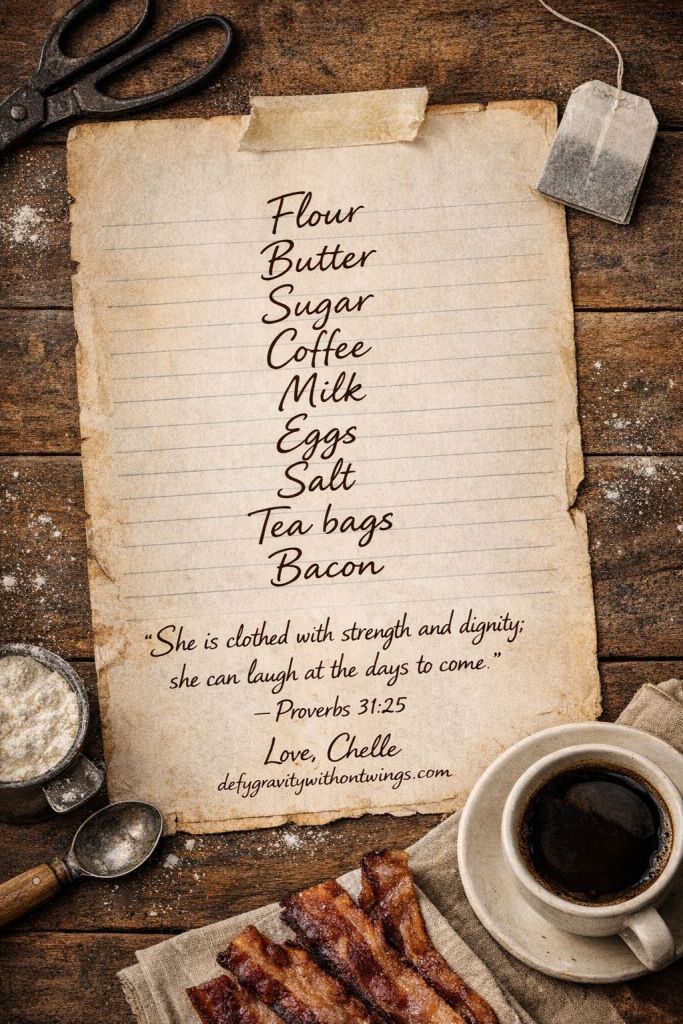
Her checklist never changed.

Flour.
Butter.
Sugar.
Coffee.
Milk.
Eggs.
Salt.
Tea bags.
Bacon.

That was it.

No emergency rations.
No twelve-step preparedness plan.
No frantic news watching.

Just quiet confidence.

Flour meant I can make something.
Butter and sugar meant comfort is still allowed.
Coffee meant sit down, we’re talking.
Milk meant somebody might need care.
Eggs meant breakfast feeds more than hunger.
Salt meant wisdom — because everything needs seasoning.
Tea bags meant there’s time to slow down.
And bacon?
Bacon meant joy is practical.

Grandma didn’t fear snow.
She respected it.
And if it wasn’t the first snow, she’d be outside making snow cream like it was just another blessing falling from the sky.

She lived what Scripture later put into words:
“She is clothed with strength and dignity; she can laugh at the days to come.” (Proverbs 31:25)

She knew storms came — and went.
She knew how to stretch what she had.
She knew a warm kitchen calmed cold nerves better than any headline ever could.

What strikes me most now is this:
Her list wasn’t about survival.
It was about presence.

Enough on hand to feed whoever showed up.
Enough calm to keep the house steady.
Enough wisdom not to confuse inconvenience with catastrophe.

We live in a time where every storm is framed like the end of the world.
But some of us were raised by women who understood that preparation doesn’t require panic — and peace doesn’t require abundance.

So if snow comes this week, let it snow.
Well… I’m no snow lover — even if I was born in January — but I trust the kind of wisdom that keeps coffee brewing, tea steeping, and bacon sizzling.

I’ll be thinking about grandma.
Her list.
Her calm.
And the quiet strength of knowing that love, when prepared, is never caught off guard.

Love, Chelle


Image

Before Dawn Breaks


Dear Martin,

Thank you for the courage it took
to love loudly
in a world fluent in hate.

Believing the long work could move
even when your hands were tired
from holding up the gate.

Our marching turned to sleepwalking.
Scars.
Stains.
Graves faded into parades.

Why teach us to love our crayoned brothers
when our sisters are heard passing
on streets made of rumor and rage.

We mastered resistance
only to trade it in
for the soft, comfy
quiet chairs of apathy.

Economic empowerments
became the next big sale,
freedom measured in discounts—
forgetting life ain’t free.

I wonder if you are proud us
I wonder if pride and grief
can do a sit-in
at the same table.

Laws need courage.
Platforms for voices.
Access breeds action.
Dream me not a fable.

I hope you see both things—
two things true at once
what we protected
and what we neglected.

The laws we guarded fiercely.
The people we forgot quietly.
What we defended,
then defected.

Still—
there are mornings when children march
without knowing your name
but carrying your dream
in their bones.

There are hands that reach back.
Feet that refuse silence.
Hearts that choose love—
to  let live  and to be left alone.

So if you are watching,
there are still some of us trying,
avoiding rose-colored glasses
and wide-angled scopes.

I hope you notice
some of us straining
to answer  the silence you were buried in
with shaking hands,
quiet prayers,
and stubborn hope.

Sincerely
a daughter of the dream
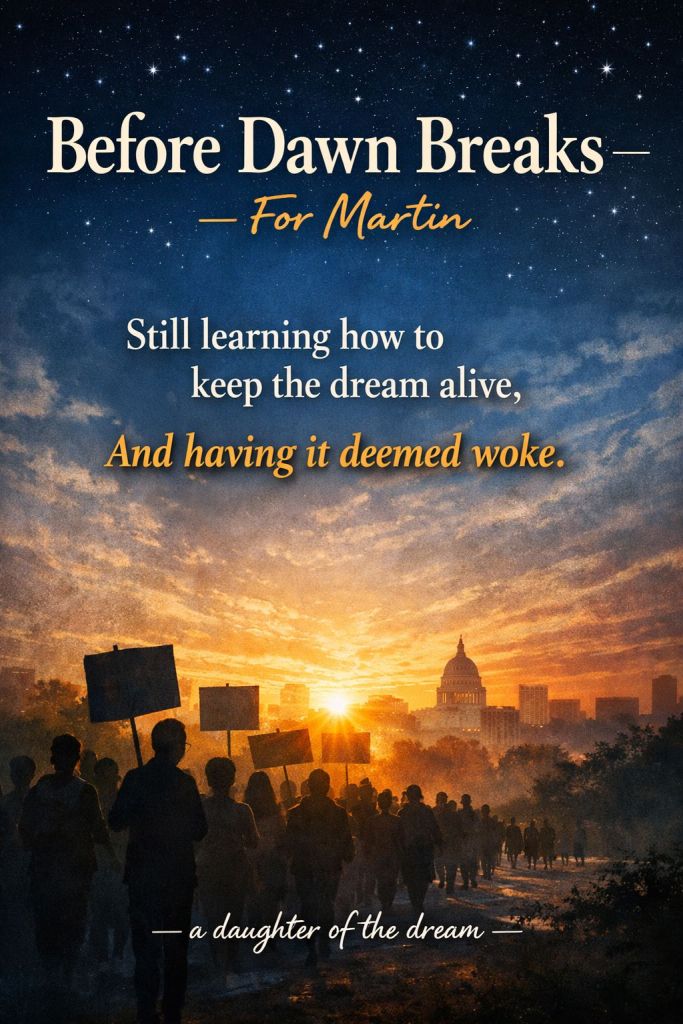
still learning how to keep it alive,
while  having it deemed woke.

Penned January 2026 – Michelle Gillison-Robinson

Image

GOD’S UP. I MIGHT AS WELL BE TOO.

Like some kind of finely tuned timepiece, my internal alarm goes off —  clockwork faithful.
No snooze button negotiations. No grace period. Just “bing.”

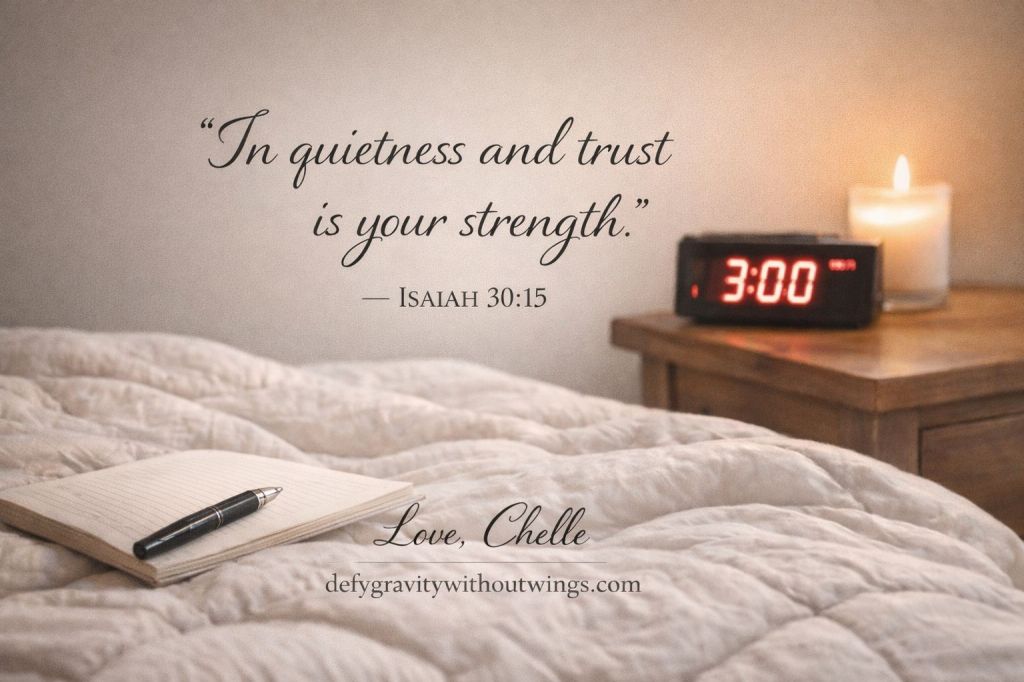
And there it is… 3:00 a.m. glowing on my digital clock
(yes, I still have one — don’t judge).

I pull the comforter up like it might save me.
It does not.

My body says, up up up,
while my soul whispers, “Really, Lord? Again?”

There was a time I filled those early hours with “responsible things” —
finishing chores I ignored the night before,
paying bills that had been staring at me all day,
or letting the TV talk so I didn’t have to think.

Busy things.
Distracting things.
Things that looked productive but didn’t change me one bit.

But lately… I’m up writing.

Blog entries.
Poems.
Devotionals.

Words spilling out at a pace that tells me I’m not in charge of this schedule anymore.

And somewhere between the glow of that clock and the scratch of my pen, truth had my full attention.

I’ve moved from me cleaning house
to God housekeeping me.

Because once I’m fully awake, I go full steam —
fixing, managing, pushing, performing.
But at 3 a.m.?
I’m not impressive. I’m not polished. I’m barely caffeinated.

And that’s exactly when God starts pointing things out.

Things my soul was too tired to hear during the day,
my pen now faithfully records in the quiet.

Cleaning me.
Pruning me.
Digging around places I thought were “fine.”
Re-creating what I rushed past in daylight.

This isn’t insomnia.
This is divine interruption.

Early-morning housekeeping —
the kind where God gently rearranges what I’ve been tripping over inside
while I’m still wrapped in blankets and honesty.

And I’m reminded, softly, without accusation or demand:
“In quietness and trust is your strength.” (Isaiah 30:15)

Turns out, God doesn’t always wake us up to get more done.

Sometimes He wakes us up because He’s not finished with us yet.

Love, Chelle

Image

Unmarked Seeds And  Clearance Rack Faith

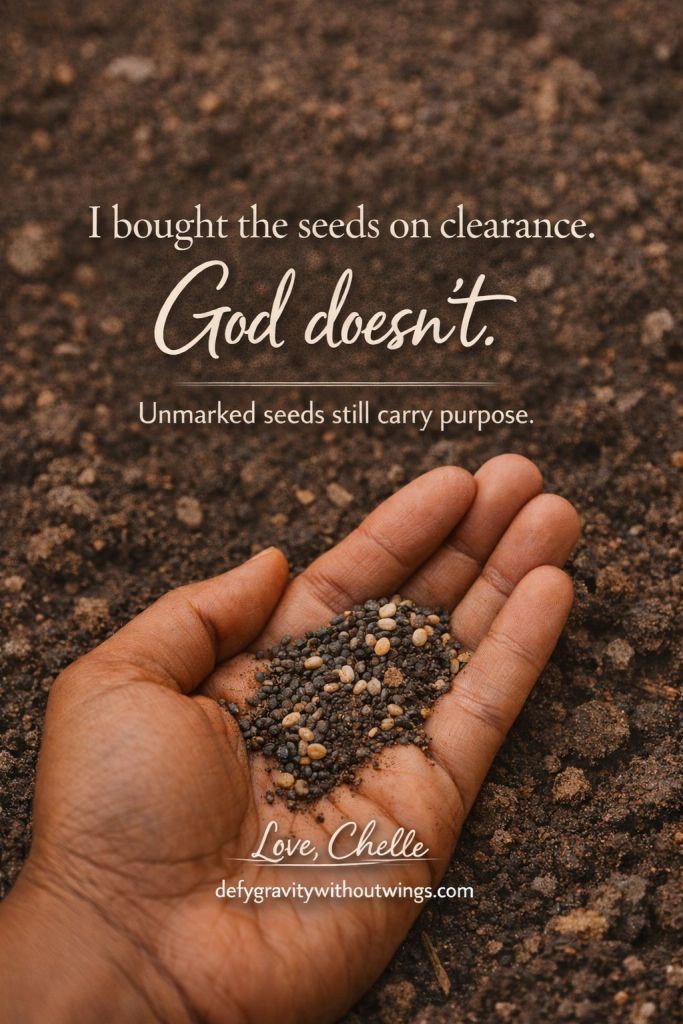
I was standing there with a handful of seeds and no idea what any of them were.
No labels. No instructions. No promises.
Just seeds.


Some were round. Some looked like dust. Some looked like… dirt pretending to be something important.

And full confession — I made the executive decision to buy them from a discount house online, which should have been my first clue that clarity was not included in the price.


Because planting unmarked seeds feels risky.
You don’t know what you’re committing to.
You don’t know how long it will take.
You don’t know what kind of care it will need — or if you just planted hope, oregano, and disappointment all in the same row.


And that is where I had to repent of my disgust with not being able to see the seeds’ vision.


God has planted a lot of unmarked seeds in me.
No timeline.
No instruction card.
No neat little packet that says “This will bloom in 90 days if watered weekly and protected from disappointment, other people’s opinions, and your own impatience.”


Just obedience.
Just trust.
Just dirt and hope.
Some seeds He plants look insignificant — almost invisible.
Some feel mislabeled by other people.
Some feel like they were handed to us without explanation at all.


And yet… seeds don’t need labels to know what they are.
They just need soil.
Light.
Time.


And a gardener who doesn’t dig them up every five minutes to check progress — which, for the record, I have learned is frowned upon in both gardening and faith.


I think that’s where I get tripped up.
I keep wanting proof before growth.
Confirmation before commitment.
Fruit before faith.


But the seed already knows what it carries — even when I don’t.


“So neither he who plants nor he who waters is anything, but only God who gives the growth.”
— 1 Corinthians 3:7


Maybe the confusion isn’t failure.
Maybe it’s faith in its earliest form.
Maybe God is saying:
Plant it anyway.
Water it anyway.
Stop interrogating the soil.
Because unmarked doesn’t mean unintentional.
And unseen doesn’t mean unimportant.
And dormant is not the same thing as dead.

Love, Chelle

Image

Good Morning From Groot

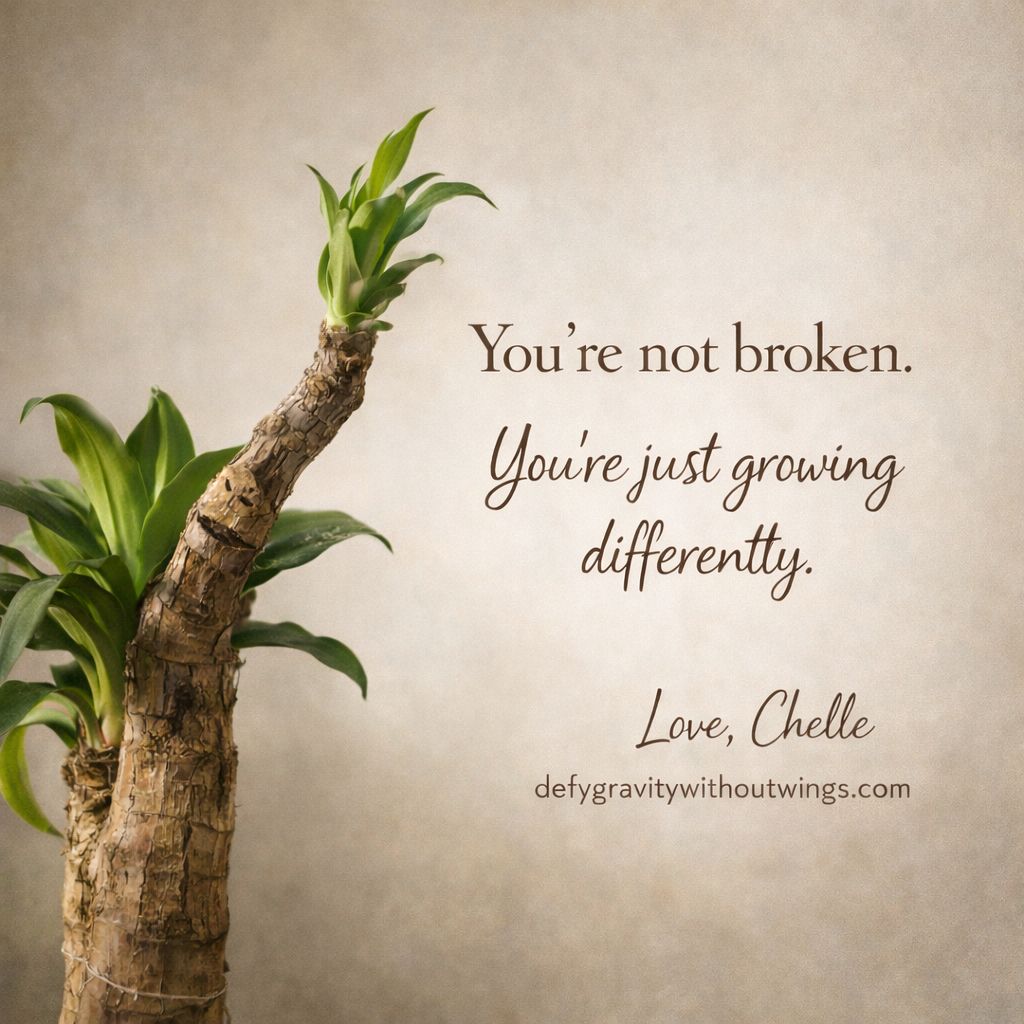
When I went to make my coffee this morning, I noticed my Brazilian wood plant — the one I call Groot because of the ornament on him — is still growing from just one side.


He’s developing a beautiful arm branch, but only one. By all accounts, there should be two by now.


Most folks would give up on a plant like that.
But I can’t.


All my life, I’ve collected broken things — toys, dolls, records… sometimes even people. Things that seemed useless or pointless to others always found a home with me. I’d turn them into art, merge them with something else, or simply let them be what they were until their value showed itself.


This little Groot reminds me that everything has value exactly as it is, even when it doesn’t quite match the catalog pictures of society.


That one arm?
It’s raised like it’s in praise.
And the smile in the bark makes me happy.


I believe God sees our imperfections with grace and purpose — I know He’s done that for me.

My seasons of brokenness and feeling like a misfit produced music, plays, and even this writing.

Periods of pain with purpose… feeling like a fish out of water… all converted into unique brands of joy.


So if you’re feeling a little uneven today…
a little out of the mold…
a little unlike what you thought you were supposed to be…
You’re not broken.
You’re just growing differently.

Now go raise that arm!


“…everyone who is called by My name,
whom I created for My glory.” — Isaiah 43:7

Love, Chelle

Image

Timing Is Everything (Apparently So Are Berries)

I’ll admit it — I went into a little shock when I learned blueberries and strawberries operate on a two-to-three-year growth plan.
Years.
Plural.

I stood there staring at seeds like they had personally betrayed me.

Up until that moment, I genuinely thought I was being resourceful.
Frugal.
Garden-savvy.
A woman with a plan.

Turns out, I had signed up for a long-term relationship without reading the commitment clause.

That’s when I decided I’m not planting berries until I move into my forever home.
Because berries don’t do well with temporary addresses.
They want stability.
Consistency.
A place where nobody’s packing boxes just as the harvest shows up.

And honestly? I get it now.

I finally understand why blueberries and strawberries cost what they do at the store.
It’s not inflation — it’s time.
It’s patience.
It’s years of watering something that gives you nothing back except leaves and hope.

I really thought it was a good idea.
And it was — just not for this season.

Jesus talked a lot about seeds, soil, and timing.
He never rushed growth — He explained it.

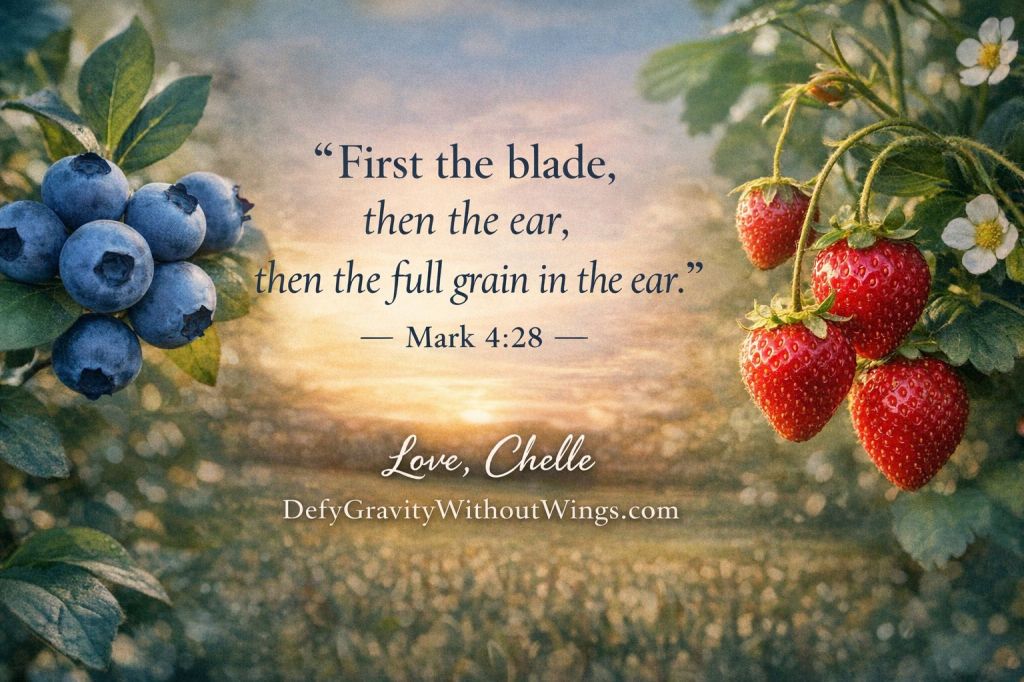
“First the blade, then the ear, then the full grain in the ear.” (Mark 4:28)

Nothing about that process is instant.
Nothing about it is wasted.

Even Jesus waited.
Thirty years before public ministry.
Hidden seasons.
Quiet obedience.
Roots forming where no one was applauding.

So I’ll wait too.
Not because I lack faith — but because I’ve learned that timing matters.

Some things are worth planting when you know you can stay long enough to enjoy the fruit.

Until then, I’ll pay store prices with a little more humility…
and a lot more respect for the journey those berries have been on.

Because growth was never the problem.
Timing was the lesson.

Love, Chelle

Image

Jesus Took A Break (And So Can You)


I noticed it, and it wouldn’t let me go.

Jesus took a break.

Not because He was lazy.
Not because the need was gone.
Not because the work was finished.

But because He knew when to pour Himself out —
and when to be filled again by the Father.

He stepped away while people still needed Him.
He withdrew while expectations still waited.
He rested even though the world would have gladly kept pulling.

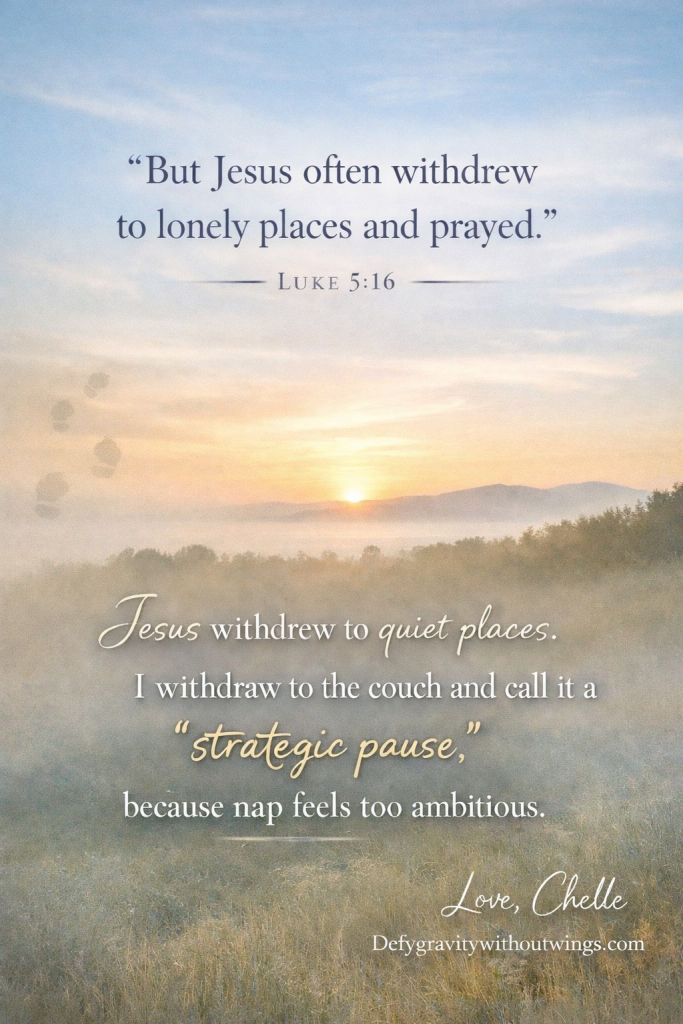
“But Jesus often withdrew to lonely places and prayed.”
— Luke 5:16

(Jesus withdrew to quiet places.
I withdraw to the couch and pretend I’m just “thinking.”)

Last night my body kept waking me up like it was tapping my shoulder saying,
Hey. We’re done pretending.

Every hour on the hour.
No deep rest. No drifting off.

Thoughts of what I needed to do today were keeping me awake, while those same thoughts were making me tired.


But, yet, there was a quiet insistence that something holy was being ignored.

(Jesus rested.
I call it a “strategic pause,” because the word nap feels too optimistic.)

Here is the truth tired women rarely hear out loud:

Rest is not quitting.
Pausing is not disobedience.
Taking a break is not a lack of faith.

Sometimes it is the most faithful thing you can do.

Jesus didn’t withdraw because He didn’t care.
He withdrew because He did — because love that lasts must return to its Source.

(Jesus took a break.
I took one too once — accidentally, in the driveway, with the car still running.)

Today I will not apologize for being tired.
I will not spiritualize exhaustion.
I will not confuse availability with holiness.

I will follow Jesus —
even if that means following Him somewhere quiet.

And if all I manage today is showing up gently,
that will be enough.

Because Jesus took a break.
And somehow… that sets me free. 

So if you can’t find me today, I am on the couch with Jesus. Wake Him and ask permission to wake me.

Love, Chelle

Footstep Notes:
Luke 5:16; Mark 1:35; Matthew 14:23

Image

Thinning Is Not Killing (Even Though It Felt Like It)

I stood in my greenhouse clutching scissors like I was about to commit a felony.
These weren’t plants.
These were my plant babies.
I grew them.
I watered them.
I whispered encouragement like a slightly unhinged garden aunt.
And now I was being told they were “too crowded.”


Excuse me???
They looked happy.
Thriving.
Living their best leafy lives.
But apparently, love without boundaries leads to chaos.
Who knew.


The word thinning showed up—
and my heart heard destruction.
Because when you’re wired like me,
making room feels an awful lot like abandonment.


I mean, how do you explain to a perfectly healthy kale plant
that it’s not being rejected—
it’s just being relocated, harvested early, or “released into purpose”?


I felt like I was ruining everything.
Until I realized…
nothing was being wasted.
Some plants were transplanted.
Some were harvested and nourished something immediately.


And the ones left behind?
They finally had space to become what they were always meant to be.
That’s when it hit me.
Pruning doesn’t change who we are.
It reveals it.
God isn’t cutting us down—


He’s cutting away what keeps us from becoming strong, rooted, and fruitful.
Not every removal is punishment.
Not every loss is failure.
Some things leave so we can finally grow into ourselves.


“Every branch that bears fruit He prunes, that it may bear more fruit.” — John 15:2


Pruning feels personal when you’re emotionally attached to the leaves.
But it’s the very thing that shapes the harvest.
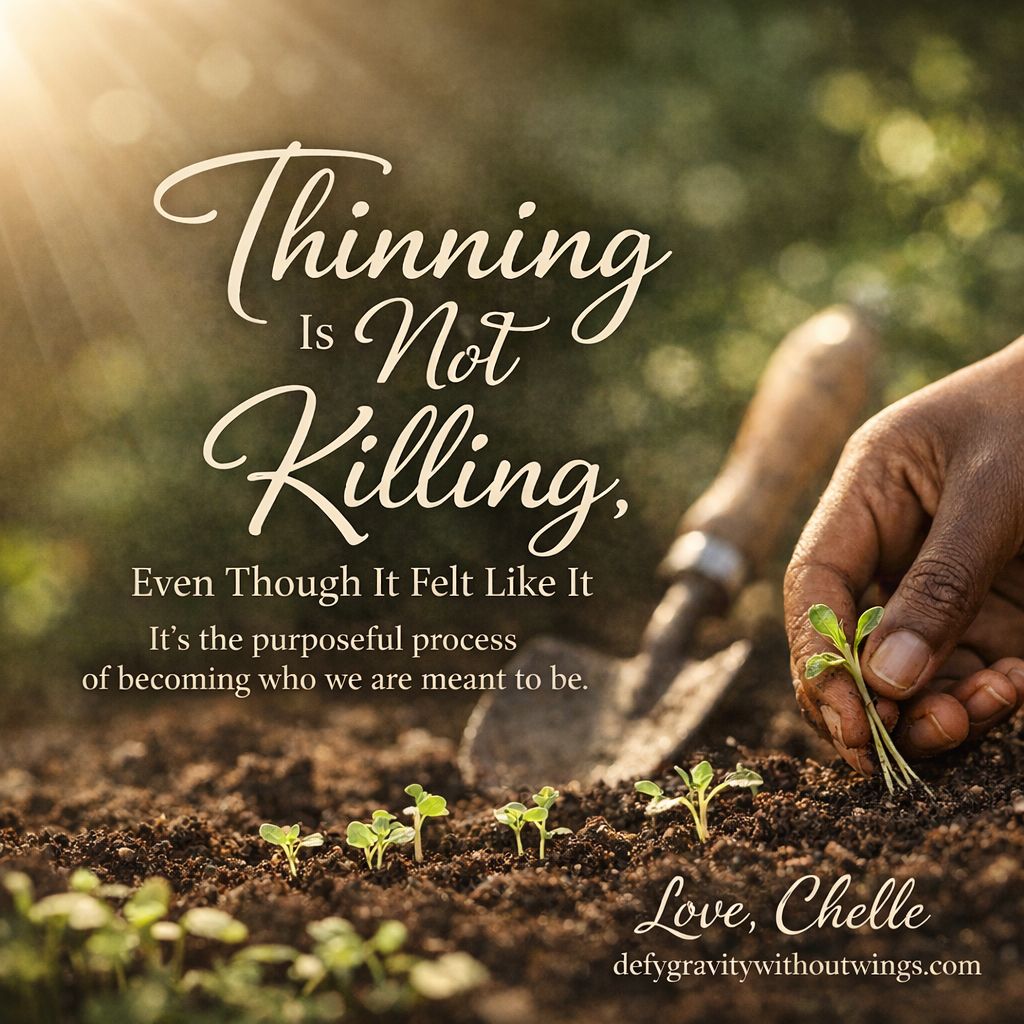
Thinning is not killing.
It’s the painful, purposeful process of becoming.


And if I’m honest…
I still apologized to my kale,
needed a moment of silence,
and may require counseling before the next round of thinning.


Because apparently God and gardening are both committed
to making us who we’re supposed to be—
even when we’re dramatic about it.


With love, Chelle,