Like some kind of finely tuned timepiece, my internal alarm goes off — clockwork faithful. No snooze button negotiations. No grace period. Just “bing.”
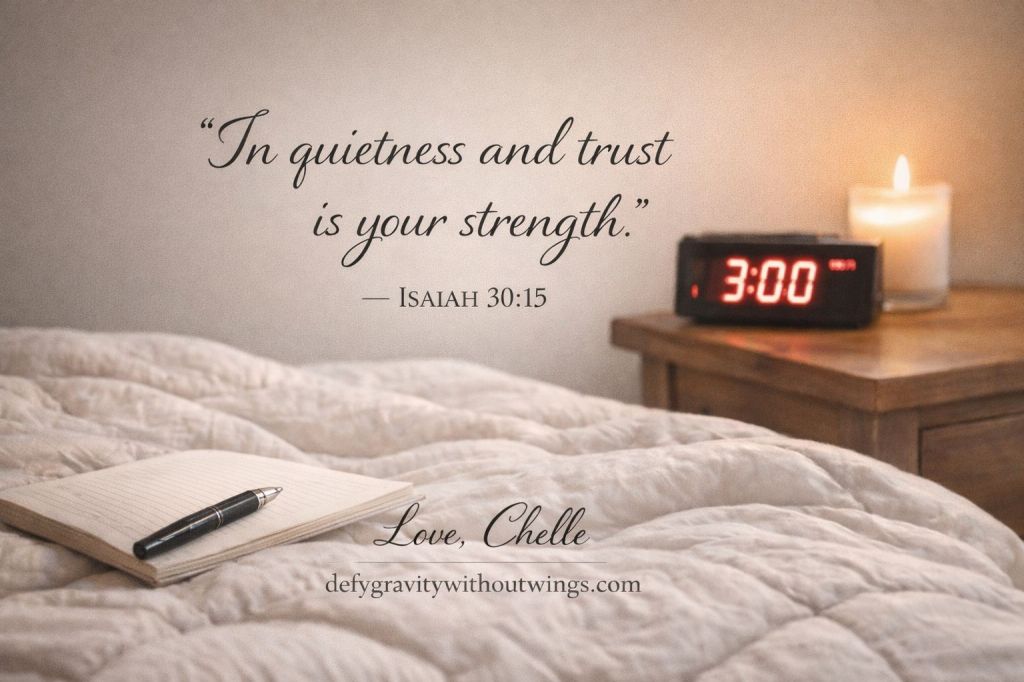
And there it is… 3:00 a.m. glowing on my digital clock (yes, I still have one — don’t judge).
I pull the comforter up like it might save me. It does not.
My body says, up up up, while my soul whispers, “Really, Lord? Again?”
There was a time I filled those early hours with “responsible things” — finishing chores I ignored the night before, paying bills that had been staring at me all day, or letting the TV talk so I didn’t have to think.
Busy things. Distracting things. Things that looked productive but didn’t change me one bit.
But lately… I’m up writing.
Blog entries. Poems. Devotionals.
Words spilling out at a pace that tells me I’m not in charge of this schedule anymore.
And somewhere between the glow of that clock and the scratch of my pen, truth had my full attention.
I’ve moved from me cleaning house to God housekeeping me.
Because once I’m fully awake, I go full steam — fixing, managing, pushing, performing. But at 3 a.m.? I’m not impressive. I’m not polished. I’m barely caffeinated.
And that’s exactly when God starts pointing things out.
Things my soul was too tired to hear during the day, my pen now faithfully records in the quiet.
Cleaning me. Pruning me. Digging around places I thought were “fine.” Re-creating what I rushed past in daylight.
This isn’t insomnia. This is divine interruption.
Early-morning housekeeping — the kind where God gently rearranges what I’ve been tripping over inside while I’m still wrapped in blankets and honesty.
And I’m reminded, softly, without accusation or demand: “In quietness and trust is your strength.” (Isaiah 30:15)
Turns out, God doesn’t always wake us up to get more done.
Sometimes He wakes us up because He’s not finished with us yet.
I couldn’t sleep, again, so I tuned into one of my favorite comfort-watch movies, Last Holiday (2006), starring Queen Latifah.
I’ve watched it more times than I’ll ever confess, but there is one scene I always slow down for. It’s the kitchen scene. My favorite one.
When Chef Didier looks at Georgia and gently compares her to the baby turnip — the smallest one in the bin, often overlooked, passed by for something bigger or flashier… yet the most tender, the most flavorful, the one a true chef treasures.
That scene gets me every time. Because the baby turnip isn’t flawed. It isn’t unfinished. It isn’t lacking. It’s just quiet. And early. And easy to miss if you’re in a hurry.
And if I’m being honest — part of why that scene hits so hard is because I’ve felt like that turnip. Overlooked. Passed by. Sitting there thinking, “Excuse me… I am organic, well-seasoned, and emotionally available.” But folks keep grabbing the big, loud potatoes.
Meanwhile, God is in the kitchen like a five-star chef saying, “Leave her. She’s tender. She’s not for everybody. And I don’t rush good ingredients.”
Whew.
That’s the holy pause in the story. Not the luxury. Not the bold declarations. But the moment when someone truly sees her.
And isn’t that what so many of us long for? We grow underground — faithful, steady, consistent — while the world keeps reaching for whatever looks impressive on the surface. We’re not trying to be flashy. We’re just trying to be faithful.
Still, being overlooked can sting. Especially when you know you’ve been planted, watered, and patient.
But the baby turnip reminds me of this truth: being passed over by people does not mean being passed by God. God delights in roots. He honors slow growth. He protects what is tender until the right time and the right hands arrive.
Sometimes you’re not hidden because you’re insignificant. You’re hidden because you’re delicate. Because you’re reserved. Because you’re meant for a table that understands flavor.
So yes — I may be under a blanket right now pretending I’m Queen Latifah — but I’m also believing, learning, and internalizing this: I don’t need to audition for worth. I don’t need to shout to be seen. I don’t need to rush my growth just because someone else is loud. If I’m being missed right now, maybe it’s because I’m being saved. And when it’s my turn? They’ll wish they hadn’t rushed past the produce section.
Lord, when I feel unseen, remind me that You see fully. Teach me to trust Your timing, even when I feel overlooked. Help me grow deep roots instead of loud leaves,and rest in the truth that being missed by people does not mean being missed by You.
“I would have fainted, unless I had believed to see the goodness of the Lord in the land of the living.” — Psalm 27:13
1/7/18.
I will always remember that date like a star date in the Star Trek Captain’s Log.
It started as a normal Sunday setup. I had just finished cleaning around the sound booth and was adjusting everything to get ready for that morning’s praise and worship. Service was running a few minutes behind, but we were still riding the spiritual high of pre-worship hour prayer.
Then it happened. My phone rang.
I almost never answer my phone during service. In fact, just two minutes earlier, I had nudged one of our teenagers about using their phone during Sunday school.
But I recognized the number. That familiar 264 exchange—the one every “kidney family” in my region of Virginia knows by heart. Breathless. Full of anticipation. Almost terrified. Palms sweating, face flushed in seconds. I answered to the coordinator’s urgent voice:
“WHERE ARE YOU?”
You see, protocol dictates that when the organ sharing center receives a possible match, they must first confirm that the prospective recipient is within four hours of their chosen transplant hospital. Once your location is confirmed, they tell you they’ll call back—and promptly hang up.
Yes. You read that right.
In one of the shakiest moments of your life, they hang up with a promise to call you back within an hour… or so… if it’s a good match.
I was still in the sound booth. My son was seated in his usual spot, about six rows in front of me. I didn’t know whether to tell him that his life might be about to change. We had already been disappointed by calls like this—twice before.
So instead, I texted him: “Be ready to go when I tap you.”
His response was simple: “Ok.” He didn’t ask why. He didn’t question me. He just trusted that if I said go, we go.
For me, however, the next 59 minutes would be the longest of my entire life. Time and space seemed to stand still. The room suddenly felt too warm, the air too stale. I can’t even remember if I set the microphones correctly. The pastor could have been shouting and I wouldn’t have heard him. The praise team was faithfully belting out worship songs my impatient ears could not discern.
All I could distinguish was the steady rhythm of the drum—now matching my racing heartbeat.
About 45 minutes into the wait, I had to correct my course. Not on the soundboard. In myself.
I found myself apologizing—to God, to Jesus, to the Holy Spirit. I had become so consumed with the call that I had stopped truly worshiping. I had stopped listening to the Word being preached.
I was esteeming what I wanted from God more than I was esteeming God Himself. And in that moment, it felt as though the Holy Spirit was echoing the same question in my heart: “WHERE ARE YOU?”
I steadied myself. I readied myself. Through tears and trembling faith, I began to worship again—declaring that as desperately as I wanted this gift to free my son from five long years of agonizing dialysis, I wanted the Presence of the Lord even more.
As my spiritual hunger was met with the assurance that God was with me no matter what, I heard in my spirit, “Hang up.”
At that exact moment, I looked down at the phone I had been clutching in my hand—and it rang. With tears streaming, I answered. Joyfully, 58 minutes into the wait, the coordinator said: “HOW FAST CAN YOU GET HERE?”
And that is the stuff our walk with Christ is made of. How often do we approach God wanting—and even needing—something deeply tied to a promise we believe He made, only to find ourselves overwhelmed by the waiting? Too often, our “knock and the door shall be opened” faith quietly shifts into a heartsick lifestyle of disappointment, dissatisfaction, and even unbelief—unless we see the manifestation.
Hebrews 11:6 reminds us that “he who comes to God must believe that He is, and that He is a rewarder of those who diligently seek Him.” Notice it says seek Him. Not diligently seek it.
When God asks, “Where are you?” may we be found seeking Him—not just the thing we hope He’ll give us. When He seems to hang up, trust that He will call again. Trust God. Trust His goodness. Even when it feels distant—it is still His plan. Even when it unfolds differently than expected—it is still His plan. Even when the answer is no—for reasons greater than we understand—better is still His plan. Reset your need for control. Let God have His way.
One last question: Since we trust that God is always right on time… how fast can you get here?
There are days when the world feels too loud for jokes.
The headlines carry war, division, fear, and the slow erosion of freedoms we once assumed were permanent. The ground feels less steady. The future feels less certain.
And the little clown in me—the one who usually believes laughter can soften almost anything—finds herself mourning.
Not because hope is gone. But because peace matters too much to pretend this doesn’t hurt.
Psalm 91 doesn’t ask us to deny danger. It invites us to dwell. “Whoever dwells in the shelter of the Most High will rest in the shadow of the Almighty.” (Psalm 91:1)
Protection, here, is not earned. It is not performed. It is not proven by volume, certainty, or strength. It is positional. To dwell is to stay. To remain. To practice presence when the world feels unrecognizable.
This is protection without performance. Not faith that shouts. Not hope that rushes to fix. Not peace that pretends everything is fine. Just presence—steady, near, covering.
The promise of Psalm 91 is not that trouble will disappear, but that God does not. The shadow does not move. The refuge does not close. The shelter does not require us to be unafraid—only willing to come close.
So today, the clown in me removes her red shoes. She sits on holy ground— trusting the same God who once said, “Stay.” Trusting that what marks the door also guards the dwelling. She mourns for peace honestly. And still—quietly—she dwells in hope.
Today’s practice is simple: not fixing, not proving, not performing— just dwelling in His Presence.
—- God of refuge and nearness, When the world feels unstable and peace feels fragile, help me to dwell rather than strive. Teach me to trust Your presence more than my ability to understand what is happening around me. Let Your covering be enough today. Amen.
This wasn’t a quiet, reflective night moment. This was a stressed 3 a.m. morning, when sleep clocks out early and your brain clocks in loud — with opinions.
I wasn’t trying to hear from God. I was trying to finish a work email before coffee, which already tells you I was operating without full emotional supervision.
I kept shortening it. Not because I didn’t know what I wanted to say — but because I know my boss. I know there may still be a meeting. I know she’ll ultimately direct and take charge. So I trimmed. Simplified. Took out the pre-explaining and the imaginary rebuttals. I said what needed to be said and stopped trying to manage the outcome.
And somewhere between rereading sentences and realizing I was too tired to argue with myself, it landed:
This is exactly how we treat God.
We make plans — good ones — and then we hover. We explain too much. We brace for redirection. We add footnotes to obedience.
Not because we don’t trust Him — but because we really like being on the steering committee.
Meanwhile, God has already given us the playback in His Word.
He’s already shown us how authority works. How obedience works. How trust works.
We do our part. We speak honestly. We move wisely. And then we let go — preferably before caffeine convinces us we should take over.
“In their hearts humans plan their course, but the Lord establishes their steps.” – Proverbs 16:9
Not might. Not if He agrees. He does.
This morning reminded me that obedience isn’t about directing God — it’s about participating with Him. Doing what’s mine to do without trying to edit the ending.
I don’t need to manage God the way I manage emails. I don’t need to anticipate His response. And I definitely don’t need to rewrite His plan before coffee.
Sometimes the most faithful thing we can do is hit send, make the coffee, and trust God with the meeting that follows.
Prayer Lord, help me do my part without trying to control Yours. Teach me to trust You with the outcome, even before the coffee kicks in. Order my steps, steady my heart, and remind me that You’re already ahead of me. Amen.
Disappointment doesn’t usually knock loudly. It just keeps adding weight.
Brick by brick, we pack the backpack: • unmet expectations • things we thought God would do by now • roles we keep carrying because “someone has to” • stories we tell ourselves about who we are and what’s possible
And if I’m honest, this is the same part of me that tries to carry all the groceries in one trip. Because clearly, asking for help would be admitting weakness… and making two trips would be a personal failure.
So there I am — keys dangling, bags cutting off circulation, dignity questionable — determined to prove I’ve got this. I call it independence. Heaven calls it unnecessary.
And somewhere between the car and the kitchen, I’m reminded that even Jesus sent the disciples out two by two.
Inevitably, something falls. Or worse… something gets left in the trunk.And a couple of days later, there’s a smell. A mysterious, soul-searching smell that forces a reckoning.
Nothing humbles you faster than realizing the real burden wasn’t the bags — it was the banana you refused to admit you dropped.
That’s how unexamined burdens work too. What we refuse to set down eventually announces itself. Some of the limits we feel aren’t placed by God — they’re placed by our own expectations of how we think He should move.
We overpack faith with control. We leave no room for surprise. No room for grace. No room for God to have His way — because the backpack is already full.
Jesus never asked us to be strong and burdened. He asked us to come — and let Him carry what we were never meant to hold.
“Cast your burden on the Lord, and He will sustain you.” — Psalm 55:22
Maybe today isn’t about pushing harder. Maybe it’s about making two trips. Or — heaven forbid — asking for help.
I’m usually the one who finds the humor, the metaphor, the small spark of light tucked inside the ordinary. I believe in joy — deeply. I still do.
But today, joy feels quieter, and sorrow feels closer to the surface . The world feels fractured. Nation against nation. Neighbor against neighbor. Families strained. Friendships reduced to likes, views, and fleeting affirmations.
And somewhere in the middle of all this noise, what seems to be slipping away is our sense of community — the kind where people are known, not curated. Where connection doesn’t require a platform or performance.
Yesterday, as I mourned world events , all of this along with a side of opinions still wrapped with faith, I was told I was hiding behind God and the Bible.
That stayed with me.
Not because it shook my faith, but because it revealed something deeper about the times we’re living in — a world so uncomfortable with lament that even sacred language is suspect when it refuses to harden into arguments or slogans.
But my faith has never been a hiding place. It has always been a meeting place — where grief and hope are allowed to sit together without rushing one another out of the room.
Today, I find myself weeping. Not because faith has failed, but because love is still very much alive. “Jesus wept.” — John 11:35 He stood in the presence of grief and loss and did not rush to fix it, explain it, or weaponize it. He allowed tears to speak where words fell short. If tears were worthy of Him, they are not beneath us. Scripture doesn’t ask us to bypass sorrow — it calls us to enter it together. “Rejoice with those who rejoice; mourn with those who mourn.” — Romans 12:15
This isn’t a departure from who I am. It’s a refusal to pretend. I still believe in hope. I still believe in resurrection. I still believe God has not lost the plot. But I also believe sorrow has a place in the story — not as an ending, but as an honest chapter.
So today, I show up softer. Quieter. More tender. Trusting that God can hold my tears just as faithfully as He holds my hope.
And believing that even here — especially here — grace is present. Love Chelle
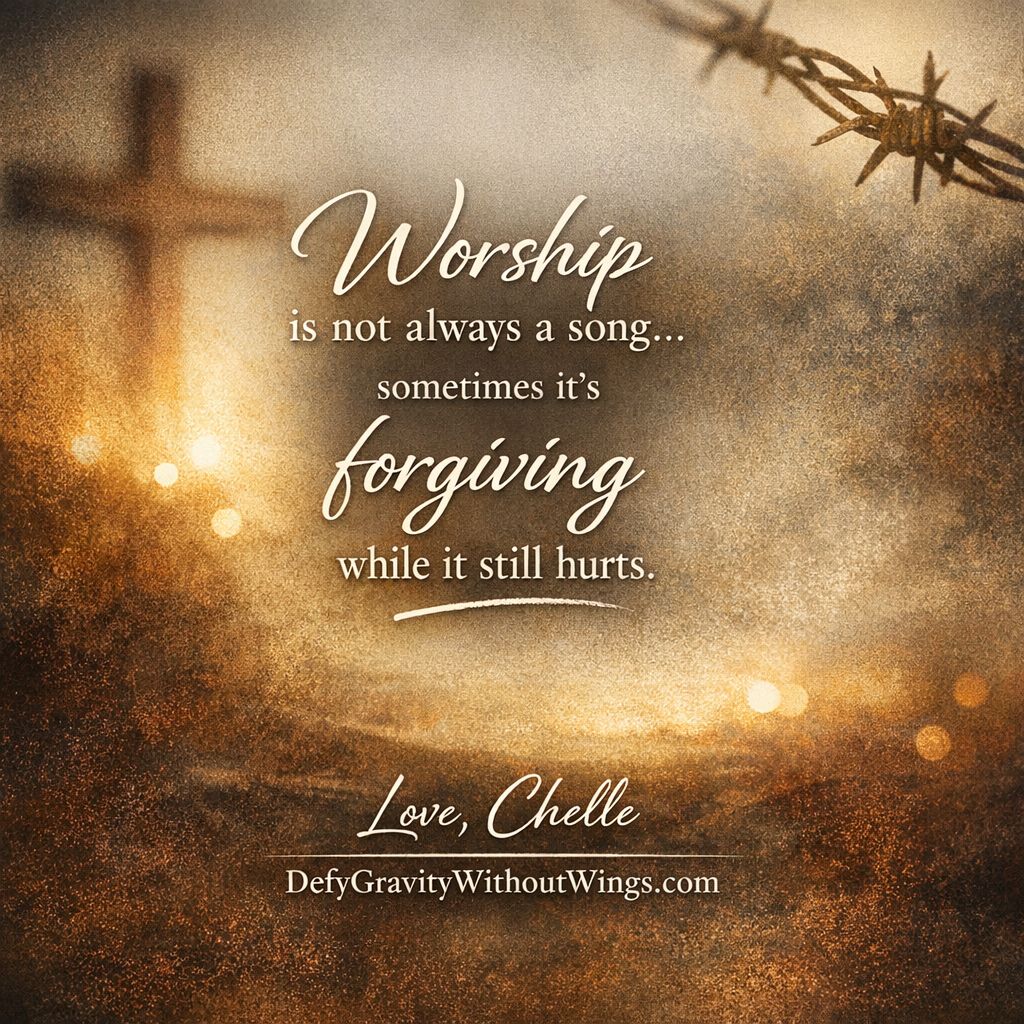
As I pack up the end of one year to experience the wonders of the next, I was reminded of how many times I was evicted. Not in the natural sense but by God.
I’ve learned that God’s eviction notices don’t come with flashing lights or raised voices. They don’t sound like “You’re fired.” They don’t arrive with chaos or fear. They feel like stability that no longer fits.
I call it an eviction notice when God begins to unsecure me in a place He never intended to be my final address. Provision is present. The lights are on. The ground is steady. And yet—peace quietly taps me on the shoulder and whispers, “This isn’t home.”
For people like me—faithful to a fault, a true “Stable Mabel”—dependable, steady, the one who shows up no matter what—God doesn’t shove. He anchors. He makes sure the floor doesn’t drop out. He removes the threat of free-fall. He rearranges just enough, so survival is no longer the distraction. And that’s when it gets confusing. Because when panic leaves, clarity arrives. And clarity is harder to ignore. An eviction notice from God doesn’t say leave now. It gently says, don’t give this place your last. It shows up as: – security without satisfaction – provision without peace – competence without calling It feels like gratitude… mixed with restlessness. I used to think eviction meant loss. But I’m learning it often means permission. Permission to stop confusing loyalty with assignment. Permission to admit that faithfulness has a future—and it doesn’t always look like staying.
Scripture gives me a different picture of how God moves His children: “Like an eagle that stirs up its nest and hovers over its young, that spreads its wings to catch them and carries them aloft…” (Deuteronomy 32:11)
When I think of God’s eviction notices now, I don’t picture being thrown out. I picture a nest that has grown too comfortable—warm feathers, familiar edges. God stirs the nest not to harm, but to wake. There is a push, yes—but there is also hovering. There is a letting go, but never abandonment. Before the feathers can be too ruffled, before fear turns into free fall, the same wings that nudged are the wings that catch. That’s what this season feels like. Not panic. Not loss. But the unsettling grace of being lifted by a God who refuses to let me stay small—and refuses to let me crash while I learn. Here is the grounding truth I’m holding close: God is not asking me to burn down my life. He is inviting me to build the next one alongside it—until it’s strong enough to stand. No rushing. No scorched earth. No fear-driven decisions. Just a quiet understanding that a holding pen is not a home—and that noticing the gate is unlocked is already movement. If this is an eviction notice, it isn’t cruel. It’s merciful. Because God doesn’t evict His children into the cold. He prepares the next place before He asks us to pack. And peace—real peace—always goes with us. — Love. Chelle
I didn’t plan on doing heart work this morning. I was just trying to clear storage—make my phone run smoother, lighten the load, make room for what’s next.
I was deleting blurry screenshots, duplicate photos, and saved recipes I’ll probably never make— right alongside hundreds of pictures of my grandchildren that I can’t bring myself to let go of.
And tucked in between it all were receipts I once needed to survive. Thirty frames of words that bruised from an argument. A disagreement that no longer makes sense. Pain from a season that had already passed.
I kept them because I thought I might need proof. Proof that I wasn’t imagining things. Proof in case I ever needed to defend myself.
And for a while, that was okay.
But this morning, standing on the edge of a new season, I realized something had shifted. I no longer needed protection from the past. I needed permission to release it.
So I didn’t reread. I didn’t rehearse the hurt. I didn’t reopen the courtroom in my mind.
I deleted.
Not because it didn’t matter— but because it doesn’t get to lead anymore.
Scripture says, “Forget the former things; do not dwell on the past. See, I am doing a new thing!” — Isaiah 43:18–19
Forgetting doesn’t mean pretending it didn’t happen. It means choosing not to live there anymore.
There’s a difference between wisdom and weight. Between remembering and reliving. Between holding truth and being held hostage by it.
“Let us throw off everything that hinders.” — Hebrews 12:1
Not everything that hinders is sinful. Some things were necessary once—but become heavy later.
I didn’t erase the story. I simply stopped carrying the evidence.
And as the year turns and the air feels fresh again, I’m learning this sacred truth:
Dead and done are not the same thing—but neither needs to be dragged into tomorrow.
Sometimes the holiest thing you can do is delete what no longer serves the person you are becoming.
Prayer: God, thank You for seasons of protection—and for the courage to release them when they’re no longer needed. Help me walk lighter into what’s next, trusting You with the truth I no longer need to carry. Amen.
I did something yesterday that I almost never do. I fell asleep at the table.
Not the polite, chin-in-hand, “I’m listening” kind of sleepy. The real kind. The head-dip. The eyelids surrendering mid-conversation. The kind that scared me just enough to notice.
Christmas finally got me.
I had planned for rest. I needed rest. But life — and love — had other things lined up.
A quick visit to the nursing home turned into three hours because they were short-staffed. Again. I stayed — because love doesn’t clock out when it’s inconvenient.
Somewhere in between, there was also chasing down folks to drop off gifts. “Let me just swing by real quick.” “One more stop.” One more smile. One more bag. One more moment of making sure nobody felt forgotten.
By the time I made it home, I barely had enough energy to pivot to the next thing — visiting my mother-in-love.
Bless her — she cooked. I ate. And somewhere between gratitude and exhaustion, my body simply said, “That’s enough now.”
I nodded off at the table.
I laughed about it later, because it was funny. But it also scared me — because I don’t do that. I’m usually the one pushing through, powering up, showing up.
What I realized later is this: That moment wasn’t weakness. It was honesty.
My body told the truth before my mouth ever would.
We talk a lot about rest, but rarely about what happens when we don’t get it — when we keep pouring, keep visiting, keep delivering, keep caring, and assume adrenaline and responsibility will carry us through.
Sometimes they do. Sometimes… they don’t.
And God doesn’t shame us for that.
“It is useless for you to work so hard from early morning until late at night, anxiously working for food to eat; for God gives rest to His loved ones.” — Psalm 127:2
That verse doesn’t scold. It exhales.
Maybe falling asleep at the table wasn’t failure. Maybe it was permission.
Permission to admit that Christmas — the beauty, the chaos, the caregiving, the gift-chasing, the expectations — costs something. Permission to stop pretending we’re machines. Permission to rest without first earning it.
Today, I’m still tired. Still booting up. Still faithful — just slower.
And that’s okay.
If you’ve nodded off emotionally, spiritually, or physically this season — you’re not broken. You’re human.
Pull up a chair. Take a breath. God is not offended by your yawn.