Image

Crumbs Of Grace, My 2nd New Year.

When I think of the most important birthdays, I don’t start with cake or candles.
I start with life.


I think of the 37th birthday when  I helped deliver my grandson, Jayon — my eldest son’s first child. On that day, I didn’t just celebrate another year of my own life; I welcomed new life, new hopes, and new dreams into the world. In a way, our birthdays became twins. His arrival was proof that God was still creating, still trusting the future to fragile hands. And year after year, Jayon has never disappointed — not because he’s perfect, but because he has lived into the promise of that moment.


I think of my 50th birthday — the day I was scheduled to start chemotherapy for breast cancer. Fear tried to claim that day, but my husband gave me a birthday slumber party instead with the ladies in my crew.. Laughter showed up before dread could unpack its bags. It felt like God whispering through cupcakes and pajamas: Fight. Fight. You are not done.


On my 55th birthday, the fear shifted again. Instead of waiting anxiously for scan results, I stood on a stage wearing a crown and a “Drive 55” shirt — a playful, holy reminder to pace myself and keep going. Sometimes courage looks regal. Sometimes it looks ridiculous. Both can preach.


But my favorite birthdays are always the next one.


Whether they arrive loud and celebratory or quiet and reflective like today, they carry the same invitation. I call January 5th my second New Year — a moment to pause, look back at all that happened since last year, the good and the not-so-good. To thank God for the joys He brought us into, and for the things He delivered us out of.


“This is the day the Lord has made; let us rejoice and be glad in it.” — Psalm 118:24


Not the perfect day.
Not the painless day.
Just this one.


And today includes crumbs.
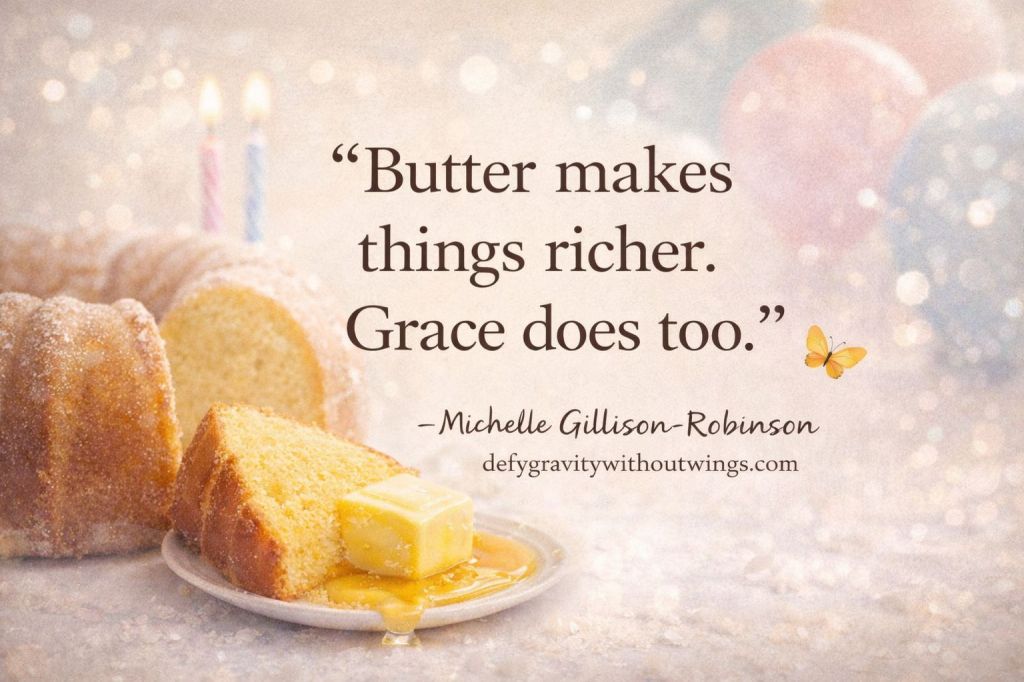
Crumbs from a Kentucky Butter Cake I made with more butter than I’m fairly certain a woman of my age should publicly admit to.

But here’s the truth: butter makes things richer. Grace does too. And neither one asks permission before doing its work.


“The steadfast love of the Lord never ceases; His mercies never come to an end; they are new every morning.” — Lamentations 3:22–23

Even on birthdays.
Especially on birthdays.


These years aren’t measured by candles alone. They’re marked by crumbs of grace — small evidences left behind that say I was fed, I was held, I was carried through

.
And if that’s what this year leaves behind — crumbs, butter, joy, survival, and gratitude — then it has been a very good year indeed.


Love, Chelle

Image

Clown Shoes On Holy Ground

I was born on a Sunday.
The old poem says, “Sunday’s child is full of grace.” I believe that’s true — but grace doesn’t arrive in a vacuum.

I was a Sunday child who learned early about loss.
About poverty that makes you grow up faster than your age.
About grief that shows up uninvited and stays too long.
About loneliness that teaches you how to be self-sufficient
and insecurities that whisper you’d better be useful if you want to be loved.

So I learned to protect myself.

I learned how to make people laugh and have them sing along.
How to lighten rooms before they noticed the weight I was carrying.
How to read emotions faster than words.
How to bring joy without asking for much in return.

What I didn’t know then was that God was watching all of it —
not with disappointment,
but with intention.

Scripture says:
“But God chose the foolish things of the world to shame the wise;
God chose the weak things of the world to shame the strong.”
— 1 Corinthians 1:27

From that place of self-protection, something holy was being formed.

My ministry didn’t begin in confidence.
It began in clown shoes —
joy worn on holy ground,
humor used as armor,
Melodies offered as a bridge when I didn’t yet have language for my own pain.

For a long time, I thought joy meant I hadn’t been hurt enough.
That if I laughed, my grief must not be legitimate.
That holiness required heaviness.

But holy ground taught me otherwise.

Holy ground can handle pride that cracks, not joy.
God was never offended by my antics.
He was present in it.

Somewhere along the way, God redeemed my survival skills.
What I once used to protect myself,
He began using to comfort others.

I didn’t stop carrying sacred things —
I just learned how to carry them without pretending they weren’t holy.

I still wear the clown shoes.
Not because I don’t know sorrow,
but because I do.

Joy is not denial.
Joy is defiance.
Joy is faith that has survived the night
and still shows up in the morning.

So if you see me smiling, laughing, singing,  softening the room —know this:

I am standing on holy ground.
I am carrying sacred things.
And God has always been in the business
of using what the world dismisses
to do His most meaningful work.

Clown shoes and all.

Image

Faith With Cream

If you know me well, you know this:
there is a Do Not Disturb sign on my whole being before my first cup of coffee.


Not because I’m mean — because I’m unfinished. Conversations are risky. Decisions are suspect. Eye contact is optional and not encouraged.

Coffee is not a luxury in my house.
It’s a transition ritual — the bridge between sleep and sanity.

I’ve tried drinking it black.
I respect the people who do.
But I am not one of them.

I also refuse to pay six dollars for a cup of bean water served with foam, a wooden stir stick, and a side of financial regret.

So I do what most of us do in real life:
I work with what I have.

A splash of cream. Sometimes thickened milk.
Sometimes eggnog (non-alcoholic, of course).
Always grace.

And somewhere between the mug and the quiet, God meets me.

Faith works the same way.

There’s a version of spirituality that insists you drink life black —
no softness, no comfort, no pause.
Just endure. Prove you’re strong. Push through.

There’s another version that says peace only comes if you buy it, chase it, or overspend your way into it.

But Scripture gives us a wiser prayer — not for excess, not for deprivation,
but for enough:

“Give me neither poverty nor riches;
feed me with the food that I need.”
— Proverbs 30:8 (NRSV)

That is provision without punishment.
Sufficiency without suffering.

Faith with cream doesn’t erase the bitterness —
it makes it bearable.
It doesn’t deny reality —
it softens it enough to receive joy.

God has always provided daily bread —
not to test us, but to sustain us.

So this morning, if you’re like me —
still warming up, still waiting for the cream you forgot at the store to arrive —
know this:

God is not offended by your need for gentleness.
He honors prayers for enough.

Drink the coffee.
Delay the noise.
Let faith be tender today.

Faith with cream still counts.

Love, Chelle

Image

Watch Night Reflection: Auld Lang Syne in a Colder World

“Auld Lang Syne” (yes… I had to look up how to spell it) is often sung on nights like this, though many of us don’t quite know what we’re saying. The phrase comes from old Scots and simply means “times long past” or “old long since.”


It’s really a question—Should old acquaintance be forgot?


Tonight, we know the answer is no.
Some traditions look different now.
Watch Night doesn’t stretch to midnight anymore.
Candles burn a little shorter.
Doors close earlier than they used to—not because faith has failed, but because the world has grown colder, louder, and less safe.
And yet… here we are.


We gather not to mourn what’s changed, but to remember what still matters.


“Because of the Lord’s great love we are not consumed,
for His compassions never fail.
They are new every morning;
great is Your faithfulness.”
— Lamentations 3:22–23 (NIV)


“Auld Lang Syne” isn’t about nostalgia—it’s about honoring the bonds that carried us through. It invites us to pause, look back, and say: We made it. Together.
So tonight, before we step into a new year, let us do a few holy things:
• Give thanks for the days behind us—both joyful and hard
• Release what no longer serves our spirit
• Recommit to the people God placed in our care
• Check on family, even the ones who don’t answer right away
• And if you really love me… bake the baker  a pineapple upside-down cake, because my birthday is in a few days (amen and thank you in advance)


Because in a world that feels colder, connection is resistance.
Community is courage.
And faith—quiet, steady faith—still keeps watch.
So even if we leave before midnight,
even if the song fades early,
we carry the meaning with us:


Old times remembered.
New mercies ahead.
God still with us.
Amen.

Loving you right into our next adventure,  Chelle


Michelle Gillison-Robinson

defygravitywithoutwings.com

Image

The Gift That Keeps Showing Up

Every morning — and sometimes as early as 3 a.m. — there’s a small sacred ritual that happens on our phones.


A text thread.
Women connected by blood, history, humor, and habit.
Aunts. Nieces. Sisters. Cousins.


It usually starts with a simple greeting. A prayer emoji or a sermon link. . A “Love y’all.”


And yes… sometimes it starts because one of us can’t sleep and assumes nobody else should be sleeping either. (That one might be on me.)


This is how we stay connected now.
Because age has a way of rearranging life, schedules don’t always line up, and seeing each other as often as we’d like isn’t always possible. But love? Love adapts.


Yesterday, my Aunt Lenora changed the subject in our group text. You know how the family matriarchy does — when wisdom rises up and gently says, Pay attention.


She shared something God had revealed to her about Great-Grandma Martha and Grandma Alice.
They used to say it often around holidays and birthdays:
“I don’t want y’all to give me any gifts this time. Thank you, but I really don’t need any more.”


At the time, we smiled. Sometimes, we insisted anyway.
Because giving is how we show love.
But after they passed, we found something that stopped us in our tracks —
gifts still in their packages.
Closets holding love that had already been received in the heart.


And suddenly, the words made sense.
It wasn’t that they had everything.
It was that satisfaction had settled in.
Gratitude had overflowed.
Hearts were full. Closets were full.
And the desire for more stuff had quietly faded.


Aunt Lenora put it beautifully in the text:
“It’s not that we have everything that could be had. It’s just that at a certain point, satisfaction sets in, gratitude is overflowing, hearts are filled… and even though you’re still grateful for expressions of love, there’s no more desire for stuff.”


And then came the revelation that wrapped everything together:
“We finally understand the real meaning of Christmas.
The Father gave the Son.
The Son gave the Spirit.
The Spirit gives us life —
so we can give the gift of love.
And that gift goes on and on and on.”


That’s it.
That’s Christmas.
Not the packages.
Not the receipts.
Not the pressure to perform joy.
Just love — passed down like an inheritance no one can lose.


This season has reminded me that our worth today is not measured by who shows up for us, but by who we show up as.
Great-Grandma Martha showed up with wisdom.
Grandma Alice showed up with contentment.
Aunt Lenora shows up with revelation.
And the women in that early-morning text thread show up — faithfully, lovingly, imperfectly.


And I show up with a pen — so that my daughter, Paula, will never forget the legacy of these women.
So she will know where she comes from.
So she will recognize the holy inheritance of faith, gratitude, and love that flows through her name.


Sometimes love looks like gifts.
Sometimes it looks like unopened packages.
And sometimes it looks like a 3 a.m. text that says, I’m thinking about you. I’m grateful for you. You’re not alone.


Scripture reminds us:
“A generous person will be enriched, and one who gives water will get water.” — Proverbs 11:25
That may be the gift that never stops giving.

Merry Christmas ,

Chelle

Image

When Christmas Doesn’t Recognize Itself

I’ll admit it—I chuckled at first.
I saw a video of a broke Hispanic father joking with his young son that ICE had taken Santa. It was meant to be humorous, a dark joke wrapped in the language of survival. I laughed… and then I stopped.


Because once the laughter faded, the weight of it settled in.


How awful to place that kind of fear on a child. How heartbreaking that this joke even works in our current climate. And then it hit me—harder than I expected.


Under the prevailing American mindset of 2025, the very figures we celebrate at Christmas wouldn’t be welcome here.
Santa would be questioned.
Mary and Joseph would be detained.
Jesus would be born into a system already suspicious of Him.
The wise men would be asked to self-deport.
The angels would be accused of violating airspace.
And the shepherds—unhoused, roaming, living off the land—would likely be jailed for existing outside the rules.


Yes, I know—it sounds like a stretch.


And yes, there must be laws. There must be order. There must be boundaries and systems and responsibility. Scripture never denies that.


But Scripture also never allows us to weaponize law against love.
Because the story of Christmas—the real one—is not clean, controlled, or credentialed. It is a story of displacement. Of vulnerability. Of outsiders. Of God choosing to arrive without papers, privilege, or protection.


Mary wasn’t prepared.
Joseph wasn’t powerful.
Jesus wasn’t safe.
And none of them fit the mold of who society typically makes room for.


Yet this is the story we retell every year with lights and carols and nativity scenes that have grown far too tidy.
Somewhere along the way, we learned to celebrate the symbols of Christmas while quietly opposing everything they stand for.
We sing about peace while nurturing fear.
We speak of joy while guarding our comfort.
We proclaim love while questioning who deserves it.


And that should sober us.
Because Jesus Himself said,
“I was a stranger, and you invited me in.”
Not you vetted me.
Not you verified my worth.
Not you made sure I belonged first.
He didn’t ask us to solve immigration policy.
He asked us to recognize people.


The question Christmas asks us—every year, relentlessly—is not whether we believe in Christ, but whether we resemble Him.
Would we make room for Him now?
Or would we ask Him to prove He belongs?
If the answer makes us uncomfortable, maybe that discomfort is holy. Maybe it’s an invitation to return—not to tradition, but to truth.
Because Christmas has always been about God crossing borders.
And love, by nature, refuses to stay contained.

Love Chelle

Love Chelle

Image

When Life Blows Your Cover

The wind didn’t check my schedule.
It didn’t ask permission.
It didn’t care that I had already done enough for one week, much less one day.


It just came—
hard, sudden, unapologetic—
and ripped the cover right off my greenhouse.


Which, for a brief and dramatic moment, sent me spiraling into full bad plant mommy theology.
I immediately calculated the money I’ve spent on soil, seeds, trays, covers, optimism, and audacity.
I pictured myself explaining—again—how I tried one more time to grow food like a capable adult.
And somewhere in that panic, I accepted my future fate:
All this effort.
All this chaos.
And next spring… one carrot.
Crooked.
Probably bitter.
Judging me.


That’s when my heart did that drop it does when something precious feels exposed.
My babies.
Tender things.
Things still growing.


That’s the panic, really.
Not the storm itself—
but the fear of exposure.


But then grace slipped in quietly.
My son found the cover.
He put it back on.
And it was secured before the temperature dropped.
That timing matters.


Because sometimes life doesn’t destroy what we love—
it just startles us long enough to remind us how vulnerable we are.


The wind will come.
Covers will lift.
Plans will flap wildly in directions we didn’t approve.


But here’s what this moment taught me:
The roots were already stronger than I realized.
Protection returned before the damage reached what mattered most.
God doesn’t always stop the wind.
Sometimes He just makes sure the cold doesn’t get to the roots.


And when I go out later today to check on my babies,
I already know this truth will meet me there:
They survived not because conditions were perfect—
but because grace showed up in time.
So if life feels a little exposed right now…
If the wind rattled what you thought was secure…
Take heart.
The cover can be restored.


Help may already be on the way.
And what God planted in you was made to survive more than you think.
“The wind blew my cover, but it didn’t get my roots.”
“The Lord will keep you from all harm—
He will watch over your life.”
— Psalms 121:7
Sometimes grace doesn’t look like calm skies—
it looks like protection returning just in time.


Love,  Chelle

Image

Fourteen Ounces

My kitchen cabinet is full of mugs.
Tall ones.
Short ones.
Skinny ones and fat ones.
Plain white. Red ones (my fav).

Loud sayings. Funny ones. Spiritual ones that make visitors pause mid-sip.


Some are glass. Some ceramic. Some insulated steel meant to keep things hot long past my capacity to remember when I made its contents.


Every day—sometimes several times a day—I reach in and choose one. Not based on worth, but on need. Coffee when I need courage. Cocoa when I need comfort. Tea when I need calm.


Over the years, some of them have lost their tops.
Okay… I lost their tops.
And without those lids, the heat doesn’t last as long. But here’s what I noticed one quiet morning while waiting for the kettle to whistle:
Almost every single one of them holds fourteen ounces.
Despite the differences.
Despite the wear.
Despite the missing pieces.
Same capacity.
No mug holds more because it’s taller.
No mug holds less because it’s chipped.
No mug is disqualified because it doesn’t match the rest.
They were all made to receive.


And I wondered when the Church forgot that.
Somewhere along the way, we started ranking the mugs.
Preferring certain shapes.
Deciding which ones looked “right” on the shelf.
We forgot that Jesus never measured vessels by appearance.
He poured Himself out freely—into fishermen, skeptics, women with reputations, men with questions, people missing lids.


“But we have this treasure in jars of clay to show that this all-surpassing power is from God and not from us.”
— 2 Corinthians 4:7


That’s muddy ministry.
Muddy ministry is faith that doesn’t stay clean.
It’s Jesus kneeling in the dirt.
Touching the untouchable.
Lingering with grief.
Showing up before fixing anything.
Muddy ministry doesn’t inspect the vessel.
It just pours.
It understands that people—like mugs—come in different shapes, carry different scars, and hold warmth differently, yet bear the same image of God and the same capacity for grace.


Religion becomes abusive when it starts inspecting mugs instead of filling them.
When it withholds the pour because the vessel doesn’t look familiar.
When it mistakes uniformity for holiness.
But Jesus?
Jesus keeps pouring.
Fourteen ounces of mercy.
Fourteen ounces of patience.
Fourteen ounces of love.
Enough for each of us.


And the mugs without lids?
They know to drink while it’s hot.
They don’t waste the moment.
Maybe that’s the real lesson.
Not to become a “better mug.”
Not to match the cabinet.
Just to stay open…
and let Him pour.


And maybe that’s why this truth found me so suddenly.
Because once upon a time, fourteen ounces wasn’t just a measurement in my kitchen.
It was my grandson, Emmanuel Langston Gillison.
Barely more than fourteen ounces at birth, his life gathered hundreds into prayer—family, friends, strangers—hoping for a miracle.
We prayed boldly.
We hoped desperately.
We trusted God with everything we had.
And when the miracle didn’t come the way we longed for, Emmanuel’s life still poured out.
His brief presence became muddy ministry in its purest form—
a ministry of grief, honesty, and learning to trust God when faith doesn’t get what it hoped for.


Fourteen ounces was enough.
Enough to draw people together.
Enough to change us.
Enough to teach us that capacity is not measured by size or by how long something lasts.
Some vessels are filled fully…
even if they are held only briefly.

Dedication
In loving memory of my grandson,
Emmanuel Langston Gillison—
Fourteen ounces of life,
and a lifetime of grace.                                  Some children grow old in years.
Some grow old in impact.

Loving you always Nama Chelle

Image

The Bottom Half Is Resting In Grace

Finding God in unfinished rooms, half-lit trees, and early-morning grace

I told myself I wasn’t writing today.
But grace has a way of interrupting plans.

For three mornings in a row, I noticed the time: 5:55 a.m.
Not because I was looking for it.
Not because I set an alarm.
I just happened to glance up — again and again — and there it was.

Triple grace.

It found me in a cluttered living room that still smelled wrong.
In a Christmas tree where the lights didn’t reach the bottom.
In a body asking for gentler care that I had time  to give it.

Nothing about the moment was polished.
Nothing was finished.
And yet, grace showed up anyway.

Grace for what I couldn’t fix.
Grace for what was still uneven.
Grace for the parts of my life that are bright in places and dim in others.

So I will add extra  ornaments where the light falls  short and call it enough.
Because sometimes the bottom half isn’t broken —
it’s just resting in grace.

And maybe that’s what grace does best.
It doesn’t announce itself.
It waits to be noticed.

“Let us then approach God’s throne of grace with confidence,
so that we may receive mercy and find grace to help us in our time of need.”
— Hebrews 4:16

So I took my own advice.
I rested my bottom half in the grace of a recliner, wrapped my hands around a cup of fragrant peppermint tea, and closed my eyes long enough to ignore the uneven lights.
I didn’t fix anything else.
I didn’t prove anything.
I just rested.

Sometimes grace doesn’t ask us to finish the job.
Sometimes it invites us to sit down in the middle of it.

Love Chelle

Image

The Cheerful Misfit

When nothing seems to fit — and that’s okay

“On the contrary, those parts of the body that seem to be weaker are indispensable.” — 1 Corinthians 12:22

Some of us move through life with the quiet sense that we’re slightly out of step — not broken, not rebellious, just never quite fitting the mold we were handed. We show up, we work hard, we love deeply… and still feel like we’re standing just off to the side of the picture.


I’ve been thinking about the quiet ones lately. The ones who don’t quite fit the mold. The ones who try to blend in, not because they lack light, but because standing out feels risky — or exhausting — or simply unnecessary.


Somewhere along the way, we were taught that faith, success, and even joy had to be loud. That if you weren’t noticed, applauded, or affirmed publicly, you must be doing something wrong. But that’s not how God works. And that’s not how growth usually happens.


There’s an old song that keeps playing in my head: “Raindrops Keep Fallin’ on My Head.” It isn’t an upbeat song. It isn’t even particularly spiritual. It’s about a man walking through life wondering why things don’t seem to line up for him the way they do for everyone else. No matter how hard he tries, the rain keeps falling — and there’s a moment where he admits, almost with a shrug, that nothing seems to fit quite right.


That feeling isn’t failure. It’s often the first sign that you were never meant to squeeze yourself into someone else’s shape.


Scripture is full of people who didn’t stand out at first glance. Shepherds. Younger siblings. Widows. Servants. People whose names were whispered before they were ever written down. God didn’t choose them because they were impressive. He chose them because they were available — willing to show up, willing to listen, willing to stay.


Sometimes the calling isn’t to stand out — it’s to stand firm.
To keep doing good when no one is clapping.
To keep loving when you’re taken for granted.
To keep believing when you feel like a misfit in the room.


If you’ve ever felt like you don’t quite belong — not in your family, not at work, not even in church — hear this gently:
You are not overlooked.
You are being shaped.


Raindrops may keep falling. Life may feel a little off-key. But God has a way of using the steady, the faithful, and the quietly obedient to water the very ground where others will one day find shelter.


You don’t have to force yourself to stand out.
You were already set apart.


Prayer
God, it’s me again — the one who sometimes trips over her own feet while trying to do the right thing. Help me remember that even when I feel out of place, I am not out of Your care. Let me stop auditioning for rooms I was never meant to impress. Teach me to walk faithfully, laugh freely, and rest in the truth that You see me — not as a joke, not as an afterthought, but as Your very worthy clown. Amen.

Now Breathe!
Inhale grace. Exhale comparison.
We may not fit every room — and that’s okay.
We belong to God. Now, come walk  forward with God and me as a cheerful misfit.

Love Chelle