I stood in my greenhouse clutching scissors like I was about to commit a felony. These weren’t plants. These were my plant babies. I grew them. I watered them. I whispered encouragement like a slightly unhinged garden aunt. And now I was being told they were “too crowded.”
Excuse me??? They looked happy. Thriving. Living their best leafy lives. But apparently, love without boundaries leads to chaos. Who knew.
The word thinning showed up— and my heart heard destruction. Because when you’re wired like me, making room feels an awful lot like abandonment.
I mean, how do you explain to a perfectly healthy kale plant that it’s not being rejected— it’s just being relocated, harvested early, or “released into purpose”?
I felt like I was ruining everything. Until I realized… nothing was being wasted. Some plants were transplanted. Some were harvested and nourished something immediately.
And the ones left behind? They finally had space to become what they were always meant to be. That’s when it hit me. Pruning doesn’t change who we are. It reveals it. God isn’t cutting us down—
He’s cutting away what keeps us from becoming strong, rooted, and fruitful. Not every removal is punishment. Not every loss is failure. Some things leave so we can finally grow into ourselves.
“Every branch that bears fruit He prunes, that it may bear more fruit.” — John 15:2
Pruning feels personal when you’re emotionally attached to the leaves. But it’s the very thing that shapes the harvest. Thinning is not killing. It’s the painful, purposeful process of becoming.
And if I’m honest… I still apologized to my kale, needed a moment of silence, and may require counseling before the next round of thinning.
Because apparently God and gardening are both committed to making us who we’re supposed to be— even when we’re dramatic about it.
“I would have fainted, unless I had believed to see the goodness of the Lord in the land of the living.” — Psalm 27:13
1/7/18.
I will always remember that date like a star date in the Star Trek Captain’s Log.
It started as a normal Sunday setup. I had just finished cleaning around the sound booth and was adjusting everything to get ready for that morning’s praise and worship. Service was running a few minutes behind, but we were still riding the spiritual high of pre-worship hour prayer.
Then it happened. My phone rang.
I almost never answer my phone during service. In fact, just two minutes earlier, I had nudged one of our teenagers about using their phone during Sunday school.
But I recognized the number. That familiar 264 exchange—the one every “kidney family” in my region of Virginia knows by heart. Breathless. Full of anticipation. Almost terrified. Palms sweating, face flushed in seconds. I answered to the coordinator’s urgent voice:
“WHERE ARE YOU?”
You see, protocol dictates that when the organ sharing center receives a possible match, they must first confirm that the prospective recipient is within four hours of their chosen transplant hospital. Once your location is confirmed, they tell you they’ll call back—and promptly hang up.
Yes. You read that right.
In one of the shakiest moments of your life, they hang up with a promise to call you back within an hour… or so… if it’s a good match.
I was still in the sound booth. My son was seated in his usual spot, about six rows in front of me. I didn’t know whether to tell him that his life might be about to change. We had already been disappointed by calls like this—twice before.
So instead, I texted him: “Be ready to go when I tap you.”
His response was simple: “Ok.” He didn’t ask why. He didn’t question me. He just trusted that if I said go, we go.
For me, however, the next 59 minutes would be the longest of my entire life. Time and space seemed to stand still. The room suddenly felt too warm, the air too stale. I can’t even remember if I set the microphones correctly. The pastor could have been shouting and I wouldn’t have heard him. The praise team was faithfully belting out worship songs my impatient ears could not discern.
All I could distinguish was the steady rhythm of the drum—now matching my racing heartbeat.
About 45 minutes into the wait, I had to correct my course. Not on the soundboard. In myself.
I found myself apologizing—to God, to Jesus, to the Holy Spirit. I had become so consumed with the call that I had stopped truly worshiping. I had stopped listening to the Word being preached.
I was esteeming what I wanted from God more than I was esteeming God Himself. And in that moment, it felt as though the Holy Spirit was echoing the same question in my heart: “WHERE ARE YOU?”
I steadied myself. I readied myself. Through tears and trembling faith, I began to worship again—declaring that as desperately as I wanted this gift to free my son from five long years of agonizing dialysis, I wanted the Presence of the Lord even more.
As my spiritual hunger was met with the assurance that God was with me no matter what, I heard in my spirit, “Hang up.”
At that exact moment, I looked down at the phone I had been clutching in my hand—and it rang. With tears streaming, I answered. Joyfully, 58 minutes into the wait, the coordinator said: “HOW FAST CAN YOU GET HERE?”
And that is the stuff our walk with Christ is made of. How often do we approach God wanting—and even needing—something deeply tied to a promise we believe He made, only to find ourselves overwhelmed by the waiting? Too often, our “knock and the door shall be opened” faith quietly shifts into a heartsick lifestyle of disappointment, dissatisfaction, and even unbelief—unless we see the manifestation.
Hebrews 11:6 reminds us that “he who comes to God must believe that He is, and that He is a rewarder of those who diligently seek Him.” Notice it says seek Him. Not diligently seek it.
When God asks, “Where are you?” may we be found seeking Him—not just the thing we hope He’ll give us. When He seems to hang up, trust that He will call again. Trust God. Trust His goodness. Even when it feels distant—it is still His plan. Even when it unfolds differently than expected—it is still His plan. Even when the answer is no—for reasons greater than we understand—better is still His plan. Reset your need for control. Let God have His way.
One last question: Since we trust that God is always right on time… how fast can you get here?
There are days when the world feels too loud for jokes.
The headlines carry war, division, fear, and the slow erosion of freedoms we once assumed were permanent. The ground feels less steady. The future feels less certain.
And the little clown in me—the one who usually believes laughter can soften almost anything—finds herself mourning.
Not because hope is gone. But because peace matters too much to pretend this doesn’t hurt.
Psalm 91 doesn’t ask us to deny danger. It invites us to dwell. “Whoever dwells in the shelter of the Most High will rest in the shadow of the Almighty.” (Psalm 91:1)
Protection, here, is not earned. It is not performed. It is not proven by volume, certainty, or strength. It is positional. To dwell is to stay. To remain. To practice presence when the world feels unrecognizable.
This is protection without performance. Not faith that shouts. Not hope that rushes to fix. Not peace that pretends everything is fine. Just presence—steady, near, covering.
The promise of Psalm 91 is not that trouble will disappear, but that God does not. The shadow does not move. The refuge does not close. The shelter does not require us to be unafraid—only willing to come close.
So today, the clown in me removes her red shoes. She sits on holy ground— trusting the same God who once said, “Stay.” Trusting that what marks the door also guards the dwelling. She mourns for peace honestly. And still—quietly—she dwells in hope.
Today’s practice is simple: not fixing, not proving, not performing— just dwelling in His Presence.
—- God of refuge and nearness, When the world feels unstable and peace feels fragile, help me to dwell rather than strive. Teach me to trust Your presence more than my ability to understand what is happening around me. Let Your covering be enough today. Amen.
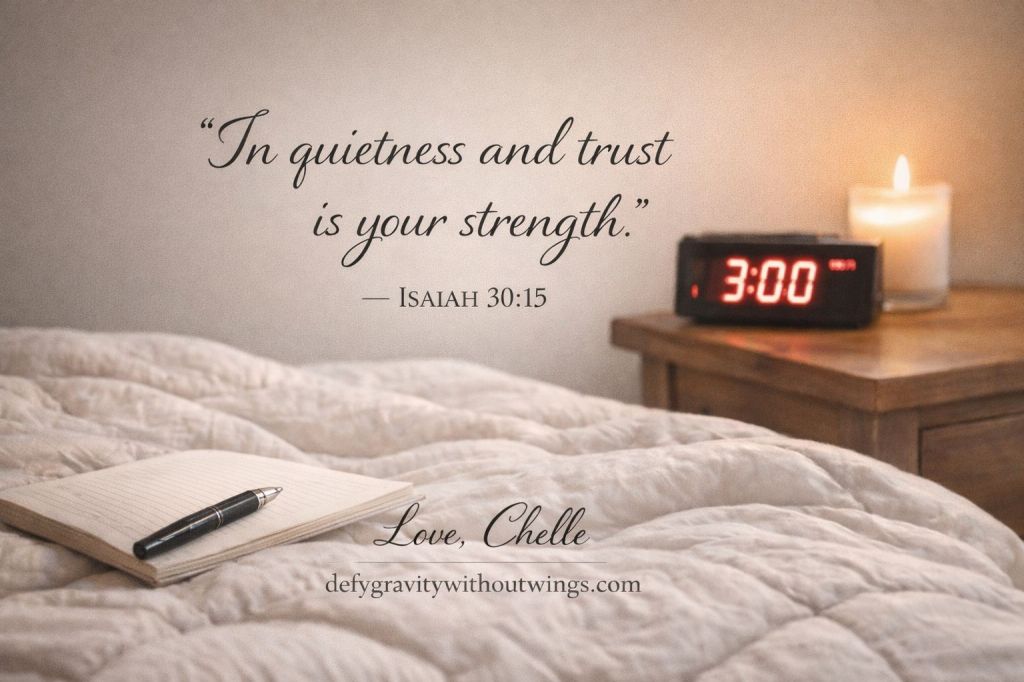
This wasn’t a quiet, reflective night moment. This was a stressed 3 a.m. morning, when sleep clocks out early and your brain clocks in loud — with opinions.
I wasn’t trying to hear from God. I was trying to finish a work email before coffee, which already tells you I was operating without full emotional supervision.
I kept shortening it. Not because I didn’t know what I wanted to say — but because I know my boss. I know there may still be a meeting. I know she’ll ultimately direct and take charge. So I trimmed. Simplified. Took out the pre-explaining and the imaginary rebuttals. I said what needed to be said and stopped trying to manage the outcome.
And somewhere between rereading sentences and realizing I was too tired to argue with myself, it landed:
This is exactly how we treat God.
We make plans — good ones — and then we hover. We explain too much. We brace for redirection. We add footnotes to obedience.
Not because we don’t trust Him — but because we really like being on the steering committee.
Meanwhile, God has already given us the playback in His Word.
He’s already shown us how authority works. How obedience works. How trust works.
We do our part. We speak honestly. We move wisely. And then we let go — preferably before caffeine convinces us we should take over.
“In their hearts humans plan their course, but the Lord establishes their steps.” – Proverbs 16:9
Not might. Not if He agrees. He does.
This morning reminded me that obedience isn’t about directing God — it’s about participating with Him. Doing what’s mine to do without trying to edit the ending.
I don’t need to manage God the way I manage emails. I don’t need to anticipate His response. And I definitely don’t need to rewrite His plan before coffee.
Sometimes the most faithful thing we can do is hit send, make the coffee, and trust God with the meeting that follows.
Prayer Lord, help me do my part without trying to control Yours. Teach me to trust You with the outcome, even before the coffee kicks in. Order my steps, steady my heart, and remind me that You’re already ahead of me. Amen.
I woke up smiling this morning. Not because everything is fixed. Not because the season has suddenly gotten easier. But because I was reminded—before my feet even hit the floor—that God still speaks.
An old friend texted me a few days ago wanting to send me a birthday gift. A cash offering. She said it might be late and she wasn’t sure how much.
I immediately told her no.
Not because I didn’t need it—but because I know her story. I know her struggles. I didn’t want her putting herself out for me. My heart was in the right place… or so I thought.
She gently stopped me and said, “God told me to sow—and I won’t interfere with God talking to me.”
Well then. Message received. Loud and clear.
Here’s the part I hadn’t said out loud to anyone: With a season of illness, deaths, job issues, a roof repair, and the bills that follow close behind, one of the quiet things I let go of was me. Specifically—my hair. Long twist locs reduced to a ponytail (which is no small feat), creative parting, strategic styling, and gray hairs hollering, “Didn’t you just get old?”
I was debating whether to cancel my usual four-hour appointment this weekend—or worse, swipe a credit card while praying over the interest rate.
But look at God.
With exactly what she sent, the Old Lady Rescue will be in full effect. No debt. No guilt. Just provision—with intention.
But the real miracle wasn’t the money.
“Not by might nor by power, but by my Spirit,” says the Lord Almighty. (Zechariah 4:6 (NIV)
It was confirmation—on both sides—that God still speaks. And He doesn’t just speak to pastors, prophets, or people with microphones. He speaks to friends. To women who listen. To hearts that say yes before they fully understand why.
I was reminded this morning that God provides for all things. Even the things we label as “extra.” Even Saturday-morning self-care. Even hair.
And I was reminded of something else: sometimes our well-meaning “no” gets in the way of someone else’s obedience.
I thought I was protecting her. Instead, I would’ve robbed us both— her of the joy of obedience, and me of the grace God had already assigned.
“My sheep listen to my voice; I know them, and they follow me.” John 10:27 (NIV)
There’s a line from the old sitcom Will & Grace that came rushing back to me this morning. One character is frustrated, asking why God doesn’t talk anymore. Another replies: “When having conversations with God, make sure you’re not doing all the talking.”
Lesson learned.
Sometimes God’s answer sounds like a text message. Sometimes provision looks like hair being restored before pride is. And sometimes Grace shows up laughing—right alongside gratitude, when we submit to His Will.
Today, I’m thankful. Not just for the gift—but for the reminder to listen… and not interfere when God speaks.
Love, Chelle
PS. A BIG thank you to my Christmas music loving, sugary named, millionaire by multiplication, friend who knows how to hear God !!!
I own a microwave. Nothing earth shattering in that announcement.
It lives near my fancy cooktop and mostly functions as a glorified popcorn popper and an occasional emergency coffee reheater. It’s efficient, dependable, and excellent at handling immediate needs.
But it has never fed my soul.
I grew up in a time when food took time. Things were simmered, stewed, braised, and watched. You didn’t just make dinner—you tended it.
I still carry evidence of that kind of cooking: little cuts on my fingers from dull knives, small burns from forgetting pot holders, and an instinct to hover near the stove because something important is happening here.
That’s the kind of faith formation I recognize. Microwave food is fast. Slow cooking is faithful.
The microwave satisfies a craving. The slow pot answers a hunger.
Scripture reminds us that faith was never meant to be instant. “Let perseverance finish its work so that you may be mature and complete, not lacking anything” (James 1:4, NIV). Perseverance doesn’t microwave. It simmers. It stays. It waits for the work to be done.
We live in a world that loves microwave spirituality: – quick verses – instant breakthroughs – tidy testimonies – three easy steps and a closing prayer.
And listen—I’m not mad at the microwave. Sometimes popcorn is necessary. But popcorn isn’t dinner.
Faith that matures—faith that holds when life burns, cuts, and bruises—comes from staying near the stove. From paying attention. From trusting the heat even when it’s uncomfortable.
Slow-cooked faith smells different. It fills the house. It draws people in before it’s finished. And yes, it might leave a mark or two. But those marks aren’t failures. They’re proof you stayed long enough for God to finish His work.
So if your faith feels like it’s taking longer than expected… If you’re still simmering when you wanted to be served… If you’ve got a few burns and nicks to show for the journey… Take heart. You’re not being microwaved. You’re being made.
Love,Chelle
Prayer Father, thank You for not rushing what You are forming in me. Help me stay near the heat without growing bitter, impatient, or afraid. Teach me to trust the slow work of Your hands, even when I want instant results. And when I’m tempted to settle for spiritual snacks, remind me that You are preparing something that truly satisfies. In Jesus’ name, Amen.
“Auld Lang Syne” (yes… I had to look up how to spell it) is often sung on nights like this, though many of us don’t quite know what we’re saying. The phrase comes from old Scots and simply means “times long past” or “old long since.”
It’s really a question—Should old acquaintance be forgot?
Tonight, we know the answer is no. Some traditions look different now. Watch Night doesn’t stretch to midnight anymore. Candles burn a little shorter. Doors close earlier than they used to—not because faith has failed, but because the world has grown colder, louder, and less safe. And yet… here we are.
We gather not to mourn what’s changed, but to remember what still matters.
“Because of the Lord’s great love we are not consumed, for His compassions never fail. They are new every morning; great is Your faithfulness.” — Lamentations 3:22–23 (NIV)
“Auld Lang Syne” isn’t about nostalgia—it’s about honoring the bonds that carried us through. It invites us to pause, look back, and say: We made it. Together. So tonight, before we step into a new year, let us do a few holy things: • Give thanks for the days behind us—both joyful and hard • Release what no longer serves our spirit • Recommit to the people God placed in our care • Check on family, even the ones who don’t answer right away • And if you really love me… bake the baker a pineapple upside-down cake, because my birthday is in a few days (amen and thank you in advance)
Because in a world that feels colder, connection is resistance. Community is courage. And faith—quiet, steady faith—still keeps watch. So even if we leave before midnight, even if the song fades early, we carry the meaning with us:
Old times remembered. New mercies ahead. God still with us. Amen.
Every writer’s fully awake nightmare: a block. A brain fart. Nothing profound to say. Nothing book-worthy for the new year.
For a brief moment, panic tried to convince me that silence meant failure. But even this—this momentary panic—became permission.
Permission to pause. Permission to breathe. Permission to simply exhale.
Truth be told, I sat there staring at the blinking cursor, waiting for something deep, prophetic, and Watch Night-worthy to appear. Nothing came. Not a sermon. Not a quote. Not even a clever churchy acronym. Just me… and the cursor… judging each other.
This morning I woke up—but my brain did not. And I’m choosing not to wrestle it into submission.
It’s New Year’s Eve Eve. There’s still much to do. Watch Night services to prepare for. Lives to show up for. And the familiar hum of New Year’s resolutions floating around everywhere.
Everywhere I turn, people are declaring what they’re going to do in the new year. Gym memberships. Journals. Green smoothies. And while I applaud the optimism, I already know February is coming… with receipts.
I’ve come to call them Reso-lies— because so many of them don’t survive past February 1st.
Yes, I have goals. Yes, I will aim. But no, I will not condemn myself or pressure myself into a failure complex when things don’t go according to plan.
This year, I’m elevating two truths instead of a checklist:
“Let the Lord be magnified, who takes pleasure in the prosperity of His servant.” — Psalm 35:27
“Delight yourself also in the Lord, and He shall give you the desires of your heart.” — Psalm 37:4
I wave both scriptures like a banner— not as entitlement, but as alignment.
I wish I could tell you this message came together neatly— that I woke up inspired, organized, and spiritually glowing. But the truth is, this word came together the same way my life usually does: honest, a little tired, and fully dependent on grace.
My prayer for the upcoming stroke of midnight is simple and surrendered:
Lord, take pleasure in this servant as I magnify You. Give me the desires of my heart that line up with the delights of Yours.
Resting is not failing. Pausing is not quitting. And waking up—even when my brain didn’t still counts as showing up.
Honoring cultural tradition, affirming shared values, and weaving Scripture with care.
A Gentle Word Before We Begin:
There was a time when I didn’t know what Kwanzaa was. And if I’m honest, there were years when the Christian church around me misunderstood it—labeling it as something it was never meant to be.
Kwanzaa is not a religion. It does not replace faith. It does not compete with Christ. It is an intentional celebration of values—principles that strengthen family, community, character, and responsibility.
Kwanzaa was established in 1966 by Dr. Maulana Karenga, in the aftermath of the Watts uprising, to reaffirm African American cultural identity and restore community-centered values rooted in family, culture, and collective responsibility.
Scripture tells us that “the law is fulfilled in one word: love” (Galatians 5:14), and that “against such things there is no law” (Galatians 5:23). When values cultivate love of God and neighbor, they deserve reflection—not fear.
This study honors the Nguzo Saba (the Seven Principles of Kwanzaa) with respect, while gently weaving Scripture for those who follow Jesus and recognize His fingerprints in every good and life-giving value.
The traditional greeting for Kwanzaa is:
“Habari Gani?”
(hah-BAH-ree GAH-nee)
It’s Swahili and means: “What’s the news?” or “What’s happening?”
When someone says: Habari Gani? Your response is the principle of the day:
Day 1 – Umoja (Unity)
Unity is not sameness; it is commitment. It is choosing one another again and again—especially when it would be easier to withdraw. Umoja reminds us that fractured families and divided communities heal when we decide to stand together.
Scripture Reflection: “How good and pleasant it is when God’s people live together in unity.” – Psalm 133:1
Prayer Thought: Lord, teach us how to guard unity without erasing truth, and to love without condition.
Day 2 – Kujichagulia (Self-Determination)
Kujichagulia is about reclaiming voice and agency. It is refusing to let others define our worth or our future. In Christ, we are not mislabeled—we are named.
Scripture Reflection: “You are a chosen people…” – 1 Peter 2:9
Prayer Thought: God, help us walk boldly in who You created us to be.
Day 3 – Ujima (Collective Work & Responsibility)
Ujima reminds us that community is not a spectator sport. We are responsible for one another—not out of obligation, but out of love.
Scripture Reflection: “Carry each other’s burdens…” – Galatians 6:2
Prayer Thought: Jesus, make us aware of where we can show up with presence.
Day 4 – Ujamaa (Cooperative Economics)
Ujamaa calls us to steward resources with communal care. Where we invest reflects what we value.
Scripture Reflection: “Each of you should use whatever gift you have received…” – 1 Peter 4:10
Prayer Thought: Lord, teach us to circulate generosity.
Day 5 – Nia (Purpose)
Purpose is not always loud. Sometimes, it is faithful consistency. Our lives are not random.
Scripture Reflection: “For we are God’s handiwork…” – Ephesians 2:10
Prayer Thought: God, align our gifts with the needs around us.
Day 6 – Kuumba (Creativity)
Creativity is holy work. Kuumba calls us to leave what we touch more beautiful.
Scripture Reflection: “See, I am doing a new thing…” – Isaiah 43:19
Prayer Thought: Creator God, let us partner with You.
Day 7 – Imani (Faith)
Imani is faith with memory. For believers, it ultimately rests in God.
Scripture Reflection: “Now faith is confidence in what we hope for…” – Hebrews 11:1
Prayer Thought: Lord, anchor our faith for generations to come.
So, if you have learned something today, then I have done my job for today. If nothing else, please know that Kwanzaa does not ask us to abandon faith. It invites us to practice values—many of which Scripture has been teaching all along. Unity. Responsibility. Purpose. Creativity. Faith. Against these, there is no law—only love.
I didn’t plan on doing heart work this morning. I was just trying to clear storage—make my phone run smoother, lighten the load, make room for what’s next.
I was deleting blurry screenshots, duplicate photos, and saved recipes I’ll probably never make— right alongside hundreds of pictures of my grandchildren that I can’t bring myself to let go of.
And tucked in between it all were receipts I once needed to survive. Thirty frames of words that bruised from an argument. A disagreement that no longer makes sense. Pain from a season that had already passed.
I kept them because I thought I might need proof. Proof that I wasn’t imagining things. Proof in case I ever needed to defend myself.
And for a while, that was okay.
But this morning, standing on the edge of a new season, I realized something had shifted. I no longer needed protection from the past. I needed permission to release it.
So I didn’t reread. I didn’t rehearse the hurt. I didn’t reopen the courtroom in my mind.
I deleted.
Not because it didn’t matter— but because it doesn’t get to lead anymore.
Scripture says, “Forget the former things; do not dwell on the past. See, I am doing a new thing!” — Isaiah 43:18–19
Forgetting doesn’t mean pretending it didn’t happen. It means choosing not to live there anymore.
There’s a difference between wisdom and weight. Between remembering and reliving. Between holding truth and being held hostage by it.
“Let us throw off everything that hinders.” — Hebrews 12:1
Not everything that hinders is sinful. Some things were necessary once—but become heavy later.
I didn’t erase the story. I simply stopped carrying the evidence.
And as the year turns and the air feels fresh again, I’m learning this sacred truth:
Dead and done are not the same thing—but neither needs to be dragged into tomorrow.
Sometimes the holiest thing you can do is delete what no longer serves the person you are becoming.
Prayer: God, thank You for seasons of protection—and for the courage to release them when they’re no longer needed. Help me walk lighter into what’s next, trusting You with the truth I no longer need to carry. Amen.