Image

When the Tool Ate the Manuscript (and Almost My Heart)

Let me tell you what almost took me out.

For weeks—WEEKS—I have been doing the holy, unglamorous work of editing and reorganizing a soon-to-be book.
Moving chapters.
Fixing commas that think they run things.
Re-threading stories.
Listening for where God was nudging—and where I was just rambling.

This was faithful work. Quiet work.
The kind nobody claps for.

And then…
The tool I use to assist and “catch mistakes” decided to eat my manuscript.

Not nibble.
Not misplace a paragraph.
Eat it.

I have survived cancer, grief, caregiving, deadlines, and ice storms—but watching weeks of careful labor vanish off a screen?
That will make your chest tighten and your salvation flicker for a hot second.

I sat there spiraling:
Did I just lose half a book?
Am I behind now?
Did I just waste weeks of my life arguing with chapter headings?

Cue the dramatic sigh.
Cue me talking to my laptop like it had personally betrayed the family.

And then—grace, wearing sneakers—slid in sideways and whispered:

Your work is not gone.
You are not behind.
We did not lose half a book.

Because real work doesn’t live only in files.
It lives in muscle memory, lived experience, and a heart that’s been steeped in the message.

And Scripture backs this up.

“So I will restore to you the years that the swarming locust has eaten…”
— Joel 2:25

God restores years, not just results.
Restoration doesn’t always look like retrieval.
What God restores often comes back stronger.

So breathe.
Roll your shoulders.
Open a new document.

The words still know how to find you.
And the story is very much alive.

Love, Chelle
defygravitywithoutwings.com

Image

Porch Prayers & Weather-Wise Faith

On days like these, my mother would stand on the porch and ask for a Bermuda High to come down and turn the snow and ice away.


In the thick, sticky heat of summer, she’d pray for a Canadian Low to sweep through and cool the air.


She didn’t call it meteorology.
She called it faith.
And more often than not, the weather shifted.


When I got older, some of my friends picked up the same habit. We didn’t have robes or titles—just house shoes, coffee cups, and enough sense to know the porch was close enough to heaven for our prayers to travel. We called ourselves the Porch-Praying Sisters.


We prayed about the weather, yes—but also about children, marriages, money, bodies that wouldn’t cooperate, and news reports that made our stomachs knot. We spoke our requests into the open air like God might just be passing by and decide to stop and listen.


Today, we’re in the middle of a Virginia ice storm.
Freezing temperatures.
Sleet tapping the windows.
The quiet, low-grade anxiety of Will we lose power? humming beneath everything else.


And maybe that’s what storms still do best.
They set the altar.


They slow us down, pull us inward, strip away noise and options until all that’s left is warmth, breath, and the remembering that we are not in control—but we are not alone either.

“When you pass through the waters, I will be with you… when you walk through the fire, you will not be burned.” (Isaiah 43:2)


Over the years, we drifted. Life scattered us. Jobs, moves, losses, disagreements, silence. That happens.
But in this current environment—
with ice on the ground, tension in the air, and uncertainty pressing in—
I find myself praying again.
Not polished prayers.
Porch prayers.


The kind that believe faith doesn’t have to be loud to be effective. The kind that remember Jesus said even “faith as small as a mustard seed” can speak to what feels immovable and tell it to move. (Matthew 17:20)


Maybe the weather won’t always change.
Maybe the power will flicker.
Maybe the storm will linger longer than we’d like.
But when a storm sets the altar,
something always moves.
And sometimes…
that something is us.


— Love,  Chelle

Image

Knowing The Voice Without The Sound


Before I knew my son was losing his hearing,
he had already learned how to listen.
He read lips.
He felt vibration.
He paid attention in ways most people never have to.
By the time the doctors named what was happening,
he had already adapted — quietly, intuitively —
as if his soul knew something before we did.
After surgeries.
After chest ports and vein accesses.
After fistulas and long recoveries.
He never complained.
He only asked one question every time:
“Can I still play my drums?”
That joyful noise he taught himself at eight years old
was his fuel.
His focus.
His prayer.
There were moments when I wondered
if the very equipment meant to help him
might dull something God had already sharpened.
Because there were times — holy times —
when his intuition outpaced amplification.

I remember watching him praise.
He couldn’t process sound the way others did,
but I could tell by the intensity in his face
that he was feeling everything.
The vibration from the keyboard.
The movement in the room.
The rhythm beneath the worship.
At the beginning of a song,
I’d turn my head just enough for him to see me.
Mouth the first line.
Offer a few hand signals.
That’s all it took.
He had studied me so well
that he knew my voice
without being able to hear it.
And I realized something then:
Recognition is deeper than sound.

Isaiah says:
“Whether you turn to the right or to the left,
your ears will hear a voice behind you, saying,
‘This is the way; walk in it.’”
— Isaiah 30:21
Not because it’s loud.
But because it’s familiar.
God does not rely on volume.
He relies on relationship.
Some people hear Him with sound.
Some with memory.
Some with movement.
Some through vibration, pattern, rhythm, and presence.
And some — like my son —
recognize the voice because they’ve watched it long enough to know it.

And if you’re reading this wondering why you can’t seem to hear God right now,
let me say this softly:
Silence does not mean absence.
And difficulty hearing does not mean you’ve lost the ability to recognize Him.
Sometimes God isn’t quieter —
we’re just being invited to listen differently.
Through memory.
Through pattern.
Through peace that doesn’t make sense yet.
Through rhythm instead of words.
You may be hearing more than you think.

We like to talk about praise as something you hear.
But sometimes praise is something you feel.
A drumbeat through the floor.
A chord through the body.
A cue from someone you trust.
I don’t know if we witnessed the world’s first deaf praise drummer.
But I know this:
I witnessed my favorite.
And through him, God handed me a Key.

Closing
God’s voice is not limited by sound.
And praise is not limited by hearing.
Some of us don’t hear God louder.
We hear Him deeper.
Because recognition doesn’t require volume —
only love, attention, and trust.

Love, Chelle

Image

Unmarked Seeds And  Clearance Rack Faith

I was standing there with a handful of seeds and no idea what any of them were.
No labels. No instructions. No promises.
Just seeds.


Some were round. Some looked like dust. Some looked like… dirt pretending to be something important.

And full confession — I made the executive decision to buy them from a discount house online, which should have been my first clue that clarity was not included in the price.


Because planting unmarked seeds feels risky.
You don’t know what you’re committing to.
You don’t know how long it will take.
You don’t know what kind of care it will need — or if you just planted hope, oregano, and disappointment all in the same row.


And that is where I had to repent of my disgust with not being able to see the seeds’ vision.


God has planted a lot of unmarked seeds in me.
No timeline.
No instruction card.
No neat little packet that says “This will bloom in 90 days if watered weekly and protected from disappointment, other people’s opinions, and your own impatience.”


Just obedience.
Just trust.
Just dirt and hope.
Some seeds He plants look insignificant — almost invisible.
Some feel mislabeled by other people.
Some feel like they were handed to us without explanation at all.


And yet… seeds don’t need labels to know what they are.
They just need soil.
Light.
Time.


And a gardener who doesn’t dig them up every five minutes to check progress — which, for the record, I have learned is frowned upon in both gardening and faith.


I think that’s where I get tripped up.
I keep wanting proof before growth.
Confirmation before commitment.
Fruit before faith.


But the seed already knows what it carries — even when I don’t.


“So neither he who plants nor he who waters is anything, but only God who gives the growth.”
— 1 Corinthians 3:7


Maybe the confusion isn’t failure.
Maybe it’s faith in its earliest form.
Maybe God is saying:
Plant it anyway.
Water it anyway.
Stop interrogating the soil.
Because unmarked doesn’t mean unintentional.
And unseen doesn’t mean unimportant.
And dormant is not the same thing as dead.

Love, Chelle

Image

Good Morning From Groot

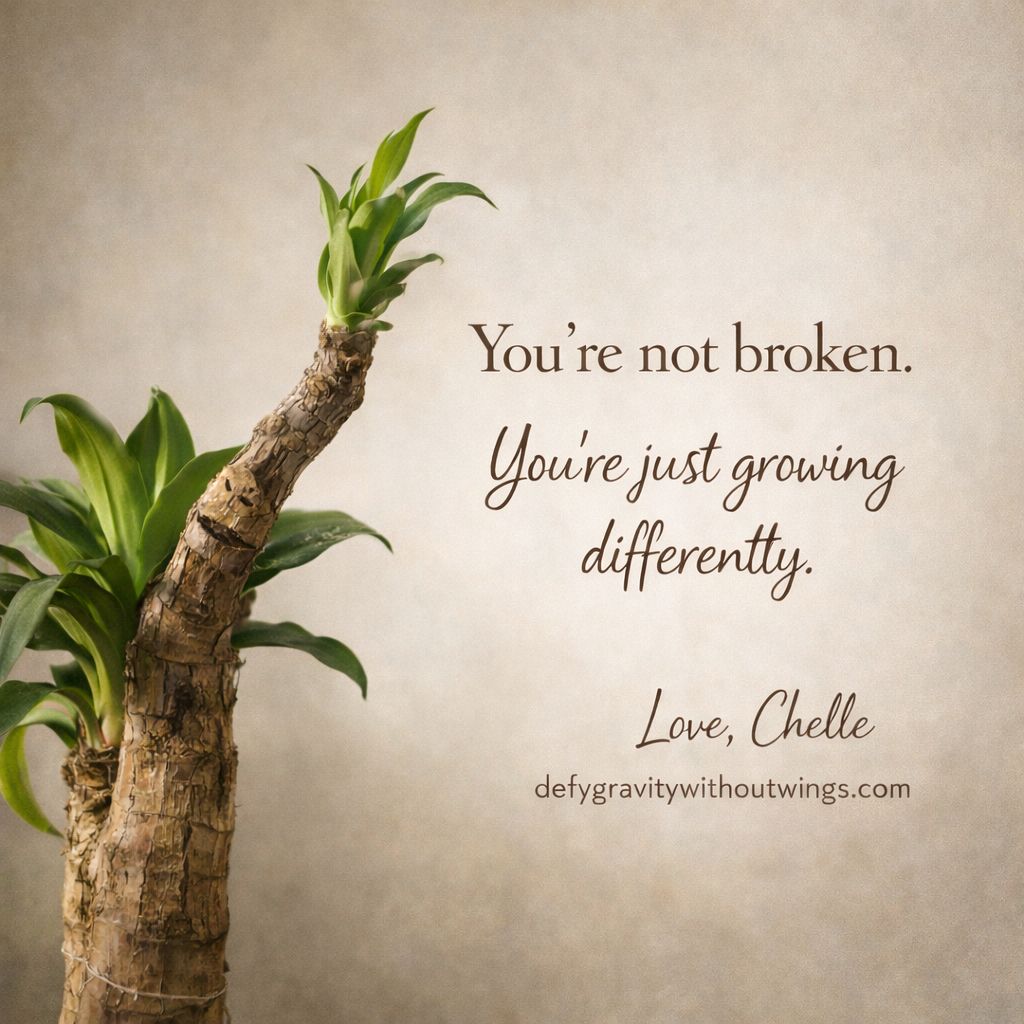
When I went to make my coffee this morning, I noticed my Brazilian wood plant — the one I call Groot because of the ornament on him — is still growing from just one side.


He’s developing a beautiful arm branch, but only one. By all accounts, there should be two by now.


Most folks would give up on a plant like that.
But I can’t.


All my life, I’ve collected broken things — toys, dolls, records… sometimes even people. Things that seemed useless or pointless to others always found a home with me. I’d turn them into art, merge them with something else, or simply let them be what they were until their value showed itself.


This little Groot reminds me that everything has value exactly as it is, even when it doesn’t quite match the catalog pictures of society.


That one arm?
It’s raised like it’s in praise.
And the smile in the bark makes me happy.


I believe God sees our imperfections with grace and purpose — I know He’s done that for me.

My seasons of brokenness and feeling like a misfit produced music, plays, and even this writing.

Periods of pain with purpose… feeling like a fish out of water… all converted into unique brands of joy.


So if you’re feeling a little uneven today…
a little out of the mold…
a little unlike what you thought you were supposed to be…
You’re not broken.
You’re just growing differently.

Now go raise that arm!


“…everyone who is called by My name,
whom I created for My glory.” — Isaiah 43:7

Love, Chelle

Image

Timing Is Everything (Apparently So Are Berries)

I’ll admit it — I went into a little shock when I learned blueberries and strawberries operate on a two-to-three-year growth plan.
Years.
Plural.

I stood there staring at seeds like they had personally betrayed me.

Up until that moment, I genuinely thought I was being resourceful.
Frugal.
Garden-savvy.
A woman with a plan.

Turns out, I had signed up for a long-term relationship without reading the commitment clause.

That’s when I decided I’m not planting berries until I move into my forever home.
Because berries don’t do well with temporary addresses.
They want stability.
Consistency.
A place where nobody’s packing boxes just as the harvest shows up.

And honestly? I get it now.

I finally understand why blueberries and strawberries cost what they do at the store.
It’s not inflation — it’s time.
It’s patience.
It’s years of watering something that gives you nothing back except leaves and hope.

I really thought it was a good idea.
And it was — just not for this season.

Jesus talked a lot about seeds, soil, and timing.
He never rushed growth — He explained it.

“First the blade, then the ear, then the full grain in the ear.” (Mark 4:28)

Nothing about that process is instant.
Nothing about it is wasted.

Even Jesus waited.
Thirty years before public ministry.
Hidden seasons.
Quiet obedience.
Roots forming where no one was applauding.

So I’ll wait too.
Not because I lack faith — but because I’ve learned that timing matters.

Some things are worth planting when you know you can stay long enough to enjoy the fruit.

Until then, I’ll pay store prices with a little more humility…
and a lot more respect for the journey those berries have been on.

Because growth was never the problem.
Timing was the lesson.

Love, Chelle

Image

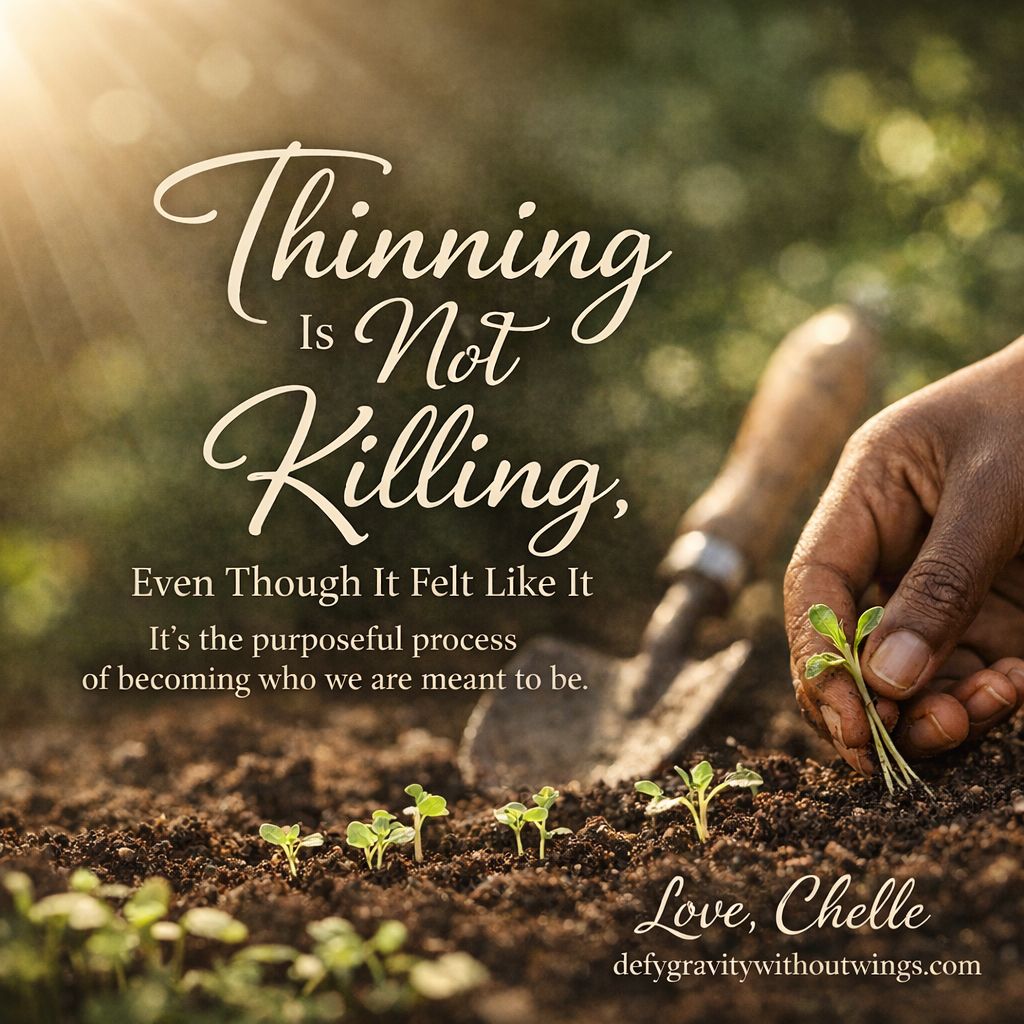
Thinning Is Not Killing (Even Though It Felt Like It)

I stood in my greenhouse clutching scissors like I was about to commit a felony.
These weren’t plants.
These were my plant babies.
I grew them.
I watered them.
I whispered encouragement like a slightly unhinged garden aunt.
And now I was being told they were “too crowded.”


Excuse me???
They looked happy.
Thriving.
Living their best leafy lives.
But apparently, love without boundaries leads to chaos.
Who knew.


The word thinning showed up—
and my heart heard destruction.
Because when you’re wired like me,
making room feels an awful lot like abandonment.


I mean, how do you explain to a perfectly healthy kale plant
that it’s not being rejected—
it’s just being relocated, harvested early, or “released into purpose”?


I felt like I was ruining everything.
Until I realized…
nothing was being wasted.
Some plants were transplanted.
Some were harvested and nourished something immediately.


And the ones left behind?
They finally had space to become what they were always meant to be.
That’s when it hit me.
Pruning doesn’t change who we are.
It reveals it.
God isn’t cutting us down—


He’s cutting away what keeps us from becoming strong, rooted, and fruitful.
Not every removal is punishment.
Not every loss is failure.
Some things leave so we can finally grow into ourselves.


“Every branch that bears fruit He prunes, that it may bear more fruit.” — John 15:2


Pruning feels personal when you’re emotionally attached to the leaves.
But it’s the very thing that shapes the harvest.
Thinning is not killing.
It’s the painful, purposeful process of becoming.


And if I’m honest…
I still apologized to my kale,
needed a moment of silence,
and may require counseling before the next round of thinning.


Because apparently God and gardening are both committed
to making us who we’re supposed to be—
even when we’re dramatic about it.


With love, Chelle,

Image

Somewhere Between The Car And The Kitchen

Disappointment doesn’t usually knock loudly.
It just keeps adding weight.


Brick by brick, we pack the backpack:
• unmet expectations
• things we thought God would do by now
• roles we keep carrying because “someone has to”
• stories we tell ourselves about who we are and what’s possible

And if I’m honest, this is the same part of me that tries to carry all the groceries in one trip.
Because clearly, asking for help would be admitting weakness…
and making two trips would be a personal failure.


So there I am — keys dangling, bags cutting off circulation, dignity questionable — determined to prove I’ve got this.
I call it independence. Heaven calls it unnecessary.


And somewhere between the car and the kitchen, I’m reminded that even Jesus sent the disciples out two by two.


Inevitably, something falls.
Or worse… something gets left in the trunk.And a couple of days later, there’s a smell. A mysterious, soul-searching smell that forces a reckoning.


Nothing humbles you faster than realizing the real burden wasn’t the bags —
it was the banana you refused to admit you dropped.


That’s how unexamined burdens work too.
What we refuse to set down eventually announces itself.
Some of the limits we feel aren’t placed by God — they’re placed by our own expectations of how we think  He should move.


We overpack faith with control.
We leave no room for surprise.
No room for grace.
No room for God to have His way — because the backpack is already full.


Jesus never asked us to be strong and burdened.
He asked us to come — and let Him carry what we were never meant to hold.


“Cast your burden on the Lord, and He will sustain you.” — Psalm 55:22


Maybe today isn’t about pushing harder.
Maybe it’s about making two trips.
Or — heaven forbid — asking for help.


Drop the bricks.
Check the trunk.
Walk  lighter.

Love, Chelle

Image

Crumbs Of Grace, My 2nd New Year.

When I think of the most important birthdays, I don’t start with cake or candles.
I start with life.


I think of the 37th birthday when  I helped deliver my grandson, Jayon — my eldest son’s first child. On that day, I didn’t just celebrate another year of my own life; I welcomed new life, new hopes, and new dreams into the world. In a way, our birthdays became twins. His arrival was proof that God was still creating, still trusting the future to fragile hands. And year after year, Jayon has never disappointed — not because he’s perfect, but because he has lived into the promise of that moment.


I think of my 50th birthday — the day I was scheduled to start chemotherapy for breast cancer. Fear tried to claim that day, but my husband gave me a birthday slumber party instead with the ladies in my crew.. Laughter showed up before dread could unpack its bags. It felt like God whispering through cupcakes and pajamas: Fight. Fight. You are not done.


On my 55th birthday, the fear shifted again. Instead of waiting anxiously for scan results, I stood on a stage wearing a crown and a “Drive 55” shirt — a playful, holy reminder to pace myself and keep going. Sometimes courage looks regal. Sometimes it looks ridiculous. Both can preach.


But my favorite birthdays are always the next one.


Whether they arrive loud and celebratory or quiet and reflective like today, they carry the same invitation. I call January 5th my second New Year — a moment to pause, look back at all that happened since last year, the good and the not-so-good. To thank God for the joys He brought us into, and for the things He delivered us out of.


“This is the day the Lord has made; let us rejoice and be glad in it.” — Psalm 118:24


Not the perfect day.
Not the painless day.
Just this one.


And today includes crumbs.
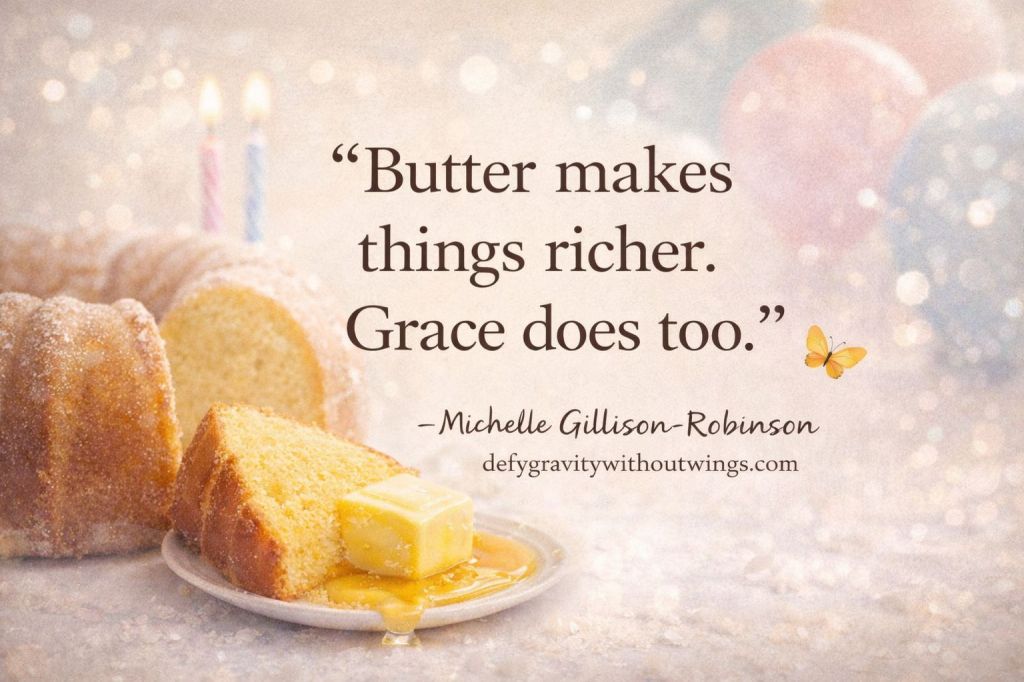
Crumbs from a Kentucky Butter Cake I made with more butter than I’m fairly certain a woman of my age should publicly admit to.

But here’s the truth: butter makes things richer. Grace does too. And neither one asks permission before doing its work.


“The steadfast love of the Lord never ceases; His mercies never come to an end; they are new every morning.” — Lamentations 3:22–23

Even on birthdays.
Especially on birthdays.


These years aren’t measured by candles alone. They’re marked by crumbs of grace — small evidences left behind that say I was fed, I was held, I was carried through

.
And if that’s what this year leaves behind — crumbs, butter, joy, survival, and gratitude — then it has been a very good year indeed.


Love, Chelle

Image

A Meeting Place


This may not sound like me.


I’m usually the one who finds the humor, the metaphor, the small spark of light tucked inside the ordinary. I believe in joy — deeply. I still do.

But today, joy feels quieter, and sorrow feels closer to the surface .
The world feels fractured.
Nation against nation.
Neighbor against neighbor.
Families strained.
Friendships reduced to likes, views, and fleeting affirmations.


And somewhere in the middle of all this noise, what seems to be slipping away is our sense of community — the kind where people are known, not curated. Where connection doesn’t require a platform or performance.


Yesterday, as I mourned world events ,  all of this along with a side of opinions still wrapped with faith, I was told I was hiding behind God and the Bible.


That stayed with me.


Not because it shook my faith, but because it revealed something deeper about the times we’re living in — a world so uncomfortable with lament that even sacred language is suspect when it refuses to harden into arguments or slogans.


But my faith has never been a hiding place.
It has always been a meeting place — where grief and hope are allowed to sit together without rushing one another out of the room.


Today, I find myself weeping.
Not because faith has failed, but because love is still very much alive.
“Jesus wept.” — John 11:35
He stood in the presence of grief and loss and did not rush to fix it, explain it, or weaponize it. He allowed tears to speak where words fell short. If tears were worthy of Him, they are not beneath us.
Scripture doesn’t ask us to bypass sorrow — it calls us to enter it together.
“Rejoice with those who rejoice; mourn with those who mourn.” — Romans 12:15


This isn’t a departure from who I am.
It’s a refusal to pretend.
I still believe in hope. I still believe in resurrection. I still believe God has not lost the plot. But I also believe sorrow has a place in the story — not as an ending, but as an honest chapter.


So today, I show up softer. Quieter. More tender. Trusting that God can hold my tears just as faithfully as He holds my hope.


And believing that even here — especially here — grace is present.
Love Chelle