Image

Powder, Not Prison (and Apparently Winter Storms Have Names Now)

So here’s something I learned this week:
winter storms have names.
I was today-years-old when I found out they name winter storms the same way they name summer hurricanes. And wouldn’t you know it—the one that iced me into my house and blocked me from my greenhouse was named Fern.
Fern.
A plant name.
A green thing.
A symbol of life.
Make it make sense.
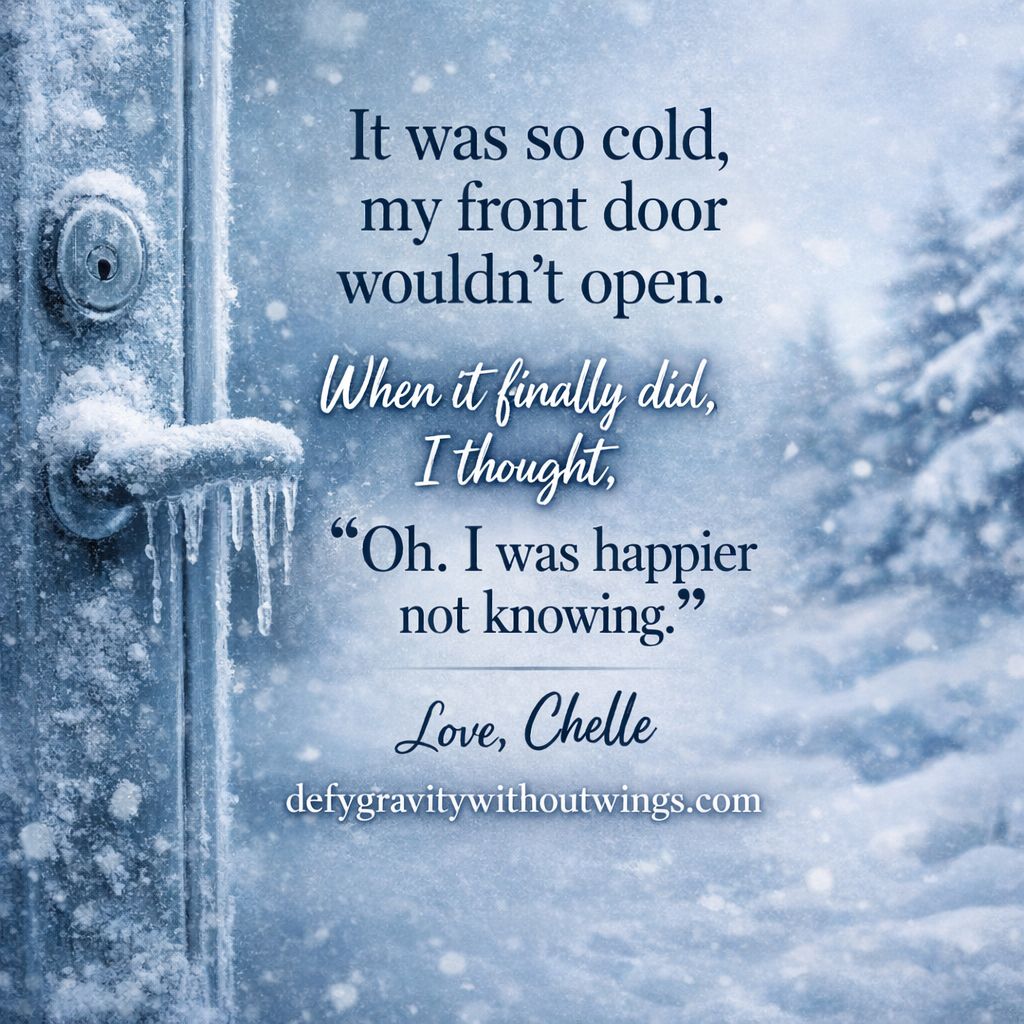
Winter Storm Fern didn’t just bring cold—she brought audacity. It was so cold one day that my front door wouldn’t even open. Not stuck—sealed. As if the house itself said, “Nope. You live here now.”
When the door finally did open the next day, I stepped outside and immediately thought,
“Oh. I was happier not knowing.”
That kind of cold doesn’t invite you out.
It humbles you back inside.
Now here we are again. More snow coming Saturday—and again on Wednesday. But this time, they’re calling for powder, not ice.
And apparently, there’s a difference.
Ice traps you.
Powder covers you.
Ice shuts doors.
Powder rests gently on what’s still alive underneath.
Some seasons don’t stop growth—they insulate it.
Under the white blanket, the soil is still breathing. Roots haven’t resigned. Seeds aren’t panicking. They know winter may come labeled and official, but it never gets the final word.
“Though the fig tree does not bud and there are no grapes on the vines… yet I will rejoice in the Lord.”
— Habakkuk 3:17–18
Faith isn’t pretending winter isn’t winter.
It’s recognizing the difference between what freezes you and what simply passes through.
Winter Storm Fern may have sealed my door for a day.
She may have iced the path to the greenhouse.
But she didn’t cancel the harvest.
Dead and dormant are not the same.
Covered and defeated are not synonyms.
Spring is not offended by powder.
And I’ve learned not to argue with doors God temporarily keeps shut.

Love, Chelle
Image

When the Tool Ate the Manuscript (and Almost My Heart)

Let me tell you what almost took me out.

For weeks—WEEKS—I have been doing the holy, unglamorous work of editing and reorganizing a soon-to-be book.
Moving chapters.
Fixing commas that think they run things.
Re-threading stories.
Listening for where God was nudging—and where I was just rambling.

This was faithful work. Quiet work.
The kind nobody claps for.

And then…
The tool I use to assist and “catch mistakes” decided to eat my manuscript.

Not nibble.
Not misplace a paragraph.
Eat it.

I have survived cancer, grief, caregiving, deadlines, and ice storms—but watching weeks of careful labor vanish off a screen?
That will make your chest tighten and your salvation flicker for a hot second.

I sat there spiraling:
Did I just lose half a book?
Am I behind now?
Did I just waste weeks of my life arguing with chapter headings?

Cue the dramatic sigh.
Cue me talking to my laptop like it had personally betrayed the family.

And then—grace, wearing sneakers—slid in sideways and whispered:

Your work is not gone.
You are not behind.
We did not lose half a book.

Because real work doesn’t live only in files.
It lives in muscle memory, lived experience, and a heart that’s been steeped in the message.

And Scripture backs this up.

“So I will restore to you the years that the swarming locust has eaten…”
— Joel 2:25

God restores years, not just results.
Restoration doesn’t always look like retrieval.
What God restores often comes back stronger.

So breathe.
Roll your shoulders.
Open a new document.

The words still know how to find you.
And the story is very much alive.

Love, Chelle
defygravitywithoutwings.com

Image

Let Peace Come (Even When the World Says “What’s the Point

As I write this, Tibetan monks are walking the East Coast on a pilgrimage for peace. Step by step. Mile by mile. No microphones. No arguments. Just feet on pavement and the quiet conviction that peace is still worth walking toward.
When I shared a simple prayer online — yes, let peace come — another believer replied,
“What’s the point? The Bible says the bad things must happen.”
It stopped me for a moment.
Yes, Scripture tells us the world will groan. It speaks honestly about deception, division, and heartbreak. The Bible doesn’t deny the mess we’re living in.
But it also never tells us to stop praying.
It never tells us to stop loving.
And it never tells us to stop showing up.
Through the prophet Isaiah, God gives us a picture that still steadies me:
“How beautiful on the mountains are the feet of those who bring good news, who proclaim peace.” (Isaiah 52:7)
Isaiah praises feet — not arguments, not timelines, not predictions.
Peace, in Scripture, is not passive.
It walks.
Somewhere along the way, religion replaced relationship and politics fractured fellowship. Both young and old are left confused — unsure what to believe or whether prayer still matters.
Here’s what I still believe:
Hope is not denial.
Hope is obedience.
Jesus never told us to love only when it fixes everything. He told us to love because that is who we are — even while we wait, even while the world aches.
So when someone asks, “What’s the point?”
This is my quiet answer:
Love still matters.
Prayer still matters.
Peace is never pointless.
Waiting for Jesus does not mean standing still.
It means walking faithfully — even now.
And if monks can walk for peace knowing the world is broken,
surely we can still pray for it.
Yes, Lord.
Let peace come.


Love, Chelle

Image

The Woman At The Table

Sometimes I miss the house in the middle of the corn fields with no indoor plumbing.
The pot-belly stove that decided when we were warm enough.
The way night fell heavy and close, and everyone settled where they could—sharing rooms, beds, blankets, breath.

I say my room, but that’s a loose word.
Privacy was a luxury we didn’t own.
Still, there was one place that felt like mine:
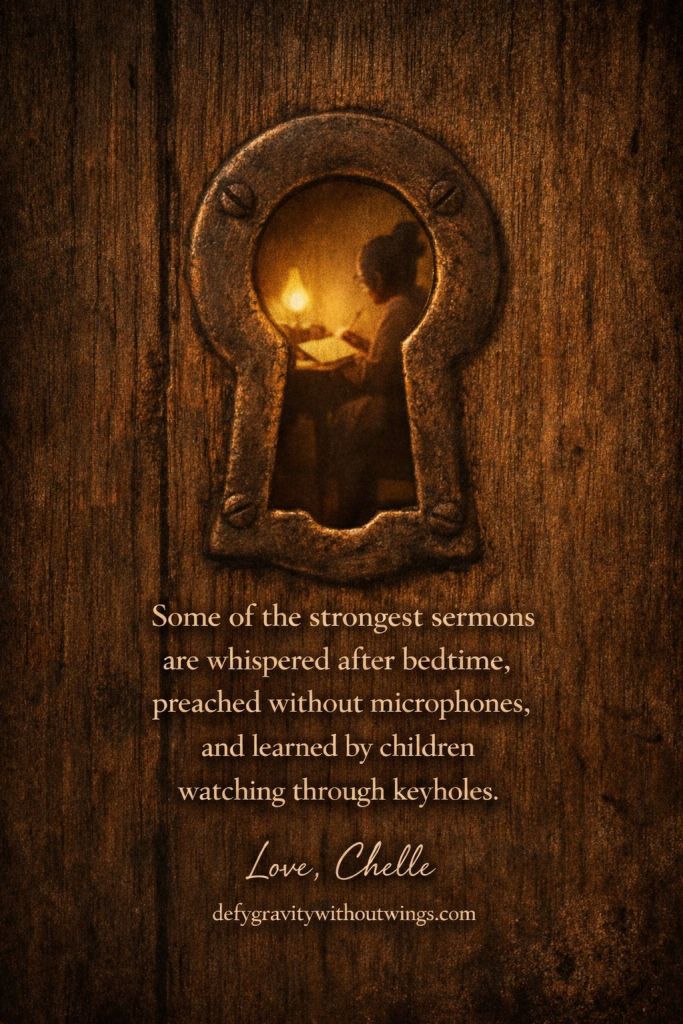
the narrow view through the keyhole.

Almost every night, after the fires were dampened and the house full of children finally stilled, I would watch my grandmother at her writing table. Her hands folded. Her Bible open. A pen moving slowly, deliberately.

Women of the Bible were her favorite.
Deborah. Ruth. Esther. Mary.
Women who listened closely and lived bravely.

She wrote sermons—real ones. Thoughtful. Scripturally sound. Insightful in ways people did not expect from a woman in those days. Especially a woman who cleaned other people’s houses for a living.

But it was her prayer ritual that marked me.

She prayed in whispers—not because God was quiet, but because love was.
She didn’t want to wake a house full of children.
Except, apparently, the little girl at the keyhole.

I couldn’t hear the words.
But I could see her face.

Sometimes she smiled.
Sometimes she laughed—like she and God shared a private joke.
Sometimes she cried. The kind of crying that doesn’t fall apart, just falls down.

And as I watched—hidden, still, unnoticed—I was learning.
Learning how faith looks when no one is applauding.
Learning that prayer does not need volume to have weight.
Learning that God listens closely to whispers.

When she finished praying, she always reached for the same thing.

A small plastic bread loaf.
One of those coin banks from organizations that fed “poor kids in Africa.”

She would slip a coin inside.
Sometimes a dollar.
Hard-earned. Scrubbed-for. Long-hours-standing money.

Money from a woman the world might have called poor—
but who never believed she was exempt from generosity.

I didn’t understand it then.
But I do now.

That table was a pulpit.
That whispering was power.
That plastic loaf was faith that refused to shrink.
And that keyhole?
It was my first seminary.

And that little girl at the keyhole?
She’s still watching.
Still learning how to pray without performing.
Still believing a few faithful offerings can touch a wide world.

“She opens her mouth with wisdom, and the teaching of kindness is on her tongue.” — Proverbs 31:26
“Your Father, who sees what is done in secret, will reward you.” — Matthew 6:6

Some of the strongest sermons are whispered after bedtime, preached without microphones, and learned by children watching through keyholes.

Love, Chelle


Image

Stone Soup For A Restless World

(Inspired by the traditional folktale “Stone Soup”)
There is an old folktale—often called Stone Soup—with roots in European oral tradition, passed from voice to voice long before it ever lived on a printed page. No single author can claim it, because it belongs to the people. To grandmothers. To kitchens. To cold evenings and tired hearts.
My grandma told me this story when I was a child.
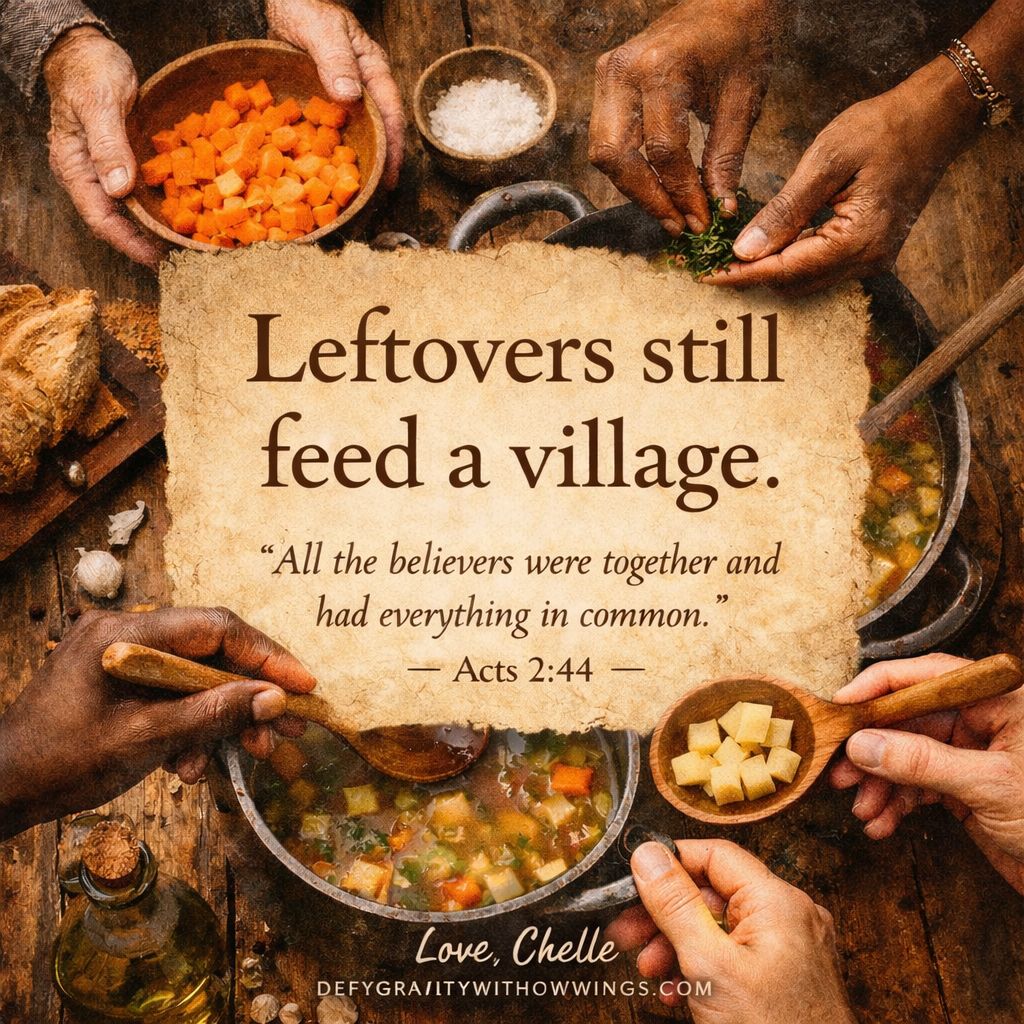
In it, strangers arrive in a village with nothing but a pot, water, and a stone. The villagers insist they have nothing to give. Nothing extra. Nothing to spare. But as the pot begins to simmer, curiosity loosens fists. A carrot appears. Then an onion. A potato. A handful of herbs. What begins as nothing becomes a feast—not because of the stone, but because everyone adds what they already had.
“All the believers were together and had everything in common.”
— Acts 2:44
What my grandmother made sure I understood wasn’t cleverness or trickery.
It was this: waste nothing, because even the smallest thing can become enough.
That lesson followed me into adulthood and straight into my freezer.
I freeze the little bits.
The half cup of vegetables left after dinner.
The last spoonful of beans.
The scraps that don’t look like a meal on their own.
And on nights like this—when the world feels heavy, when the news is loud, when unrest simmers hotter than any stove—I pull out those frozen fragments. I drop my own version of a stone into broth. I add spices. I stir. And somehow, once again, there is soup.
Scripture reminds us that when we bring what we have—no matter how small—God knows how to make it enough.
“Each of you should use whatever gift you have received to serve others.”
— 1 Peter 4:10
Nothing fancy.
Nothing wasteful.
Nothing done alone.
Wouldn’t it be lovely—
in a world so divided, so guarded, so afraid of scarcity—
if we could remember how to do this together?
Not fix everything.
Not agree on everything.
Just show up with what we have.
A carrot. A story. A pot. A willingness.
Stone Soup reminds us that abundance doesn’t start with excess.
It starts with shared heat.
With open hands.
With the quiet decision to believe that together is still possible.
Tonight, I’ll keep stirring.
And I’ll keep believing.
Love, Chelle
DefyGravityWithoutWings.com

Image

Porch Prayers & Weather-Wise Faith

On days like these, my mother would stand on the porch and ask for a Bermuda High to come down and turn the snow and ice away.


In the thick, sticky heat of summer, she’d pray for a Canadian Low to sweep through and cool the air.


She didn’t call it meteorology.
She called it faith.
And more often than not, the weather shifted.


When I got older, some of my friends picked up the same habit. We didn’t have robes or titles—just house shoes, coffee cups, and enough sense to know the porch was close enough to heaven for our prayers to travel. We called ourselves the Porch-Praying Sisters.


We prayed about the weather, yes—but also about children, marriages, money, bodies that wouldn’t cooperate, and news reports that made our stomachs knot. We spoke our requests into the open air like God might just be passing by and decide to stop and listen.


Today, we’re in the middle of a Virginia ice storm.
Freezing temperatures.
Sleet tapping the windows.
The quiet, low-grade anxiety of Will we lose power? humming beneath everything else.


And maybe that’s what storms still do best.
They set the altar.


They slow us down, pull us inward, strip away noise and options until all that’s left is warmth, breath, and the remembering that we are not in control—but we are not alone either.

“When you pass through the waters, I will be with you… when you walk through the fire, you will not be burned.” (Isaiah 43:2)


Over the years, we drifted. Life scattered us. Jobs, moves, losses, disagreements, silence. That happens.
But in this current environment—
with ice on the ground, tension in the air, and uncertainty pressing in—
I find myself praying again.
Not polished prayers.
Porch prayers.


The kind that believe faith doesn’t have to be loud to be effective. The kind that remember Jesus said even “faith as small as a mustard seed” can speak to what feels immovable and tell it to move. (Matthew 17:20)


Maybe the weather won’t always change.
Maybe the power will flicker.
Maybe the storm will linger longer than we’d like.
But when a storm sets the altar,
something always moves.
And sometimes…
that something is us.


— Love,  Chelle

Image

Numbers and Neighbors (and Why You May See Me Writing Quietly for a While)

Numbers and neighbors matter.
I’ve spent most of my life thinking numbers were for accountants, engineers, and people who enjoy spreadsheets far more than I ever will. But lately—especially in this season of writing—I’m learning that numbers aren’t really about math.


They’re about order.


Numbers tell you where something belongs.
They tell you what comes before and what comes after.
They keep things from floating around unfinished and untethered.


And then there are neighbors.
Neighbors are what give numbers meaning.
Nothing meaningful stands alone—not stories, not seasons, not faith, and not writing. What sits beside something shapes how it’s understood. Context matters. Timing matters. Placement matters.


Right now, my writing life looks a little different. Instead of posting every thought as soon as it forms, I’m learning to sit with them. To ask where they belong. What needs to come before. What needs to follow.
It turns out this is how a book is being built.


Isaiah reminds us:
“The Lord will guide you always… You will be like a well-watered garden.” (Isaiah 58:11)
Gardens grow by placement.
By timing.
By knowing what belongs next to what.


So if my writing shows up a little differently for a while, know this:
Nothing is disappearing.
It’s being ordered.
Numbers and neighbors matter.


Love, Chelle

Image

Knowing The Voice Without The Sound


Before I knew my son was losing his hearing,
he had already learned how to listen.
He read lips.
He felt vibration.
He paid attention in ways most people never have to.
By the time the doctors named what was happening,
he had already adapted — quietly, intuitively —
as if his soul knew something before we did.
After surgeries.
After chest ports and vein accesses.
After fistulas and long recoveries.
He never complained.
He only asked one question every time:
“Can I still play my drums?”
That joyful noise he taught himself at eight years old
was his fuel.
His focus.
His prayer.
There were moments when I wondered
if the very equipment meant to help him
might dull something God had already sharpened.
Because there were times — holy times —
when his intuition outpaced amplification.

I remember watching him praise.
He couldn’t process sound the way others did,
but I could tell by the intensity in his face
that he was feeling everything.
The vibration from the keyboard.
The movement in the room.
The rhythm beneath the worship.
At the beginning of a song,
I’d turn my head just enough for him to see me.
Mouth the first line.
Offer a few hand signals.
That’s all it took.
He had studied me so well
that he knew my voice
without being able to hear it.
And I realized something then:
Recognition is deeper than sound.

Isaiah says:
“Whether you turn to the right or to the left,
your ears will hear a voice behind you, saying,
‘This is the way; walk in it.’”
— Isaiah 30:21
Not because it’s loud.
But because it’s familiar.
God does not rely on volume.
He relies on relationship.
Some people hear Him with sound.
Some with memory.
Some with movement.
Some through vibration, pattern, rhythm, and presence.
And some — like my son —
recognize the voice because they’ve watched it long enough to know it.

And if you’re reading this wondering why you can’t seem to hear God right now,
let me say this softly:
Silence does not mean absence.
And difficulty hearing does not mean you’ve lost the ability to recognize Him.
Sometimes God isn’t quieter —
we’re just being invited to listen differently.
Through memory.
Through pattern.
Through peace that doesn’t make sense yet.
Through rhythm instead of words.
You may be hearing more than you think.

We like to talk about praise as something you hear.
But sometimes praise is something you feel.
A drumbeat through the floor.
A chord through the body.
A cue from someone you trust.
I don’t know if we witnessed the world’s first deaf praise drummer.
But I know this:
I witnessed my favorite.
And through him, God handed me a Key.

Closing
God’s voice is not limited by sound.
And praise is not limited by hearing.
Some of us don’t hear God louder.
We hear Him deeper.
Because recognition doesn’t require volume —
only love, attention, and trust.

Love, Chelle
Image

Grandma Didn’t Fear The Snow


Every time the forecast whispers snow, Virginia loses its mind.

Milk disappears first.
Bread follows.
Eggs become currency.
And suddenly people who haven’t cooked since 2014 are preparing for Snowmageddon: The Reckoning.

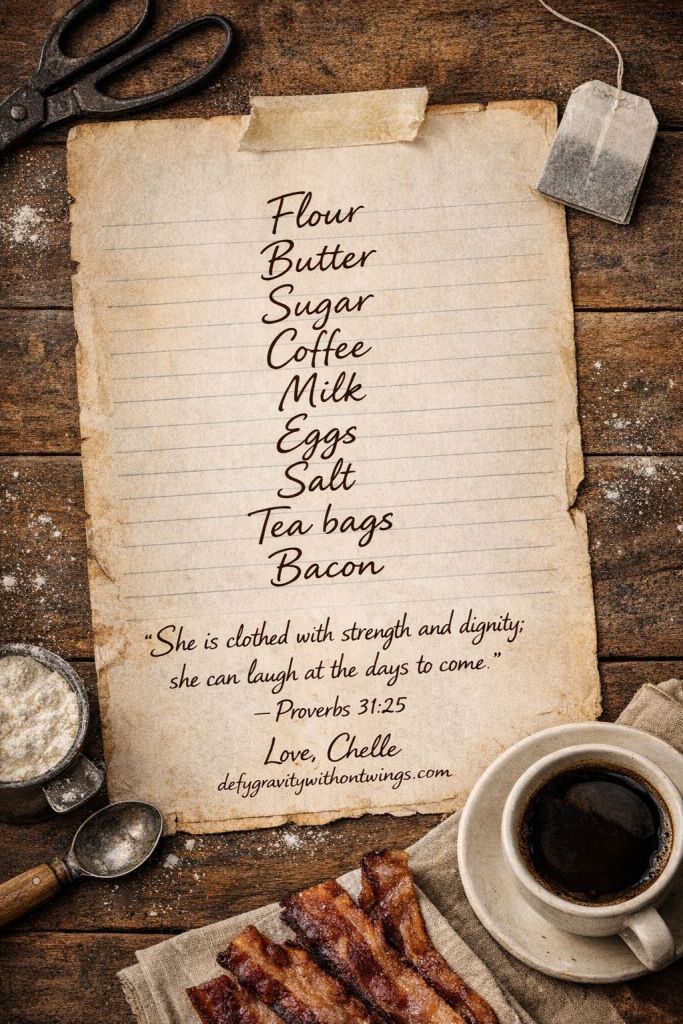
This morning, listening to the low-grade panic hum through social media, I thought of my grandma.

Her checklist never changed.

Flour.
Butter.
Sugar.
Coffee.
Milk.
Eggs.
Salt.
Tea bags.
Bacon.

That was it.

No emergency rations.
No twelve-step preparedness plan.
No frantic news watching.

Just quiet confidence.

Flour meant I can make something.
Butter and sugar meant comfort is still allowed.
Coffee meant sit down, we’re talking.
Milk meant somebody might need care.
Eggs meant breakfast feeds more than hunger.
Salt meant wisdom — because everything needs seasoning.
Tea bags meant there’s time to slow down.
And bacon?
Bacon meant joy is practical.

Grandma didn’t fear snow.
She respected it.
And if it wasn’t the first snow, she’d be outside making snow cream like it was just another blessing falling from the sky.

She lived what Scripture later put into words:
“She is clothed with strength and dignity; she can laugh at the days to come.” (Proverbs 31:25)

She knew storms came — and went.
She knew how to stretch what she had.
She knew a warm kitchen calmed cold nerves better than any headline ever could.

What strikes me most now is this:
Her list wasn’t about survival.
It was about presence.

Enough on hand to feed whoever showed up.
Enough calm to keep the house steady.
Enough wisdom not to confuse inconvenience with catastrophe.

We live in a time where every storm is framed like the end of the world.
But some of us were raised by women who understood that preparation doesn’t require panic — and peace doesn’t require abundance.

So if snow comes this week, let it snow.
Well… I’m no snow lover — even if I was born in January — but I trust the kind of wisdom that keeps coffee brewing, tea steeping, and bacon sizzling.

I’ll be thinking about grandma.
Her list.
Her calm.
And the quiet strength of knowing that love, when prepared, is never caught off guard.

Love, Chelle


Image

Some Breaks Bring New Growth

I told myself I would not cry.


I said it out loud. Twice.

Then I heard the soft, unmistakable sound of soil shifting where it shouldn’t, followed by the sight every plant-loving heart knows too well — one of my pothos vines snapped clean away from the rest of the plant.

Just like that.
An accident.
A break.

My first thought wasn’t theological. It was maternal.
Can it be saved?

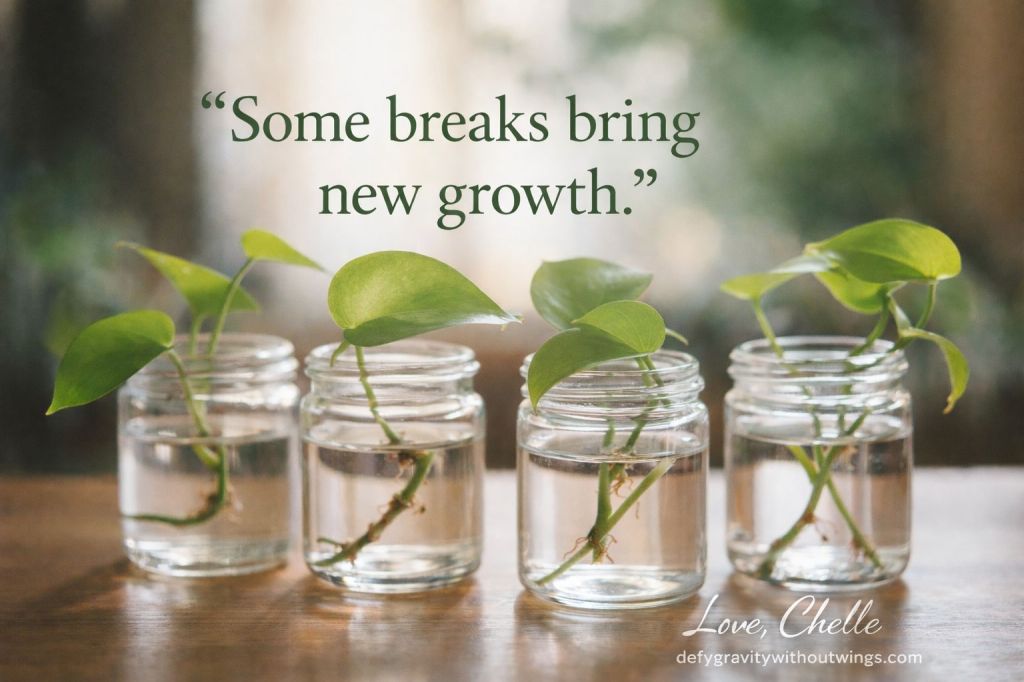
I picked it up gently, turning the broken vine over in my hands, looking for signs of life. And there they were — tiny nodes, already formed. Places where roots could grow, even though they hadn’t yet.

What looked like damage was actually possibility.

I learned something standing there in my living room with dirt on the floor and a vine in my hand:
Not every break is a loss. Some breaks are an invitation.

The plant wasn’t ruined. It was multiplied.
What separated didn’t die — it prepared to grow again, just differently, in a new place.

And isn’t that how it goes with us?

We panic when something breaks — a plan, a season, a relationship, a version of ourselves we worked hard to protect. We assume broken means finished. But God has a way of seeing roots where we only see separation.

Scripture whispers this truth gently:

“There is a time for everything… a time to plant and a time to uproot.”
— Ecclesiastes 3:1–2

Uprooting feels violent when it happens unexpectedly.
But uprooting isn’t destruction — it’s movement.

That vine didn’t know it was about to be replanted.
It didn’t resist the separation.
It just carried what it needed inside itself and waited for water.

Maybe that’s where we are too.

Maybe what snapped didn’t end us.
Maybe it exposed what was already capable of growing.

So I didn’t lose a plant today.
I gained four jars of hope sitting on my counter.

What broke didn’t disappear — it multiplied.
And maybe that’s the part we forget when something snaps in our hands.

Waiting isn’t wasted.
It’s where roots decide to show up.

“Those who wait for the Lord shall renew their strength.”
— Isaiah 40:31

Some breaks bring new growth.
They just need water… and a little time.

With love,
Chelle
defygravitywithoutwings.com