Image

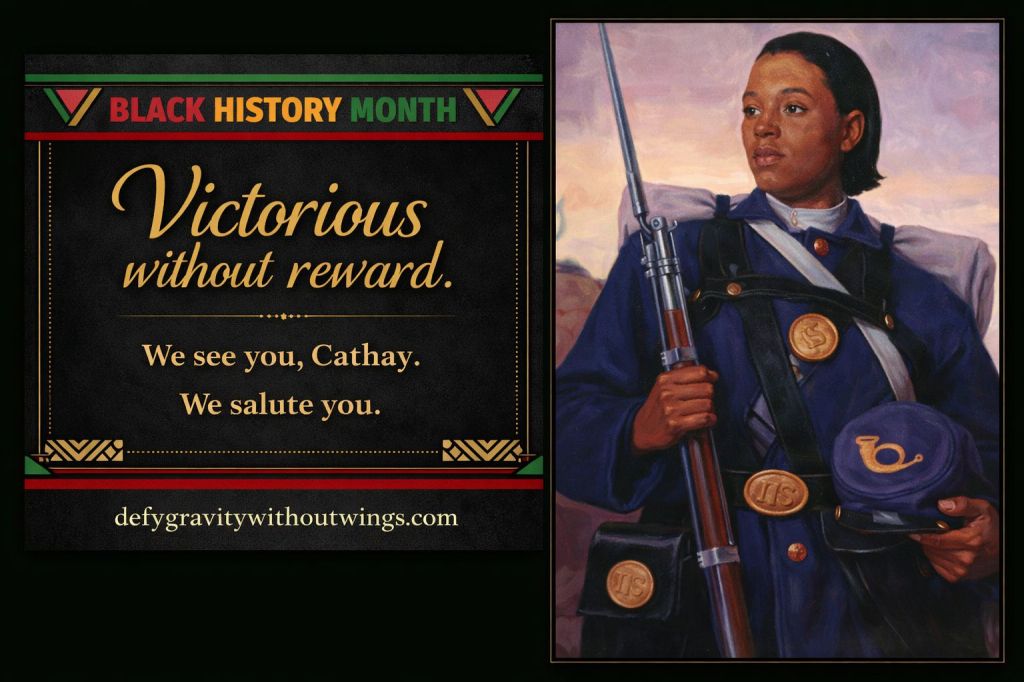
Cathay Williams: Known By God. Hidden By History

Cathay Williams is one of my favorite Black history figures — not because she is well known, but because she is not.


I was first introduced to her by my nephew, Remmie, during one of the hardest seasons of my life — while I was going through breast cancer. He told me her story and then said something that stopped me cold.


He said I reminded him of her.


Like Cathay, I hid some of the pain I was really going through — not out of denial, but out of love.
Not because the fight wasn’t real, but because I wanted to encourage others who were fighting too.


Cathay Williams was born enslaved in Missouri around 1844. During the Civil War, she followed the Union Army as a cook and laundress. But when the war ended and the Army opened its ranks to Black men only, Cathay did something unthinkable.


She cut her hair,

wrapped her body,

changed her name to William Cathay

— and enlisted.


For nearly two years, she served as a soldier in the 38th U.S. Infantry, one of the original Buffalo Soldier regiments. She marched. She guarded. She endured brutal conditions — all while hiding her identity in a world that would not make space for who she truly was.


Eventually, illness exposed what society refused to imagine:
a Black woman had carried a rifle, worn the uniform, and served her country faithfully.


She was discharged — not for lack of courage, but for daring to exist outside the rules.


Cathay Williams lived a life where survival required disguise.
Not because she lacked strength — but because the world lacked vision.


There are seasons when God calls people to serve before the world is ready to name them correctly.
Cathay was known as William by the Army.
But she was known fully by God.
“The Lord does not see as mortals see; they look on the outward appearance, but the Lord looks on the heart.” — 1 Samuel 16:7


History overlooked her.
The Army dismissed her.
But heaven recorded her obedience.
Some call her story deception.
Others call it desperation.


But I call it courage under constraint.


And here is the part history often whispers instead of says out loud:
Cathay Williams never received military honors.
She never received a pension.
In 1891, after her health had been permanently damaged by her service, she applied for a military disability pension. It was denied. She died poor and largely forgotten.


She was victorious without reward.


Cathay Williams did everything she was asked to do — and more.
She served faithfully.
She endured quietly.
She finished her assignment.


Her story reminds us that victory and recognition are not the same thing.
“Well done” does not always come from the systems we serve — but it is always recorded by God.
She didn’t fight for history.
She fought through it.
And God did not waste a single step she took.


She did not live to see her story told.
But her life still speaks.


And for those who have ever given their strength, their hope, or their encouragement without guarantee of return:
You may be unrewarded by the world —
but you are not unseen by God.


We see you, Cathay.
We salute you.


Love, Chelle

About the History in Bread Crumbs
Bread Crumbs reflections are grounded in documented historical records, including archives from the U.S. National Archives, Library of Congress, court records, contemporaneous newspapers, and first-person accounts. Spiritual reflections and personal connections are clearly marked as such and are offered with respect for the historical record.

.

Image

Reframing The Heart

Somewhere along the way, many of us learned a quiet lie —
not from God, but from human interpretation.

We learned it from what was modeled, praised, or rewarded.
From homes, churches, systems, and relationships that mistook endurance for faithfulness and exhaustion for virtue.


Most people were doing the best they could with what they knew — but they were still human.
And without realizing it, we carried those lessons into our understanding of God.

I know this because I have done it myself.

I confused being loved with doing to be loved.
I mixed up belief with performance.
And I carried that misunderstanding into my faith and called it obedience.

But that is not God’s heart.

God does not delight in depletion.
He delights in wholeness.

Jesus did not invite people to follow Him so they could replace Him.
He did not ask them to become saviors, fixers, or endless wells.
He asked them to come — as they were — and to unlearn what fear had taught them about love.

Scripture never praises burnout.
It praises obedience rooted in love, not fear.
It honors service that flows from being seen — not from trying to be noticed.

When Jesus said, “Come to Me, all who are weary and burdened, and I will give you rest,”
He was not offering a reward for those who gave the most.
He was correcting what people had been taught about God.

If your kindness comes from feeling unseen,
if your faith feels like constant output,
if your love has slowly turned into self-erasure —
that may be something you learned, but it is not something God requires.

God does not need you emptied to be faithful.
He desires you rooted, restored, and whole.

Being needed is not the same as being loved.
And God’s love has never required you to disappear.

God, help me separate Your voice from the voices that shaped me.
Heal what I learned in survival mode.
Teach me Your heart — not a human version of it.

Love, Chelle
DefyGravityWithoutWings.com

Image

Powder, Not Prison (and Apparently Winter Storms Have Names Now)

So here’s something I learned this week:
winter storms have names.
I was today-years-old when I found out they name winter storms the same way they name summer hurricanes. And wouldn’t you know it—the one that iced me into my house and blocked me from my greenhouse was named Fern.
Fern.
A plant name.
A green thing.
A symbol of life.
Make it make sense.
Winter Storm Fern didn’t just bring cold—she brought audacity. It was so cold one day that my front door wouldn’t even open. Not stuck—sealed. As if the house itself said, “Nope. You live here now.”
When the door finally did open the next day, I stepped outside and immediately thought,
“Oh. I was happier not knowing.”
That kind of cold doesn’t invite you out.
It humbles you back inside.
Now here we are again. More snow coming Saturday—and again on Wednesday. But this time, they’re calling for powder, not ice.
And apparently, there’s a difference.
Ice traps you.
Powder covers you.
Ice shuts doors.
Powder rests gently on what’s still alive underneath.
Some seasons don’t stop growth—they insulate it.
Under the white blanket, the soil is still breathing. Roots haven’t resigned. Seeds aren’t panicking. They know winter may come labeled and official, but it never gets the final word.
“Though the fig tree does not bud and there are no grapes on the vines… yet I will rejoice in the Lord.”
— Habakkuk 3:17–18
Faith isn’t pretending winter isn’t winter.
It’s recognizing the difference between what freezes you and what simply passes through.
Winter Storm Fern may have sealed my door for a day.
She may have iced the path to the greenhouse.
But she didn’t cancel the harvest.
Dead and dormant are not the same.
Covered and defeated are not synonyms.
Spring is not offended by powder.
And I’ve learned not to argue with doors God temporarily keeps shut.

Love, Chelle

Image

The Woman At The Table

Sometimes I miss the house in the middle of the corn fields with no indoor plumbing.
The pot-belly stove that decided when we were warm enough.
The way night fell heavy and close, and everyone settled where they could—sharing rooms, beds, blankets, breath.

I say my room, but that’s a loose word.
Privacy was a luxury we didn’t own.
Still, there was one place that felt like mine:
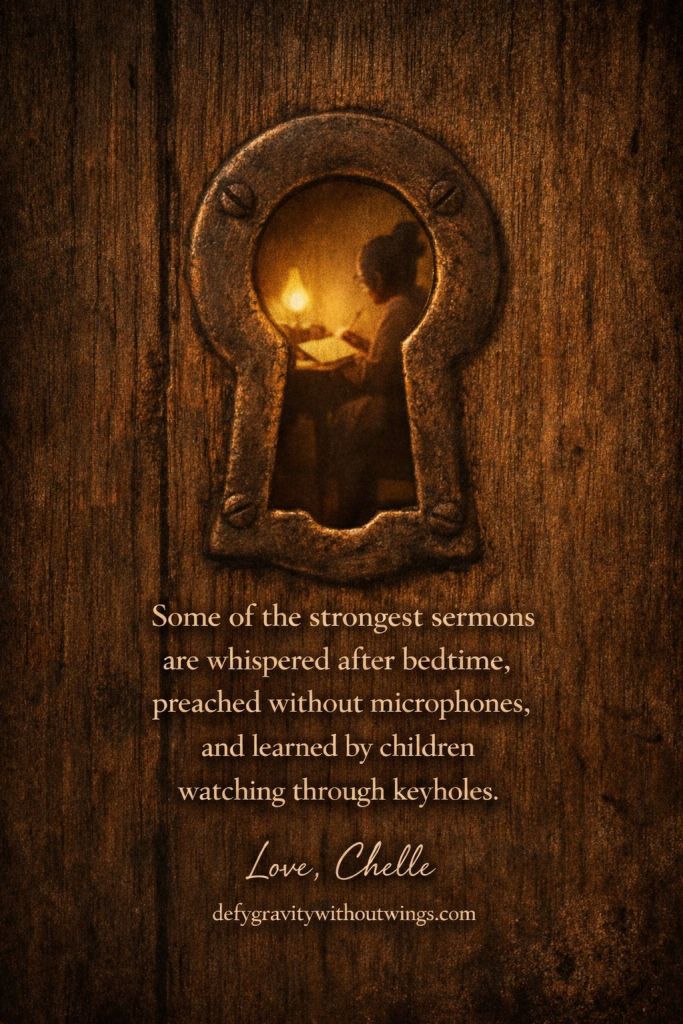
the narrow view through the keyhole.

Almost every night, after the fires were dampened and the house full of children finally stilled, I would watch my grandmother at her writing table. Her hands folded. Her Bible open. A pen moving slowly, deliberately.

Women of the Bible were her favorite.
Deborah. Ruth. Esther. Mary.
Women who listened closely and lived bravely.

She wrote sermons—real ones. Thoughtful. Scripturally sound. Insightful in ways people did not expect from a woman in those days. Especially a woman who cleaned other people’s houses for a living.

But it was her prayer ritual that marked me.

She prayed in whispers—not because God was quiet, but because love was.
She didn’t want to wake a house full of children.
Except, apparently, the little girl at the keyhole.

I couldn’t hear the words.
But I could see her face.

Sometimes she smiled.
Sometimes she laughed—like she and God shared a private joke.
Sometimes she cried. The kind of crying that doesn’t fall apart, just falls down.

And as I watched—hidden, still, unnoticed—I was learning.
Learning how faith looks when no one is applauding.
Learning that prayer does not need volume to have weight.
Learning that God listens closely to whispers.

When she finished praying, she always reached for the same thing.

A small plastic bread loaf.
One of those coin banks from organizations that fed “poor kids in Africa.”

She would slip a coin inside.
Sometimes a dollar.
Hard-earned. Scrubbed-for. Long-hours-standing money.

Money from a woman the world might have called poor—
but who never believed she was exempt from generosity.

I didn’t understand it then.
But I do now.

That table was a pulpit.
That whispering was power.
That plastic loaf was faith that refused to shrink.
And that keyhole?
It was my first seminary.

And that little girl at the keyhole?
She’s still watching.
Still learning how to pray without performing.
Still believing a few faithful offerings can touch a wide world.

“She opens her mouth with wisdom, and the teaching of kindness is on her tongue.” — Proverbs 31:26
“Your Father, who sees what is done in secret, will reward you.” — Matthew 6:6

Some of the strongest sermons are whispered after bedtime, preached without microphones, and learned by children watching through keyholes.

Love, Chelle


Image

GOD’S UP. I MIGHT AS WELL BE TOO.

Like some kind of finely tuned timepiece, my internal alarm goes off —  clockwork faithful.
No snooze button negotiations. No grace period. Just “bing.”

And there it is… 3:00 a.m. glowing on my digital clock
(yes, I still have one — don’t judge).

I pull the comforter up like it might save me.
It does not.

My body says, up up up,
while my soul whispers, “Really, Lord? Again?”

There was a time I filled those early hours with “responsible things” —
finishing chores I ignored the night before,
paying bills that had been staring at me all day,
or letting the TV talk so I didn’t have to think.

Busy things.
Distracting things.
Things that looked productive but didn’t change me one bit.

But lately… I’m up writing.

Blog entries.
Poems.
Devotionals.

Words spilling out at a pace that tells me I’m not in charge of this schedule anymore.

And somewhere between the glow of that clock and the scratch of my pen, truth had my full attention.

I’ve moved from me cleaning house
to God housekeeping me.

Because once I’m fully awake, I go full steam —
fixing, managing, pushing, performing.
But at 3 a.m.?
I’m not impressive. I’m not polished. I’m barely caffeinated.

And that’s exactly when God starts pointing things out.

Things my soul was too tired to hear during the day,
my pen now faithfully records in the quiet.

Cleaning me.
Pruning me.
Digging around places I thought were “fine.”
Re-creating what I rushed past in daylight.

This isn’t insomnia.
This is divine interruption.

Early-morning housekeeping —
the kind where God gently rearranges what I’ve been tripping over inside
while I’m still wrapped in blankets and honesty.

And I’m reminded, softly, without accusation or demand:
“In quietness and trust is your strength.” (Isaiah 30:15)

Turns out, God doesn’t always wake us up to get more done.

Sometimes He wakes us up because He’s not finished with us yet.

Love, Chelle

Image

Unmarked Seeds And  Clearance Rack Faith

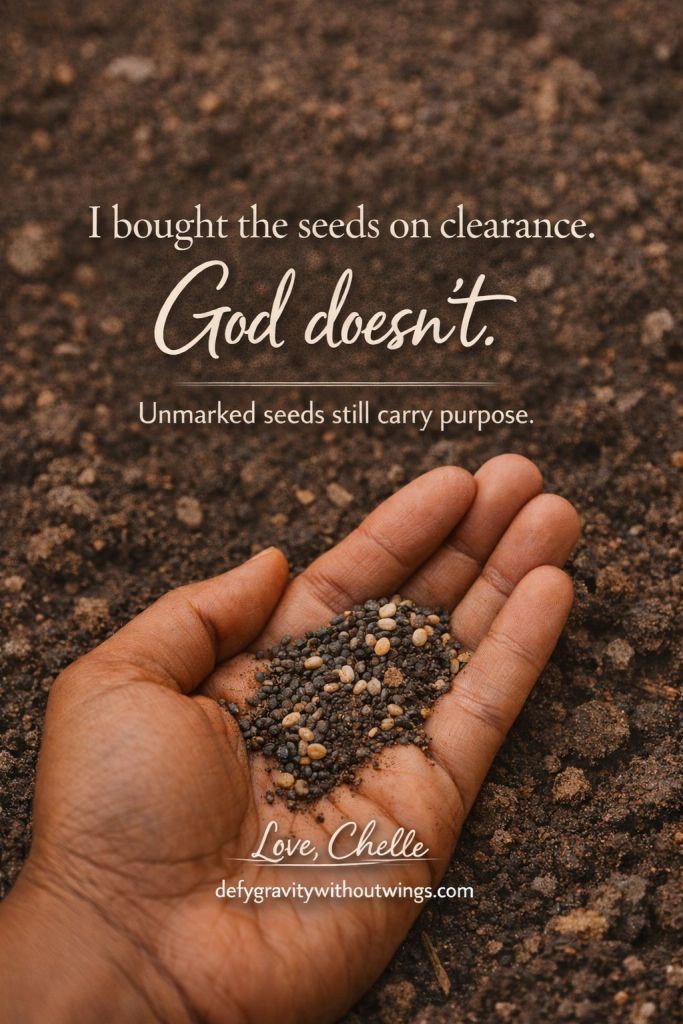
I was standing there with a handful of seeds and no idea what any of them were.
No labels. No instructions. No promises.
Just seeds.


Some were round. Some looked like dust. Some looked like… dirt pretending to be something important.

And full confession — I made the executive decision to buy them from a discount house online, which should have been my first clue that clarity was not included in the price.


Because planting unmarked seeds feels risky.
You don’t know what you’re committing to.
You don’t know how long it will take.
You don’t know what kind of care it will need — or if you just planted hope, oregano, and disappointment all in the same row.


And that is where I had to repent of my disgust with not being able to see the seeds’ vision.


God has planted a lot of unmarked seeds in me.
No timeline.
No instruction card.
No neat little packet that says “This will bloom in 90 days if watered weekly and protected from disappointment, other people’s opinions, and your own impatience.”


Just obedience.
Just trust.
Just dirt and hope.
Some seeds He plants look insignificant — almost invisible.
Some feel mislabeled by other people.
Some feel like they were handed to us without explanation at all.


And yet… seeds don’t need labels to know what they are.
They just need soil.
Light.
Time.


And a gardener who doesn’t dig them up every five minutes to check progress — which, for the record, I have learned is frowned upon in both gardening and faith.


I think that’s where I get tripped up.
I keep wanting proof before growth.
Confirmation before commitment.
Fruit before faith.


But the seed already knows what it carries — even when I don’t.


“So neither he who plants nor he who waters is anything, but only God who gives the growth.”
— 1 Corinthians 3:7


Maybe the confusion isn’t failure.
Maybe it’s faith in its earliest form.
Maybe God is saying:
Plant it anyway.
Water it anyway.
Stop interrogating the soil.
Because unmarked doesn’t mean unintentional.
And unseen doesn’t mean unimportant.
And dormant is not the same thing as dead.

Love, Chelle

Image

Jesus Took A Break (And So Can You)


I noticed it, and it wouldn’t let me go.

Jesus took a break.

Not because He was lazy.
Not because the need was gone.
Not because the work was finished.

But because He knew when to pour Himself out —
and when to be filled again by the Father.

He stepped away while people still needed Him.
He withdrew while expectations still waited.
He rested even though the world would have gladly kept pulling.

“But Jesus often withdrew to lonely places and prayed.”
— Luke 5:16

(Jesus withdrew to quiet places.
I withdraw to the couch and pretend I’m just “thinking.”)

Last night my body kept waking me up like it was tapping my shoulder saying,
Hey. We’re done pretending.

Every hour on the hour.
No deep rest. No drifting off.

Thoughts of what I needed to do today were keeping me awake, while those same thoughts were making me tired.


But, yet, there was a quiet insistence that something holy was being ignored.

(Jesus rested.
I call it a “strategic pause,” because the word nap feels too optimistic.)

Here is the truth tired women rarely hear out loud:

Rest is not quitting.
Pausing is not disobedience.
Taking a break is not a lack of faith.

Sometimes it is the most faithful thing you can do.

Jesus didn’t withdraw because He didn’t care.
He withdrew because He did — because love that lasts must return to its Source.

(Jesus took a break.
I took one too once — accidentally, in the driveway, with the car still running.)

Today I will not apologize for being tired.
I will not spiritualize exhaustion.
I will not confuse availability with holiness.

I will follow Jesus —
even if that means following Him somewhere quiet.

And if all I manage today is showing up gently,
that will be enough.

Because Jesus took a break.
And somehow… that sets me free. 

So if you can’t find me today, I am on the couch with Jesus. Wake Him and ask permission to wake me.

Love, Chelle

Footstep Notes:
Luke 5:16; Mark 1:35; Matthew 14:23

Image

Thinning Is Not Killing (Even Though It Felt Like It)

I stood in my greenhouse clutching scissors like I was about to commit a felony.
These weren’t plants.
These were my plant babies.
I grew them.
I watered them.
I whispered encouragement like a slightly unhinged garden aunt.
And now I was being told they were “too crowded.”


Excuse me???
They looked happy.
Thriving.
Living their best leafy lives.
But apparently, love without boundaries leads to chaos.
Who knew.


The word thinning showed up—
and my heart heard destruction.
Because when you’re wired like me,
making room feels an awful lot like abandonment.


I mean, how do you explain to a perfectly healthy kale plant
that it’s not being rejected—
it’s just being relocated, harvested early, or “released into purpose”?


I felt like I was ruining everything.
Until I realized…
nothing was being wasted.
Some plants were transplanted.
Some were harvested and nourished something immediately.


And the ones left behind?
They finally had space to become what they were always meant to be.
That’s when it hit me.
Pruning doesn’t change who we are.
It reveals it.
God isn’t cutting us down—


He’s cutting away what keeps us from becoming strong, rooted, and fruitful.
Not every removal is punishment.
Not every loss is failure.
Some things leave so we can finally grow into ourselves.


“Every branch that bears fruit He prunes, that it may bear more fruit.” — John 15:2


Pruning feels personal when you’re emotionally attached to the leaves.
But it’s the very thing that shapes the harvest.
Thinning is not killing.
It’s the painful, purposeful process of becoming.


And if I’m honest…
I still apologized to my kale,
needed a moment of silence,
and may require counseling before the next round of thinning.


Because apparently God and gardening are both committed
to making us who we’re supposed to be—
even when we’re dramatic about it.


With love, Chelle,

Image

Before Coffee,  Before Control

This wasn’t a quiet, reflective night moment.
This was a stressed 3 a.m. morning, when sleep clocks out early and your brain clocks in loud — with opinions.

I wasn’t trying to hear from God.
I was trying to finish a work  email before coffee, which already tells you I was operating without full emotional supervision.

I kept shortening it.
Not because I didn’t know what I wanted to say — but because I know my boss. I know there may still be a meeting. I know she’ll ultimately direct and take charge. So I trimmed. Simplified. Took out the pre-explaining and the imaginary rebuttals. I said what needed to be said and stopped trying to manage the outcome.

And somewhere between rereading sentences and realizing I was too tired to argue with myself, it landed:

This is exactly how we treat God.

We make plans — good ones — and then we hover.
We explain too much.
We brace for redirection.
We add footnotes to obedience.

Not because we don’t trust Him —
but because we really like being on the steering committee.

Meanwhile, God has already given us the playback in His Word.

He’s already shown us how authority works.
How obedience works.
How trust works.

We do our part.
We speak honestly.
We move wisely.
And then we let go — preferably before caffeine convinces us we should take over.

“In their hearts humans plan their course, but the Lord establishes their steps.” – Proverbs 16:9

Not might.
Not if He agrees.
He does.

This morning reminded me that obedience isn’t about directing God — it’s about participating with Him. Doing what’s mine to do without trying to edit the ending.

I don’t need to manage God the way I manage emails.
I don’t need to anticipate His response.
And I definitely don’t need to rewrite His plan before coffee.

Sometimes the most faithful thing we can do is hit send, make the coffee, and trust God with the meeting that follows.

Prayer
Lord, help me do my part without trying to control Yours. Teach me to trust You with the outcome, even before the coffee kicks in.
Order my steps, steady my heart, and remind me that You’re already ahead of me.
Amen.

Love, Chelle

Image

Will & Grace

I woke up smiling this morning.
Not because everything is fixed.
Not because the season has suddenly gotten easier.
But because I was reminded—before my feet even hit the floor—that God still speaks.


An old friend texted me a few days ago wanting to send me a birthday gift. A cash offering. She said it might be late and she wasn’t sure how much.


I immediately told her no.


Not because I didn’t need it—but because I know her story. I know her struggles.
I didn’t want her putting herself out for me.
My heart was in the right place… or so I thought.


She gently stopped me and said, “God told me to sow—and I won’t interfere with God talking to me.”


Well then.
Message received. Loud and clear.


Here’s the part I hadn’t said out loud to anyone:
With a season of   illness, deaths, job issues, a roof repair, and the bills that follow close behind, one of the quiet things I let go of was me.
Specifically—my hair.
Long twist locs reduced to a ponytail (which is no small feat), creative parting, strategic styling,
and gray hairs hollering, “Didn’t you just get old?”


I was debating whether to cancel my usual four-hour appointment this weekend—or worse, swipe a credit card while praying over the interest rate.


But look at God.


With exactly what she sent, the Old Lady Rescue will be in full effect.
No debt. No guilt. Just provision—with intention.


But the real miracle wasn’t the money.


“Not by might nor by power, but by my Spirit,” says the Lord Almighty. (Zechariah 4:6 (NIV)


It was confirmation—on both sides—that God still speaks.
And He doesn’t just speak to pastors, prophets, or people with microphones.
He speaks to friends.
To women who listen.
To hearts that say yes before they fully understand why.


I was reminded this morning that God provides for all things.
Even the things we label as “extra.”
Even Saturday-morning self-care.
Even hair.


And I was reminded of something else:
sometimes our well-meaning “no” gets in the way of someone else’s obedience.


I thought I was protecting her.
Instead, I would’ve robbed us both—
her of the joy of obedience,
and me of the grace God had already assigned.


“My sheep listen to my voice; I know them, and they follow me.”  John 10:27 (NIV)


There’s a line from the old sitcom Will & Grace that came rushing back to me this morning.
One character is frustrated, asking why God doesn’t talk anymore.
Another replies:
“When having conversations with God, make sure you’re not doing all the talking.”


Lesson learned.


Sometimes God’s answer sounds like a text message.
Sometimes provision looks like hair being restored before pride is.
And sometimes Grace shows up laughing—right alongside gratitude, when we submit to His Will.


Today, I’m thankful.
Not just for the gift—but for the reminder to listen…
and not interfere when God speaks.


Love, Chelle


PS.
A BIG  thank you to my Christmas music loving,  sugary named, millionaire by multiplication, friend who knows how to hear God !!!